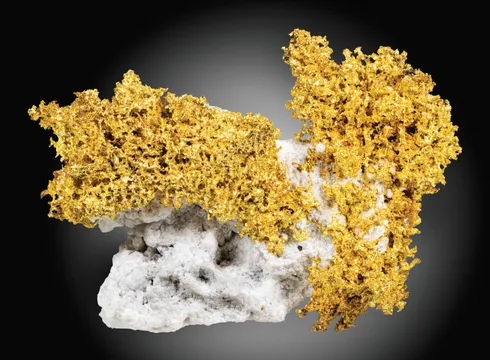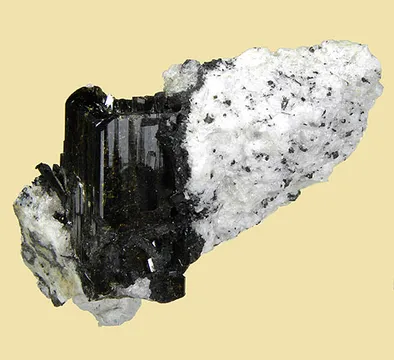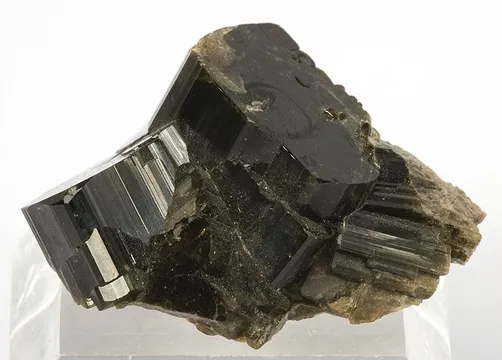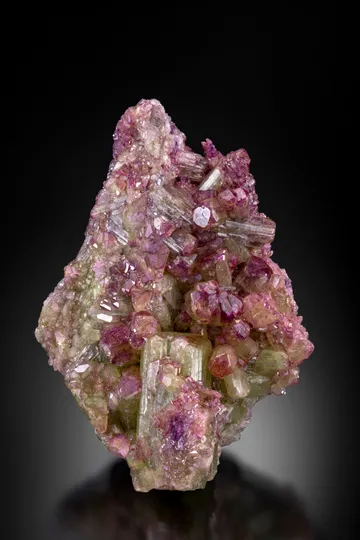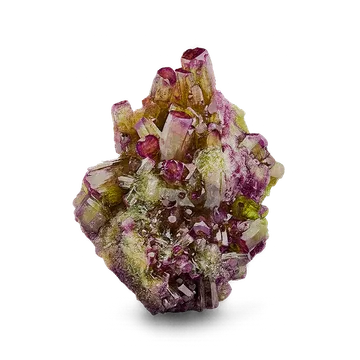
ベルクーム・ヴェスビアニット:ロディジナイト-サーペンティナイト中の鋭く美しいプリズム結晶で知られるアルプスの産地。オリーブグリーンからワインレッドまでの色調があり、コレクターに形状が評価される。
Key facts
Bellecombeはアルプスのヴェスヴィアナイトの偉大な産地の一つです。広範な商業用宝石鉱床というよりは、ロディンゲイト脈が蛇紋岩質岩脈で鋭く光沢のあるプリズム状結晶を深いオリーブグリーン、緑がかった茶、赤褐色、ワインレッドの色調で産出する、典型的なコレクターの産地です。最高標本は密度のある建築的な外観をしており、光沢面が明瞭で、縦の筋、結晶の終端部がシャープで、淡いロディンゲイト基質に嵌め込まれているか、ヘソナイト、ディオプサイト、クリノクロア、グロッスラーと一緒に見つかることがあります。

この産地の配置はイタリア西アルプスのピエモンテ盆地のベルブコム島状蛇紋岩質の蛇紋岩層です。鉱化作用はヴェスヴィアナイトの石灰岩-スカルン世界よりもロディンゲイトの世界に属します。すなわち、カルシウムが豊富で二酸化ケイ素が少なく、基質岩がマフィックな岩類と蛇紋岩化する超苦性岩が相互作用した際に形成されるメタソマティック岩脈です。コレクター的には、この設定がベルブコム標本が「アルプス的」だと感じさせる理由です。シャープな珪酸塩結晶が密度の高い、硬い脈状組成として現れ、ドリュス性の外被や緩いスカルンポケットではない点が特徴です。
この産地の科学的重要性は、標本を特徴づける同じ特徴にあります。ベルブコムのロディンゲイトは、アルプスの流体活動の複数の世代を記録しており、ヴェスヴィアナイトを含む脈は以前のガーネット・ディオプサイトを含む段階の後に続きます。ベルブコムや近隣のMontjovet産の宝石学的研究は、透明片を小さな石にカットできることを示す一方で、標本が経済的な宝石源にはならなかった理由も示しています。ヴェスヴィアナイトは不均一に分布する異質なロディンゲイト体内に存在するためです。

コレクターはまず光沢と形を重視します。最も好まれるベルブコム産ヴェスヴィアナイトは、必ずしも最大の塊ではなく、ガラス光沢の面、完全な終端、はっきりとした垂直の筋、そして説得力のある本体色(オリーブグリーン、金緑、赤褐色、または濃いワインレッド)を備えたものです。ミニチュアとサムネイルが取引の主流です。清浄で二重終端を持つ結晶、あるいは基質上のバランスの取れたクラスターは、大きくて打撲された集合体よりもはるかに価値があることがあります。## 特集標本
Search for specimens: View all vesuvianite specimens from Bellecombe, Aosta Valley, Italy
Bellecombe is a village locality in the municipality of Châtillon, Aosta Valley, northwestern Italy, recorded at approximately 45.73333° N, 7.65000° E. In mineralogical usage, “Bellecombe” refers not simply to the village but to the surrounding rodingite-serpentinite occurrences that have yielded vesuvianite, hessonite, grossular, diopside, clinochlore, epidote, alumovesuvianite, and related Alpine calc-silicate species.
The deposit type is rodingite in serpentinite. The rodingitic rocks were formed by metasomatic alteration of mafic material within ultramafic host rocks during serpentinization and subsequent Alpine metamorphic-fluid events. Published work describes the Bellecombe occurrence as fine-grained rodingitic rocks within antigorite-serpentinite, derived from basaltic dikes and cross-cut by several generations of veins. Vesuvianite belongs to one of the later vein generations in that sequence, after earlier chlorite-diopside-grossular, andradite-grossular-diopside, and garnet-rich assemblages.
Massimo Novaga’s 1994 gemological study covered an area of about 12 square kilometers northeast and northwest of Bellecombe, noting massive serpentinite and Cretaceous rodingite-vesuvianite rocks. In the field, the rodingite-vesuvianite bodies occur as brown or pink fine-grained veins and lenses, with the calc-silicate assemblage including diopside or augite, epidote, garnet, chlorite, and vesuvianite. The same study noted that rodingite veins are visible in serpentinite near Montjovet and near the road from Ussel to Bellecombe, and that chlorite borders at the margins of the veins are a characteristic feature.
The locality is not a modern commercial mine for vesuvianite. Its importance is specimen-based: classic Alpine material, historically collected and circulated through European collections, with additional material appearing from older stocks. Novaga concluded that gem-quality vesuvianite occurs in the Bellecombe-Montjovet rodingites, but that economic extraction is not feasible because the rodingites are heterogeneous and the vesuvianite is not uniformly distributed. The same paper stated that the area was protected by the Valle d’Aosta regional authority, so collecting should be treated as permission-dependent rather than as open casual access.
Notable finds are best understood as specimen types rather than single famous pockets. Bellecombe has produced thumbnail to miniature clusters of sharply terminated green to reddish brown crystals, occasional wine-red clusters, doubly terminated individuals, and specimens with small hessonite crystals on or around vesuvianite. Older European collection pieces—especially those with crisp form, excellent luster, and minimal bruising—are the standard against which new trade offerings are judged.## Bellecombe, Aosta Valley, Italy産ヴェスヴィアナイトの特徴
Bellecombe産ヴェスヴィアナイトは特徴的に錐状結晶で四方晶系を示し、十字形から長方形の断面、平坦な終端部、面取りされたエッジ、プリズム面に沿った縦方向の縞模様を持つことが多い。最良の結晶は密度の高いガラス光沢を持ち、暗色の結晶がエッジ部の緑色または赤褐色の半透明性に光が当たるまでほぼ黒く見えることがある。
色はこの産地の魅力の一つである。公表された宝石学的研究ではBanchetteとBellecombeの材料を緑がかった茶色と記述している一方、コレクター標本では視覚的な幅が広く、暗いオリーブグリーン、金緑、茶緑、赤褐色、ワインレッドなどが見られる。近くのPonte delle Capreの材料はNovagaの研究ではより黄みがかった茶色として区別され、後の抽象的な研究ではMt. Rosの材料を茶色から赤褐色と記述し、その色が相対的に高いチタン含有に起因するとされている。Bellecombe表示のコレクター作品では、色が濃いオリーブグリーンの結晶で高い光沢を持つもの、または赤褐色からワインレッドで透光性がある結晶が特に需要が高い。
標本のサイズは典型的には小さい。公表資料やディーラーが記述した標本の個々の結晶は、数ミリメートルから約2 cm程度の範囲が一般的である。NovagaはBanchetteとBellecombeの錐状結晶が長さ3 cmに達することを報告した。Bellecombe-Montjovet研究のファセット石は1.2~3.1カラットであり、透明な材料が存在するが限定的で、通常はインクルージョンを含んでいることを示す有用な覚え書きである。
関連する鉱物は産地認識の要となる。MindatのBellecombeの産地リストにはアルムヴェスヴィアナイト、グロソラル(ヒッソナイトを含む)、ディオプサイト、クリノクロール、エピドート、アクチノライト、ムスコバイト、プレニット、チタン石、ウォラストナイト、ジルコーン、アパタイト、クロライト族鉱物が含まれる。標本上で最もよく見られる関連はクリノクロール、ディオプサイト、グロソラルまたはヒッソナイト、そして淡色のロディン石基質である。茶褐色のヒッソナイト粒は立ち上がるヴェスヴィアナイト結晶に輝く温かな背景を提供し、ディオプサイトとクリノクロールは多くの標本に緑色のアルプス的マトリクス的性格を与える。
宝石学的測定は追加の産地フィンガープリントを提供する。NovagaはValle d’Aosta産ヴェスヴィアナイトを2種類に分けた。Type Aは屈折率が約1.724–1.736、Type Bは約1.714–1.722である。BellecombeとBanchetteのサンプルは低い屈折率群に属し、Loc. BanchetteとBellecombe材料には黄緑色の二色視が報告された。本研究はまた小さな管や通道内、負の結晶内に多数の含有物を記録しており、切削可能な材料は実在するが小さく、一般には豊富ではない理由を説明している。ベルクームベレブコ産のヴェスビウニットは、シャープさ、光沢、色、完全性、文脈の組み合わせによって品質が決まります。トップ結晶は適切に終端を持ち、清潔な縞模様を示し、プリズム面に強い反射率を備えているべきです。マトリックスは結晶を飲み込むのではなく、結晶を縁取るように配置されていると価値を高めます。ヒソン石の共生は、明るく傷のない場合にはプラス要素となります。小さくて自然界の色が深く美しい結晶は、終端部が擦り減っていたり、エッジが欠けていたり、面が鈍い大きな塊よりも望ましいです。## Collector Notes
Bellecombe vesuvianite is a classic locality material with a loyal European following, and good pieces are not abundant in the general market. Recent listings show miniatures and thumbnails appearing through specialist dealers rather than in large quantities: examples around 3–4 cm with sharp crystals have been offered in the several-hundred-euro range, while smaller thumbnails and sold archive pieces demonstrate continued demand for clean, lustrous crystals.
Authentication is usually a question of locality accuracy rather than treatment. The species is not commonly treated in the way many gemstones are, and I found no documented treatment or fake problem specific to Bellecombe vesuvianite. Still, mislabeling can happen because dark green or brown vesuvianite from other Alpine rodingites can look superficially similar. A credible Bellecombe specimen should fit the locality’s visual language: prismatic green to brown vesuvianite, often with hessonite, diopside, clinochlore, grossular, or pale rodingitic matrix, rather than a flamboyant Jeffrey Mine color style or a coarse skarn association from another source.
Condition matters strongly. Bellecombe crystals are often blocky and robust-looking, but edges and terminations chip readily enough that magnification is essential. Check the top faces for contact marks, the bevelled edges for small bruises, and the base of crystals for repairs or rehealed-looking breaks. Many otherwise attractive specimens have backside contacts; these are acceptable when honestly disclosed and invisible from the display face. Display-face damage on a thumbnail, however, sharply reduces desirability.
Specimens with old collection provenance deserve extra attention. Pieces from older European or North American collections, including documented dealer stock and named collections, carry weight because significant new production is limited and collecting access is constrained. Labels reading Bellecombe, Châtillon, Valle d’Aosta, Val d’Aosta, or older variants such as “Aoste” may all refer to the same classic locality, but “Bellecombe” should not be casually expanded to nearby Banchettes, Montjovet, or Ponte delle Capre unless the label or documentation supports it.
For a serious locality suite, the ideal group would include a lustrous olive-green miniature, a reddish brown or wine-red crystal group, a vesuvianite-hessonite association, and a small sharp thumbnail showing the textbook tetragonal form. Faceted Bellecombe vesuvianite is much less commonly encountered and should be bought with gemological documentation if locality is part of the price.## 鉱物学的記録と Publications
Massimo Novaga, “Vesuvianite from Bellecombe and Montjovet (AO Italy): a material of gemmological interest,” The Journal of Gemmology, 24(3), 1994, pp. 173–177 — Bellecombe-Montjovet material に関する主要な宝石学論文で、現場設定、rodingite 岩類学、結晶形、屈折率、密度、内包物、複屈折、経済的制限を扱う。
Massimo Novaga, “Caratterizzazione mineralogica e gemmologica dei filoni rodingitici di vesuvianite nell’area di Bellecombe (Aosta),” Rivista Mineralogica Italiana, 21(4), 1997, pp. 360–366 — Gems & Gemology Fall 1998 に要約;Bellecombe地域の rodingite 産状の vesuvianite を、 Mt. Ros および Banchettes 材料、光学特性、比重、1–3 ct のカット石を含めて説明。
Simona Ferrando, M. L. Frezzotti, P. Orione, R. C. Conte, and Roberto Compagnoni, “Late-Alpine rodingitization in the Bellecombe meta-ophiolites (Aosta Valley, Italian Western Alps): evidence from mineral assemblages and serpentinization-derived H2-bearing brine,” International Geology Review, 52, 2010, pp. 1220–1243 — Bellecombeのアンチゴライト-蛇紋岩化とその複数の脈系についての現代的な主要地質論文、 vesuvianite 含有脈や H2 含有ブライン包有を含む。
Federico Pezzotta, Gaspare Maletto, Tiziano Bonisoli, and Giancarlo Piccoli, “Minéralogie des rodingites alpines: Formation, caractéristiques et divers faciès,” in Minéraux des Rodingites alpines (Italie-Suisse), Le Règne Minéral Hors Série 20, 2014 — Bellecombe の参考文献として Mindat に掲載;イタリア-スイスの rodingite 矿物学文脈を含む、アルプスの広範な rodingite の扱い。
Antonio Miglioli, “Postscript: vesuvianite and hessonite from Le Banchette, Bellecombe, Aosta Valley, Italy,” The Mineralogical Record, 46(5), 2015, pp. 788–789 — Mindat の Bellecombe 参照リストにある局所性ノート;Bellecombe/Banchette の vesuvianite-ハゾナイトの関連性に関する。
Franca Piera Caucia, Luigi Marinoni, Maurizio Scacchetti, Maria Pia Riccardi, and Omar Bartoli, “The Vesuvianite Gems of the Val d’Ala (Piedmont, Italy),” Minerals, 10(6), 535, 2020 — Val d’Ala に焦点を当てつつ、 rodingites におけるイタリアアルプスの vesuvianite を比較する際に有用で、 Bellecombe を重要な Aosta Valley 出所の一つとして明示的に言及。
Mindat locality page: Bellecombe, Châtillon, Aosta Valley, Italy — 中心的な局所データベース記録。座標、鉱物リスト、参考文献、標本写真へのリンクを掲載。- [Mindat occurrence page: Bellecombe産ヴェシューヴァナイト(Châtillon, アオスタ県、イタリア)](https://www.mindat.org/locentries.php?m=4223&p=4363) — Bellecombe産ヴェシューヴァナイトの種特有の産状記録で、写真データに基づく関連鉱物および産地の品質評価を含む。## Videos & Media
“Vesuvianite (doubly terminated) from Bellecombe, Châtillon, Italy” — Fabre Minerals — 深緑色で光沢があり、二方晶で Bellecombe ベセブイナイトの短い標本動画。並列成長を示す; 標本サイズ 2.4 × 2.3 × 1.4 cm、主晶 1.5 × 1.2 cm。
Wikimedia Commons: Minerals of Bellecombe — Bellecombe のベセブイナイト、グロッサリル、ダイオプサイト、および locality 関連のメディアを含むオープン画像カテゴリ。
Wikimedia Commons: Vesuvianite-114159 — Rob Lavinsky が撮影したベセブイナイトのボルドー系紅色の標本。 locality の色域の赤い端を確認するのに有用。
Wikimedia Commons: Vesuvianite-220793 — 古い収集資料からのオリーブグリーンの Bellecombe ベセブイナイトのクラスター。コレクターが評価するブロック状でガラス質のスタイルを illustrating。
Mineral Auctions archive: Vesuvianite, ex Richard Kosnar Collection — Bellecombe のミニチュアのオークション記録。歴史的市場コンテキストと locality に関するコレクター向け表現に有用。
Mineral Auctions archive: Vesuvianite, rare doubly terminated crystal — 1992年に採集されたとされる 1.6 cm の二方晶 Bellecombe 結晶のオークション記録。入札履歴あり。
Wendel Minerals: Bellecombe vesuvianite, item 2317 — 高級 Bellecombe ミニチュア標本のディーラー出品。内部結晶系のベセブイナイト、ヘソナイトの関連、ストライーション、コンディションノート。
Minfind: Bellecombe vesuvianite search/listing context — 専門ディーラーの Bellecombe ベセブイナイトの販売実績と関連出品を表示する市場アグリゲータページ。
Mindat reference record: Novaga 1994 — Bellecombe と Montjovet のベセブイナイトに関する Journal of Gemmology の主要論文の文献記録。