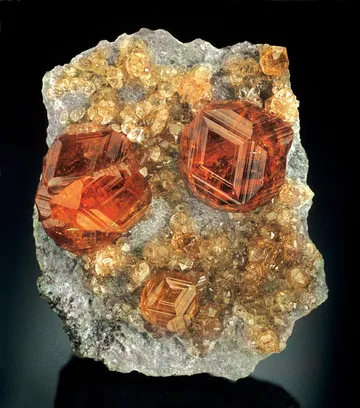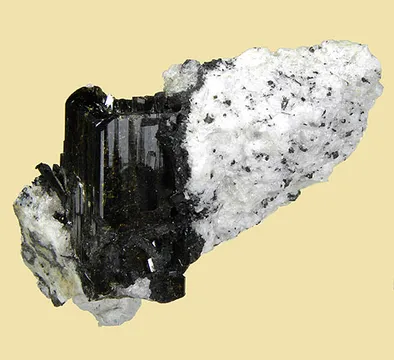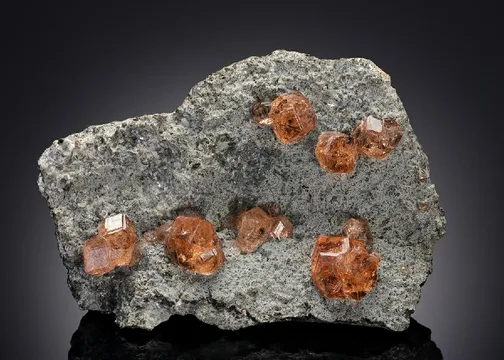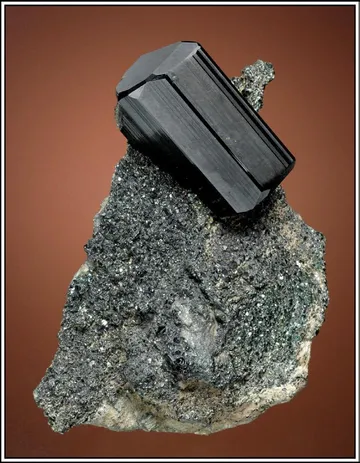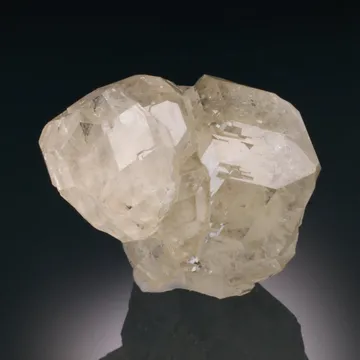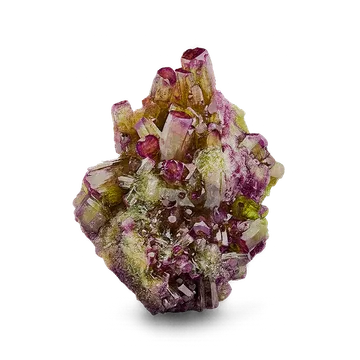
Vesuvianite — Jeffrey Mine, Québec: sharp, glassy tetragonal prisms in vivid green to violet hues, formed in rodingite; a classic, collector-worthy crystal.
Key facts
Jeffrey Mine vesuvianite is one of the defining North American classics for the species: sharp, glassy, tetragonal prisms in a palette that seems almost improbable for one locality—apple green, yellow-green, emerald to dioptase-green, mauve, pink, raspberry, violet, brown, and rare multicolored crystals with green bodies and purple or raspberry terminations. The finest pieces are not merely colorful; they have a crisp, architectural presence, with bright luster, transparent to translucent zones, complex terminations, and, in the best cases, all-around crystallization that gives them the feeling of miniature sculpture rather than mine-run crystallization.

Photo: Wikimedia Commons
The mineralogical setting is as important as the color. Jeffrey was a giant chrysotile asbestos operation in serpentinized ultramafic rock, but the collectible vesuvianite came from rodingite—calcium-rich altered dikes and veins enclosed in serpentinized dunite and peridotite. That rodingite environment produced a compact but astonishingly varied suite of calcium silicates: vesuvianite-group minerals, diopside, grossular, prehnite, wollastonite-group material, and related late-stage species. The vesuvianite discoveries that made the mine famous were concentrated in a relatively small rodingite zone, yet pockets separated by only centimeters could yield different colors and habits.

Photo: Wikimedia Commons
Jeffrey Mine is historically best known to collectors for orange hessonite grossular, but its vesuvianite is now equally canonical. The 1970s and 1980s brought purple, pink, yellow, green, and multicolored crystals from the former 2440 level, including the famous green prisms with saturated violet terminations known among collectors as “purple-cap” vesuvianite. Later collecting in 2002 and 2003 reopened part of the same rodingite dike and produced another wave of important specimens: emerald-green crystals, yellowish green floaters with purple cores, deep amethyst groups, and multicolored clusters now considered among the finest Jeffrey vesuvianites.
For serious collectors, the ideal Jeffrey specimen combines three qualities: vivid natural color, glassy intact terminations, and a recognizable locality style. A single sharp mauve thumbnail can be more desirable than a larger dull cluster; a bicolored crystal with an undamaged violet cap is a trophy; and green crystals with gemmy windows, pointed terminations, or attractive diopside association are all highly collectible. The mine is inactive, the major collecting areas are no longer productive, and the best material now circulates through older collections and specialized dealers rather than fresh production.

Photo: Wikimedia Commons
Search for specimens: View all vesuvianite specimens from Jeffrey Mine, Québec, Canada
Jeffrey Mine is at Val-des-Sources, formerly Asbestos, in the Les Sources RCM of Québec’s Estrie region. Its historical names include Jeffrey Quarry and, informally, Johns-Manville Mine after the long-time operator. The locality is an inactive open-cast mine; Mindat records the deposit as first discovered in 1879 and gives the position as 45° 46' 10'' N, 71° 57' 0'' W. The town formally adopted the name Val-des-Sources after the end of asbestos mining, but older specimen labels reading “Asbestos, Quebec” are correct historical labels and should not be dismissed.
The mine exploited chrysotile asbestos in a serpentinized ultramafic body. The asbestos ore was a stockwork of fiber veins in serpentine, especially in serpentinized peridotite within the lower portion of an ultrabasic sill. Geological descriptions of the Asbestos area place the mine in an ophiolitic association of serpentinized peridotite, dunite, pyroxenite, gabbro, rodingite, and granitic to dioritic rocks. For specimen collectors, the crucial host was rodingite: a calcium-enriched altered rock produced where mafic or felsic dikes interacted with serpentinizing ultramafic rocks. Vesuvianite crystals were found in a large rodingite dike enclosed in dunite, while grossular was more typical of fractures in red syenite, albitite, and other rodingite bodies.
At the scale of the pit, Jeffrey was immense: an open pit roughly 2 km across and hundreds of meters deep. The collectible vesuvianite zone, however, was far more intimate. The important occurrences lay in the upper east portion of the pit, in a rodingite dike near the former 2440 level and close to the southeast limit of the orebody. Traces of purplish acicular vesuvianite had been reported from that dike during geological mapping as early as 1950. Important specimen discoveries followed in 1978 and 1988, and the same dike became accessible again in 2002 after ground movement exposed part of it near a secondary mine road.
Collecting access has always been unusual. Public collecting in the open pit itself was forbidden, though mine guests, university groups, scientists, and escorted visitors were sometimes admitted. Workers collected specimens despite formal restrictions, especially after the 1960s when grossular and later vesuvianite developed a strong collector market. For many years mine management maintained a separate “mineral site” near the mine installations where potentially interesting rock was trucked for visitors; that site was not equivalent to open-pit collecting and eventually stopped receiving new material.
The Club de Minéralogie d’Asbestos became the principal route for authorized collecting. Beginning in 1994, the club received permission for summer excursions, typically several trips between May and October. After 2001, instability in much of the pit restricted collecting to a small safer zone in the upper east portion—the same zone that included the vesuvianite-bearing rodingite. The last club excursions described in the literature occurred in 2003, after which slumping and flooding made continued collecting doubtful and increasingly unsafe.
Major vesuvianite production came in pulses rather than continuous mining. The 1978 material, the 1988 expansion, and the 2002–2003 reopening of the rodingite dike are the key episodes for specimen history. A large number of newly collected vesuvianites reached the market around the 2003 Tucson show, but by spring and summer 2003 the numbers had already fallen sharply. The end of regular asbestos mining, the cessation of pumping, and flooding of the pit removed the old collecting context. Modern Jeffrey vesuvianite specimens therefore represent historical production, older miner-collected material, club-excursion finds, and occasional pieces released from private collections.
Jeffrey vesuvianite occurs as prismatic crystals, typically with square to rectangular cross sections and flat, modified, or pointed terminations. The best crystals are well-defined and lustrous; Mindat records crystals from 1 to 10 cm, while published collecting accounts describe common thumbnail and miniature material, cabinet specimens, isolated crystals up to about 4.5 cm, and exceptional multicolored groups larger than 10 cm. The most admired pieces show undamaged terminations, gemmy zones, three-dimensional growth, and color zoning visible without magnification.
The color range is the great signature of the locality. Light green to yellow-green material is commonest in the collector market and often forms glassy prismatic clusters. Mauve to violet and pink material gives Jeffrey its distinctive look, especially in manganese-bearing crystals. The saturated purple-pink to raspberry crystals can look almost tourmaline-like at first glance, but their tetragonal prism habit and terminations distinguish them. Deep emerald to dioptase-green “chromian” vesuvianite is rarer and highly prized, especially as single loose crystals or small clusters with gemmy patches. Brown vesuvianite is reported but is much less visible in the specimen market.
Bicolored and multicolored crystals are the Jeffrey hallmark. Classic “purple-cap” specimens consist of pale green prisms with deep purple, highly lustrous flat terminations. Other crystals may show light green prisms with mauve, raspberry, emerald-green, or darker green caps; some have purple cores visible through yellow-green overgrowths; and a few show complex purple-yellow-green zoning. These color changes are not simply cosmetic surface effects: studies of Jeffrey vesuvianite-group chemistry relate the colors to variations in aluminum, iron, manganese, titanium, and local growth-sector chemistry.
Modern mineralogy adds an important caution: not every old-labeled “Jeffrey vesuvianite” is necessarily vesuvianite in the strict post-2017 species sense. Alumovesuvianite, Ca19Al(Al,Mg)12Si18O69(OH)9, was described from Jeffrey Mine as a new vesuvianite-group member, and subsequent discussion suggests that much of the light green and mauve Jeffrey material in collections may belong to alumovesuvianite rather than vesuvianite sensu stricto. Emerald-green material, lower in aluminum and richer in Fe3+ in available analyses, is more likely to be true vesuvianite. For marketplace and collection purposes, “vesuvianite group” is often the safest broad term unless a specimen has analytical confirmation.
Associated minerals vary by pocket. In the vesuvianite collecting area, transparent colorless tabular diopside is a scarce but attractive companion and can reach more than 1 cm. Small black needles of groutite and small prisms of manganite are reported in the same area. Native copper and chromite occurred in the zone, sometimes with blue spertiniite on copper, but published accounts emphasize that those copper/spertiniite occurrences were not directly associated with vesuvianite. Grossular—although abundant and famous elsewhere in the mine—was not found in the principal vesuvianite collecting area described from the 2002–2003 discoveries.
Quality depends first on termination and luster. Jeffrey crystals are often broken from tight vugs or from granular vesuvianite-filled pockets, so edge contacts, incomplete tips, and bruised corners are common. A choice specimen should have at least one dominant, fully terminated crystal; bright glassy faces; visible color zoning; and minimal abrasion on the cap or prism edges. In bicolored material, the boundary between green and purple should be distinct and natural-looking, not merely a stained surface or photographic artifact. In green material, the finest examples have saturated color without becoming opaque, and the best “chrome” or emerald-green pieces show high luster and sharp morphology rather than just color.
The first authenticity issue is locality labeling. Older labels may read “Asbestos, Quebec,” “Jeffrey Quarry,” “Jeffrey Mine,” or “Johns-Manville Mine.” These can all refer to the same collecting complex, but vague labels such as “Quebec vesuvianite” are less useful because other Québec asbestos and rodingite localities also produced vesuvianite-group material. Conversely, specimens labeled “Val-des-Sources” are modern relabelings of the same town area and should not be treated as a different locality.
The second issue is species naming. Much Jeffrey material sold for decades as vesuvianite predates the description of alumovesuvianite. A specimen can be completely authentic Jeffrey Mine material and still be analytically closer to alumovesuvianite than vesuvianite sensu stricto. Collectors who build species-systematic collections should request analytical support for specimens sold specifically as alumovesuvianite or as true vesuvianite. Collectors who build locality or aesthetic collections can safely recognize the traditional “Jeffrey vesuvianite” field name while noting the vesuvianite-group complexity.
Documented treatments and synthetic equivalents are not a central concern for Jeffrey vesuvianite crystals. General gemological references list no known treatments, synthetics, or common imitations for vesuvianite as a gemstone species. Massive vesuvianite material from other contexts can be dyed or impregnated in the lapidary trade, but that is a different problem from sharp Jeffrey crystal specimens. For Jeffrey pieces, the realistic concerns are mislabeling, over-optimistic varietal names, assembled or repaired clusters in high-end material, and lighting-enhanced photographs that make mauve or green saturation appear stronger than it is in hand.
Condition is critical. Vesuvianite is hard enough for stable cabinet display, but sharp terminations and prism edges chip easily. Many Jeffrey crystals grew in cramped pockets or as near-floaters in granular vesuvianite; extraction often left back contacts, side contacts, nicks, or missing terminations. In bicolored pieces, the cap is usually the most visually important and the most vulnerable part. A small thumbnail with perfect luster and an intact purple cap is often more desirable than a larger specimen with abraded tips.
Rarity is uneven. Small apple-green to yellow-green Jeffrey specimens still appear periodically through dealer inventories and older collection dispersals. Good mauve and purple material is scarcer, especially in gemmy, sharply terminated thumbnails. True “purple-cap” specimens with bright green prisms and intense violet terminations are genuinely rare and command strong collector interest. Deep emerald-green or “chromian” crystals with fine form are also scarce. Large cabinet specimens, all-around crystallized clusters, multicolored pieces, and examples with documented old collections—especially ex-Marco Amabili or specimens pictured in major publications—belong in the trophy category.
Current market availability is therefore mostly secondary-market availability. The mine is inactive, the historic vesuvianite zone is not a regular collecting source, and important pieces tend to move privately or through specialized dealers. When evaluating a purchase, give weight to old labels, collection history, publication references, analytical notes where present, and honest condition descriptions. The best Jeffrey vesuvianites are not common “pretty green crystals”; they are historical specimens from one of Canada’s most important mineral localities.
The Jeffrey vesuvianite story is a story of a huge mine and a tiny productive zone. The pit itself was vast, but the celebrated vesuvianite came from a rodingite dike in one restricted part of the workings. Traces of purplish acicular vesuvianite were already noticed during geological mapping in 1950, long before the mineral market fully recognized what the dike could produce. When the former 2440 level was worked in 1978 and again in 1988, the dike yielded the purple, pink, yellow, green, and multicolored crystals that put Jeffrey vesuvianite into the first rank of world localities.
Then the dike disappeared. In 1988, when the mine was expanded, the roots of the vesuvianite-bearing zone were covered. For years the best material was history: specimens in collections, old miner finds, and pieces that surfaced at shows. The reopening was accidental and geological, not planned as a specimen-mining campaign. After ground movement in the open pit, part of the old dike was exposed again in 2002 beside a secondary mine road. A rodingite zone that had made the mine famous was suddenly reachable again.
The May 2002 excursion began under “awful weather conditions,” yet collectors found transparent pink and purple vesuvianite clusters. The best crystals had shiny pink terminations over pale-green prism faces—a look that immediately announced Jeffrey even before a label was read. During later 2002 visits, enthusiasm grew because the dike kept changing personality: one visit produced pink and purple; another yielded deep green; another opened yellow-green pockets with purple cores.
The July and August 2002 finds of deep green vesuvianite were especially important. Some crystals were described as emerald to dioptase-green, up to 4.4 cm long and nearly 1 cm wide. They came from small vugs in a thin emerald-green vein of massive vesuvianite embedded in a broader pale-green vesuvianite vein. The best pieces were loose translucent single crystals, some with small gemmy areas. For collectors accustomed to Jeffrey’s purple caps and mauve crystals, these saturated green crystals added another classic face to the locality.
The excursion of August 25, 2002 became one of the great late chapters of Jeffrey collecting. Two collectors recovered more than 100 yellowish green vesuvianite specimens from a large pocket, some with purple cores. Among them was a cluster of doubly terminated crystals individually reaching 3 cm by 1 cm. The specimens ranged from thumbnails to cabinet pieces; the largest measured about 25 x 35 cm. The pocket was filled with fine granular vesuvianite, so many of the pieces came out as virtual floaters rather than as crystals locked hard into matrix.
The weeks after that pocket were intense. Miners collected additional top-quality specimens in the same area with a power shovel, until mine management bulldozed over the collecting site. Among the recovered pieces was a 12.6-cm multicolored cluster of partially gemmy purple-yellow-green vesuvianite, dominated by a sharp 1.4 x 1.6 x 6 cm multicolored crystal with a modified flat termination. The same season produced an 8 x 10 cm all-around specimen with crystals, some doubly terminated, to 3.4 cm. For many collectors, these late finds did not merely add more Jeffrey vesuvianite to the market; they clarified the locality’s full range.
What makes the zone so memorable is how condensed it was. In the published account, the dramatic variation in morphology and color came from an area only about 40 meters long. Pockets only a few centimeters apart could contain crystals of different color or form. One pocket might give green prisms with purple caps; another, forest-green pointed crystals; another, amethyst-colored groups; another, multicolored clusters. The whole Jeffrey vesuvianite legend rests on that combination of geological confinement and chemical variability.
The larger mine story turned darker as production waned. The open pit became increasingly unstable, houses stood close to the lip, lateral expansion was nearly exhausted, and deeper mining was costly. In October 2002 the mine closed after bankruptcy problems, then briefly reopened after an arrangement connected to obtaining special asbestos for NASA space-shuttle seals. By April 2003 it closed again. When pumping stopped, water began reclaiming the pit; by July 2003 the bottom was flooded to almost 100 meters, and the best grossular collecting areas were underwater. The final club excursions ended in that same atmosphere of slumping ground, rising water, and uncertainty.
The last note from the 2003 collecting account is one of gratitude. The authors thanked former Jeffrey miners—Alain, Denis, Michel, Normand, Réjean, and René among them—for collecting with skill and helping make the locality world-famous. That matters. Jeffrey specimens did not come from a neat museum dig; they came from an operating industrial mine, from power shovels, club days, miner networks, and the small windows of access that opened when benches crossed the right rock.