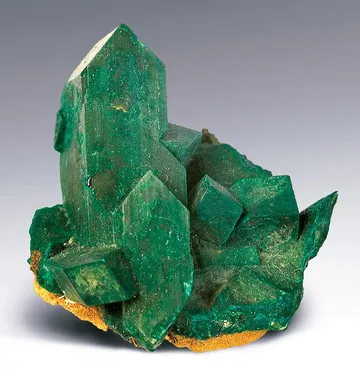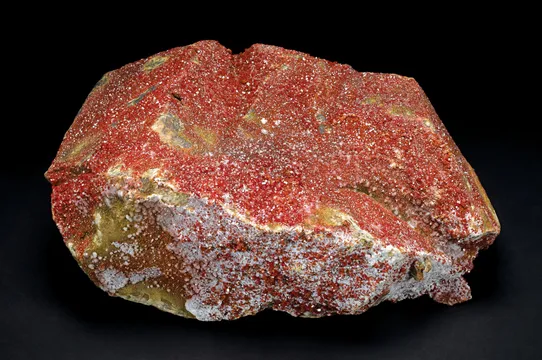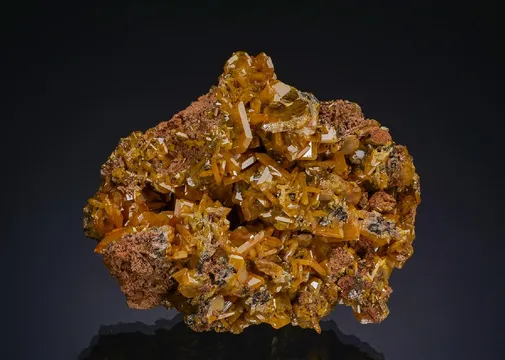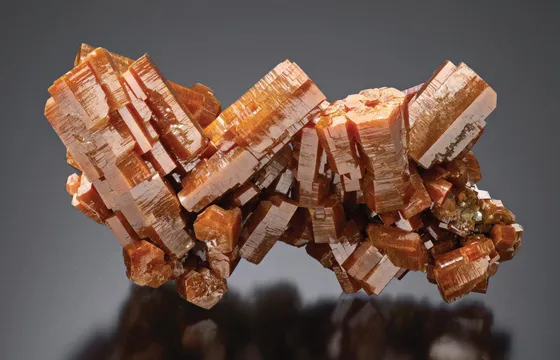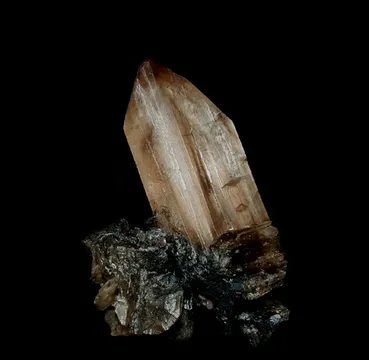
Touissit, Maroc vanadinite - prismes hexagonaux olives à crème avec un éclat argenté; variété portant de l’arsénic, autrefois appelée endlichite, un site clé à Touissi…
Key facts
Touissit vanadinite est le Marocain plus discret, plus complexe sur le plan minéralogique et classique. Il ne joue pas la carte du drama rouge cerise saisissant de Mibladen; son attrait est plus subtil et, pour de nombreux collectionneurs sérieux, plus intrigant. Les meilleures pièces de Touissit présentent des prismes hexagonaux robustes et des cristaux en forme de baril dans des teintes olive, caramel, beige, brun bronze, jaune fumé, orange brûlé et blanc crème, généralement avec une brillance superficielle argentée ou poussiéreuse et des zonages occasionnels. De beaux exemplaires donnent l’impression de métal vieilli ou de miel ancien poli plutôt que d’un brillant rouge bonbon.

Photo : Wikimedia Commons / Géry Parent
La raison pour laquelle Touissit compte n’est pas seulement la beauté mais la chimie. Une grande partie du matériel de collection se situe dans le voisinage compositionnel vanadinite–mimérite–pyromorphite, où VO4, AsO4 et PO4 peuvent compliquer à la fois la couleur et le nommage. Touissit est l’une des localités marocaines les plus fortement associées à la vanadinite portant de l’arsenic, souvent rencontrée dans le commerce sous l’ancien nom de variété «endlichite». Les étiquettes actuelles sont plus prudentes : vanadinite, vanadinite porteuse d’arsenic, ou vanadinite anciennement appelée endlichite, selon l’analyse et la terminologie du collectionneur.
Géologiquement, la localité appartient au district minier Touissit-Bou Beker, dans l’est du Maroc, un district carbonaté contenant plomb, zinc et argent développé dans de la dolomite. L’oxydation du minerai contenant galène et sphalérite a produit une exceptionnelle suite secondaire : anglesite, cérussite, azurite, wulfenite, vanadinite, mottramite, descloizite, smithsonite, gypse et d’autres espèces. La vanadinite ici fait partie de cet assemblage oxydé plomb-vanadium-arsenic plutôt que d’une occurrence autonome.

Photo : Wikimedia Commons / Didier Descouens
Historiquement, le district a été exploité pour le plomb, le zinc, le cuivre et l’argent, mais pour les collectionneurs, sa meilleure période est venue plus tard, lorsque des travaux fortement oxydés ont donné naissance à des minéraux secondaires de classe mondiale. Vers la fin des années 1970 et au début des années 1980, la vanadinite de Touissit avait établi son identité comme un style marocain distinctif : non pas la vanadinite rouge de Mibladen, mais des cristaux lustreux, allongés, souvent en forme de baril, dans des teintes jaunes-brun à bronze, parfois sur de la mottramite ou de la descloizite noirs et parfois sur une matrice carbonatée pâle.Les collectionneurs recherchent d’abord la netteté, des terminaisons complètes et un caractère localité honnête. Les pièces les plus prisées présentent des cristaux hexagonaux bien formés qui se tiennent nettement sur la matrice, une lustre dense pour le style, une zonation visible ou un contraste de couleur, et peu ou pas d’abrasion sur les arêtes du fût et les faces terminales. Les gros cristaux sont précieux, mais la chimie et la provenance comptent tout autant: anciennes étiquettes, notes analytiques ou un historique de collection crédible peuvent être importants car le matériau de Touissit a longtemps été confondu avec la pyromorphite et n'a pas toujours été étiqueté de manière cohérente.## Spécimens vedettes
Rechercher des spécimens : Voir tous les spécimens de vanadinite de Touissit, Maroc
Touissit se situe dans le district minier Touissit-Bou Beker, province de Jerada, région de l'Oriental, au nord-est du Maroc, au sud d'Oujda et près de la frontière algérienne. Le district est une ceinture semi-continue ENE-WSW de dépôts de plomb-zinc de type Mississippi Valley carbonatement hébergés dans la dolomite, d'environ 16 km de long et localement d'environ 100 m à 1 200 m de large. Ses dépôts principaux, d'ouest en est, sont Mekta, Beddiane, Touissit et Bou Beker, avec des puits, des fosses et des localités historiquement séparées telles que Shaft IX et la Mine Zellidja.
Les gisements sont épigenétiques, des remplacements mésostratiques dans la dolomite. Les fluides minéralisants étaient chauds et salins, et l’association principale de sulfures consistait surtout en galène et sphalérite avec pyrite ou marquesite et des minéraux portant le cuivre tels que chalcopyrite et bornite en moindre quantité. Dans les zones oxydées, ces sulfures se décomposaient pour produire les carbonates, sulfates, vanadates, molybdates, arsenates et carbonates de cuivre qui rendirent Touissit célèbre parmi les collectionneurs.
Les textures d’oxyde dominantes sont liées à la brecciation. Les breccias minéralisées comprennent des breccias de fracture, mosaïque, décombres et roche-matrice cimentées par la dolomite, les espaces entre fragments angulaires de dolostone hôte étant remplis par l’oxyde. Les gangues minérales comprennent dolomite, dolomite ferrifère, calcite, quartz mineur, et localement une girée abondante de gypse secondaire. Cette architecture carbonatée poreuse et fracturée a facilité les conditions d’espace ouvert nécessaires à des cristaux secondaires bien formés, y compris la vanadinite.
L’exploitation dans la zone plus large Bou Beker-Touissit a déjà fait l’objet de travaux d’économie géologique au milieu du XXe siècle, et l’histoire de la production du district s’étend sur la majeure partie du XXe siècle. Entre 1926 et 2002, le groupe Touissit-Bou Beker-El Abed a produit environ 70 millions de tonnes de minerai avec environ 4 % de plomb, 3,5 % de zinc, moins de 1 % de cuivre et autour de 120 g/t d’argent. Les opérations de la Compagnie Minière de Touissit se sont terminées en 2002; les productions ultérieures ont été à petite échelle et artisanales.
Pour les collectionneurs, l’ère des spécimens clé a commencé non pas avec les premières mines mais avec l’accès aux zones oxydées à la fin des années 1970. Cette période a apporté de belles azurites, anglesites, cérussites, wulfenites, vanadinite et des minéraux de plomb rares dans les collections internationales. La vanadinite de Touissit de cette période est désormais essentiellement du matériel de stock ancien. Les spécimens continuent d’apparaître à travers des dispersions de collections, des inventaires de marchands et des ventes aux enchères, mais une production significative nouvelle du style classique en barillet-cristal porté par l’arsenic n’a pas été une caractéristique régulière du marché moderne.L’accès au champ doit être considéré comme un accès minier restreint, et non comme une collecte occasionnelle. Le district contient d’anciennes mines, des puits et des sols oxydés instables, et l’autorisation des détenteurs appropriés des droits fonciers et miniers est essentielle. Pour la plupart des collectionneurs, l’acquisition légitime passe par des marchands établis, des registres de vente aux enchères, des anciennes collections et des spécimens portant des étiquettes crédibles.## Caractéristiques de la vanadinite de Touissit, Maroc
La vanadinite de Touissit est surtout connue pour ses prismes hexagonaux allongés et ses cristaux en forme de barillet épais, plutôt que pour les plaquettes hexagonales rouges translucides, brillantes et comparées traditionnellement à Mibladen. Les cristaux peuvent être terminés seul ou doublement terminés, et les meilleures pièces présentent des faces prismatiques nettes, des terminaisons basales complètes et des surfaces brillantes qui peuvent paraître soyeuses, métalliques ou légèrement givré selon la génération du cristal et le revêtement de surface.
La couleur est la signature de la localité. Les exemples typiques de Touissit vont du jaune pâle, crème, olive, beige, brun, caramel, bronze, gris-brun fumé, et orange brûlé à des exemples plus inhabituellement rouges-orange. Les matériaux contenant de l’arsenic ont tendance à occuper la plage jaune-brun à olive-bronze, et certaines pièces présentent des capuchons gris, marron ou argentés sur les extrémités des cristaux. Le zonage est une attraction majeure lorsqu’il est présent, notamment lorsque les intérieurs pâles des barillets sont caps ou recouverts par des faces terminales plus sombres.
La taille des cristaux varie considérablement. De nombreux échantillons de marché présentent des cristaux de quelques millimètres à environ 1 cm. Des pièces anciennes de cabinet de meilleure qualité peuvent porter des cristaux d’environ 1,3 à 2,2 cm, et des descriptions publiées des matériaux de Touissit incluent des cristaux crème-blanc à brun zonés jusqu’à environ 3 cm associés à la mottramite zincienne. Des cristaux de cette taille sont importants pour la localité et devraient être soigneusement évalués pour l’usure des arêtes, les ecchymoses et la véritable qualité de termination.
Les minéraux associés sont particulièrement utiles pour reconnaître le style de Touissit. La mottramite noire est l’un des compagnons classiques, apparaissant en revêtement ou en petits cristaux lustreux autour ou sous la vanadinite. La descloizite est également signalée dans le district et est associée à certains échantillons de vanadinite arsenifère. La dolomite et la calcite fournissent une matrice carbonatée pâle sur certaines pièces; la galène, la sphalérite, la cérussite, l’anglesite, la gypse, la smithsonite, la wolfrénite, l’azurite et la malachite appartiennent à l’ensemble district oxydé plus large. Des spécimens rares peuvent impliquer la série pyromorphite-mimétite-vanadinite de manière plus directe, y compris des pièces dont il a été discuté comme des combinaisons pyromorphite/vanadinite.
Les plus beaux spécimens de vanadinite de Touissit réunissent plusieurs traits: habit clair de barillet ou hexagonal allongé, bonne couverture tridimensionnelle, terminaisons intactes, lustre fort, zonage de couleur attrayant et provenance ancienne stable. Un spécimen n’a pas besoin d’être rouge pour être important; en fait, les meilleures pièces de Touissit sont désirables précisément parce qu’elles ne ressemblent pas à la vanadinite rouge marocaine familière. Les cristaux olive pâle, caramel, bronze et crème-brun font partie de l’identité de la localité.## Notes du collectionneur
Le principal défi de collection de la vanadinite de Touissit réside dans l’identification et l’étiquetage. Les spécimens issus des trouvailles classiques ont parfois été commercialisés comme pyromorphite parce que la couleur et l’habitus en baril peuvent rappeler la pyromorphite plus que la vanadinite rouge attendue par la plupart des collectionneurs. Des analyses ultérieures ont montré que bon nombre de ces pièces étaient des vanadinites, souvent avec une teneur en arsenic. Le vieux nom «endlichite» figure encore sur les étiquettes et dans les descriptions des marchands, mais il est préférable de le traiter comme un terme varietal ou historique pour la vanadinite porteuse d’arsenic plutôt que comme un nom moderne distinct.
Étant donné que la chimie peut varier au sein de la série vanadinite-mimetite-pyromorphite, les étiquetages les plus solides sont ceux étayés par une analyse ou par une provenance hautement fiable. Une pièce étiquetée «endlichite» sans appui analytique ne devrait pas être automatiquement considérée comme contenant beaucoup d’arsenic, et une pièce étiquetée «pyromorphite» de Touissit devrait être examinée avec prudence. Pour des exemples précieux, la confirmation par XRF, SEM-EDS ou toute autre analyse est raisonnable.
Les problèmes de condition sont typiques des spécimens de vanadate-plomb, mais ils sont importants à Touissit car les cristaux présentent souvent des bords de baril proéminents et des terminaisons exposées. Recherchez des pourtours meurtris, des faces basales ébréchées, des cristaux latéraux cassés et des points hauts dulls et abrasés. La coloration pâle à bronze peut dissimuler de petits contacts sous une lumière ambiante normale, donc une loupe est essentielle. Un peu de contact périphérique est courant sur les pièces en matrice; les exemplaires destinés aux collectionneurs devraient conserver les cristaux d’affichage principaux intacts.
Aucun traitement spécial n’est devenu une partie de l’histoire reconnue de la collecte pour la vanadinite de Touissit, comme cela peut être le cas pour le mauvais étiquetage. Les risques les plus réalistes restent la mauvaise localité, la mauvaise espèce, l’utilisation trop confiante de «endlichite» et la confusion avec Mibladen ou d’autres styles de vanadinite marocains. Manipulez les spécimens comme des minéraux porteurs de plomb : tenez-les à l’écart de la poussière dans l’espace d’exposition, lavez-vous les mains après les avoir manipulés et évitez tout frottement inutile ou nettoyage agressif.
La disponibilité sur le marché est limitée mais non inexistante. Les meilleurs morceaux classiques circulent principalement à partir d’anciennes collections, et les records de ventes aux enchères dans les années 2020 montrent que la vanadinite de Touissit apparaît toujours sous forme de petits échantillons de cabinet, de cabinet moyen et de gros cabinet. Les prix varient largement en fonction de l’esthétique, de la provenance, de la taille des cristaux et de la confiance dans l’identification. Des exemples modestes issus de stock ancien peuvent être accessibles, tandis que des pièces de grande taille, non endommagées, bien provenues et portant de l’arsenic, avec des cristaux en baril, restent nettement plus rares que la vanadinite rouge marocaine ordinaire.## Stories & Field Notes
La storytelling la plus persistante de Touissit est une histoire d’erreur d’identité. Lorsque les matériaux de la fin des années 1970 et du début des années 1980 ont pénétré le monde des collectionneurs, leurs cristaux tubulaires olive, jaune et marron ne ressemblaient pas à la vanadinite rouge qui finirait par dominer les plateaux des marchands marocains. Ils ressemblèrent suffisamment à la pyromorphite pour que certains soient vendus ainsi. Les cristaux avaient la bonne confiance hexagonale, la bonne habitude robuste et la bonne gamme de couleurs pour tromper les regards expérimentés.
Puis l’analyse a commencé à réécrire les étiquettes. Des spécimens qui avaient été présentés comme pyromorphite se sont révélés être de la vanadinite, contenant couramment de l’arsenic. Marchands et collectionneurs continuaient d’utiliser l’ancien terme « endlichite », mais la leçon moderne est plus subtile : une étiquette de Touissit n’est pas qu’un nom de lieu, c’est une question chimique. Sur certains morceaux, les preuves visuelles seules ne suffisent pas. Les exemples les plus intéressants se situent précisément dans cette incertitude, où la couleur, l’habitude et la chimie se croisent.
Un spécimen mis aux enchères issu d’une ancienne collection minière du Colorado illustre bien le problème. Il était décrit comme une grande pièce de cabinet, 14,3 x 9,3 x 4,5 cm, avec des prismes hexagonaux robustes jusqu’à 2,2 cm, colorés du bronze terni au caramel pastel et au jaune poussiéreux. Une faible mottramite était visible. La description notait que de telles pièces avaient été initialement supposées pyromorphite, mais l’analyse les situait dans le champ de la vanadinite porteuse d’arsenic autrefois appelée endlichite. Le spécimen portait la provenance de Dave Bergman, souvenir dans le monde minéral pour son travail au Sweet Home Mine près d’Alma, au Colorado. Ce parcours — des travaux oxydés de plomb et zinc marocains à la collection d’une figure minière américaine, jusqu’à un record moderne aux enchères — montre comment la vanadinite de Touissit atteint désormais souvent les collectionneurs: non pas à partir des bacs de mine fraîchement sortis, mais des biographies d’anciennes collections.
Un autre spécimen cabinet de Touissit, anciennement dans la collection Jack Halpern, montre une autre facette de l’histoire. Mesurant 9,8 x 7,7 x 4,3 cm, il était décrit comme chargé de cristaux hexagonaux brillants jusqu’à environ 1 cm, d’un orange brûlé avec une douce superposition argentée par endroits. Sa description lors de la vente a soulevé la même prudence: certaines annonces appellent le matériau arsenic-bearing « endlichite », mais l’analyse du matériau comparable peut ne pas toujours révéler un arsenic significatif. La conclusion a été délibérément conservatrice — étiqueter simplement vanadinite à moins que la chimie n’exige davantage. Pour une localité où les anciennes étiquettes peuvent être romantiques, cette retenue fait partie de la bonne collection.## Registres et Publications Minéralogiques- White, John Sampson (1984), “Vanadinite from Touissit, Morocco, and Comments on Endlichite,” The Mineralogical Record, 15(6), 347–350 — L’article clé spécifique à la localité reliant la vanadinite de Touissit au problème de nomenclature de l’endlichite.
Jahn, Steffen, and Bode, Rainer (2013), “The Touissit-Bou Beker mining district, Morocco,” The Mineralogical Record, 44(6), 595–651 — Traitement majeur du district orienté collectionneurs couvrant la série minérale oxydée et l’importance des spécimens.
Claveau, Jacques; Paulhac, Jean; and Pellerin, Jean (1952), “The lead and zinc deposits of the Bou Beker-Touissit area, eastern French Morocco,” Economic Geology, 47(5), 481–493 — Article précoce d’économie géologique sur les dépôts de plomb-zinc de Bou Beker-Touissit.
Rajlich, Petr (1983), “Geology of Oued Mekta, a Mississippi Valley-type deposit, Touissit-Bou Beker region, eastern Morocco,” Economic Geology, 78(6), 1239–1254 — Géologie MVT détaillée pour une partie du district.
Dupuy, Jean-Jacques, and Touray, Jean-Claude (1986), “Multistage ore deposition at the Oued Mekta strata-bound lead deposit, Touissit-Bou Beker District, eastern Morocco,” Economic Geology, 81(6), 1558–1561 — Article court mais important sur la déposition minérale multistage dans le district.
Makhoukhi, S.; Schmitt, J.M.; Bouabdelli, M.; Bastoul, A.; and Marignac, Ch. (2000), “Modelling of an MVT deposit: Touissit-Bou Beker district, eastern Morocco,” Journal of Geochemical Exploration, 69–70, 109–113 — Modélisation géochimique et génétique du district en système MVT.
Bouabdellah, M.; Sangster, D.F.; Leach, D.L.; Brown, A.C.; Johnson, C.A.; and Emsbo, P. (2012), “Genesis of the Touissit-Bou Beker Mississippi Valley-Type District (Morocco-Algeria) and Its Relationship to the Africa-Europe Collision,” Economic Geology, 107(1), 117–146 — Interprétation génétique moderne du district MVT plus large Maroc-Algerie.
Bouabdellah, M.; Boukirou, W.; Potra, A.; Melchiorre, E.; Bouzahzah, H.; Yans, J.; Zaid, K.; Idbaroud, M.; Poot, J.; Dekoninck, A.; and Levresse, G. (2021), “Origin of the Moroccan Touissit-Bou Beker and Jbel Bou Dahar Supergene Non-Sulfide Biomineralization and Its Relevance to Microbiological Activity, Late Miocene Uplift and Climate Changes,” Minerals, 11(4), 401 — Travail moderne en libre accès sur la biomineralisation supergénique non-soufrée dans le district.
Mindat occurrence record: Vanadinite from Touissit, Touissit-Bou Beker mining district — Enregistrement d’occurrence de locality avec références et accès à la galerie.
Wikimedia Commons: File:Endlichite - Maroc.jpg — Photographie de style musée documentée d’arséniatan vanadinite sur descloïsite noire, créditée à Didier Descouens.
Wikimedia Commons: File:Vanadinite 18.jpg — Photographie au gros plan de vanadinite porteuse d’arsenic provenant de la zone de la Mine Zellidja, créditée à Géry Parent.
Wikimedia Commons: File:Vanadinite-57245.jpg — Photographie et description de Vanadinite olive classique de Touissit par Rob Lavinsky, provenant de la collection Paul Jung.## Vidéos & Médias
IRB2183 ARSÉNATIAN VANADINITE, Touissit Maroc — Crystal Classics — Short vidéo d’échantillon de vanadinite arseniatine de Touissit, utile pour voir l’éclat et la couverture cristalline en trois dimensions.