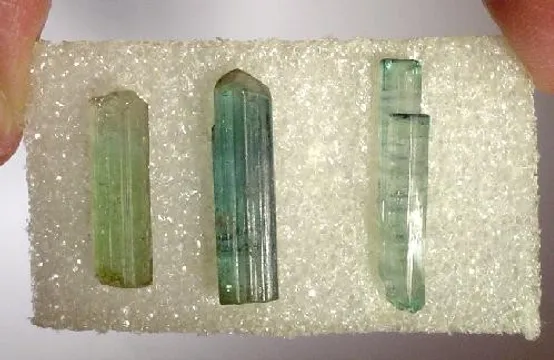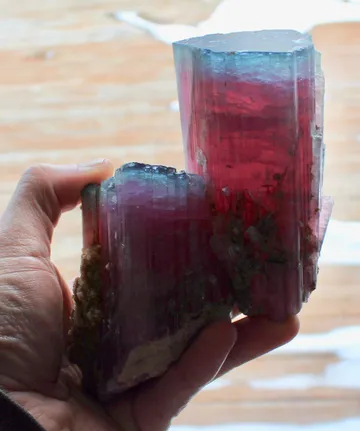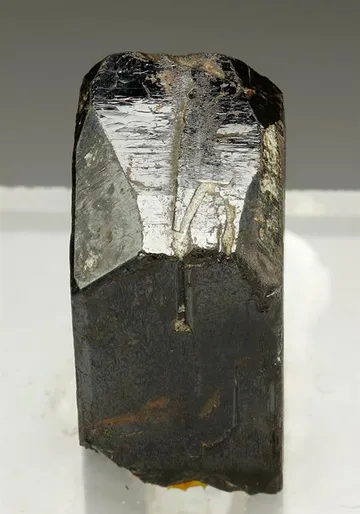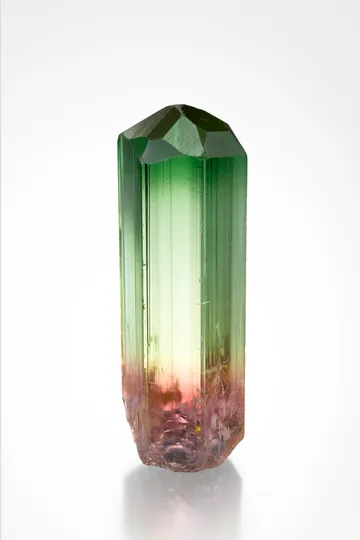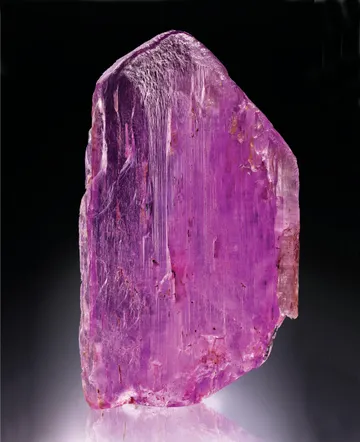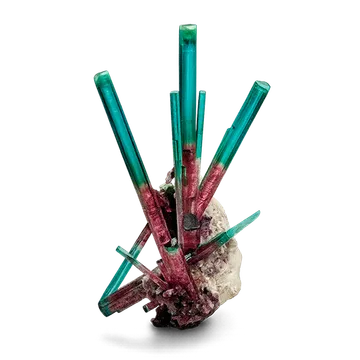
Tourmaline from Pala Mining District, USA—elbaite and schorl with pink, blue, green hues, color zoning, and the iconic Tourmaline Queen blue-capped crystals.
Key facts
Pala tourmaline is the classic American pegmatite tourmaline: robust, strongly striated prisms of elbaite and schorl, often in pink, red, blue, green, or sharply zoned combinations, with the best pieces still carrying the aura of the early twentieth-century California gem rush. To serious collectors, the district is not simply “a place in California that produced tourmaline.” It is the locality behind the Tourmaline Queen blue caps, the Stewart and Pala Chief mining stories, the China trade in pink material, and a century-plus of specimens that helped define what a North American gem pegmatite could produce.
The visual signature is color zoning with personality. Pala elbaites can be deep rubellite inside a darker blue or green skin, bicolored pink-to-blue crystals, stout green-capped crystals, watermelon sections, or pink prisms tucked into quartz, cleavelandite, lepidolite, and morganite-bearing matrix. The great Tourmaline Queen pieces are the locality’s crown jewels: pink to red elbaite crystals with vivid blue terminations, some on quartz and cleavelandite, recovered in 1972 from the famous “Blue Cap” pocket. Those specimens remain among the most recognizable American minerals ever found.

Photo: Wikimedia Commons
Geologically, the district belongs to the gem-bearing pegmatites of northern San Diego County within the Peninsular Ranges batholith. The productive bodies are composite pegmatite-aplite dikes hosted largely in mafic rocks such as gabbro and tonalite. They are not broad, evenly mineralized ore bodies; they are pockety, zoned, and highly selective. The miner’s reward was rarely tonnage. It was the clay-filled vug, the miarolitic cavity, the streak of lepidolite or cleavelandite that hinted at a pocket, and the occasional handful of crystals that transformed months of barren drifting into mineral history.
Pala’s historical importance rests on both gem rough and specimens. Formal mining in the district began in the nineteenth century, but the great period of production ran from about 1900 into the early 1920s. By 1947, recorded output included thousands of tons of lepidolite, nearly three thousand pounds of tourmaline, and more than a thousand pounds of gem spodumene. Much early pink tourmaline went to China for carving and ornament, and the collapse of that market after the fall of the Qing dynasty helped end the first boom. Later episodes, especially the 1971–1978 work by Pala Properties International at the Tourmaline Queen, reintroduced the district to the specimen world with extraordinary blue-cap elbaites.

Photo: Wikimedia Commons
Collectors look for saturated color, natural terminations, strong zoning, credible provenance, and matrix that tells the Pala story: bladed cleavelandite, quartz, lilac lepidolite, morganite, feldspar, or clay-pocket associations. A small, undamaged, well-documented Pala crystal can be more desirable than a larger anonymous tourmaline from a more prolific foreign locality. For the finest Tourmaline Queen blue caps, rarity and history dominate the conversation; for more obtainable pieces, the prize is an honest old California crystal with unmistakable color, form, and locality.
Search for specimens: View all tourmaline specimens from Pala Mining District, USA
The Pala Mining District lies in northern San Diego County, California, around the town of Pala and the hills of Chief Mountain and Tourmaline Queen Mountain. Its famous mines include the Stewart Lithia mine, Tourmaline Queen, Tourmaline King, Pala Chief, Oceanview/Elizabeth R area, White Queen, Katerina, and related prospects. The district is part of the broader southern California pegmatite province, but its own identity is built on lithium-rich, gem-bearing pegmatite-aplite bodies that produced lepidolite, elbaite, schorl, spodumene, beryl, quartz, feldspars, and a long list of rare accessory minerals.
The productive dikes are typically zoned and irregular. They may show aplite layers, graphic granite, feldspar-rich zones, quartz cores, lepidolite masses, cleavelandite, and miarolitic pockets. Tourmaline may occur as black schorl in the pegmatite and country-rock contact zones, as colored elbaite in pockets, or as crystals associated with quartz, cleavelandite, lepidolite, and beryl. The important point for collectors is that Pala tourmaline is a pocket mineral. Rich color and fine crystal form were localized, and large areas of apparently promising pegmatite could be barren.
Mining history in the district is unusually well documented. The Pala pegmatites attracted formal mining activity in the nineteenth century, with the most active district-wide period from 1900 to 1922. The Pala Chief deposits were discovered in May 1903 and quickly became important for tourmaline and kunzite. The Tourmaline Queen was claimed in March 1903 and became the leading tourmaline producer in the district during the 1904–1914 period. The Pala Chief’s early tourmaline production fed the China carving trade, while its kunzite attracted the attention of George F. Kunz and Tiffany & Co.
Production fell sharply after the early boom. The China market, especially important for pink tourmaline, weakened after the 1911 overthrow of the Qing dynasty; prices and demand declined, and many workings became uneconomic. The 1920s and 1930s brought mostly assessment work and intermittent small-scale activity. A modest revival followed as domestic gem material became scarcer and prices rose in the 1940s, but the district never returned to the scale of the pre-1914 rush.
The modern specimen era began when renewed work reopened older possibilities. Ed Swoboda acquired important Pala properties, and Pala Properties International, with Bill Larson and a small crew, worked the Stewart and then the Tourmaline Queen. Their 1972 discovery of the Tourmaline Queen blue-cap pocket produced a limited group of world-class specimens and changed the market’s sense of what California tourmaline could be. Later work in the district, including activity at the Pala Chief, Tourmaline Queen, Elizabeth R, and Oceanview areas, has continued to produce tourmaline, kunzite, morganite, aquamarine, quartz, lepidolite, and associated pegmatite minerals.
Access today is not open-ended public collecting. Historic mines are private properties, patented claims, active operations, or closed workings, and old underground mines are inherently dangerous. The Pala Chief is owned by Oceanview Mines, LLC and is not generally open except for special scheduled fee digs. The Oceanview operation has offered public fee digging through screened mine material on scheduled days, with reservations required. Collectors should treat all Pala localities as permission-only and should not attempt to enter old adits, shafts, or mine roads without explicit authorization.
Pala tourmaline spans black schorl to gem elbaite. Schorl commonly occurs as black, striated prisms in pegmatite and matrix material, sometimes large and lustrous but generally of lower gem interest. The colored elbaites are the collector’s focus: pink, red, blue, blue-gray, green, blue-green, watermelon, and multicolored crystals, commonly with strong longitudinal striations and stout trigonal to rounded-triangular cross sections.
The district is especially known for pink to red elbaite. Early production supplied pink material for carving and cabochons, while specimen pockets later revealed rubellite crystals on quartz, cleavelandite, and lepidolite. Some crystals are deceptively dark on the outside but reveal rich red or purple-pink interiors when backlit. This dark exterior over a vivid interior is a recurring feature of older Pala material and should not be mistaken automatically for poor color; in hand, transmitted light often tells the truth.
Bicolored crystals are among the district’s most desirable forms. The best-known are the Tourmaline Queen blue caps: rubellite bodies with blue terminations, often described as sapphire-blue to indicolite-blue at the cap. Other Pala crystals show green caps, blue-gray terminations, watermelon zoning, or pink cores with green rims. Slices and broken terminations can display attractive color zoning, but intact natural terminations are far more important to advanced collectors.
Crystal habit tends to be stout rather than needle-thin in the finest Queen and Chief material. Documented Pala Chief tourmalines from the 2000 pocket were described as stout prisms in the roughly 6.1 x 2.3 cm to 8.4 x 6.2 cm range. Tourmaline Queen specimens range from small one-inch pocket crystals to impressive cabinet-size matrix pieces. Historic blue-cap crystals and matrix groups can reach sizes that place them among the most important American mineral specimens, but such pieces are tightly held in museum and major private collections.
Matrix is a major value factor. White cleavelandite blades provide the classic contrast for red and blue elbaite. Quartz matrix, especially when clear or smoky and aesthetically arranged, is highly desirable. Lepidolite adds lilac color and geological context, while morganite associations from the Tourmaline Queen and related pegmatites are especially prized. Some pieces are single crystals; others are tourmaline on quartz, tourmaline with cleavelandite, or rarer assemblages involving morganite, beryl, and lepidolite.
Common associates include quartz, albite var. cleavelandite, microcline and perthite, lepidolite, muscovite, spodumene, beryl including morganite and aquamarine, garnet, fluorapatite, lithiophilite-triphylite group phosphates, tantalite-columbite minerals, and clay minerals in pockets. The clay is not incidental: many fine crystals were freed from sticky red or brown clay, and careful pocket work often meant removing clay by hand rather than by force.
Quality is judged by color, termination, luster, transparency, zoning, and damage. The best Pala crystals have saturated body color, a clean natural termination, strong luster, and enough translucency to light up under backlighting. For blue caps, the cap must be real and clearly defined, not merely a vague bluish end. For matrix pieces, composition matters: the crystal should rise naturally from the matrix, not sit awkwardly, and the matrix should enhance rather than overwhelm it. Provenance is unusually important; “Pala” alone is less satisfying than “Tourmaline Queen, 1972 Blue Cap pocket,” “Pala Chief, November 2000 pocket,” or “old Stewart mine material, ex Bill Larson collection.”
Authenticity in Pala tourmaline is mainly a matter of provenance, repair, and honest disclosure rather than outright synthetic fakery. Laboratory-grown tourmaline crystals are not a normal mineral-specimen problem, and glass imitations rarely fool experienced collectors under magnification. The greater risks are vague locality labels, polished or modified terminations, repaired breaks, and crystals mounted or reassembled in ways that are not fully described.
Repairs are common enough that collectors should assume nothing. Pala tourmalines grew in pockets that were later disturbed by pocket collapse, earth movement, decomposition, and blasting. Even in the famous 1972 Tourmaline Queen find, some important specimens required repair, and contemporary accounts describe broken crystals and “jigsaw” restoration work. A repaired Pala specimen can still be important, even museum-grade, but the number, location, and quality of repairs should be reflected in price.
Check blue caps carefully. A true Tourmaline Queen blue cap is a locality-specific, historically loaded object, not simply any pink-and-blue tourmaline from California. Ask for mine, pocket, date, prior ownership, old labels, and publication or exhibition history where possible. A blue termination should show natural growth features, striations, and appropriate surface texture. Suspiciously glossy flat ends may indicate polishing; unnaturally perfect joins may indicate composite work. Under magnification, look for glue lines, filled fractures, mismatched striations, and discontinuous color zoning.
Condition issues are typical of tourmaline but amplified by Pala’s pocket history. Terminations may be contacted, chipped, naturally etched, or broken and repaired. Edges on old crystals can show wear from mining, washing, transport, or decades in collections. Matrix pieces may have reattached quartz or cleavelandite, stabilized clay areas, or repaired tourmaline-to-matrix contacts. Many old California pieces have passed through several hands, and older repairs may be harder to see than fresh ones.
Treatments are less prominent for specimen crystals than for cut gems, but they should not be ignored. Pink tourmaline gems may be heated or irradiated in the broader gem trade; for mineral specimens, the practical concerns are polishing, oiling or coating to improve luster, fracture filling, and repair. Ask directly whether the piece is natural, repaired, restored, polished, oiled, coated, or mounted.
Market availability is sharply tiered. Small schorl, broken colored elbaite, and mine-run Pala material still appear through fee digs, local dealers, and collector trades. Good colored Pala elbaite singles are much scarcer. Fine matrix specimens from the Tourmaline Queen, Pala Chief, and Stewart are difficult to obtain. True 1972 Tourmaline Queen blue caps, especially undamaged or aesthetically repaired matrix pieces with old provenance, are elite specimens and should be treated like classic American icons rather than ordinary tourmaline inventory.
The Pala story has one of the most cinematic openings in American gem mining: red ants. In the early account of the Pala Chief, Frank A. Salmons is credited as discoverer, and the “workings of a colony of red ants” are said to have helped reveal the deposit. From that unlikely clue came a mine that would send pink tourmaline into the China trade and kunzite to Tiffany & Co. The pegmatite ledge at the Pala Chief was described as 15 to 20 feet thick, lying near-parallel to the hill surface, and opened by a cut roughly 100 yards long and 6 to 25 feet deep. For a collector, that is a perfect Pala image: a hilltop pegmatite, black tourmaline and graphic granite in the ledge, pockets with lepidolite, and somewhere in the altered rock the colors that made the district famous.
The Tourmaline Queen’s second life began with doubt. By the 1950s, local collectors often said the Pala area was nearly worked out. Bill Larson later wrote that detailed questioning would produce “facts and figures” about who had tried what and failed. The mines still kept enough secrets to tempt the stubborn. Pala Properties had been working the Stewart mine since 1968, and the plan was to move up the hill to the Tourmaline Queen. Then, while waiting for a delayed bulldozer, John McLean placed a final blast in the Stewart between two adits in a rich lepidolite zone. When the fumes cleared, a tourmaline “a full 10 inches by 4 inches” was lying in the rubble. José Montes first thought it was quartz; when he saw the red, he began jumping and celebrating. After three and a half years of work, the Stewart had produced what Larson called its largest and finest tourmaline.
The move to the Tourmaline Queen was not glamorous. The crew commuted two uphill miles from the Stewart in a yellow truck because moving living quarters to the top of the hill was impractical. Old adits had sloughed in after heavy rains. Upper workings were so silted that they had to be crawled through on hands and knees; lower workings were filled with water, the walls coated in mud. John McLean and José Montes “poor-boyed” the operation with pick, shovel, compressor, jackleg drill, rubber hose, and generator. Air had to be routed through whatever old opening could be made useful. Before the big discoveries, the mine was mud, old workings, and the slow reading of a pegmatite wall.
In September 1971 McLean began drilling and blasting downdip. Water was placed manually into drill holes to keep down dust. Muck was backfilled into old blank tunnels. After two weeks of hard work, only 20 feet of new tunnel had been made, but the Queen answered. Larson and Buzz Gray were in Seattle at the National Gem and Mineral Show when Karla Larson called: a large pocket of dark blue tourmaline had been hit. The pocket measured about 2 x 2 x 1 feet and held sticky red clay. Four fine tourmalines came out, including a doubly terminated crystal about 3 x 2 inches. The exteriors were dark blue; the interiors were deep rubellite. For a district where recent pockets had often lacked red, that was the signal the mine had passed its test.
The work then became more serious, and more exhausting. Concrete replaced dirt on the working pads. The dangerous sloughed face was blasted back. For more than a month the crew reopened the main adit with pick, shovel, and wheelbarrow. A winch had to haul the wheelbarrow up the adit because the pegmatite dipped 12 to 15 degrees. After two months, they could finally walk upright down the 180-foot downdip instead of crawling. That detail matters: the blue-cap legend did not emerge from a clean tunnel and a display case. It came from a mine where every blast created hours of hand mucking.
The first truly electric moment came in a small pocket after 40 barren feet. McLean had followed a softer zone near what looked like a fault plane. The next shots exposed lepidolite, then a pocket containing one specimen: a quartz crystal about 5 x 4 inches with a rubellite tourmaline flaring out of its center, 2 inches in diameter. The tourmaline came out in three pieces. Larson understood that repair could make it important, and he also understood why it had broken: in small pockets, crystals might fill the space from wall to wall and then be shattered by pocket rupture, movement, or decomposition.
Soon after, McLean came down from the mine with the sentence every pocket miner wants to hear: “I can’t tell how big it is, but there is one tourmaline exposed measuring 2 x 2 inches.” Larson, Buzz Gray, and Rocky Willis followed him up the mountain. The pocket was elliptical, about 1.5 by 1 foot, exposed two feet above the floor at the back of a short jog in the adit. In the center of the hard feldspar, quartz, and mica was a brown, wet mass of sticky red clay. Larson pushed a 10-inch screwdriver into it and buried it to the handle. When he finally removed the exposed crystal and wiped it clean with his thumb, the termination showed bright indicolite blue over deep rubellite. He left the open pocket to call Ed Swoboda.
The next day Ed and Kumja Swoboda came down early. Ed lay on foam rubber pads and worked the clay with his fingers, soon covered in red mud. Gloves were useless because they took away the necessary touch and quickly became heavy with clay. Quartz and feldspar shards in the clay could cut fingers. For hours, Ed removed six or seven powder boxes of clay and found no tourmaline beyond the first piece. The pocket grew to more than 3 x 2 x 2 feet and still seemed nearly barren. At times a mud-covered plastic screwdriver handle fooled the miners into thinking it was a gem crystal. By afternoon they gave up, disappointed.
Then McLean returned to the pocket after the others left. The next call brought everyone back up the mountain at night. The generator couged to life, sweeping away Larson’s thoughts of the old miners who had used carbide lamps or candles. In the enlarged pocket, Ed soon felt a large crystal, at least four inches, then another nearly parallel to it. They were not attached as a matrix pair, but as single crystals they were the finest yet: red bodies with blue caps. Karla cleaned them with a little beer. By 4 a.m., with the pocket so deep that the digger had to crawl inside it, the crew called it a night, waking Karla where she had curled around the two crystals.
Then came the “Candelabra.” After a week of careful blasting with half and quarter sticks of dynamite, the original pocket had connected to two new ones. One Wednesday night, Larson went up with his father to remove an exposed crystal. The generator failed; even a “good luck kick” did not help. Carl had brought a large flashlight, and that was enough. In the beam, the exposed tourmaline glowed red. The crystal would not come free. Larson used a double jack and chisel for nearly an hour in a cramped position, then began removing clay from around it. A quartz crystal took shape behind the tourmaline. They appeared attached. He resisted the urge to rip it out.
As the piece emerged, it proved to be more than a foot long. At the rear, Larson found a second tourmaline attached. A small bar was placed in the center; gentle pressure moved the whole mass. He reached in with both hands and pulled out the specimen that became known as the “Candelabra.” It had two tourmalines on opposite ends and a place at the center top where a third had once been attached. Forty minutes later, they found that third tourmaline, and it fit perfectly. The Candelabra went on to public display at the Smithsonian, the emblem of the Queen’s modern reign.
The pocket still had more to give. On a Friday night, after a week of meticulous preparation, two pockets sat about 18 inches apart, each roughly 2 feet across. Josie, Ed, Bryant, Buzz, Carl, and Larson gathered at the Stewart, then went up to the Queen. Ed and Larson each got into a pocket and realized the two openings connected. They worked out the bridge and formed a single face. The singles came regularly. After each man had removed three or four superb crystals, Ed leaned over and said, “You know, I can die happily now!” Later, after dinner at about 9:00 p.m., the men returned in fog while Karla and Josie went home to wash the earlier crystals. Working only with fingers to avoid breakage, they exposed ten crystals at once. Then Larson touched what he thought was quartz and saw deep salmon pink: “Morganite,” he shouted.
The surprise was not just morganite; it was morganite on tourmaline. Then a second morganite cluster appeared, also with tourmaline. The pieces were so unexpected that the miners could barely process them. They hauled out five dynamite boxes full of mud and specimens, then clogged the drains at home washing the clay away. The kitchen table was already lined with ten sparkling tourmalines from earlier that evening. In the cleaned material, Larson found a second tourmaline that fit onto the morganite cluster. Another quartz crystal proved to have places where two tourmalines fit, producing another breathtaking specimen. By the end, they knew they had the Candelabra and two additional magnificent pieces. They toasted with brandy and stumbled off to sleep.
The Tourmaline Queen discovery was unusually well documented for its time. Dean Luxton, an advanced collector and amateur photographer, rented a camper, filled it with photographic equipment, and parked at the Stewart Mine for weeks. He lived and worked with McLean and Montes while photographing the Queen discovery from beginning to end, taking more than a thousand photographs. The American Museum of Natural History planned to show his slide documentation beginning in February 1973, and the Los Angeles County Museum sent assistant curator Barbara Lowe and a photographer. Few gem pockets had ever been recorded so carefully while they were being excavated.
The celebration was as memorable as the mud. About one hundred people gathered underground at the Tourmaline Queen for a party and a toast: “To the continued success of the Tourmaline Queen.” Among the guests were Dr. Pierre Bariand of the University of Paris, Dr. Peter Embrey of the British Museum, Louis Moyd of the Canadian National Museum, Paul Desautels and John White of the Smithsonian, Prosper Williams from Canada, and Josie Scripps of San Luis Rey. Champagne glasses clinked underground because a California mine had done what many thought impossible: it had produced, in the modern era, a pocket of tourmalines worthy of the old legends.
The district did not end with the Queen. At the Pala Chief in November 2000, Bob Dawson extended a short tunnel after improving roads and security. After drilling and blasting through about 3 meters of pegmatite, he hit a pocket about 1 meter long, 0.5 meter wide, and 0.3 meter thick. It lay in the pegmatite core zone beside purple lepidolite. The pocket produced five well-formed pink tourmalines with flat pale blue-gray terminations, plus pieces of pink kunzite. One tourmaline measured 8.4 x 6.2 cm. For a district often treated as already historic, the find was a reminder that Pala’s best pockets were never evenly distributed in time. They appeared when geology, ownership, patience, and luck happened to meet.