






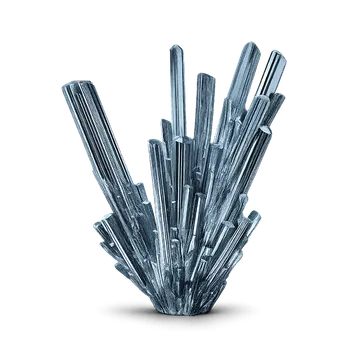
中国・石口黄山 Sb鉱床産ステブナイト— 世界最大のヒ素鉱床。光沢のある blade のような結晶と、コレクターに prized される劇的なスプレー状結晶。
Key facts
Xikuangshan は現代スズ鉱脈の重要な産地のひとつである。中央湖南省にある巨大な砒金鉱床で、100年以上にわたり産業とコレクターの双方に供給してきた。コレクターにとってその魅力は視覚的に直感的である。最高標本は、鋼灰色から銀黒、非常に金属光沢のある閃亜鉛鉛成分の結晶を、刃状・錐状・縞模様の結晶で示し、多くは花咲くような群晶、曲がったまたは穏やかに弧を描く集合体、分離した槍状晶、そしてドラマチックなスズ鉛閃石-石灰閃石の組み合わせを見せる。局地は特に重要である。単なる標本の産出地ではなく、世界最大の known アンチモン鉱床であり、主鉱物は閃錫鉛石である。
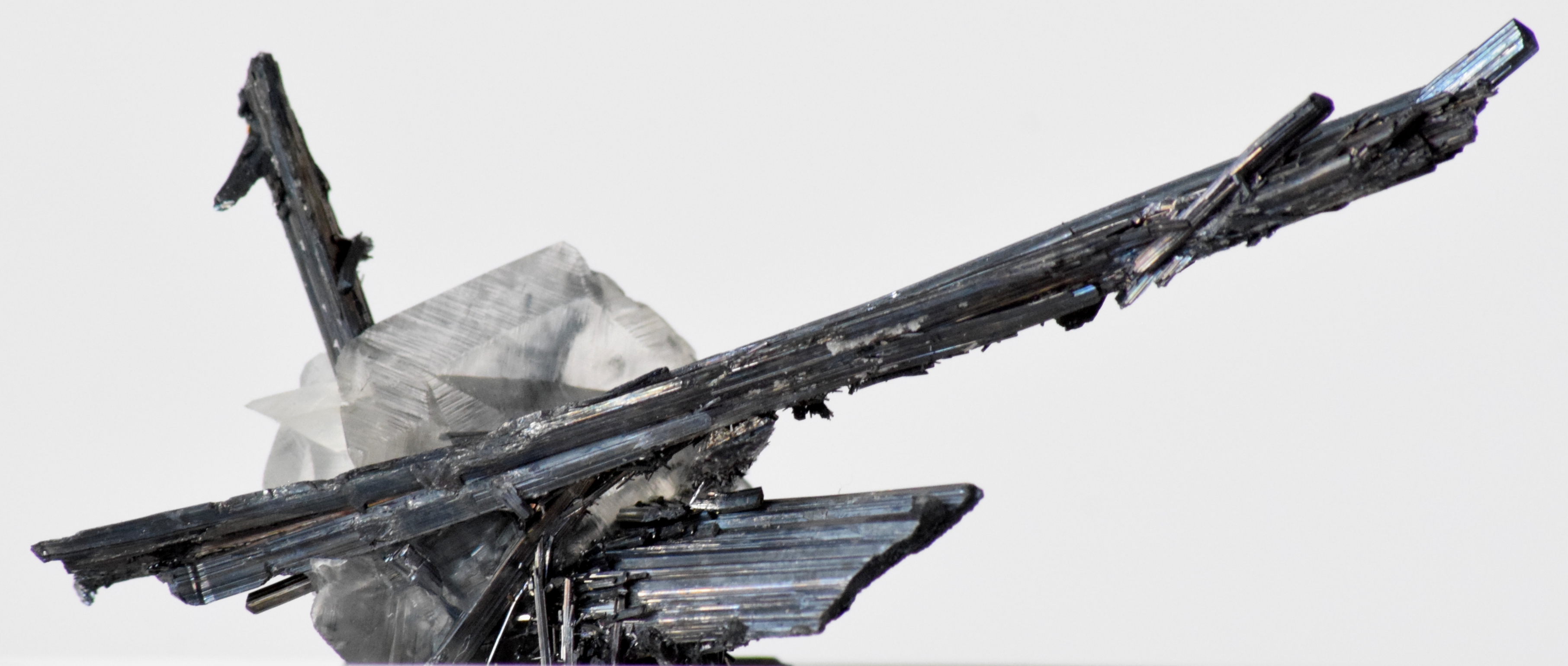
写真: Wikimedia Commons / Klaproth
地質的には、鉱床は湖南省中部の Xiangzhong 金属成因帯にあり、南中国の広域金属成因帯に含まれる。鉱区は層状沈積岩の褶曲・断層で支配され、閃錫鉛鉱化は珪化した石灰岩に濃縮され、F75 断層系および Xikuangshan 複合構造のアーク(背斜)と緊密に結びついている。主鉱物は組成が単純で、閃錫鉛石が経済鉱物であり、主に石英と方解石を伴い、蛍石、方解石、滑石、さらにはいくつかの超生鉱物が少量現れる。
Xikuangshan の採集上の意義は、大規模採掘と繊細な結晶形成との対比にある。鉱物学的研究では巨大でネットワーク状・破砕状・散在状の閃錫鉛鉱が記述される一方、コレクター市場では、光沢のある彫刻的な結晶と、慎重な採取を経てのみ生き残り得たマトリックス作品が見られる。最も desirable な石は、金属光沢、鋭い縞模様、完璧な終端部、三次元的な形状、そして確かな出所をバランス良く備える。淡色の方解石上の閃錫鉛石は特徴的な組み合わせだが、石英・方解石・方解石・鉱物元素の一部が変成した閃錫鉛鉱(stibiconite)へと変化したものも特別な趣きを加える。

*写真: Wikimedia Commons / James St. John*歴史的に、石壕山(石硃山)は中国の錫亜鉛産業と切り離せない存在です。 この地域の銻鉱床は明代から知られていたとされ、中国で最初の銻工場が1897年にそこに設置されました。過去100年の間、この地区は「世界の錫亜鉛の都」として有名になり、石壕山の標本は鉱の貯蔵庫や精錬所から博物館のケース、私人の陳列棚、国際鉱物ショーへと移動しました。## 特集標本
Search for specimens: View all stibnite specimens from Xikuangshan Sb Deposit, China
Xikuangshan Sb Deposit is in Lengshuijiang County, Loudi, Hunan Province, China, at about 27°47′N, 111°29′E. Mindat lists the locality as an active deposit, and modern geological work treats it as the largest known antimony deposit in the world. The ore field lies in central Hunan, near Lengshuijiang City, in the northern part of the Xiangzhong Basin.
The deposit is hosted mainly by Upper Devonian and Lower Carboniferous sedimentary strata. The key host sequence includes the Upper Devonian Shetianqiao Formation, dominated by limestone with local shale, and the overlying Xikuangshan Formation, an interbedded shale-carbonate unit with a hematite layer. The younger Lower Carboniferous Menggongao, Yanguan, and Datang formations include limestone and sandstone. The antimony mineralization is concentrated in silicified limestone, especially fossil-rich limestone of the Shetianqiao Formation, beneath organic-rich shale in the lowermost Xikuangshan Formation.
Structurally, Xikuangshan is a fault- and fold-controlled hydrothermal deposit. Mineralization is constrained by en echelon second-order anticlines within the Xikuangshan complex anticline and is strongly influenced by the NE-trending F75 fault, part of the Taojiang–Chengbu regional fault system. The main named ore blocks are Daocaowan, Laokuangshan, Tongjiayuan, Wuhua, and Feishuiyan. Most orebodies occur in the footwall of F75, and silicification strengthens toward that structure.
Orebody geometry is substantial. Published descriptions give individual antimony orebodies extending roughly 30–600 m along strike, dipping downward 1300–1800 m, and ranging from 1–5 m thick, locally reaching 20 m. Ore grades are reported generally around 3.5–5.7 wt% Sb, averaging about 4.0 wt% Sb. In specimen terms, those numbers matter because they explain the abundance of stibnite-rich material, but they do not mean fine crystals are common; attractive, undamaged crystal groups are a small survival fraction from a large industrial system.
The ore assemblages are commonly grouped into early and late stages. Early-stage mineralization includes quartz-stibnite, fluorite-quartz-stibnite, and barite-quartz-stibnite veins. Late-stage mineralization is represented by calcite-stibnite veins. Quartz-stibnite veins are the dominant ore type and account for more than 80% of the district’s Sb ore reserves in one modern study. Fluid-inclusion work has argued that Xikuangshan is better regarded as mesothermal rather than epithermal, with stibnite and its apparently intergrown gangue minerals precipitating from different hydrothermal solutions._Xikuangshan_鉛鉱化の年齢決定は長年の活発な研究課題である。初期のSm-Nd 計 calcite の年齢決定は中生代を示したが、新しい現場測定の calcite U-Pb 法による鉛鉱と共生する方解石の作業は、古喜年齢をパレオセンと古新世の年代を報告した:Daocaowan の方解石-辰鉭鉱脈が 58.1 ± 0.9 Ma、Feishuiyan の石英-辰鉭鉱脈が約 50–52 Ma。この年齢の問題は Xikuangshan が南中国のアンチモニー帯を解釈する際の参照鉱床であるため、依然として重要である。
採鉱の歴史は長く集中的である。この地域のアンチモニー鉱床は歴史的に知られており、Xikuangshan での産業的なアンチモニー企業は 1897 年に始まった。Hsi-kuang-shan Twinkling Star Co., Ltd. は中国鋼鉄鉱材公司(China Minmetals)と関連し、アンチモニーの採鉱・分離・精錬・研究開発を行う大型の非鉄企業として自称しており、2017 年には年産能力をアンチモニー鉱石 60 万トン、アンチモニ ンインゴット 2 万トン、三酸化アンチモニー 4 万トンと報告されている。2025 年に引用された地方当局データによれば、過去世紀にわたり Xikuangshan から約 200 万メトリックトンのアンチモニー金属が生産された。
収集アクセスは現実的に理解されるべきである:Xikuangshan は actively な、産業的なアンチモニー地区であり、公開の採集スポットではない。市場に流通する標本は、鉱山関連の回収、中国の鉱物ディーラー、古いコレクション、および国際的な標本流通を経由して来ている。真剣な収集家は、古いラベル、信頼できる所有権の連鎖、正確な産地表記を重視すべきである—Xikuangshan Sb の deposit、Lengshuijiang County、Loudi、Hunan、China—多くの中国のスビナイトは「湖南省、中国」などの広義または略式のラベルで市場に流通していることが多いためである。## 中国・ハンゲンサン Sb 鉱床産のアンチモン鉱(賓都鉱)の特徴
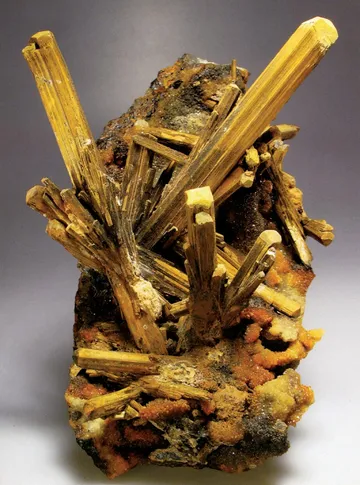
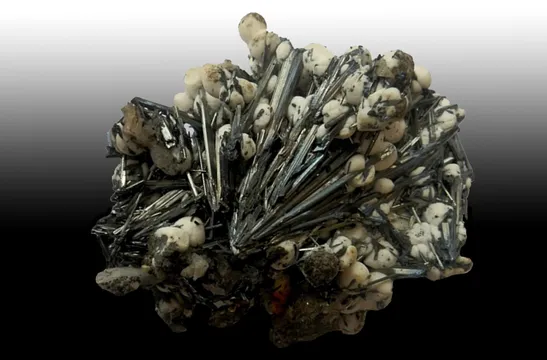
ハンゲンサン産のアンチモン鉱は伝統的に金属光沢があり、鋼灰色から銀灰色で、プリズム方向に強く縞状です。収集家の産状は、細長い単結晶からずんとした刃状、スプレー状、分岐集塊、ジャックストロウ状集合、十字形群、円弧状またはわずかに曲がった結晶など、さまざまです。 一部の標本はほぼ建築的です:スプレーを横切る強い中心ブレード、方解石を貫く槍状の結晶、または淡色の炭酸塩から生じる平行な刃の塊。
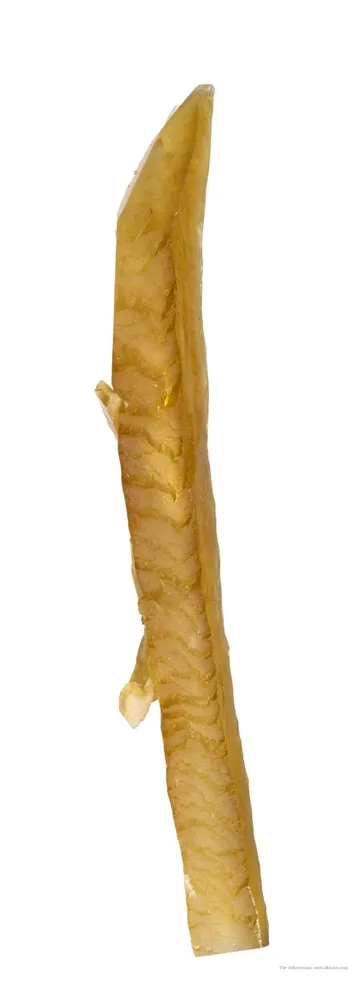
最も馴染みの高品質品は、小型キャビネット~キャビネットサイズの標本で、一般に5–15 cmの範囲ですが、単結晶やグループは小さめにも大きめにもなります。 デラーが記録する例には、約3 cmのミニチュアな分離結晶、約4–5 cmの方解石-Анチモン鉱の組み合わせ、約10–15 cmのキャビネット石、そして16 cmを超える大型展示標本が含まれます。 市場から記録された大型キャビネット標本の一例は、縦16.7×横5.6×厚3.7 cmで、個々のアンチモン鉱結晶が約10.2 cmに達していました。 ウィキメディアのハンゲンサン産アンチモン鉱-方解石写真は、最長のアンチモン鉱結晶を7 cmと記録しています。
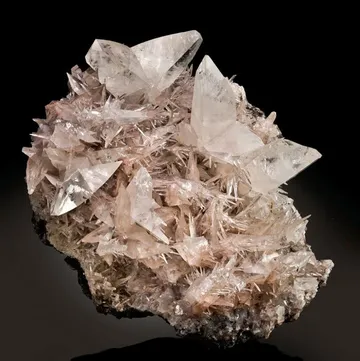
特徴的なアソシエーションは方解石です。ハンゲンサンの方解石は、薄い、透明、白色がかかった、琥珀色、蜂蜜色、または金色の平たい菱形または塊として現れ、内部にアンチモン鉱が埋め込まれ、貫通したり、方解石の上に乗ったり、または方解石を通して突出したりします。 石英もよく付随します。特に石英-アンチモン鉱鉱脈において、見た目に美しい石英を伴う標本は、単純なアンチモン鉱やアンチモン鉛石-方解石の組み合わせよりは市場で標準的ではありません。 バリド、蛍石、ドロマイト、天然硫黄、ヴァレンティナイト、ステブイコナイト、セバンタイト、センアルモン石、黄鉄鉱、閃亜鉛鉱、ポリト石、及び少量の超鉱化性砒素鉱物もこの産地で記録されています。

写真: Wikimedia Commons / Rob Lavinsky, iRocks.com
品質はまず光沢と一体性で判断します。高品質のハンゲンサン結晶は、明るい金属的反射、強い軸方向の縞状、清浄な端部を示すべきです。アンチモン鉱は軟らかく可鍛性があり、結晶が長く細いことが多いため、先端の欠落、端部の接触、肋の傷、割れ欠けが一般的です。最良の例は先端の損失が最小で、三次元的な構成が強く、結晶間の開放性が十分にあり、形がはっきり読み取れるものです。美的なXikuangshan産の砒礫-輝石墨(アンチモンと石灰石の造形)は、石灰石が単なる大きな伴生鉱物ではなく、黒金色のアンチモンと対照的な結晶中の菱形や blades(ブレード状)を形成している場合に特に魅力的です。単一のアンチモン結晶が単一の石灰石菱形を貫くスタイルは、特に満足感が高く、珍しい部類です。ドロマイト、石膏、硫黄、ヴァレンチン石、または部分的なアンチモン石酸化(stibiconite)変質を伴うアンチモンは魅力的であり得ますが、注意深く評価されるべきです。いくつかは鉱物学的には典型的に美しいものより興味深い場合があります。
この産地の材料は、クラシックな日本の一ノ久保 styleと異なり、一般には巨大で孤立した博物館級のブレードよりも、現代中国のスプレー、クラスター、組み合わせ作品を重視する傾向があります。武寧(Wuning)や他の中国のアンチモン鉱山産地と比較すると、Xikuangshanには「偉大なアンチモン鉱石の鉱山地帯」という付加的な重みがあり、多くのコレクターにとって、その locality の意義は、地名が明確に示された控えめな例でさえ評価を高めます。## Collector Notes
Xikuangshan stibnite is available on the collector market, but truly top-condition examples are much less common than the name recognition suggests. The deposit produced abundant ore and many specimens over time, including important waves of Chinese stibnite that appeared internationally in the late 20th and early 21st centuries. Today, market offerings include fresh-looking dealer stock, older 1980s–1990s material, ex-collection pieces, and occasional stibnite-calcite combinations from recognized collections.
Condition is the central issue. Stibnite has Mohs hardness around 2 and is easily scratched, bent, bruised, or broken. Xikuangshan sprays often have peripheral tip damage, contacted side crystals, broken back-side blades, or trimmed bases. None of these automatically disqualify a specimen, but the price should reflect them. A cabinet spray with several obvious broken terminations is a different object from a sharp, balanced cluster with only hidden peripheral contact.
Repairs and stabilization are always worth checking on fine stibnite, especially where long crystals meet matrix or where a dramatic spear would be especially vulnerable. Use magnification and a long-wave/short-wave UV light to look for glue lines, unnatural junctions, or fluorescence at contacts. Because Xikuangshan stibnite commonly forms sprays and intergrowths, natural contacts can look complicated; the goal is not to distrust every complex specimen, but to confirm that the composition is geological rather than assembled.
No single famous, locality-specific fake type dominates Xikuangshan stibnite in the way some other minerals have well-known fraudulent forms. The more realistic concerns are repaired crystals, glued reattachments, reconstructed sprays, incorrect or vague locality labels, and altered material described imprecisely. Specimens partly converted to stibiconite should be described as “stibnite altering to stibiconite” when metallic stibnite remains, or “stibiconite after stibnite” when the original stibnite habit is preserved but the sulfide is largely replaced. That distinction matters to mineralogical accuracy and market value.
Mislabeling is a practical concern. At least one auctioned Xikuangshan stibnite-calcite specimen was noted by the seller as having been erroneously labeled “Henan” rather than Hunan. Older labels may use spelling variants such as Hsikwangshan or simplified locality wording. Strong provenance should include Xikuangshan, Lengshuijiang, Loudi, Hunan; “China stibnite” alone is insufficient for serious locality collecting.価格は大きく幅があります。小さく清潔なサムネイルやミニチュアは比較的手に入りやすい場合がありますが、大きく光沢があり、損傷のないスプレーや上質な閃莫石-方解石の組み合わせはかなりの価格になることがあります。最近の公的に記録されたオークション事例では、改変や破損のある作品には控えめな金額、魅力的なキャビネット・グループには数百ドル、そして大柄で華麗で比較的損傷のない標本には$1,000を超えることもありました。標本のプレミアムは、場所・光沢・形状・状態・出所の結びつきから生じるものであり、中国産の閃莫石であることだけでは決まりません。
Xikuangshan閃莫石は優しく扱い、摩耗を避けて保管してください。硬い鉱物が金属表面を傷つけやすい混雑した引き出しには置かないでください。超音波洗浄や激しい洗浄は避けてください。ほこりは柔らかいブラシやエアーブラシで除去します。閃莫石には硫化アンチモンが含まれるため、砕いたり舐めたり子供やペットの手の届くところに置いたりしないでください。通常の展示取り扱いは、手を洗えば問題なく行えます。## Stories & Field Notes
Xikuangshan’s name carries an irony: it means “tin mine mountain,” yet its fame rests on antimony. Local accounts trace the discovery of antimony deposits in the area back to the Ming Dynasty, but the modern industrial story begins in 1897, when China’s first antimony plant was established there. Over the following century the mountain became an industrial landmark, producing nearly 2 million metric tons of antimony metal according to local-authority figures cited in 2025. That output was described as about one-third of China’s total and one-quarter of world production, enough to give Lengshuijiang the title “World Antimony Capital.”
The human memory of the mine is not only metallic luster and cabinet specimens. China Daily profiled Xie Guoxiu, 83, whose family had lived for generations in the Xikuangshan area. She remembered the core mining district roughly two decades earlier, when hills around her home were stripped bare and covered with toxic slag. Xie had worked as an ore-washing worker in the old days, and she recalled “hundreds of small, private mining workshops” in the region. Her memory of pollution was domestic and exact: “We couldn't grow vegetables in the yard and had to buy vegetables from an urban area far away.” The air was bad enough, she said, that many neighbors moved away.
That same landscape has been recast in recent years. Xikuangshan’s ecological restoration campaign began in 2006 under the Lengshuijiang city government. Early work included moving residents from subsidence-affected zones, dredging polluted rivers, and building alternative water-supply systems. In 2013, Hunan’s “No. 1 Project” for comprehensive pollution treatment along the Xiangjiang River included Xikuangshan among eight key mining areas. From 2018 to 2021, more than 300 million yuan—reported as $42.6 million—was invested in restoration, reviving 187 hectares of forest and 160 hectares of farmland.
The contrast is startling: abandoned mining sites replaced by photovoltaic stations and wind farms; denuded slopes turned into forest, grass, farmland, and scenic destinations. Xie Guoxiu’s family now runs a rural restaurant and guesthouse. During the May Day and National Day holidays in 2025, she said the establishment was fully booked, and during that year’s May Day holiday the Xikuangshan scenic area welcomed more than 20,000 tourists. Xikuangshan was showcased in 2021 at COP15 in Kunming as one of China’s ecological restoration cases, and in 2025 it was selected as one of 20 exemplary cases under the UN Decade on Ecosystem Restoration.
For a collector holding a bright stibnite spray from Xikuangshan, those stories sharpen the specimen. It is not an anonymous Chinese sulfide. It is a survivor from a giant ore system, a century-old industrial mountain, and a locality whose name now carries mineralogical, economic, environmental, and cultural weight.## 鉱物学的記録と出版物- Mindat: Xikuangshan Sb deposit, Lengshuijiang Co., Loudi, Hunan, China — コアローカリティデータベースエントリ。座標、アクティブデポジット状態、鉱物リスト、地質要約、関連岩石タイプ、参考文献を含む。
Mindat: Stibnite from Xikuangshan Sb deposit — Xikuangshan におけるアンチモン化鉛鉱(Stibnite)の種特有の出現ページ。関連鉱物と大きな標本写真記録を含む。
Ottens, Berthold. 2007. “Chinese stibnite: Xikuangshan, Lushi, Wuning and other localities.” The Mineralogical Record 38(1), 3–17. — Mindat が中国の stibnite 地区として挙げる、Xikuangshan を含む主要な収集家向け公表物。
Hu, A’xiang, and Peng, Jiantang. 2018. “Fluid inclusions and ore precipitation mechanism in the giant Xikuangshan mesothermal antimony deposit, South China: Conventional and infrared microthermometric constraints.” Ore Geology Reviews 95, 49–64. — Xikuangshan をメソス処理型鉱床と位置づけ、石鉛鉱の析出機構を論じる重要な鉱床成因論文。
Xu, Junwei, Liu, Xianghua, Lai, Jianqing, He, Hongsheng, Song, Xiangfa, Zhai, Degao, Li, Bin, Wang, Yuhua, Shi, Jian, and Zhou, Xi. 2022. “In Situ U-Pb Geochronology of Calcite from the World’s Largest Antimony Deposit at Xikuangshan, Southern China.” Minerals 12(7), 899. — 開放アクセス研究。世界最大のアンチモン鉱床Xikuangshanの calcite の同位体年代(U-Pb)を現場測定で報告。古生代境界の古生物年代の要約と鉱床地質のまとめ。
Song, Xiangfa, Lai, Jianqing, Xu, Junwei, Liu, Xianghua, Li, Bin, He, Hongsheng, Wang, Yuhua, Shi, Jian, Wang, Chaofei, and Wen, Chunhua. 2022. “Material Source and Genesis of the Daocaowan Sb Deposit in the Xikuangshan Ore Field: LA-ICP-MS Trace Elements and Sulfur Isotope Evidence from Stibnite.” Minerals 12(11), 1407. — Xikuangshan鉱帯内の Daocaowan 鉱鉱ブロックにおける stibnite の微量元素と硫黄同位体証拠を用いた鉱物源と成因の geochemical 研究。
Yang, Zhaozhu, Qiu, Hui, and Ma, Dongsheng. 1998. “Sm-Nd Dating for Antimony Mineralization in the Xikuangshan Deposit, Hunan, China.” Resource Geology 46(4), 227–231. — Xikuangshan 鉱化作用の年齢議論の一部として残る初期の同位体年代測定研究。
Wang, Xiaofei, He, Mengchang, and Xi, Jianhong. 2011. “Antimony distribution and mobility in rivers around the world’s largest antimony mine of Xikuangshan, Hunan Province, China.” Microchemical Journal 97(1), 4–11. — 世界最大のアンチモン鉱山周辺の河川におけるアンチモンの分布と移動性を示す環境地化学研究。
Wikimedia Commons: Category Xikuangshan Sb Deposit — 開放画像カテゴリには、方鉛鉱脈、方鉛鉱石、方鉛鉱石碍が含まれ、方鉛鉱脈の locality 写真が含まれています。## Videos & Media
“Collector's Piece: Stibnite from Xikuangshan Mine, China” — Heritage 1971 — Dealer specimen video linked from a Heritage 1971 listing for an 8.5 cm Xikuangshan stibnite floater acquired in 2007.
“Old, polluted mining site thrives in a green avatar” — China Daily — Illustrated news feature on Xikuangshan’s mining legacy and ecological restoration, with named local voices and restoration figures.
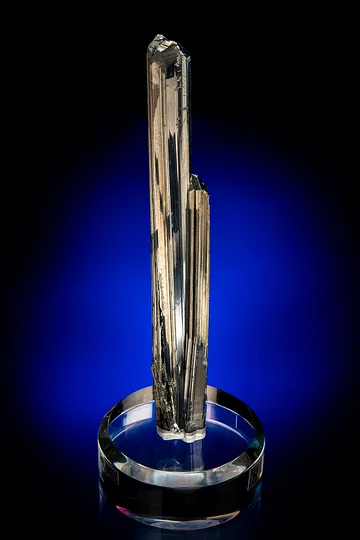

_2.jpg)
