






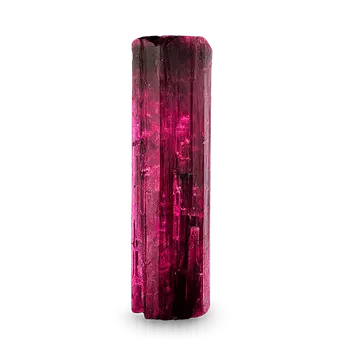
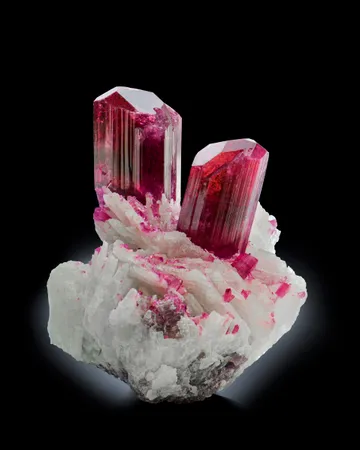
Paprok rubellite is one of the defining modern tourmalines of the Hindu Kush: bright pink to raspberry-red elbaite, often so clean and glassy that even cabinet-size crystals keep a gemmy glow. The locality’s best pieces have the look collectors want from Afghan lithium pegmatites—sharp trigonal prisms, wet vitreous luster, strong vertical striations, crisp terminations, and color zoning that can run from bubblegum pink through cranberry-red into green, blue, or colorless zones. When a Paprok rubellite sits naturally on white cleavelandite or quartz, the contrast is instantly recognizable: saturated pink tourmaline against a pale, snowy pegmatite matrix.
Key facts
Paprok rubellite is one of the defining modern tourmalines of the Hindu Kush: bright pink to raspberry-red elbaite, often so clean and glassy that even cabinet-size crystals keep a gemmy glow. The locality’s best pieces have the look collectors want from Afghan lithium pegmatites—sharp trigonal prisms, wet vitreous luster, strong vertical striations, crisp terminations, and color zoning that can run from bubblegum pink through cranberry-red into green, blue, or colorless zones. When a Paprok rubellite sits naturally on white cleavelandite or quartz, the contrast is instantly recognizable: saturated pink tourmaline against a pale, snowy pegmatite matrix.
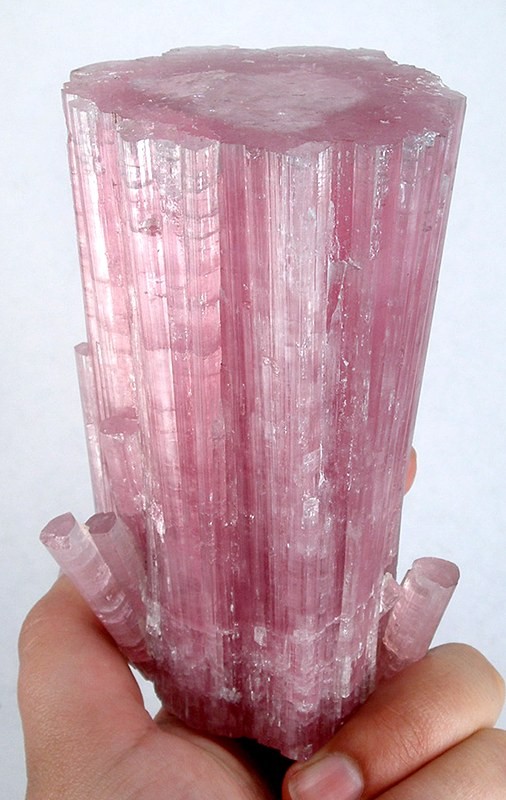
Photo: Wikimedia Commons
Paprok belongs to the rare-metal, gem-bearing pegmatite province of northeastern Afghanistan, a belt famous for lithium minerals, beryllium minerals, tantalum-niobium oxides, quartz, feldspar, lepidolite, and gem tourmaline. The Paprok workings are pegmatites hosted in Late Triassic slate, and the locality is part of the broader Nuristan-Kunar gem province that came to international collector attention through Soviet geological work, Afghan mining, and the late-20th-century trade in tourmaline, kunzite, aquamarine, and rare pegmatite species.
Mineralogically, Paprok is not merely a “pink tourmaline” locality. It has produced rubellite, elbaite, fluor-elbaite, foitite, schorl, verdelite, indicolite, achroite, quartz, smoky quartz, albite var. cleavelandite, microcline, lepidolite, beryl, aquamarine, morganite, beryllonite, pollucite, petalite, spodumene, kunzite, hambergite, hydroxylherderite, microlite-group minerals, tantalite-(Mn), wodginite, stibiotantalite, väyrynenite, viitaniemiite, and other species. That breadth matters to collectors because the best rubellites are part of complex pocket assemblages, not isolated color curiosities.

Photo: Wikimedia Commons
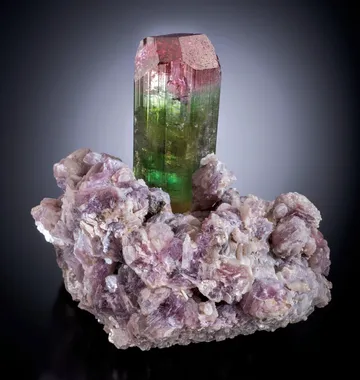
The locality is especially important for color-zoned “watermelon” tourmaline. A scientific study of Paprok watermelon tourmaline documented multiple chemically distinct zones, including a pink core and green rim, and identified fluor-elbaite in the core zone as the first reported fluor-elbaite for the Nuristan region. For collectors, that translates into specimens where the beauty is not superficial: the pink-red and green zoning records real changes in the pocket chemistry during crystal growth.
Search for specimens: View all rubellite specimens from Paprok, Nuristan, Afghanistan
Paprok is in Kamdesh District, Nuristan Province, northeastern Afghanistan. Mindat records the locality as a pegmatite field at approximately 35° 30' 20" N, 71° 4' 50" E, and notes the historical spellings Papruk Mine and Paprowk Mine. The locality commonly called the Paprok mine is not a single neat shaft in the classic Western sense; it consists of several workings in pegmatites on the right side of the Kéhi Dara Valley, south of Paprok village. The named workings include Me Tunnel Madan, KAL Tunnel Madan, GUL Tunnel Madan, and Al Madan, with madan meaning mine or working.
The deposit type is gem-bearing rare-metal pegmatite. Paprok’s pegmatites are hosted in Late Triassic slate and are part of the larger Nuristan rare-metal pegmatite area of interest. Regional summaries describe the Nuristan pegmatite belts as genetically and spatially related to fertile two-mica granites of the Oligocene-age Alingar Pluton. The broader rare-metal pegmatite province includes lithium, beryllium, cesium, tantalum, niobium, tin, rubidium, and gem minerals, with Paprok specifically documented for gem lithium-bearing pegmatites and tourmaline.
Older USGS locality tables list Papruk, synonym Paprowk, in the Parun field, with commodities recorded as GEM and Li, deposit type pegmatite, status “Active Small mine” as of 1995, host rock Late Triassic slate, and significant minerals including tourmaline, spodumene, beryl, albite, cleavelandite, topaz, and lepidolite. Those same tables describe the broader pegmatite zone as about 65 km long, with pegmatite dikes up to 2,000 m long, while gem tourmaline-bearing dikes are commonly 50–60 m long and 5–8 m thick.
Paprok’s mining history sits inside the turbulent but productive history of Afghan gem mining. Soviet geologists studied the Nuristan pegmatites in the early 1970s, and by the 1980s Afghan tourmaline and kunzite were entering international gem and mineral markets in quantity. Paprok and nearby Hindu Kush pegmatites became especially important to collectors in the 1990s and 2000s as fine, color-zoned tourmaline crystals reached Tucson, Munich, Sainte-Marie-aux-Mines, Peshawar, and high-end dealer inventories.
The locality is not a public collecting site. Serious collectors should treat Paprok material as mine-produced, trade-distributed specimen material rather than a destination for casual field collecting. Access is constrained by geography, local ownership, security conditions, and Afghanistan’s political and export environment. Specimens typically reach the market through Afghan and Pakistani mining and dealer networks, then through international dealers, auctions, and old collections.
Notable finds include large pink rubellite crystals, pink-green “watermelon” tourmalines, blue-capped and multi-colored elbaites, matrix specimens on quartz and cleavelandite, and rare associated pegmatite species. Paprok is also notable beyond rubellite for minerals such as väyrynenite, beryllonite, pollucite, viitaniemiite, and tantalum-bearing oxides—an indication that the pegmatites are highly evolved, chemically complex systems.
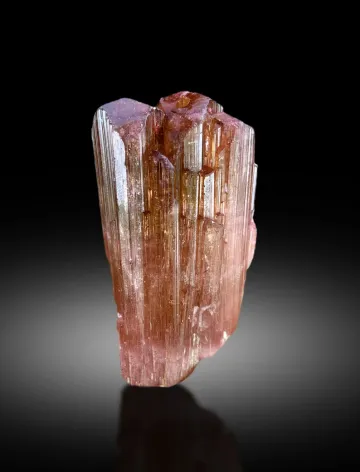
Paprok rubellite most often appears as prismatic elbaite crystals with strong vertical striations and a rounded triangular to trigonal cross-section. Crystals may be slender pencils, robust columns, stubby gem prisms, or thick cabinet-size individuals. Good pieces usually have flat pinacoidal terminations, complex pyramidal terminations, or intricate multi-faced caps with bright luster. The best terminations are not merely complete; they are glassy, reflective, and geometrically interesting.
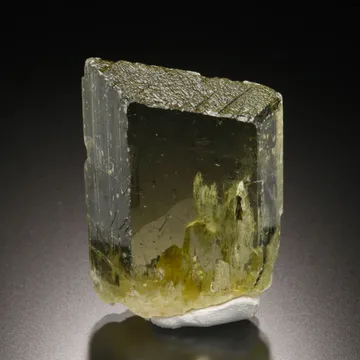
Color is the locality’s calling card. Paprok rubellite ranges from pale candy pink to bubblegum pink, rose, raspberry, cranberry-red, and purplish pink. Some crystals are dominantly pink-red, while others show strong zoning: pink cores with green rims, green bases grading into pink tips, blue or violet caps, colorless zones, smoky or dark internal phantoms, and alternating bands along the prism. A fully saturated, transparent pink-red crystal from Paprok is prized, but many collectors prefer the more complex pieces where red, pink, green, and blue occupy the same crystal.
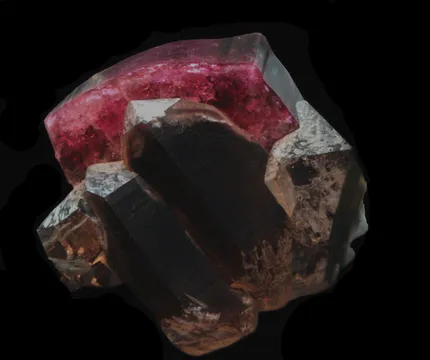
The locality’s rubellite commonly occurs with quartz, smoky quartz, albite var. cleavelandite, lepidolite, microcline, and other lithium-pegmatite minerals. Matrix examples with tourmaline crossing or perched on quartz are especially desirable. White cleavelandite can frame the rubellite beautifully, though it can also partially coat or obscure crystals. Lepidolite rosettes, when naturally attached and undamaged, add both color contrast and locality character.
Typical collector pieces range from thumbnail and miniature single crystals around 2–5 cm to small cabinet specimens in the 5–10 cm range. Larger crystals and matrix groups are known, including rubellite crystals exceeding 10 cm, but the combination of large size, strong pink-red color, transparency, sharp termination, natural matrix, and no repair is much less common. The best large pieces command attention because tourmaline becomes progressively harder to keep transparent and undamaged as size increases.
Quality is judged by color saturation, transparency, luster, termination, completeness, zoning, and matrix aesthetics. For Paprok specifically, collectors also value locality-typical combinations: pink-red tourmaline on white cleavelandite, pink crystals on quartz, strongly zoned watermelon sections, and multi-color crystals with a clear transition rather than muddy blending. A repaired but visually superb large Paprok specimen may still be important, but an unrepaired, fully terminated crystal on natural matrix is the premium condition.
Paprok rubellite should be understood as a tourmaline variety rather than a distinct mineral species. Most collector labels use rubellite for pink to red tourmaline, commonly elbaite or fluor-elbaite in lithium pegmatite contexts. The general elbaite formula is Na(Li1.5Al1.5)Al6(Si6O18)(BO3)3(OH)3(OH), while fluor-elbaite substitutes fluorine at the relevant anion site, Na(Li1.5Al1.5)Al6(Si6O18)(BO3)3(OH)3F. Without analysis, the visual term rubellite is usually appropriate for pink-red Paprok tourmaline, but the exact tourmaline species may not be provable from appearance alone.
Paprok rubellite is available on the market, but the top tier is not common. Small single crystals, polished or cut gem material, and lesser repaired pieces appear with some regularity. Fine, unrepaired matrix specimens with saturated pink-red color, good transparency, and an elegant composition are scarce. Large cabinet specimens with no repairs are exceptional.
Repairs are the main authenticity and condition issue. Tourmalines from pegmatite pockets commonly detach during growth, pocket collapse, mining, cleaning, transport, or later handling. Reattachment to matrix, repair through the crystal, and restoration at broken terminations should be expected often enough that every important Paprok specimen deserves close inspection. A single honest repair on a large tourmaline is not automatically disqualifying, but it must be disclosed and priced accordingly.
Look carefully at the base of crystals where they meet quartz or cleavelandite. Glue can hide in white albite, pocket clay, or along contact shadows. Under longwave ultraviolet light, some adhesives fluoresce differently from the surrounding minerals. Under magnification, suspicious areas may show meniscus-like glue, unnatural wet seams, trapped dust, or an abrupt break in striations. Repaired crystals may still be collectible, but a specimen sold as “no repair” should withstand serious examination.
Polished or re-cut terminations are another concern. Natural Paprok terminations can be flat, highly lustrous, and surprisingly smooth, so a flat top is not by itself evidence of tampering. The warning signs are an overly mirrorlike surface, missing natural growth texture, a termination that cuts across internal zoning in an unnatural plane, or a termination whose polish differs from the prism faces. On a valuable rubellite, ask directly whether the termination is natural, repaired, polished, or restored.
Treatment is a greater concern for cut rubellite than for matrix specimens, but collectors should still know the issue. Rubellite and pink tourmaline can be irradiated to intensify color, and studies on Afghanistan rubellite have shown that gamma irradiation can change color by strengthening absorption related to Mn3+. For loose gems, laboratory reporting is the proper route. For natural crystals, the larger concern is usually not irradiation but repair, cleaning, and restoration.
Condition issues specific to Paprok-style tourmalines include bruised prism edges, chipped terminations, pressure cracks, internal veils, rehealed fractures, missing side crystals, cleavelandite coatings, and matrix instability. Transparent pink-red tourmaline shows damage easily; a tiny white ding can be visually loud on a saturated rubellite prism. Conversely, included or slightly etched crystals may still be attractive if the color and form are strong.
Provenance matters. Old Paprok material from 1980s–1990s collections can carry added value, especially if accompanied by original labels using Papruk or Paprowk spellings. Current dealer labels may use Paprok, Papruk, Paprock, Paprowk, Nuristan, Kunar, or simply Afghanistan; the best labels specify Paprok, Kamdesh District, Nuristan Province, Afghanistan. Because Afghan and Pakistani gem-pegmatite material can look similar, locality confidence depends on dealer reliability, old labels, specimen style, and sometimes analytical context—not merely on color.
The older literature on Nuristan gem mining reads less like a tidy mining report and more like a travel account from a mountain world where geology and access are inseparable. To reach the Nuristan pegmatite country in the 1980s, the route described from Kabul ran along the Kabul-Jalalabad road, then north to Mehtar Lam for about 20 km and another 40 km northeast toward the village of Nuristan. The passable road ended several kilometers beyond the village. From there, the mines were foot travel: narrow gorges, rocky trails, and in one reported trip to Nilaw, two full days on foot to reach the deposit.
That terrain explains much about the specimens. These were not bench-mined crystals emerging from a road-cut quarry. The gem pockets were in hard pegmatite in sparsely populated mountains, and miners used large drills to get into the rock. Within the pegmatites, the prize was not a vein of color visible from afar but pocket contents: crystals in cavities, often lying in soft powdered clay within quartz-rich zones. The same conditions that made complete, sharp crystals possible also made removal difficult. A crystal could be perfectly formed in a pocket and still be broken, detached, or bruised by the time it reached a collector’s tray.
Paprok itself resolves into named workings rather than a single romantic “mine.” On the right side of Kéhi Dara Valley, south of Paprok village, the principal workings are recorded as Me Tunnel Madan, KAL Tunnel Madan, GUL Tunnel Madan, and Al Madan. The word madan simply means mine or working, but to collectors it gives a glimpse of how locality names travel: from local mine language to Afghan dealers, to Peshawar trading rooms, to old handwritten labels, and finally to specimen cabinets around the world.
The scientific story of Paprok watermelon tourmaline is equally vivid, though it happens under microscopes rather than on mountain trails. A studied Paprok crystal was not chemically uniform. It held four zones: a pink core, green outer zones, and changing proportions of elbaite, rossmanite, liddicoatite, schorl, and foitite components. The pink core carried iron at the detection limit, while iron increased outward into the green zones. That is the collector’s color story translated into chemistry—the crystal did not simply “turn green”; it recorded changing Fe and Li availability during growth. Inclusions of stannite and calcium carbonates pointed the authors toward a hydrothermal role in the crystal’s formation.
Paprok also has a rare-species undercurrent that serious collectors should not ignore. The locality is known not only for rubellite but also for minerals such as väyrynenite, viitaniemiite, beryllonite, pollucite, and tantalum-bearing oxides. In 2018, Peter Lyckberg summarized that the Hindu Kush pegmatites discovered at Kala and Paprok villages in 1959 and 1969 had again yielded gem tourmaline in “a rainbow of colors,” while Paprok and the Pech Valley also produced gem-quality pollucite and rare species such as manganotantalite. That combination—major gem tourmaline plus rare phosphate and tantalum mineralogy—is why Paprok is more than a pretty pink-tourmaline locality.

_2.jpg)