Paprok, Afghanistan: renowned for gem spodumene with kunzite, triphane, and hiddenite; a lithium-rich pegmatite locality prized by collectors for refined cryst…
Key facts
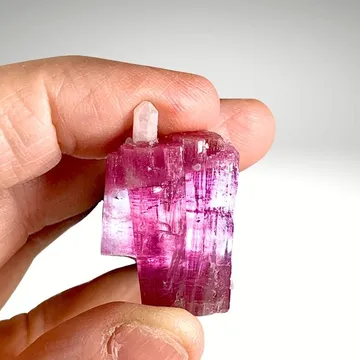
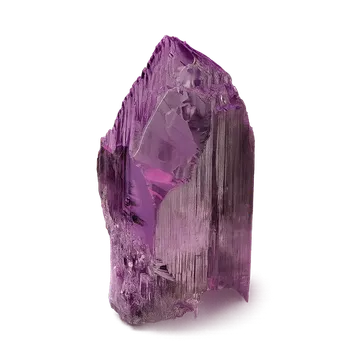
Paprok is one of the modern classic names for Afghan gem pegmatite minerals, and its spodumene is prized for the combination collectors want but seldom get all in one crystal: glassy luster, strong longitudinal striation, clean prismatic architecture, chisel-like terminations, and colors ranging from pale pink and lilac kunzite to yellowish triphane and green spodumene often traded as hiddenite. The best crystals have a taut, blade-like look—long, flattened prisms with bright faces and a gemmy interior that catches light from end to end. Even when the color is delicate rather than saturated, Paprok material can have a visual refinement that makes it immediately recognizable among Afghan pegmatite specimens.

Photo: Wikimedia Commons
The locality belongs to the lithium-rich rare-metal pegmatite belt of northeastern Afghanistan, in the rugged Nuristan region near the Afghanistan-Pakistan frontier. Paprok is not simply a single neat mine in the industrial sense. Collectors and dealers use the name for a group of gem-bearing pegmatite workings around Paprok village in Kamdesh District, with historical spellings including Papruk and Paprowk. These pegmatites are hosted in Late Triassic slate and form part of a highly fractionated pegmatite environment that has also produced elbaite, cleavelandite, smoky quartz, beryl, topaz, pollucite, petalite, microlite-group minerals, tantalite-(Mn), hambergite, hydroxylherderite, beryllonite, and several rare phosphates.

Photo: Wikimedia Commons
Paprok’s importance for collectors is inseparable from the broader Afghan pegmatite boom that brought Nuristan and adjacent Kunar and Laghman specimens onto the international market in the late twentieth century and after. Afghan spodumene had already become a serious collector material by the 1980s, when substantial quantities of kunzite and tourmaline from Nuristan were being reported in the gem trade. Paprok later emerged as one of the locality names collectors learned to ask for specifically, not just for spodumene, but for vividly zoned tourmaline, elegant matrix pieces, and rare accessory species.
For spodumene specialists, Paprok is especially attractive because it offers more than one collecting style. There are sharp single crystals for form purists, gemmy kunzite blades for color collectors, green spodumene on cleavelandite and smoky quartz for association collectors, and rare matrix pieces where spodumene shares the stage with tourmaline, microlite, feldspar, or lepidolite. The finest specimens balance a fragile set of virtues: undamaged terminations, clean edges, good transparency, visible color, attractive striation, and a believable, well-documented Paprok provenance.
Search for specimens: View all spodumene specimens from Paprok, Afghanistan
Paprok lies in Kamdesh District, Nuristan Province, northeastern Afghanistan. The commonly cited coordinates for the locality are approximately 35° 30' 20" N, 71° 4' 50" E. Mindat records the site as a pegmatite field and notes the alternative historical names Papruk Mine and Paprowk Mine. In collector usage, “Paprok Mine” usually refers to several workings in pegmatites on the right side of the Kéhi Dara Valley, south of Paprok village. Named workings recorded for the locality include Me Tunnel Madan, KAL Tunnel Madan, GUL Tunnel Madan, and Al Madan; “madan” is used locally for a mine or working.
Geologically, Paprok belongs to the rare-metal, gem-bearing pegmatites of northeastern Afghanistan. The immediate Paprok pegmatites are hosted in Late Triassic slate, while the broader Parun or Paron pegmatite field is described in regional summaries as lying in Early Proterozoic metamorphic schists and slightly metamorphosed Late Triassic sedimentary rocks. The pegmatites were emplaced near an Oligocene granite intrusion, a relationship typical of the rare-metal pegmatite systems that carry lithium, beryllium, tantalum, cesium, boron, and fluorine-enriched mineral assemblages.
The larger Paron pegmatite field is important primarily for lithium in spodumene. Regional summaries describe two long zones of spodumene dikes—the Paprok and Waygal zones—and two shorter zones, Pasgusta and Drumgal. Within the Paprok zone, spodumene dikes have been defined at Pakawalpet, Jamanak, Pashki, and Boni. Veins and vein zones of the spodumene-albite pegmatites in the wider field are reported as reaching 1 to 5 km in length and 20 to 40 m in width. The pegmatite types recognized in the field include spodumene-microcline-albite, spodumene-albite, and spodumene-microcline-cleavelandite pegmatites with pollucite and tantalite.
Paprok’s mineral list marks it as a highly fractionated pegmatite locality rather than merely a lithium occurrence. The verified suite includes albite and cleavelandite, beryl varieties including aquamarine, goshenite, and morganite, elbaite and fluor-elbaite, schorl, quartz and smoky quartz, microcline, muscovite, lepidolite, petalite, pollucite, topaz, fluorapatite, hambergite, hydroxylherderite, beryllonite, eosphorite, childrenite, väyrynenite, viitaniemiite, stibiotantalite, tantalite-(Mn), wodginite, and microlite-group minerals. For spodumene collectors, this matters because the finest Paprok specimens are often valued not only as isolated crystals but as evidence of this complex pegmatite chemistry: lithium silicates with cleavelandite, quartz, tourmaline, lepidolite, and tantalum-bearing accessory minerals.
Mining has been small-scale and specimen-driven rather than a large mechanized lithium operation. The locality’s output reached international collectors through Afghan and Pakistani mineral trade routes, especially the Peshawar market network that has long handled Nuristan pegmatite minerals. Production has been episodic, with pockets and tunnels yielding bursts of fine material rather than steady mine-run output. Access for independent collectors should be regarded as impractical and potentially unsafe; the workings are remote, locally controlled, and within a region where security, land rights, and mining permissions are complex. Serious collectors should acquire Paprok spodumene through reputable dealers with clear provenance rather than attempt field access.
Notable finds from Paprok include sharp pink kunzite crystals, green spodumene on cleavelandite and smoky quartz, yellowish to near-colorless triphane-like crystals, and rare matrix pieces combining spodumene with tourmaline, microlite-group minerals, or feldspar. Modern auction and dealer records show that cabinet-size Paprok spodumene remains active in the market, including large single crystals exceeding 20 cm and well-preserved kunzite crystals in the 8–13 cm range.
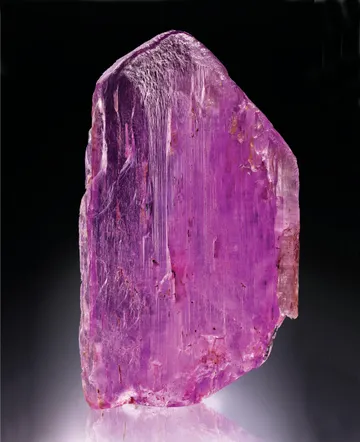
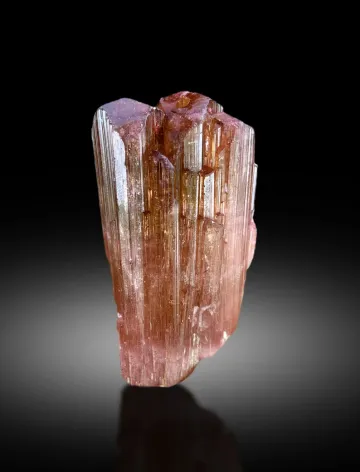
Paprok spodumene is a lithium aluminum pyroxene, LiAlSi2O6, and its collector appeal is built on crystal form as much as color. Typical specimens are elongated, flattened prisms with strong vertical striations. Terminations may be sharp and chisel-like, and the best crystals have the clean, architectural look that spodumene collectors prize: broad lustrous faces, crisp edges, and enough transparency to let the body color glow through the crystal.
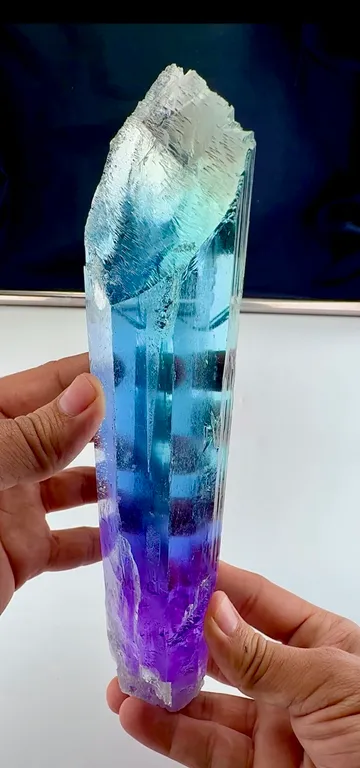
Colors include pale pink, lilac-pink, lavender, violet, nearly colorless, yellowish, yellow-green, green, and bicolored combinations. Pink to purple material is usually sold as kunzite. Yellow to yellowish material may be described as triphane, although careful dealers sometimes use that name cautiously when the color is only a faint yellow cast. Green Paprok spodumene is commonly marketed as hiddenite, but collectors should treat that varietal name carefully because true hiddenite is chromium- or vanadium-colored green spodumene, while some green Afghan spodumene may owe its color to other causes or to irradiation-related color centers.
The crystal habit is often “textbook” spodumene: bladed, prismatic, and strongly striated. Fine examples may show pronounced pleochroism, especially when viewed down the length of the crystal. Some Paprok specimens have frosty faces on one side and glassier faces on another, a feature that can make the crystal appear to change personality as it is turned in the hand. Natural etching is also seen, particularly on large single crystals, where etched seams or small solution pockets can add interest without necessarily lowering desirability if the overall form and termination remain strong.
Size ranges are broad. Thumbnail and small miniature crystals around 2–3 cm exist and can be exceptionally sharp. Attractive small cabinet examples around 8–13 cm are well documented, including doubly terminated kunzite and elongated purple crystals with good transparency. Larger cabinet crystals are known; a modern auction example from Paprok measured 24 x 6 x 3 cm and weighed 863.5 grams. In the broader eastern Afghanistan pegmatite belt, spodumene crystals can become far larger, but at Paprok the collector market particularly values crystals that combine size with termination, transparency, and undamaged edges.
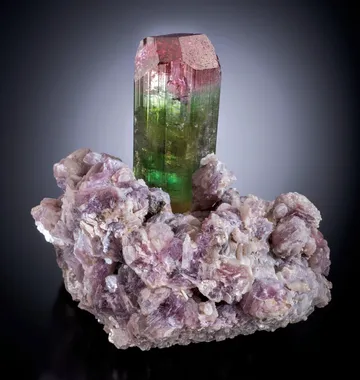
Associated minerals are one of the locality’s strengths. The most classic matrix associations include cleavelandite, smoky quartz, microcline, lepidolite, tourmaline, and microlite-group minerals. Green spodumene with cleavelandite and smoky quartz is especially attractive because it displays the lithium pegmatite assemblage in a compact, visually readable way. Kunzite with tourmaline and microlite on microcline is much rarer than single-crystal spodumene and commands attention because it ties Paprok’s spodumene production directly to the locality’s famous tourmaline and rare-element mineralogy.
Quality is judged by a combination of color, clarity, form, and condition. Saturated lilac-pink or violet color is always desirable, but even pale crystals can be important if they are sharply terminated, lustrous, doubly terminated, or unusually transparent. For green material, stability and provenance matter as much as hue. For yellowish triphane-like crystals, collectors look for clean body color rather than a murky gray-yellow tone. Across all colors, chips on terminations, bruised edges, cleavages, repairs, and glued bases should be evaluated carefully because spodumene’s perfect cleavage makes damage common.
Paprok spodumene is available on the market, but fine examples are selective purchases rather than commodity specimens. Small, pale, incomplete, or cleaved crystals are relatively obtainable. Sharp, transparent, strongly colored, undamaged crystals from the locality are much scarcer. Matrix specimens with convincing spodumene plus tourmaline, cleavelandite, smoky quartz, microlite, or lepidolite are especially desirable because they are less common than isolated crystals and provide stronger locality character.
The main authenticity concern is not usually whether the crystal is spodumene; the habit and cleavage are distinctive, and basic testing can confirm the species. The more serious issues are locality accuracy, color treatment, repair, and misleading varietal names. Afghan and Pakistani pegmatite specimens have moved through complex trade channels for decades, and labels can migrate between famous names such as Paprok, Mawi, Dara-i-Pech, Kunar, Laghman, and general “Nuristan.” A Paprok label is strongest when it comes with old collection provenance, dealer documentation, a mindat-linked specimen record, auction history, or association minerals consistent with the locality.
Color treatment deserves special attention. Kunzite can be irradiated to modify or intensify color, and irradiation can produce green colors in spodumene that may fade or shift when exposed to light or mild heat. Green Afghan spodumene should therefore be approached with caution, especially if the color is unnaturally uniform, intensely emerald-green, or unsupported by reliable provenance and gemological evidence. A fine green Paprok specimen can be legitimate and collectible, but the buyer should not assume that every green crystal sold as hiddenite is chromium-colored natural hiddenite in the strict sense.
Kunzite is also light sensitive. Pink and lilac color may fade with prolonged exposure to strong light, and some irradiated colors are notably fugitive. Display Paprok kunzite away from direct sun and intense UV-rich lighting. Museum-style low light is the safer choice for long-term color preservation. This is not simply a gem-cutter’s warning; it applies directly to display specimens, especially pale pink crystals whose value depends heavily on delicate color.
Condition problems are common because spodumene has perfect cleavage and is brittle compared with many associated pegmatite minerals. Look closely for repaired terminations, reattached sections, cleavage cracks running across the prism, bruised longitudinal edges, and small chips disguised by the crystal’s striation. Natural etching should not be confused with damage: etched pockets and dissolution seams can be part of the specimen’s growth and pocket history. The distinction is whether the feature interrupts the crystal’s form through breakage or is integrated into the natural surface.
For high-end purchases, insist on direct disclosure of repairs, restorations, irradiation, oiling, glued bases, and any recutting or polishing. Spodumene crystals are sometimes stabilized, repaired, or mounted because large blades are vulnerable. A well-disclosed old repair may be acceptable on a rare matrix piece, but undisclosed reconstruction materially changes value. The cleanest Paprok pieces are those with complete natural terminations, unrepaired edges, stable color, and a label trail that predates the most recent wave of online locality inflation.
One small but telling Paprok story is preserved in the description of an 8.2 x 2.4 x 2.2 cm kunzite crystal photographed before March 2010. It was not just another pale Afghan spodumene blade: the specimen weighed 106 grams, was doubly terminated, and carried a sharp chisel termination at the top. The description singled out the different personalities of its faces—two striated, one frosty, one glassy—and emphasized that the crystal was gemmy through the center. For a collector, that is the language of a specimen that succeeds from several angles: color, form, termination, transparency, and surface character all in one narrow prism.
Another Paprok moment surfaced in the modern auction market on October 8, 2025, when Heritage Auctions sold a 24 x 6 x 3 cm, 863.5-gram spodumene from the Daniel “Dan” R. Kennedy collection for $7,500. The crystal was cataloged as a triphane-like, near-colorless to softly yellow specimen, not a saturated pink kunzite. Its appeal was architectural: a large, fully formed single “floater,” sharp at the termination, with smooth lustrous prism faces, broad-face striations, natural etching underneath, and a pronounced etched seam along the back. The catalog also noted gentle orange fluorescence under UV light. It is a useful reminder that Paprok value is not only about purple color; in a locality famous for gem minerals, sheer completeness and sculptural crystal form can carry a specimen.
A third Paprok story belongs to the matrix specimens, the ones that show the pegmatite rather than just the individual crystal. One sold dealer example measured 103 x 66 x 54 mm and carried purplish-pink spodumene with tourmaline and microlite on microcline. The point was not simply that five minerals sat on the same rock. It was that spodumene, tourmaline, microlite, and feldspar were all telling the same geochemical story: a highly fractionated pegmatite pocket where lithium, boron, tantalum, alkalis, and volatile components had been concentrated enough to crystallize a specimen that was both aesthetic and mineralogically specific to Paprok.