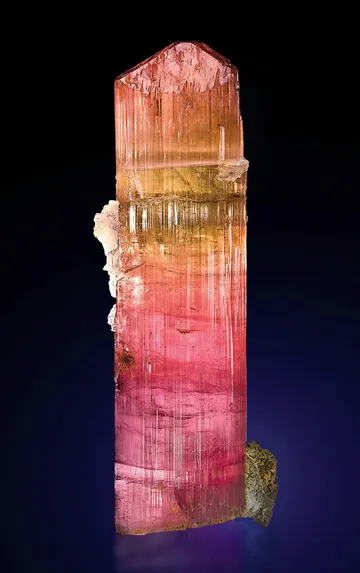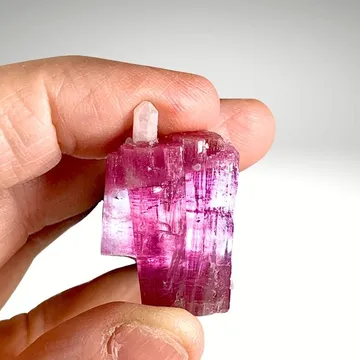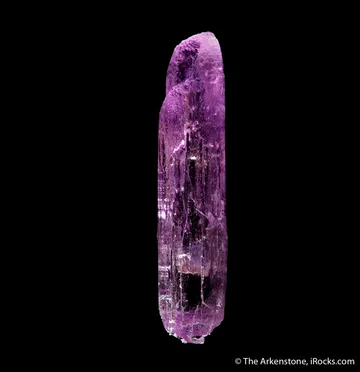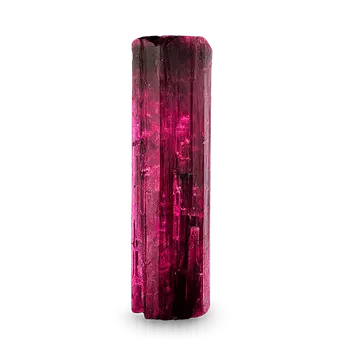
Rubellite from Himalaya Mine — pink to cranberry elbaite tourmaline with glassy prisms and distinct color zoning; a historic, prolific pegmatite locality prize…
Key facts
Himalaya Mine rubellite is one of the great American pegmatite classics: bright to deep pink elbaite from Gem Hill, Mesa Grande, San Diego County, California, with the particular charisma of a locality that produced both gem rough and cabinet specimens for more than a century. The best pieces have the look collectors want from southern California tourmaline—glassy prism faces, strong vertical striations, saturated rose to cranberry color, and the frequent company of white cleavelandite, lavender lepidolite, quartz, feldspar, and occasional green color zoning. Even modest specimens carry historical weight, because the Himalaya was not a short-lived pocket locality but a prolonged, prolific mining system whose crystals entered gem, museum, and private collections in large numbers.
The deposit is a miarolitic LCT-type granitic pegmatite—lithium-, cesium-, tantalum-enriched and strongly boron-bearing—developed in the Mesa Grande pegmatite district. The Himalaya dike system is not a broad open-pit pegmatite mass but a remarkably productive, comparatively thin system of tabular pegmatite-aplite dikes. That geological economy is part of its mystique: a dike averaging around a meter thick yielded a volume and quality of pink, green, bicolored, and watermelon tourmaline that made the mine North America’s benchmark producer of gem and specimen-grade tourmaline.

Photo: Wikimedia Commons
Historically, Himalaya pink tourmaline is inseparable from the China trade. In the first great mining period, pink and red tourmaline from southern California was exported in quantity for carving, ornaments, and decorative objects prized by the Chinese market. That demand helped drive production before its collapse in the early twentieth century. Later generations of collectors came to value what early commercial miners often cared less about: transparent, lustrous, well-terminated crystals, especially those with undamaged terminations, graceful color zoning, and aesthetic matrix.
For collectors today, “Himalaya rubellite” can mean several different levels of ambition. At the accessible end are small crystals, broken prisms, crystal sections in lepidolite, and fragments recovered from old dump or pay-dig material. More desirable are terminated loose crystals with good luster and a convincing natural base or second termination. The finest specimens are matrix pieces or complete crystals that show clean form, rich pink to reddish-pink color, strong translucency to transparency, and minimal repair—an especially important point because many large tourmalines from pocket environments are naturally broken or were damaged during extraction.

Photo: Wikimedia Commons
Search for specimens: View all rubellite specimens from Himalaya Mine, USA
The Himalaya Mine is on Gem Hill in the Mesa Grande Mining District of San Diego County, California, near Santa Ysabel and Lake Henshaw. The formal locality is generally given as Himalaya Mine, Gem Hill, Mesa Grande Mining District, San Diego County, California, USA. Mindat places the mine at approximately 33° 12' 42" N, 116° 47' 52" W, and records the historical locality names “Himalaya dikes” and “Himalaya pegmatite.”
Geologically, the locality belongs to the southern California gem-pegmatite province. The Himalaya system is a miarolitic LCT-type granitic pegmatite, enriched in boron and capable of producing open pockets lined with tourmaline and associated pegmatite minerals. Detailed studies describe two principal subparallel pegmatite-aplite dikes, with additional branches. The two main dikes range from less than 0.5 m to about 2 m in combined thickness, can be separated by several meters, and have been traced for roughly 915 m along strike. The upper dike has been the principal source of the valuable pink tourmaline specimens, while the lower dike is more associated with green tourmaline.
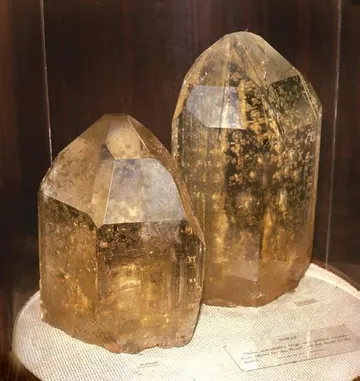
The dikes have the internal architecture collectors expect in complex gem pegmatites but rarely see so clearly expressed: footwall aplite, central pocket zones, graphic and massive pegmatite, albite-rich zones, quartz, feldspar, mica, and tourmaline. The gem material formed in miarolitic cavities, often embedded in sticky clay-rich pocket material. Associated minerals documented from the mine include albite and cleavelandite, quartz including smoky quartz, microcline and other feldspar, lepidolite and muscovite, beryl varieties including morganite and goshenite, fluorapatite, garnet, pollucite, cassiterite, columbite-tantalite minerals, stibiotantalite, and numerous clay and alteration minerals. That diversity is part of the collecting appeal: a Himalaya specimen may be judged not only as a tourmaline but as a complete pegmatite-pocket object.
Commercial mining began around the end of the nineteenth century. Mesa Grande tourmaline discoveries were reported in 1899, and claims on what became the Himalaya vein were made in the 1898–1902 period. The early history involved Gail Lewis, Charles Orcutt, D. L. Hoover, C. E. McGary, Frank F. Wright, Frank N. Wright, Archibald Edward Heighway Jr., and Lippman Tannenbaum, whose Himalaya Mining Co. became central to the first major commercial period. Tannenbaum’s activity peaked around 1910, then production declined as markets weakened and financial problems mounted; he filed for bankruptcy in April 1913.
The mine’s production history is episodic rather than continuous. Major periods include the original boom from about 1898 to 1912, renewed activity in the 1950s and early 1960s, corporate ownership beginning with Himalaya Gem Mines, Inc. in the 1960s, and renewed mining under William “Bill” Larson and Pala Properties International from the late 1970s through the 1990s. A collapse of the adit during winter rains in 1969 interrupted underground access. In 1977, Larson obtained a lease and drove a new lower adit to reach fresher, less weathered pocket ground below older workings. Pala Properties later purchased the mine in 1988 and operated it successfully until 1997.
Access today must be treated as private-property access, not open collecting. The mine itself is privately owned and reached through private land. Public collecting has historically been offered not as free mine access but as fee-dig screening of mine material, notably through the Himalaya Tourmaline Mine Dig at Lake Henshaw Resort. The operator’s current web page lists the dig as “Currently Closed,” while also offering ore buckets by mail. Collectors planning a visit should verify current status directly with the operator and should not attempt to locate or enter the mine independently.
Notable finds are often described in terms of pockets rather than single named specimens. Large pockets produced quantities of gem tourmaline, and the mine’s overall production has been estimated in the tens to more than one hundred tons of tourmaline depending on the source and period counted. The most important point for collectors is not a single trophy crystal but the mine’s sustained ability to produce: loose gem crystals, matrix specimens, bicolored and watermelon crystals, pink rubellite prisms, quartz-and-lepidolite combinations, and enough material to define the look of American elbaite for generations.
Himalaya rubellite is principally pink to reddish-pink elbaite, with the trade name “rubellite” applied most convincingly to the richer red, cranberry, raspberry, and deep rose crystals. Much of the locality’s commercial and collector material is lighter pink tourmaline; the best rubellite-grade pieces are more saturated and hold color well through the crystal. Strong purplish-pink to maroon tones occur, and many crystals show subtle to obvious zoning. Green caps, green bases, or bicolored pink-and-green sections are part of the locality’s broader tourmaline identity, though a strictly rubellite specimen is judged first on the red-to-pink body color.
Crystal habit is typically prismatic, with vertical striations on the prism faces and terminations that may be flat, pyramidal, or hemimorphic, meaning the two ends of a crystal can show different forms. Doubly terminated crystals from Himalaya are especially desirable when both ends are natural and undamaged. Some crystals are straight, sharp, and pencil-like; others are thicker prisms with broad faces, and occasional curved or slightly bent crystals are known. The best examples combine bright luster with visible internal life—translucency, partial transparency, or gem windows that let light move through the red-pink body.
Size ranges vary widely. Small crystals and fragments under a centimeter are common in screened material and old dumps. Miniature to small-cabinet crystals in the 2–6 cm range are a familiar market size for loose Himalaya rubellite. Larger crystals and clusters exist, including matrix specimens over 10 cm across and individual prisms several centimeters thick, but as size increases, condition and repair become increasingly important. Cabinet pieces with multiple pink crystals on quartz, lepidolite, albite, or feldspar are significantly scarcer than loose single crystals or etched/broken fragments.
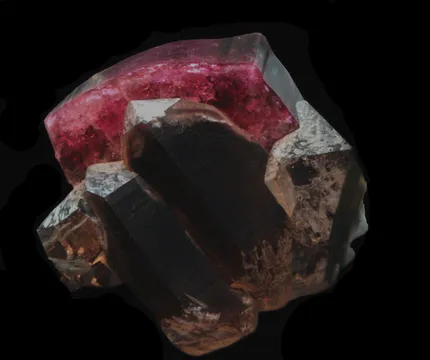
Matrix associations are a major locality signature. Lavender to lilac lepidolite gives Himalaya rubellite a pleasing color contrast and often immediately suggests southern California. White bladed cleavelandite, quartz, smoky quartz, microcline or orthoclase, muscovite, and clay-pocket remnants are also characteristic. Fine matrix pieces may show rubellite rising from white albite blades, leaning against quartz, or embedded in lepidolite-rich pegmatite. The association with feldspar and cleavelandite is not just decorative; it reflects the zoned pocket environment in which the tourmalines formed.
Quality is determined by the same fundamentals as other elite tourmaline localities, but with a Himalaya-specific eye. Color should be saturated enough to justify “rubellite” rather than merely pale pink tourmaline. Luster should be glassy, not dull or abraded. Prism edges should be sharp, with minimal bruising along the vertical ribs. Terminations matter greatly: a clean, natural termination can make a specimen, while a repaired, polished, or chipped termination must be priced accordingly. Matrix aesthetics also matter; a smaller crystal attractively placed on lepidolite, quartz, or albite may be more desirable than a larger but battered loose prism.
Collectors also prize identifiable locality character. A Himalaya rubellite commonly has a more historical, old-California look than many modern Brazilian or Afghan rubellites: pink to cranberry rather than neon red, often with lepidolite, quartz, and cleavelandite; sometimes bicolored; and frequently accompanied by old labels or collection history. Provenance can be a serious value factor, especially for specimens from pre-1960 production, the Pala Properties period, or well-known private collections.
The main authenticity issue with Himalaya rubellite is not synthetic tourmaline. Laboratory-grown tourmaline in convincing collector-crystal form is not a normal market problem. The more practical concerns are repairs, restorations, polished terminations, glued composite specimens, vague locality claims, and overuse of the word “rubellite” for ordinary pale pink elbaite.
Repairs are common in tourmaline specimens generally and especially understandable in pocket tourmalines from a mine like the Himalaya, where crystals may have broken naturally in the pocket or during extraction from clay, quartz, and feldspar. A cleanly repaired significant crystal is not automatically undesirable, but it must be disclosed. Use magnification and a strong light to check for glue lines, slight misalignment of striations, glossy adhesive at contacts, and suspiciously continuous crystals that do not quite match across a break. Ultraviolet light can sometimes help reveal adhesives, though not all glues fluoresce.
Polished or modified terminations require careful inspection. Natural tourmaline terminations usually show growth features—small trigonal or pyramidal faces, subtle etching, uneven natural luster, or microscopic growth hillocks. A perfectly flat, mirror-like end on an otherwise natural-looking crystal may be a natural basal pinacoid, but it may also be a polished break. Himalaya crystals can genuinely have flat terminations, so the question is not “flat equals fake,” but whether the surface texture and edge relationships look geological rather than lapidary-made.
Condition issues are predictable: chipped terminations, bruised prism edges, broken bases, pocket etching, internal cracks, and cleaved or crumbly lepidolite matrix. Rubellite color can mask internal fractures until the crystal is backlit. For transparent or gemmy pieces, inspect in transmitted light to separate attractive internal veils from structural cracks that reach the surface. On matrix specimens, check whether tourmalines are naturally seated in the pocket matrix or reattached. A reattached crystal can still be collectible if disclosed, but an undisclosed composite should be avoided.
Treatments are more relevant for cut stones than mineral specimens. Pink and red tourmaline gems can be heated or irradiated in the broader gem trade, and such treatments may be difficult to detect. For natural crystal specimens from Himalaya, color treatment is not usually the central concern; physical alteration and repair are more important. Faceted Himalaya stones should be bought with normal gemological caution, especially if the price assumes untreated natural color.
Rarity is tiered. Small fragments, partial crystals, and pale pink tourmaline from Himalaya remain available because of the mine’s long production history and the distribution of dump and pay-dig material. Good loose terminated rubellite crystals are less common but still obtainable. Fine, unrepaired, richly colored, well-terminated crystals with strong luster are scarce. Matrix specimens with attractive composition, multiple good crystals, and little damage are distinctly desirable. Old-label pieces from early mining or classic California collections can command a premium beyond their purely visual qualities.
Current market availability is best described as steady but selective. Himalaya material appears regularly through mineral dealers, auctions, older collections, and specimen marketplaces, but top examples are not abundant in proportion to the mine’s fame. Many available pieces are pink rather than true red rubellite, or they show the honest damage expected from a heavily worked historic pegmatite. For serious collectors, the buying discipline is simple: demand precise locality, ask directly about repair and restoration, examine terminations and contacts, and pay more for color, luster, completeness, and provenance rather than size alone.
The early Himalaya story has all the ingredients of a western mining drama: children carrying home bright crystals before adults fully understood the source, overlapping claims along a valuable pegmatite vein, legal pressure, opportunistic overstaking, and a market half a world away deciding the fate of a California hillside. By the late 1890s, Mesa Grande gem tourmaline had become public knowledge. Charles Orcutt claimed the northern end of the vein on November 16, 1899, mined his ground, and publicized the finds. Then came D. L. Hoover, C. E. McGary, and the Wright shoe retailers, who named their claims the Sancho Pancho Mine. Archibald Edward Heighway Jr.—called the “Cincinnati giant” by the New York Times—entered the story in 1901, took over the property, mined it, fell into royalty trouble, and overstaked the earlier claims. Lippman Tannenbaum bought in next, only to face litigation from the Hoover group. In December 1903, Tannenbaum paid the Sancho Pancho owners $6,000, and the legal storm moved aside.
For a few years the mine fed a remarkable export trade. Pink and red tourmaline was not merely a collector’s curiosity; it was carving material for a Chinese market that prized the color. The early miners were chasing quantity and carving-grade mass as much as cabinet beauty. Later collectors would wince at the idea, but transparent crystals—now the very pieces collectors admire—could be of secondary interest compared with opaque pink material suitable for cutting and carving. When the Chinese market collapsed around 1911–1912, the economics changed abruptly. The mine did not vanish, but its rhythm shifted from boom production to sporadic mining, leasing, collecting, and rediscovery.
One of the most vivid modern descriptions of the mine begins not underground but at Dudley’s Bakery near Julian. A DesertUSA group gathered there, then drove about thirty minutes toward Gem Hill, passing private roads and gates before reaching the mine area. From the house on Gem Hill to the mine entrance, the road required four-wheel drive, so many visitors walked the half-mile uphill. At the portal they put on knee-high rubber boots, hard hats, and flashlights. Outside, the temperature was about 80 degrees; at the entrance, cold air flowed out of the adit.
Inside, the mine became a different world. Visitors signed in on an “In and Out” board, a simple safety device that suddenly made sense in a maze of dark workings. A few feet in, the floor was covered by ankle-deep muddy water. Flashlights reached only a short distance ahead. Low timbering forced people to duck. After about five minutes, the tunnel reached an intersection: one direction led toward the current production area where three workers were mining tourmaline; the group instead went left toward a large already-excavated pocket.
There the geology became visible at human scale. Pegmatite veins cut through the walls, with empty pockets where tourmalines had been removed. Pink, green, and black tourmaline fragments remained in the walls, and lavender mica shimmered among them. In one place, a large smoky quartz crystal had been left in the ceiling as a teaching specimen, still in place so visitors could see how pocket crystals sat before removal. A few yards beyond it was a large pocket excavated at a steep uphill slant from the tunnel wall. Workers had removed the gem tourmalines by hand; to reach the narrowest sections, they had to lie on their sides and crawl into the vein.
Another field image from the Himalaya is quieter but just as revealing: an expert pegmatite miner named Benjamin working a pocket with bamboo skewers. The pocket was beside a white dike and extended for several feet. Instead of prying blindly with steel, he used the skewers to probe sticky mud and ease crystals out without damaging them. The crystals were wrapped carefully and placed into plastic bags. In another moment, a hydraulic jack was set under part of the dike to remove a section of pocket wall. That combination—delicate bamboo skewers for crystals, hydraulic force for rock—captures the practical art of specimen mining in a pegmatite pocket.
The mine’s later corporate and collector era brought its own turning points. Ralph Potter bought the Himalaya property in 1952, and the long-term caretaker Herb Hill informally allowed specimen collectors onto the site. By 1958, underground workings were reopened and new tourmaline pockets were found. In December 1963, Potter formed Himalaya Gem Mines, Inc., selling shares to a group of eight local mineral collectors while retaining an interest. Underground mining continued until winter rains in 1969 collapsed the adit. Then, in July 1977, William “Bill” Larson, through Pala Properties International, took a ten-year lease and reopened the mine. Because near-surface bedrock was weathered, Larson drove a new lower adit to intersect the pegmatite below the older shallow workings, aiming for fresher pockets. That decision helped define the modern specimen-producing chapter of the Himalaya.
The scale remains startling because the rock body was so thin. Gemological summaries have described production exceeding 100 tons of tourmaline from a dike averaging less than a meter thick. The underground result was a honeycomb of workings inside Gem Hill, a hard-won network following a narrow but extraordinarily generous pegmatite. For collectors, that is the essential Himalaya paradox: a slender dike, a vast output, and crystals that still carry the intimacy of pocket mining—mud, clay, quartz, lepidolite, feldspar, and the sudden flash of pink.