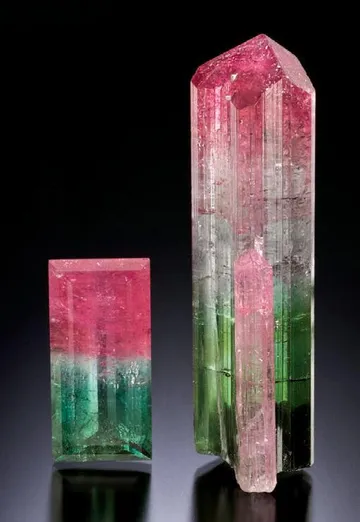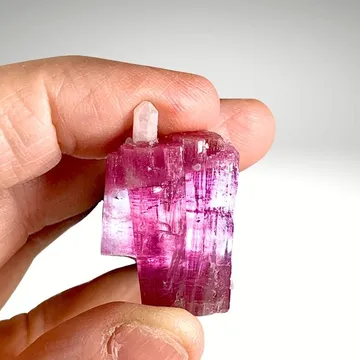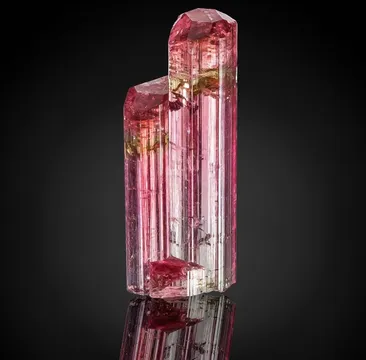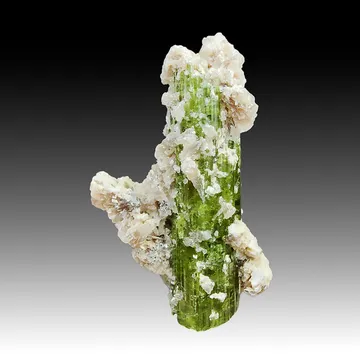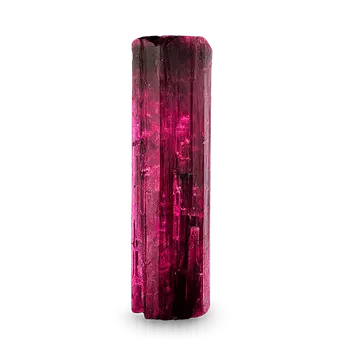
Rubellite from Cruzeiro Mine, Brazil: raspberry to deep rose-red elbaite with lustrous prisms, notable for sustained production and strong collector appeal.
Key facts
Cruzeiro rubellite has the particular kind of beauty collectors associate with the great Brazilian pegmatites: hot raspberry to deep rose-red elbaite in clean, lustrous, striated prisms, often with the visual drama of black caps, green zones, or a sudden transition into water-clear colorless sections. The best crystals are not merely pink tourmalines. They have the saturated, glowing red-magenta body color that earns the varietal name rubellite, with enough transparency in the upper crystal to light up under a case lamp or a collector’s fiber optic.
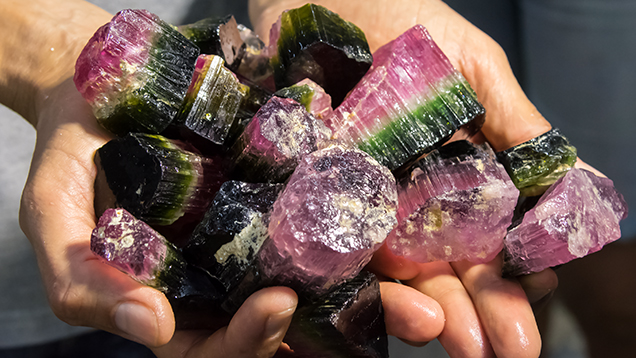
Photo: GIA
The mine sits in the São José da Safira area of Minas Gerais, north of Governador Valadares, in one of the world’s great tourmaline-producing belts. Its pegmatites are large, lithium- and boron-rich granitic bodies emplaced in quartzite and related metamorphic rocks. For the collector, that geology translates into a very specific look: tourmaline crystals recovered from albite-rich pocket zones near quartz cores, commonly in loose singles rather than matrix, but with lepidolite, cleavelandite, quartz, and iron-manganese coatings as important pocket indicators.
Cruzeiro’s importance is not built on a single romantic pocket alone, although it has had those too. Its stature comes from continuity. It has yielded tourmaline for generations: green, blue, pink, rubellite, bicolor, and multicolor material in both gem rough and display crystals. Where Jonas is remembered for a legendary burst of giant cranberry-red rubellites, Cruzeiro is admired for sustained production, scientific interest, and an unusually wide range of crystal styles.
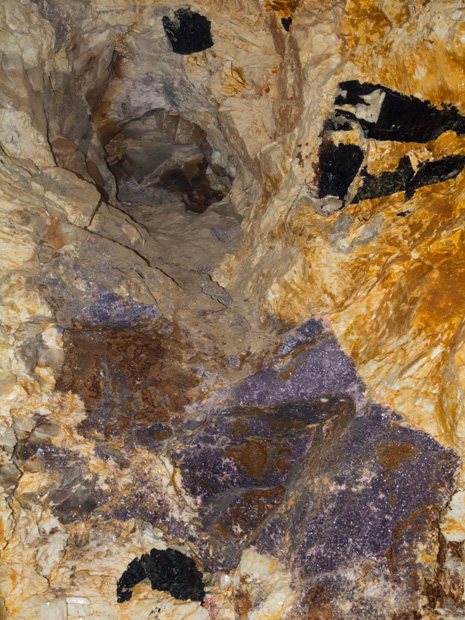
Photo: GIA
Collectors look first for color that remains alive without backlighting: raspberry, cherry, cranberry, or deep pink-red rather than pale pink or muddy maroon. After that come termination, luster, and integrity. Fine Cruzeiro rubellites may be slim and elegant, stubby and flat-topped, or multicolored with a rubellite body passing into green and ending in black. The most desirable pieces combine strong front-lit color, glassy luster, sharp prism striations, an undamaged natural termination, and credible old or mine-direct provenance.
Search for specimens: View all rubellite specimens from Cruzeiro Mine, Brazil
Cruzeiro Mine is located near São José da Safira, Minas Gerais, in the Governador Valadares gem district of eastern Brazil. The mine is reached from the Governador Valadares region and lies in mountainous terrain near the Serra Safira, an area whose name preserves the old confusion between blue tourmaline and sapphire. Historical accounts place the deposit north to northwest of São José da Safira, and modern reports describe it as roughly two hours from Governador Valadares by road.
The deposit is a complex rare-element granitic pegmatite system. The main mining area has been described as several parallel pegmatite bodies, with veins numbered 01, 02, 03, 04 and an intermediate 01½ vein; older scientific studies treated three principal subvertical dikes. They dip steeply, intrude quartzite, and show sharply defined contacts. The pegmatites are zoned around quartz-rich cores, with wall and intermediate zones containing muscovite, quartz, feldspar, microcline, albite, and the pocket environments that yield gem tourmaline.
At Cruzeiro, gem tourmaline is especially associated with albite-rich zones close to the quartz core rather than with microcline-dominant portions of the pegmatite. Miners watch for cleavelandite, purple lepidolite, black tourmaline, and yellow-brown to dark iron-manganese oxide or phosphate coatings as signs that gem pockets may be near. Associated minerals recorded from the mine include albite and cleavelandite, lepidolite, muscovite, quartz, beryl, aquamarine, morganite, schorl, petalite, cassiterite, columbite-tantalite, tantalite, apatite, calcite, pyrite, garnet, amblygonite-group material, and rare phosphate or uranium-bearing secondary species. That association reflects the highly evolved, lithium-, boron-, beryllium-, manganese-, tin-, niobium-, tantalum-, phosphorus-, uranium-, and copper-bearing nature of the pegmatitic system.
The historical arc of the mine begins before rubellite was the prize. The area’s green and blue tourmalines were repeatedly mistaken for emeralds or sapphires by early explorers, and the region’s mica became strategically important before tourmaline dominated the business. Geological and historical summaries report a deposit discovery in the early twentieth century and a formal lease before the 1940s; the mine’s own modern history presents Cruzeiro as operating since 1940. In the 1940s, mica mining in the district employed hundreds of workers and supplied a significant share of world mica production. When the mica market weakened, tourmaline became the focus.
Tourmaline mining at Cruzeiro is closely tied to the Neves family. José Neves and Antonio De Assis Neves began as mica miners and tourmaline dealers, later buying the mine from interests associated with Julius Sauer of Amsterdam Sauer. After a fatal family plane crash in January 1992, Beatrice Neves, Antonio de Neves Jr., and Douglas Williams Neves continued the operation. Modern accounts describe Cruzeiro as a large commercial mine with formal management, employees, active underground workings, cutting and marketing relationships, and a mine-to-market identity rather than an open collecting locality.
Collecting access should therefore be understood accordingly. Cruzeiro is an active private commercial gemstone mine, not a casual fee-dig or public collecting site. Specimens reach collectors through the mine’s production stream, Brazilian dealers, international mineral dealers, gem cutters, old collections, and marketplace resales. Field visits, when they occur, are arranged professional visits rather than ordinary collecting trips.
Production has been long and episodic. Historical production from 1955 to 1970 was reported at an average of about 200 kg of tourmaline crystals per week, with only a small proportion reaching gem quality. Modern GIA field reporting described annual production averaging more than eight tons of tourmaline over a five-year span, divided among carving and bead material, clean facet-grade, cabochon-grade, and specimen-grade pieces. Pink and rubellite colors formed a large share of production, but many crystals are bicolored or multicolored, complicating simple color percentages.
Notable finds give the locality much of its collecting romance. A 1966 hard-rock pocket produced a single 14 kg deep-red rubellite crystal that cut an estimated 10,000 to 12,000 carats of clean stones. In mid-1971, several pockets yielded about 400 rubellite crystals in one of Brazil’s major rubellite events, a find that helped establish Cruzeiro as a premier Brazilian rubellite mine. Later finds continued through the 1980s and into modern production. The mine’s own public history identifies a 2012 “Legend Pocket” as an exceptional rubellite discovery, and a major MIM Museum specimen from that find has been described as a 55 x 38 x 22 cm plate with a 19 cm main crystal.
Cruzeiro rubellite is usually manganese-rich elbaite, the red-to-pink tourmaline of evolved lithium pegmatites. Modern crystal-chemical work on pink tourmalines from Cruzeiro confirms Mn-rich elbaite compositions, with manganese responsible for the pink-to-red coloration and lithium-rich pegmatitic conditions reflected in the chemistry. In collector language, that means the best pieces are judged less by species novelty than by the familiar but demanding rubellite standards: saturation, transparency, luster, form, and condition.
Crystal habit is strongly prismatic. Cruzeiro crystals may be long, thin, and pencil-like; thicker, shorter, flat-topped prisms; simple singles; intergrown clusters; or pocket fragments showing parallel growth. Prism faces commonly show lengthwise striations. Terminations may be flat pinacoids, modified pinacoids, complex stepped or etched terminations, black caps, green caps, or more corroded natural ends depending on pocket chemistry and growth history.
Color is the locality’s signature. Fine examples run from vivid hot pink through raspberry and cranberry to dark rose-red. Some crystals show a darker maroon phantom band or a rubellite core with green outer zones. Others pass from rubellite to green and end in black, a style repeatedly noted in modern mine production. Bicolor pieces can show rubellite paired with green, blue-green, or water-clear zones. Collectors should distinguish attractive zoning from weak color: a crystal that needs strong backlighting to look red is less desirable than one that reads as rubellite under normal cabinet light.
Size ranges are broad. Historical reports mention many transparent to opaque green, blue-green, and pink tourmalines 10 to 25 cm long, while rubellite crystals of 5 cm or more were considered notable and some stubby, flat-terminated crystals weighed several kilograms. Today’s collector market commonly shows thumbnails, miniatures, and small-cabinet loose crystals in the 3 to 7 cm range, with larger, cleaner, well-terminated rubellites far less common and priced accordingly. Large matrix plates from exceptional pockets are museum-level pieces.
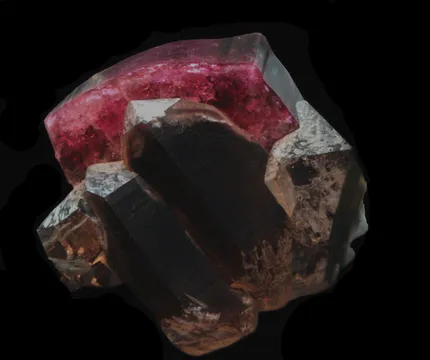
Matrix is less common than loose crystals because weathered feldspars in the pegmatite alter to clay minerals, allowing tourmalines to be recovered separated from their original pocket walls. When matrix is present, the most attractive associations are white albite or cleavelandite, lavender to purple lepidolite, quartz, or pale cookeite coatings. These pale backgrounds intensify the rubellite color and help tie the specimen visually and geologically to the pocket environment. Black schorl, massive garnet, beryl, morganite, aquamarine, and phosphate or oxide coatings are also part of the broader Cruzeiro paragenesis.
Several quality factors distinguish a strong Cruzeiro rubellite from ordinary pink tourmaline:
Cruzeiro rubellite is available often enough that a serious collector can still obtain a representative piece, but top examples are not common. The locality produced abundantly, yet the fraction suitable for fine mineral specimens is limited. Most production historically went to cutting, carving, beads, cabochons, or industrial use; only a minority was kept as specimens. That is why small, attractive crystals remain accessible while large, saturated, glassy, undamaged, well-terminated rubellites are genuinely competitive.
Authenticity concerns fall into three categories: locality confidence, repairs, and treatment. Locality is the most common uncertainty. Minas Gerais has many tourmaline-producing pegmatites, and rubellite from Cruzeiro, Jonas, Pederneira, Santa Rosa, Barra do Salinas, and other districts can resemble one another in isolated crystals. Color alone is not reliable proof of origin. A credible label, an old collection history, a known pocket style, or dealer documentation matters more than a seller’s visual guess.
Repairs are normal in the tourmaline world, especially on larger pocket crystals. Tourmaline crystals break along fractures during pocket extraction, transport, or cleaning, and repaired specimens can still be excellent if the work is disclosed, stable, and aesthetically unobtrusive. Inspect along prism striations for slight misalignment, glue lines, unnatural glossy seams, or fluorescence from adhesive under longwave ultraviolet light. On matrix specimens, pay close attention to the crystal-to-matrix contact; an isolated rubellite glued onto albite or quartz from another source is far more problematic than a clean repair to a broken crystal.
Polished terminations are another concern. Cruzeiro rubellites can have naturally flat pinacoidal terminations, so a flat top is not automatically suspicious. The warning sign is a termination that looks mirror-smooth, overly planar, and textureless compared with the prism faces, especially if it lacks growth hillocks, etch marks, tiny pits, or natural edge relationships. A repolished termination should be disclosed and priced well below a comparable natural termination.
Gem treatments are more relevant to cut rubellite than to mineral specimens, but collectors should still be aware of them. Heat may lighten overly dark rubellite, irradiation may intensify pink-to-red color in some tourmalines, and fissure or cavity filling can improve apparent clarity. Such treatments are difficult to prove visually in rough or crystals, and they are not usually the first concern for a specimen collector; however, vivid color paired with unusually clean, gem-like material should always be evaluated with provenance in mind. For high-value pieces, a gemological report or expert examination may be justified.
Condition standards are strict. Termination bruising, edge chips, basal damage, internal fractures, and dull etched patches all affect value. A broken base is expected on loose crystals detached from pocket walls, but the display face and termination should be carefully inspected. Scuffing on the termination is common in market pieces and can be acceptable on a moderately priced specimen, but not on a premium example. Slender crystals need special care because tourmaline is hard enough to resist scratching but still brittle under point pressure.
Market availability remains healthy compared with many famous rubellite localities. Cruzeiro material appears through Brazilian dealers, international mineral dealers, auction platforms, and modern marketplaces, including fresh-looking miniatures and older collection specimens. The best buys are often honest, bright miniature crystals with excellent color and minor, disclosed imperfections. Museum-grade plates, large glassy singles, and old deep-red crystals from historic production periods are much scarcer and should be judged against major rubellite localities worldwide, not merely against ordinary Brazilian tourmaline.
Cruzeiro’s earliest stories begin with mistaken identity. Green tourmalines from the region entered the imagination of explorers as emeralds, and blue tourmalines gave the Serra Safira its sapphire-flavored name. By the time mineralogists and gem dealers understood the truth, the mistake had already helped place the mountains on the map: the supposed emerald and sapphire country was in fact one of the great tourmaline districts of Brazil.
The first commercial fortunes at Cruzeiro were not built on rubellite but on mica. During the wartime mica years, hundreds of men worked the deposits, and the nearby city of Governador Valadares grew with the trade. Old mica workings, caved tunnels, and waste-filled passages became part of the mine’s physical memory. When the mica market faded, the stones that had once been secondary curiosities became the mine’s future.
José Neves and Antonio De Assis Neves entered that story as practical mining men. They had mined mica, hauled it to Governador Valadares, bought and sold the production of other miners, and then turned increasingly toward tourmaline. At first, they wanted large, clean crystals; material that later generations might have valued was discarded into waste piles. Their ambitions widened from mining to cutting and dealing, and eventually the mine passed through the hands of Julius Sauer’s Amsterdam Sauer orbit before returning to the Neves family in 1982. José Neves sold what he owned and brought his brother into the venture. The risk was enormous, but the timing proved extraordinary: within a month of Sauer warning him not to take excessive chances in such an uncertain business, José hit a major pink-tourmaline deposit. Soon afterward, Cruzeiro was producing red, pink, green, blue, and bicolor tourmaline, including 26 kg of very clean rubellite.
The mine’s 1966 rubellite story is one of those pocket episodes collectors remember because it reduces a huge operation to a single crystal. A hard-rock pocket yielded a deep-red crystal weighing 14 kg and no other gem-quality crystals. From that one stone came an estimated 10,000 to 12,000 carats of very clean cut gems. It is a reminder that a pegmatite pocket is not a predictable warehouse. Sometimes a cavity gives hundreds of crystals; sometimes the whole drama is one red prism.
In 1968, Cruzeiro produced a very different kind of abundance: more than 2,000 kg of largely opaque but finely colored green tourmaline from a single pocket, material that went worldwide for carving and mineral specimens. Then, in mid-1971, came a rubellite event worthy of the mine’s reputation: about 400 rubellite crystals from several pockets, one of Brazil’s great rubellite finds and a major reason Cruzeiro became fixed in the collector mind as more than a green-tourmaline producer.
The Neves family story turned tragic in January 1992 when both brothers died in a plane crash in Brazil. Douglas Williams Neves, still a teenager, had already spent time at the mine with his father. He mined tourmaline with a pick, washed and cleaned what he found, and sold stones directly to his father. After the crash, Douglas, Beatrice Neves, and Antonio de Neves Jr. carried the business forward. Modern accounts of Cruzeiro are inseparable from that continuity: a family mine that survived catastrophe and became one of the most productive colored-stone operations in the world.
Visitors to the mine describe a mountain setting of green hills and broad views, followed by a descent into galleries and ladders. The practical work remains intimate despite the scale of production. In some areas, tourmalines appear through the pegmatite walls in a pattern the miners call staining; elsewhere, crystals sit in pockets, sometimes massive pockets, and are removed with picks and then hand tools. Rough is washed in wire baskets submerged in drums of water, swirled so lighter overburden falls away and tourmaline remains. During one GIA visit, the washed crystals included multicolored pieces transitioning from red-pink rubellite to green and ending in black; some were then wrapped in newspaper for protection, an old-fashioned gesture in the middle of a modern international gem business.
The emotional rhythm of a pocket has not disappeared. Douglas Neves and Beatrice described being ready to come to the mine at any hour, even after thousands of discoveries. An important pocket could mean working all night, because the value of the crystals and the risk of damage make slow extraction essential. Their first impulse, they said, was to keep the tourmalines; the reality of running a mine meant selling them.
A modern chapter is the 2012 Legend Pocket, described by the mine as one of its great rubellite moments. One reported MIM Museum specimen from that find measures 55 x 38 x 22 cm, weighs 23,400 g, and carries a 19 cm main rubellite crystal on a large lepidolite plate coated with white cookeite. The image is pure Cruzeiro theater: a broad pale stage, pink-red translucent prisms, flat and stepped terminations, and the unmistakable sense that a single pocket can still change the collector conversation.