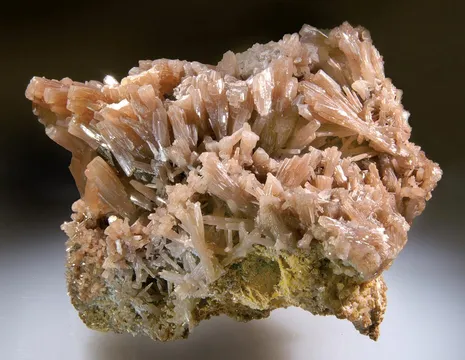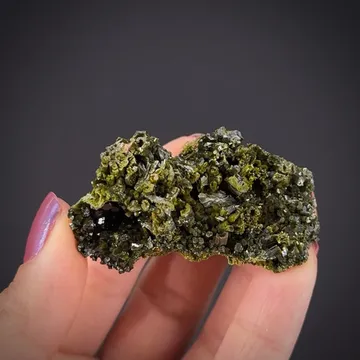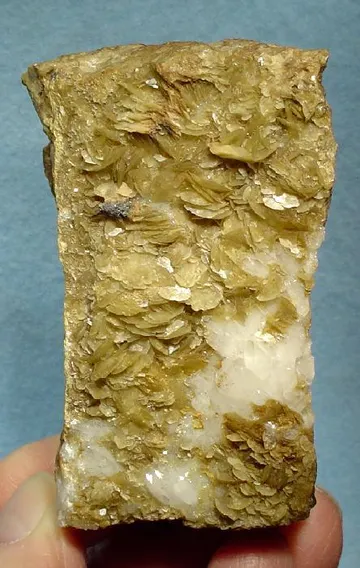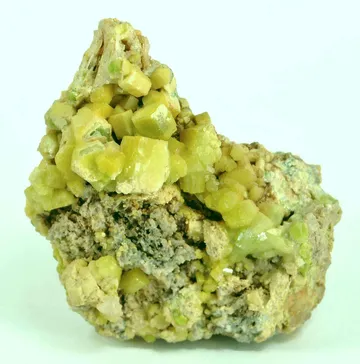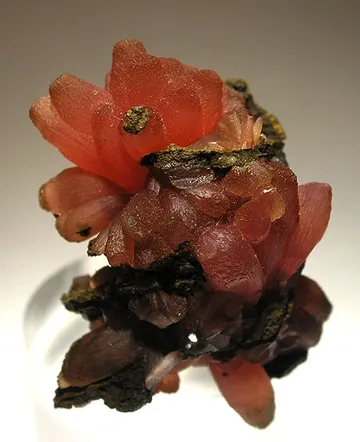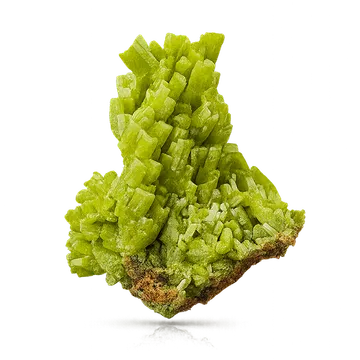
ドイツ・バート・エムス産のパイロモルフィット — ヨーロッパの鉛鉱物で、オリーブ色から茶色がかった光沢のある菱形結晶の螓形が特徴。旧鉱山地として有名で、コレクターの関心を集めます。
Key facts
Bad Emsのピロモルファイトは、ヨーロッパの古典的な鉛鉱物標本のひとつです。コンパクトでずっしりと重く、歴史を感じさせる硫黄系の色調のものが多く、地域特有の丸みを帯びた六角形の「樽状結晶」がオリーブ、タバコブラウン、ハニーブラウン、緑がかった茶色、あるいは珍しく豊かな緑色としてすぐに見分けられます。標本の産地名には、収集家の感覚で少し幅があります。「Bad Ems」と記された古いラベルは、Bad Ems本体の鉱山、特にMercur鉱山とPfingstwieseだけでなく、Lahnstein近郊のFriedrichssegenやBraubachのRosenbergを含む、広いEms–Lahn脈地区を指すこともあります。その広範な用法は、この素材を集める魅力の一部であり、同時に難しさの一部でもあります。

最高品質のBad Ems標本は単なる「緑色のピロモルファイト」ではありません。特有の建築的個性を備えています:丸みを帯びた終端をもつずんぐりとした艶のある柱状晶、短い結晶の積み重ね「 cascades( cascades)」、ノッブな集合体として配置された樽型結晶、そして一部 Rosenberg産の標本では放射状の六角柱から成る球状の群集体などです。古い茶色やオリーブ色の結晶は、現代の中国産やフランス産ピロモルファイトの電気的な色彩ほど派手ではなく落ち着いた輝きを放ちますが、成熟した色調と産地の歴史、そしてヨーロッパの旧鉱山らしい特徴を重視する本格的な収集家には高く評価されます。
地質がその見た目を説明します。Bad EmsはLahn沿いの古い水熱脈地区に属しており、サイジライト-石英脈がPb-Zn-Cu-Agの鉱物をデボニアンの母岩中に運んでいました。鉛源は銀水鉛鉱(ガレナ)で、鉛を含む脈の酸化によってピロモルファイトが生成され、セリウス石、アンゲサイト、リモナイト/ゲオザイト、石英、そして二次的な鉛、銅、亜鉛、ニッケル、コバルト、砒酸塩、リン酸塩、硫酸塩、炭酸塩鉱物の豊富な組み合わせが生じました。この地区の鉱物学的名声は特にピロモルファイトとセリウス石に支えられています。

収集家にとって、Bad Emsのピロモルファイトは微妙さのある産地です。傷のない光沢のある二重終端の樽状結晶を小さなミニチュアとして持つものは、より大きなプレートよりも望ましいとされることがあります。色が自然で均一、古い出所を裏付ける場合、緑色の標本が特に求められますが、茶色の“Emser Tönnchen”素材は依然として古典的な形態です。小さな樽のような結晶が、この地区をドイツのピロモルファイトの代名詞とする所以です。## 掲載特集標本
Search for specimens: View all pyromorphite specimens from Bad Ems, Germany
Bad Ems lies in Rhineland-Palatinate on the Lahn River, and the pyromorphite specimens sold under that name come from the historic Ems–Lahn vein system rather than from a single pocket or a single shaft. The practical collecting geography includes the Bad Ems mines such as Mercur, Pfingstwiese, Fahnenberg, Neuhoffnung and related workings, plus Friedrichssegen toward Lahnstein and Rosenberg at Braubach. Older labels may say only “Ems,” “Bad Ems,” “Nassau,” “Lahn,” “Braubach,” or “Friedrichssegen,” depending on the age of the label and the dealer or museum tradition that preserved it.
The ore bodies were hydrothermal siderite-quartz veins mineralized with lead, zinc, copper and silver. Galena and sphalerite were the principal economic sulfides, accompanied locally by chalcopyrite and other ore minerals. In the oxidized portions of the veins, pyromorphite formed from lead liberated from galena in the presence of phosphate and chloride-bearing fluids. The resulting specimens are commonly on quartz, limonite/goethite-rich matrix, altered vein material, or associated with cerussite and other secondary lead minerals.
The mining history is long. Ore extraction in the Bad Ems area is traditionally traced back to Roman activity, with medieval and later underground mining following older surface workings. Mining is documented in the region by 1158, and the industrial period greatly expanded production. In 1871 the mines operated under the Emser Blei- und Silberwerk AG, the Bad Ems Lead and Silver Works; in 1909 the enterprise passed to the company that became Stolberger Zink AG. Mercur and Pfingstwiese were abandoned in 1945, while Friedrichssegen had already closed in 1913. Rosenberg and associated Braubach workings remained part of the broader district’s later history, with 20th-century activity extending beyond the classic pyromorphite collecting period.
The finest pyromorphites are overwhelmingly historic. Dealers regularly describe high-quality Bad Ems material as 19th-century or early-collection material, and that is consistent with the look of many specimens: old labels, trimmed miniatures, compact clusters, and cabinet pieces that clearly circulated through European collections long before the modern mineral-show era. Some later finds and rediscoveries exist, particularly from dumps or reopened exposures, but the district is not a modern production locality. Good specimens now come mainly from old collections.アクセスは、明示的に許可を得ない限り、閉じられているとみなすべきです。鉱山は放棄された歴史的採掘場であり、公開の採集場ではなく、地下アクセスは危険で一般的に制限されています。コレクターにとって最も安全で現実的なルートは標本市場であり、古いラベル、以前の採集履歴、そしてその標本の結晶形状が名指しサブローカな地名に一致するかどうかに注意を払います。

著名なサブローカには、それぞれ独自の個性があります。Mercurは、オリーブ色から濃いオリーブグリーン、ずんぐりとした樽状の結晶、および密集した簇に強く関連付けられます。Pfingstwieseは、Mercurの運営の一部であったことがあり、小さめですがBad Emsの重要な名称で、そこではジメン化鉛が重要な種として記録されています。Friedrichssegenは、茶褐色から半透明の茶色の樽状結晶で有名で、多くは美しいミニチュア簇や平行成長を伴います。Rosenbergはブローブハッハ地区の広いEms地区での使用例で、淡いオレンジがかったタン色から茶色のジメン化鉛で知られており、時には微小な放射状のプリズムから成る球状の集合体として見られます。## バート・エムス(ドイツ)産パイロモルファイトの特性
Bad Ems産パイロモルファイトは Pb5(PO4)3Cl で、リン系乱礁の一員だが、コレクターにとって重要なのは地区の結晶言語である。最も診断的な結晶は、丸みを帯びた筒状の長柱状六方晶プリズムで、長さは短〜中程度、輪郭は樽のようである。ドイツのコレクターは古典的な形を「エムサー・トンネンヘン(Emser Tönnchen)」と呼ぶことが多く、直訳すると「小さなエムスの樽」。多くの結晶は平らなピナコイド終端、緩やかに凸の面、または段階的に積み重なる成長を示す。結晶が二重終端となってクラスターに見られることは珍しくなく、最良の群は互いに結晶が絡み合った樽のような建築的な配置を呈する。
色は淡い褐色や橙褐色からタバコ褐色、クローブ褐色、オリーブ褐色、濃いオリーブグリーン、黄緑色、稀に強い緑色へと変化する。クラシックな見た目は明るいリンゴ色よりも茶色系やオリーブ色が多い。強い緑のBad Ems素材は希少でより求められるが、色だけでは十分でない。最高品質の標本は着色度とツヤ、結晶形のシャープさ、そして一貫した構成を組み合わせている。
光沢は通常は樹脂様から油脂様で、傷のない新鮮な面では非常に明るくなる。結晶の縁が半透明になるものもあり、特にブラウンのフリードリヒスゼーゲン(Friedrichssegen)の例ではその半透明性が強い光の下で内部に温かな光を放つ。より暗いオリーブのメリュル型結晶はより巨大に見え、蝋状で重量感があり、黒色または茶色の酸化物で縁取られた凹部がパイロモルファイトを強調する。
結晶サイズは大きく変動する。ミニチュアおよび小型キャビネット標本が市場を支配する。数ミリメートルの個別結晶は普通で、1 cm程度の結晶は望ましく、1.2–1.5 cmの結晶は完全形のとき特に魅力的である。メリュル型の頑丈な結晶は大きいこともあるが、しばしば部分的に共成長していたり、接触していたり、欠けていたりする。 博物館級のキャビネット標本も存在するが、真剣な収集ではほとんどがサムネイル、ミニチュア、小型キャビネットで、結晶品質を間近に判断できる。
共生鉱物には、水晶、酸化鉄系(水酸化鉄・酸化鉄)、ガレナ、閃亜鉛鉱、鉄輝石、閃亜鉛鉱(セラックス)および角閃、黄鉄鉱、方解石、玉髄、孔雀石、藍銅礬鉛(アズライト)などが含まれ、広い地区には二次銅-亜鉛-鉛の砒酸塩・リン酸塩・硫酸塩・炭酸塩の広い鋳型群がある。収集可能なパイロモルファイト標本では、水晶と鉄酸化物が最も一般的な視覚的パートナーで、青石砒亜鉛鉱の共生は、清浄で損傷のない状態のとき特に魅力的である。
品質要因は産地特有である。Bad Emsについてコレクターが重視する点:- ** recognizable barrel habit:** しゃがみ型、丸みを帯びた十角形の「樽」が特徴です。
Bad Ems pyromorphite is not a locality where one expects large quantities of fresh, modern production. Good specimens are finite classics, and the market supply is dominated by old collections, dealer recirculation, auction pieces, and occasional specimens with historic labels. Fine miniatures are much more available than fine cabinet pieces, and the best green specimens are notably harder to find than the typical brown to olive-brown material.
The main authenticity issue is not usually synthetic pyromorphite; it is locality attribution. “Bad Ems” has been used broadly for the district, and older labels may fold Friedrichssegen, Mercur, Rosenberg, Braubach, or other nearby workings into the same classic name. That is not always wrong in the historic collector sense, but it should be understood. A specimen sold as “Bad Ems” without a sublocality may still be perfectly legitimate, yet a precise sublocality should be supported by habit, matrix, label history, and comparison with documented examples.
Documented Bad Ems-specific treatments or mass-produced fakes are not a major theme in the literature or market records I found. The usual mineral-market cautions still apply: inspect for glued repairs, artificially attached crystals, concealed breaks, and suspiciously vivid or uniform color. Pyromorphite is heavy and brittle; clean breaks and edge chips are common. Glue can sometimes be seen in recesses or at the base of reattached crystals, especially under magnification or ultraviolet light. Any repair should be disclosed.
Condition is the central buying issue. The exposed tops of barrel crystals chip readily, and old specimens have often passed through many hands. Look closely at terminations, edge crystals, and high points. Small peripheral losses are normal and may be acceptable on a historic specimen, but damage to the main display crystals strongly affects value. Iron oxide matrix can also shed grains, and older trimmed pieces may have sawn or broken backs that are not a problem unless the display face is compromised.
For current market availability, expect the following pattern: modest old-style thumbnails and miniatures appear with some regularity; attractive brown Friedrichssegen-style clusters are obtainable but increasingly competitive; dark olive Mercur-type pieces with stout crystals are scarcer; rich green Bad Ems specimens with strong aesthetics are rare; and large, undamaged cabinet specimens with excellent provenance are important classic pieces. A good old label can materially improve desirability, particularly if it narrows the sublocality or connects the specimen to a known European or American collection.## Stories & Field Notes
バッド・エムスの話は unusually layered because the locality name belongs both to a mineral district and to a famous spa town. While visitors came for the Lahn valley baths, miners were working the hills for lead, silver, zinc, and copper. That contrast—spa culture below, ore veins above and around—helps explain why so many labels from the district look like relics of another Europe: “Nassau,” “Ems,” “Braubach,” “Friedrichssegen,” written in old hands, sometimes long before modern locality conventions were standardized.
Friedrichssegen has one of the most evocative surviving visual records: an 1898 postcard bearing the miner’s greeting “Glück auf,” with smoking industrial buildings, a church, hillside works, and a miner standing in a tunnel with his lamp and tool. It is not a mineral specimen, but it is exactly the world from which the brown pyromorphite barrels emerged. A collector holding a small, warm-brown Friedrichssegen pyromorphite is holding a remnant of that same industrial landscape.
The old-label trail can be just as compelling. Some specimens attributed broadly to the Bad Ems region circulated through 19th-century dealers and museums, and modern sellers occasionally document them with Krantz-style labels, Smithsonian-linked labels, or old European collection tags. Those labels matter because the best pyromorphite was collected when the mines were active or shortly thereafter. On a classic Bad Ems piece, the paper can be almost as revealing as the crystals: it may preserve an obsolete locality name, an old political geography, or a dealer’s usage that predates modern databases by a century.
There is also a quieter detective story in the way collectors argue over sublocalities. Bad Ems pyromorphite can look deceptively similar from one mine to another, and expert collectors have long compared crystal habit, color, and matrix to decide whether a specimen is Mercur, Friedrichssegen, Rosenberg, or simply “Bad Ems District.” The old name is famous, but the best attributions often depend on small clues: olive versus brown color, globular aggregates versus stacked barrels, quartz matrix versus iron oxide matrix, and whether the crystal terminations look like the known “little barrels” of a particular mine.## 鉱物学的記録と出版物
Roland Dietrich and Rainer Bode, “Famous Mineral Localities: The Mines and Minerals of Bad Ems [Germany],” The Mineralogical Record, Vol. 15, No. 6, November–December 1984, pp. 323–344. This is the core English-language classic-locality article for the Bad Ems mines and their minerals. (mineralogicalrecord.com)
A. Seeliger, D. E. Buchert and T. Noll, “Der Emser Gangzug,” Der Aufschluss, Vol. 60, 2009, pp. 66–160. A major German treatment of the Ems vein system, cited in the locality records for Bad Ems. (mindat.org)
M. Au, “Bad Ems – Kaiserbad und Heimat weltbekannter Pyromorphite,” Mineralien-Welt, Vol. 29, No. 2, 2018, pp. 44–117. A substantial modern German article focused on Bad Ems as a spa town and home of world-famous pyromorphites. (mindat.org)
Stefan Weiß, Mineralfundstellen Atlas Deutschland West, Christian Weise Verlag, Munich, 1990, 320 pp. Frequently cited in Mindat records for Bad Ems, Mercur, Pfingstwiese and Friedrichssegen species occurrences. (mindat.org)
Charles Palache, Harry Berman and Clifford Frondel, The System of Mineralogy, 7th ed., Vol. 2, John Wiley & Sons, 1951. Cited by Mindat for pyromorphite from Friedrichssegen. (mindat.org)
Günther Schnorrer, “Mineralogische Neuheiten von bekannten deutschen Fundorten,” Lapis, Vol. 20, No. 12, 1995, pp. 43–48, 62. Cited for mineralogical updates in the Bad Ems area. (mindat.org)
Günter Möhn, J. Frohwein and G. Blaß, “Neue Mineralfunde von der Grube Friedrichssegen bei Bad Ems,” Lapis, Vol. 34, No. 5, 2009, pp. 35–40, 58. Cited in the Friedrichssegen record for later mineralogical findings from the mine. (mindat.org)
Mindat’s Pfingstwiese occurrence record classifies pyromorphite from the mine as “Excellent – world class for species or very significant,” reflecting the locality’s status within the district. (mindat.org)
Wikimedia Commons hosts multiple free-use specimen images of Bad Ems district pyromorphite, including Mercur Mine and Friedrichssegen Mine examples photographed by Rob Lavinsky of iRocks.com. ()## Videos & Media
“Bad Ems, Bad Ems District, Germany からのピロモルファイト” — Fabre Minerals, Vimeo. カスケード状の多面体結晶と曲がった終端を持つ、8.9 × 5 × 4 cm の茶色い Bad Ems ピロモルファイトの回転標本動画。 (vimeo.com)
“IRB2105 ピロモルファイト、Bad Ems District, Germany” — Crystal Classics, Vimeo. Crystal Classics が提供する Bad Ems District のピロモルファイトを記録したディーラー標本動画。 (vimeo.com)
Wikimedia Commons: Friedrichssegen Mine カテゴリ. ヒストリックな鉱山の眺め、ポストカード、Friedrichssegen の複数のピロモルファイト標本写真を含む有用なメディアアーカイブ。 (commons.wikimedia.org)
Wikimedia Commons: Mercur Mine ピロモルファイトの写真. Bad Ems の Mercur Mine からの暗いオリーブ色、樽形のピロモルファイトの無料使用画像。 (commons.wikimedia.org)## さらなる読み物と外部リンク- Mindat: Bad Ems-Nassau, Rhein-Lahn-Kreis, Rhineland-Palatinate, Germany — バート・エムス=ナッサウ鉱区全体の地域鉱物リストと概要。Pb-Zn-Cu-Ag脈系を含む。 (mindat.org)
Mindat: Bad Ems town locality — バート・エムスの鉱物標本場所の focused ページ。Mercur、Pfingstwiese および関連する Bad Ems 鉱山の参照。 (mindat.org)
Mindat: Mercur Mine, Bad Ems — オリーブ色および濃いオリーブ色のバート・エムス・ピロモルファイトの主要鉱山ページ。標本の座標、鉱物リスト、放棄日を含む。 (mindat.org)
Mindat: Pfingstwiese Mine, Bad Ems — 重要な廃坑記録。Mercur へのつながりと顕著なピロモルファイトの産出を指摘。 (mindat.org)
Mindat: Friedrichssegen Mine — バート・エムス地区の主要標本地記録。褐色の樽形ピロモルファイトと非常に大きな二次鉱物群を含む。 (mindat.org)
Mindat article: Best of Pyromorphite, Germany — コレクター指向の概要。ドイツで最も重要なピロモルファイト標本地としてバート・エムスを位置づけ、地区標本を紹介。 (mindat.org)
Mineralogical Record: Vol. 15, No. 6, 1984 — バート・エムスの鉱山と鉱物に関する classic Dietrich and Bode 記事のバックイシュー。 (mineralogicalrecord.com)
MB-Lampenstube: Mineralien vom Bad Emser Gangzug — ドイツのコレクター向けページ。エムス脈系とそのピロモルファイト、セラムサイトその他二次鉱物のコレクター価値を要約。 (mb-lampenstube.de)
Wikimedia Commons: Pyromorphite from Mercur Mine — オリーブ色の樽形 Mercur Mine ピロモルファイトのフリー用途画像と標本説明。 (commons.wikimedia.org)
Wikimedia Commons: Pyromorphite from Friedrichssegen Mine — 半透明な褐色の Friedrichssegen ピロモルファイト樽のフリー用途画像と標本説明。 (commons.wikimedia.org)
Wikimedia Commons: Friedrichssegen mine postcard, circa 18988.png) — 公共ドメインの歴史的ポストカード。古典的なフリードリヒツセーゲン標本の背後に鉱物の世界が描かれています。 (commons.wikimedia.org)
[鉱物オークション: セレスサイトを伴う rares green spheres in Bad Ems 線域のピロモルファイト](https://www.mineralauctions.com/items/pyromorphite-rare-green-spheres-with-cerussite-ex-kay-robertson-collection-70777)— 緑色のBad Ems地区ピロモルファイトの希少性と希少性を示す市場記録。 (mineralauctions.com)
[Crystal Classics: Rosenberg Mine pyromorphite](https://crystalclassics.com/products/pyromorphite-216)— Rosenbergの淡いオレンジみのあるタン色の球状ピロモルファイトの習性を見分ける際のディーラー記述。 (crystalclassics.com)
[Marin Mineral Company: Bad Ems pyromorphite with Smithsonian/Carl Bosch provenance](https://www.marinmineral.com/mixed705.html)— 大型の黄緑色結晶、クォーツ基質、旧コレクション履歴を含むBad Emsピロモルファイトを記録したディーラーアーカイブ。 (marinmineral.com)
[Main pyromorphite Collector's Guide](https://earthwonders.com/guides/pyromorphite)