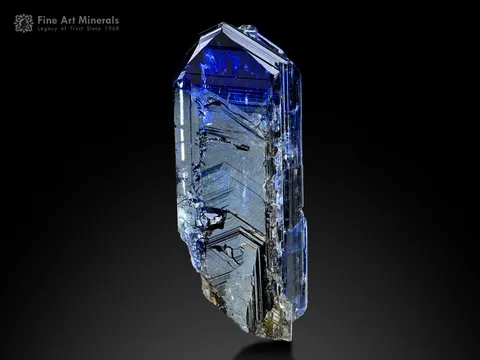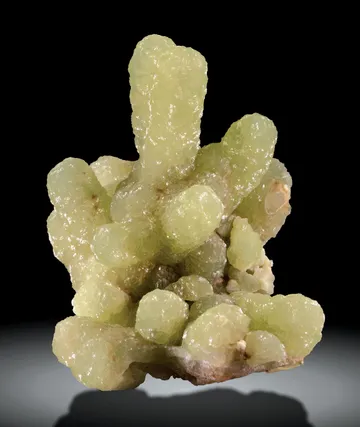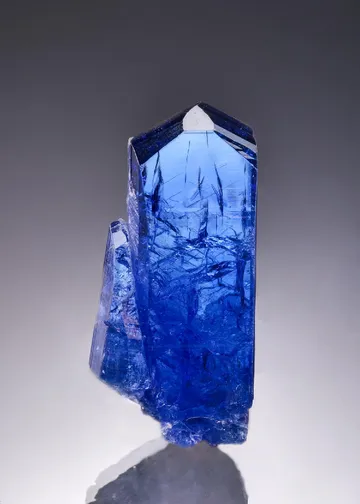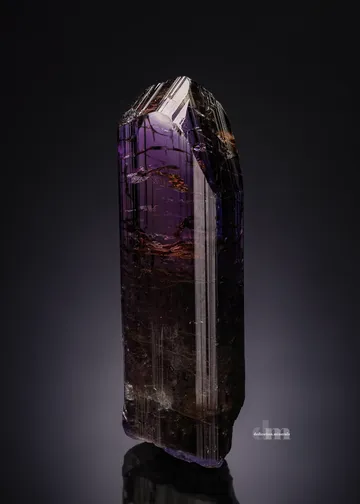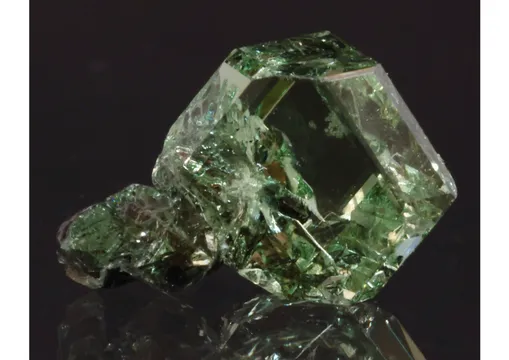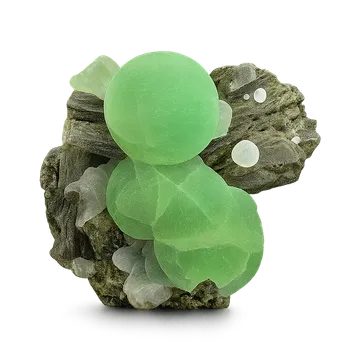
Merelani Hills prehnite, Tanzania: glossy translucent crystals on black graphite, lemon-to-mint colors, and a prized locality with context for collectors.
Key facts
Merelani Hills prehnite is one of the surprises of a locality that collectors first learned to revere for tanzanite. In hand specimen it is immediately recognizable: glassy yellow-green to lemon-yellow clusters, bright mint-green blades, and occasional blue to celestine-blue rosettes, commonly sharpened by the dark metallic contrast of graphite. The best examples have the translucency and internal glow of gem material, but with the crystallographic interest of discrete tabular, blocky, bladed, or rosette crystals rather than the more familiar botryoidal prehnite seen from many classic basalt localities.
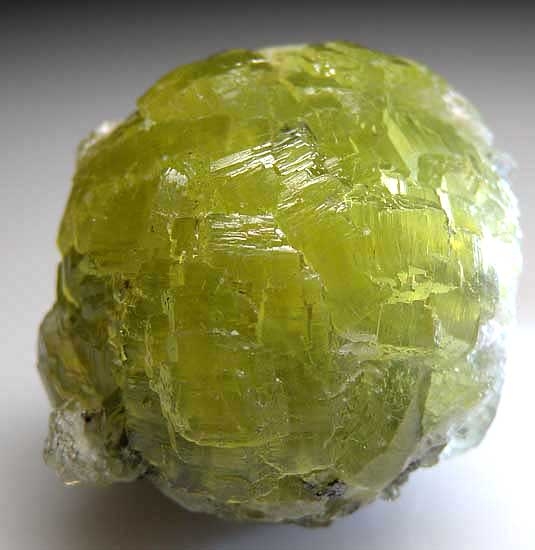
Photo: Marin Mineral Company
The locality sits in the Merelani gem mining area on the slopes of the Lelatema Mountains, within the high-grade metamorphic terranes of northeastern Tanzania’s Mozambique Belt. The same graphitic gneisses, calc-silicate rocks, boudinaged pegmatitic veins, hydrothermal fracture fillings, and altered shear-zone rocks that made Merelani famous for vanadian zoisite also produced a collector’s suite of graphite, diopside, fluorapatite, tsavorite, tremolite, calcite, quartz, pyrite, fluorite, chabazite, laumontite, and other species. Prehnite belongs to that late-stage pocket-and-fracture mineralogy: the specimens collectors prize are not anonymous green masses, but open-space crystals grown with the “Merelani look” of glossy silicates on black carbon-rich matrix.
For serious collectors, the charm is twofold. First, Merelani prehnite can be genuinely beautiful: high-luster, translucent, sharply crystallized, and colorful. Second, it belongs to a locality where many specimens carry mineralogical context. Graphite inclusions, attached tanzanite or zoisite shards, tiny blue fluorapatite, diopside, calcite, or zeolite-group associates can turn an already attractive prehnite into a locality specimen that speaks directly to the geochemistry of the deposit. Fine pieces are judged by the same standards as the best Merelani minerals generally: crystal definition, undamaged edges, color saturation, transparency, balance on matrix, and credible association.
Search for specimens: View all prehnite specimens from Merelani Hills, Tanzania
The Merelani gem mining area, also spelled Mererani or Mirerani, is a long narrow mining belt in the Merelani Hills on the slopes of the Lelatema Mountains, southeast of Arusha. It is subdivided into the famous Blocks A, B, C, and D, with additional named mines and pits. The district is best known as the world’s commercial source of tanzanite, but the collector mineralogy is much broader, and prehnite is now firmly part of that mineralogical identity.
Geologically, the prehnite-bearing material belongs to a graphitic, high-grade metamorphic environment that has been folded, sheared, fractured, altered, and mineralized. Regional studies describe garnet-kyanite/sillimanite-biotite gneiss, kyanite/sillimanite-graphite gneiss, biotite-graphite gneiss, calc-silicate rocks, quartz-feldspar gneiss, dolomitic marble, and pegmatites in the Merelani-Lelatema area. The gem mineralization is concentrated in graphitic gneiss and related hydrothermally altered zones, especially where pegmatitic veins have been boudinaged and fractured. The prehnite specimens collected for the mineral market represent this open-space, late-stage mineral growth within a deposit better known to the gem trade for zoisite.
Mining history at Merelani begins with the tanzanite rush following the 1960s discovery of blue gem zoisite. Early surface collecting quickly gave way to pits and underground workings. In 1990 the Tanzanian government demarcated the mining area into Blocks A, B, C, and D. Block C became the mechanized large-scale concession associated with Graphtan, Afgem, and later TanzaniteOne, while Blocks B and D remained dominated by small-scale and artisanal miners. Much of the prehnite that reached collectors appears to have come through the same specimen channels that handled Merelani graphite, diopside, fluorapatite, tanzanite-on-matrix, and sulfide specimens, particularly from artisanal workings where individual pockets could be recognized and preserved.
Collecting access should be understood as mining access, not recreational collecting. Merelani is an active gem mining district with controlled concessions, security, deep workings, and serious underground hazards. Specimens reaching collectors are recovered by miners and dealers, not by casual visitors. The graphitic ground, narrow underground workings, blasting, dust, poor ventilation in artisanal mines, and long underground development make the field context very different from a quarry collecting trip. Provenance, mine block, and pit names are therefore valuable when available, but many specimens in commerce are labeled simply “Merelani Hills” or “Merelani, Tanzania.”
Production has been episodic. Yellow to yellow-green prehnite clusters have circulated for years, including memorable small thumbnails and miniatures on graphite. Blue prehnite is much less common and has been documented from a January 2013 find, with tabular to rosette crystals on graphite. A later 2019 find placed additional sharp, translucent yellow-green to green prehnites on the market, including small cabinet pieces with graphite and occasional minor tanzanite. These find-based pulses explain why Merelani prehnite can appear suddenly in dealer stocks and auctions, then thin out again.
Notable finds from the wider Merelani system include world-class graphite with diopside and fluorapatite from the Karo Mine in Block D, spectacular sulfides, the type locality mineral merelaniite, and later type-locality work on richardsite. Prehnite is important in that broader picture because it is both a collector species in its own right and a matrix or associated mineral in the Merelani pocket assemblage. It is one of the minerals that turned the locality from a “tanzanite mine” in the narrow gem-trade sense into a full-scale mineral locality of international standing.
Merelani prehnite is valued above all for crystallized form. Many specimens show rounded spherical or hemispherical clusters made of intergrown tabular crystals; others are bladed, lamellar, blocky, “clamshell” aggregates, spearpoint-like crystals, or rosettes. The best pieces show individual crystals separating from the mass rather than a merely botryoidal surface. Fine rosette and bladed examples are especially desirable because they depart from the more common globular prehnite habit.
The dominant colors are yellow-green, lemon yellow, apple green, and mint green. Some yellow pieces are strongly translucent, with light entering deep into the cluster and giving a glowing internal body color. Blue prehnite from Merelani is a special subcategory: celestine-blue to bluish crystals, sometimes with color-change behavior described by dealers and collectors as shifting under indoor versus outdoor illumination. Blue examples are not the norm for the locality and should be treated as a distinct, scarcer find style rather than as the expected Merelani appearance.
Typical collector specimens range from thumbnails around 1.5 to 3 cm through miniatures and small cabinet pieces around 5 to 7 cm. Larger, undamaged, complete clusters are much less common. Individual crystals on some bladed or blue specimens can reach the centimeter scale, and documented blue material includes blades up to about 2 cm. Most attractive pieces are small enough for a thumbnail or miniature cabinet, which makes unusually large, clean, well-balanced specimens particularly competitive.
Graphite is the signature associate. It may appear as a dark matrix, black inclusions within the prehnite, tiny metallic blebs on the reverse, or a thin peppering that gives the piece contrast. Tanzanite or zoisite can occur as attached shards or associated crystals, though fine natural combinations must be examined carefully because Merelani matrix specimens have a known history of assembly fakes. Calcite is common in the wider assemblage and may be present with prehnite; other documented or commonly noted associates include diopside, fluorapatite, quartz, pyrite, marcasite, fluorite, chabazite-Ca, stilbite-Ca, laumontite, rhodochrosite, and, in the broader Merelani mineral suite, graphite-rich sulfide assemblages and merelaniite.
The strongest quality factors are sharpness, luster, translucency, color, and completeness. Merelani prehnite should not look dull, waxy, or massive if it is being sold as fine locality material. Bright vitreous faces, crisp crystal edges, depth of color, and clean separation between crystals are more important than sheer size. Graphite can enhance value when it provides contrast and locality character, but heavy graphite inclusions can darken the piece and reduce the glow. Minor attached tanzanite, blue apatite, or diopside can add interest if the association is demonstrably natural.
Condition is a major discriminator. Many Merelani prehnites are small and easily bruised at the crystal edges. Spherical clusters are often more robust than delicate bladed rosettes, but they still may show contact marks, cleaves, or abrasions where crystals projected outward. Because the best material is translucent, internal fractures and bruised terminations are visible under strong light. A top piece should be examined with both reflected light for luster and transmitted light for internal cracks, repaired breaks, and any glue lines at the matrix contact.
The most important authenticity concern is not synthetic prehnite; it is assembled Merelani matrix. The district has documented fakes in which tanzanite, diopside, pyrite, smoky quartz, and other Merelani-looking components were glued to calcite, graphite, brown zoisite, or laumontite matrices. One gemological report described a constructed specimen using grayish purple tanzanite, light green diopside, and smoky quartz fragments mounted on calcite and graphite, with a white chalky glue mixture visible under magnification and fluorescing bright white under long-wave ultraviolet light. Later mineralogical writing on Merelani sulfides also noted cyanoacrylate-glued tanzanite, pyrite, and diopside on mixed matrix. Prehnite itself is not singled out in those reports as the glued species, but any Merelani “association” specimen with valuable crystals on matrix deserves the same scrutiny.
For Merelani prehnite, inspect the contact between prehnite and graphite or calcite under 10x to 20x magnification. Natural contacts should show growth relationships: prehnite entering cavities, graphite included in the crystal, calcite or zeolite material intergrown rather than smeared, and no meniscus of adhesive around the base. White paste, glossy glue, bubbles, unnatural gaps, fluorescence concentrated along attachment seams, or crystals perched in improbable orientations are red flags. A small loose prehnite cluster is often safer than an overdramatic “tanzanite on prehnite on graphite” combination with no credible provenance.
Treatments are not a major documented issue for Merelani prehnite specimens. Unlike tanzanite, whose color is commonly affected by heat in gem use, prehnite in mineral specimens is generally collected and sold for its natural crystal form and color. The practical risks are enhancement by assembly, repair, oiling or coating to disguise bruising, and mislabeling of locality or association. Blue Merelani prehnite is scarce enough that exaggerated color claims should be checked against daylight, LED, and incandescent or halogen light; good blue material exists, but photography can make it look more saturated than it appears in hand.
The commonest condition problems are edge wear, cleaved or contacted crystals, bruised luster on high points, broken blades, and dark graphite inclusions that reduce transparency. The very features that make the locality desirable—sharp protruding crystals, glassy faces, and bright translucency—also make damage easier to see. For spherical clusters, look for completeness all around; for bladed material, look for intact terminations and undamaged leading edges; for rosettes, look for symmetry and lack of broken petals.
In rarity terms, Merelani prehnite is available but not abundant in the way common basalt-cavity prehnite is available. Small yellow-green clusters and graphite-associated thumbnails appear regularly enough that collectors can be selective. Fine lemon-yellow translucent floaters, large complete clusters, sculptural bladed groups, blue rosettes, and convincing natural associations with tanzanite, fluorapatite, or diopside are much harder. Current market availability is find-driven: older 2013 blue pieces and 2019 yellow-green material still circulate through collections, dealer back stock, and auctions, but the best examples are usually gone quickly when a fresh lot appears.
The human story of Merelani begins with a mineral other than prehnite, but it explains why prehnite specimens from this locality carry such a charge. Ndugu Jumanne Ngoma’s account of finding blue crystals in January 1967 has become part of the mine’s origin legend. Walking through the bush in the Kiteto area of Merelani on his way to visit relatives, he saw blue crystals lying on the ground. In a few hours he gathered about 5 kg. Those surface pieces were the beginning of the tanzanite rush, and the same rush built the underground world in which later collector minerals—prehnite among them—would be noticed, saved, and sold rather than crushed or ignored.
By the time Vincent Pardieu, Richard W. Hughes, and their companions visited the district in October 2007, the easy surface days were long over. At Block D they entered a mining world where claims were packed inside barbed-wire-topped tin compounds and the boundary between neighboring workings could continue underground. At the Kikuyu Mine, the manager was Nixon Monga, only 24 years old, running the operation with two partners after his father’s death nine years earlier. Sixty miners worked below in teams of thirty, six hours at a time. Monga told the visitors that the previous two years had produced hardly any stones and that the work had become harder as the tunnels went deeper.
The shaft they were shown began with a vertical drop of about 100 m on a wooden ladder. From there, miners had to travel another 200 to 300 m through tight tunnels to reach the working face. Some members of the party went down; others stayed above, joking that someone would need to call a doctor if things went wrong. The men who disappeared into the hole later described a descent without rope or hard hat, where a fall by one person above could mean death for everyone on the ladder below.
The horizontal passages below were not really passages in the comfortable sense. They twisted up and down and were in places no more than a meter high. The taller visitors could not even crawl on hands and knees; they had to move on their bellies. In those graphite-charged tunnels, miners coming the other way meant body-to-body contact in dust and sweat. The air was so full of carbon that the visitors eventually removed their masks because, as the original account put it, breathing carbon was easier than not breathing at all. A small opening that sent cold air down from the surface felt miraculous after an hour of hot graphite dust.
At the working face, the miners pointed out the veins they were following—pyrite and graphite were their guides. That detail matters for collectors. Merelani’s black graphite is not just aesthetic contrast on a specimen label; it is part of the lived geology of the mine, coating skin, filling lungs, marking pockets, and framing the crystals. The same carbon-rich environment that makes prehnite on graphite so visually distinctive also gives the district its harsh underground character.
When the party finally climbed back out, exhaustion had narrowed their world to the ladder and the circle of light above. The account describes men emerging from the shaft as “black ghosts,” collapsing at the surface, too spent even to hold water to their lips. In the sun, graphite dust made their skin sparkle. A photograph caption from the same visit notes a miner holding only a small fragment of pale green diopside after six hours underground. That small diopside, and by extension every preserved Merelani prehnite, graphite, fluorapatite, or tanzanite specimen, came from a system where hope, luck, geology, and physical risk were inseparable.
A more mineralogical “field note” came from the Karo Mine in Block D, where a remarkable December 2007 pocket yielded exceptional graphite crystals with diopside, fluorapatite, and other minerals. That find became famous enough to inspire the Rocks & Minerals article “Miracle at Merelani.” Its importance for prehnite collectors is contextual: it showed that Merelani was not merely a gem rough locality but a world-class source of crystallized mineral specimens. Once miners and dealers recognized the value of intact pocket minerals beyond tanzanite, species such as prehnite had a better chance of being recovered carefully rather than broken, discarded, or overlooked.
Wilson, Wendell E.; Saul, John M.; Pardieu, Vincent; Hughes, Richard W. “Famous mineral localities: The Merelani Tanzanite Mines, Lelatema Mountains, Arusha Region, Tanzania.” The Mineralogical Record, 40(5), 346–408, 2009. The essential collector-locality monograph for Merelani’s history, geology, mining blocks, and mineral suite.
Jaszczak, John A.; Trinchillo, Daniel. “Miracle at Merelani: A Remarkable Occurrence of Graphite, Diopside, and Associated Minerals from the Karo Mine, Block D, Merelani Hills, Arusha Region, Tanzania.” Rocks & Minerals, 88(2), 154–165, 2013. A detailed account of the Karo Mine pocket that helped establish Merelani as a world-class crystallized-mineral locality beyond tanzanite.
Malisa, E. P. “Petrography and mineral chemistry of the pelitic and semi-pelitic gneisses of the Merelani tanzanite mining area, northeastern Tanzania.” Tanzania Journal of Science, 31(2), Article 33, 2005. Useful for understanding the high-grade gneissic host rocks and metamorphic conditions of the Merelani mining area.
Feneyrol, J.; et al. “Lithostratigraphic and structural controls of ‘tsavorite’ deposits at Lemshuku, Merelani area, Tanzania.” Comptes Rendus Geoscience, 342, 778–785, 2010. A regional structural and lithostratigraphic treatment of the Lelatema-Merelani gem system.
Mayala, L. P.; Veiga, M. M.; Khorzoughi, M. B. “Assessment of mine ventilation systems and air pollution impacts on artisanal tanzanite miners at Merelani, Tanzania.” Journal of Cleaner Production, 116, 118–124, 2016. Important occupational-health context for the artisanal underground workings that supply much of the specimen market.
Boehm, Edward. “Gems & Gemology Gem News International,” Summer 2004, p. 179. Documents assembled fake Merelani matrix specimens made with tanzanite, diopside, smoky quartz, calcite, graphite, glue, and chalky paste.
Harrison, Simon; Jaszczak, John A.; Wise, Michael A.; Keim, Mike; Rumsey, Mike. “Spectacular Sulfides from the Merelani Tanzanite Deposit, Manyara Region, Tanzania.” The Mineralogical Record, 45(5), 553–570, 2014. Valuable for the broader Merelani sulfide assemblage and for market notes on glued Merelani matrix fakes.
Jaszczak, John; Rumsey, Michael; Bindi, Luca; Hackney, Stephen; Wise, Michael; Stanley, Chris; Spratt, John. “Merelaniite, Mo4Pb4VSbS15, a New Molybdenum-Essential Member of the Cylindrite Group, from the Merelani Tanzanite Deposit, Lelatema Mountains, Manyara Region, Tanzania.” Minerals, 6(4), 115, 2016. Type-mineral paper demonstrating the sophistication and rarity of the Merelani pocket assemblage.
Bindi, Luca; Jaszczak, John A. “Richardsite, Zn2CuGaS4, A New Gallium-Essential Member of the Stannite Group from the Gem Mines near Merelani, Tanzania.” Minerals, 10(5), 467, 2020. Another type-locality contribution from Merelani’s complex sulfide mineralogy.
Tanzanite Mines of Merelani — Working the Blueseam — Vincent Pardieu & Richard W. Hughes, Lotus Gemology — A richly illustrated field article with underground Merelani photographs and first-hand mining narrative.
Tanzanite Mines of Merelani • Working the Blueseam — Vincent Pardieu & Richard W. Hughes, Ruby-Sapphire.com — Alternate presentation of the same major field report, including mining photographs, locality history, and acknowledgments.
Going Down a Tanzanite Mine — Gemstones.com — Video visit into the Merelani tanzanite mining environment, useful for visualizing the underground context of Merelani collector minerals.
Mindat: Prehnite from Merelani Hills, Lelatema Mountains, Simanjiro District, Manyara Region, Tanzania — Best quick reference for the locality occurrence, formula, quality rating, associated minerals, and photo data.
Mindat: Prehnite from D-Block Mine, Merelani Hills, Tanzania — Useful for D-Block-specific prehnite habits, confirmation methods, and associated mineral data.
Mindat: Merelani Hills locality page — Broad locality page covering names, mining blocks, mineral list, references, and regional context.
Marin Mineral Company: Prehnite from Merelani — Archived dealer page showing the yellow-green graphite-associated specimen style that made Merelani prehnite popular with collectors.
Mineral Auctions: Blue Prehnite with Graphite, 2013 find — Useful market record for uncommon blue Merelani prehnite, including find date, crystal size, and specimen dimensions.
Mineral Auctions: Prehnite with Graphite, 2019 find — Good market record for sharp yellow-green crystallized prehnite from a later find.
Mineral Auctions: Prehnite with Graphite — Illustrates the mint-green bladed, spearpoint-style Merelani prehnite habit.
GIA: Summer 2004 Gems & Gemology PDF — Includes a key report on assembled fake Merelani matrix specimens and practical detection clues.
Sustainable Gemstones Knowledge Hub: Merelani mine ventilation and air pollution study — Accessible entry for the occupational-health study on artisanal tanzanite mining at Merelani.