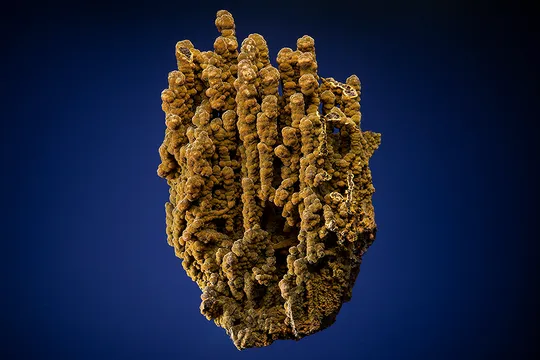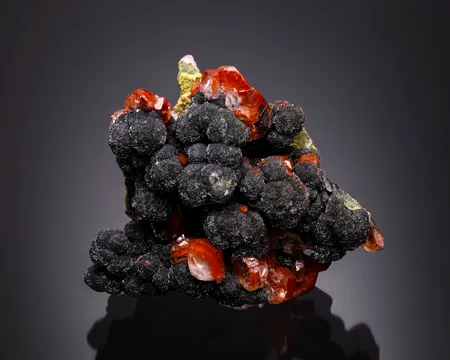
Mottramite - vivid green to olive botryoidal coatings and striking luster; a popular vanadate prized for color, texture, and key localities.
Key facts
Mottramite, PbCu(VO4)(OH), is a lead–copper vanadate and the copper-rich member of the descloizite–mottramite solid-solution series. It forms in the oxidized zones of Pb–Zn–Cu deposits and is beloved by collectors for its rich green to olive colors, velvety botryoidal coatings, sparkling microcrystalline druses, and, more rarely, sharp crystals. Classic specimens show vivid green mats or hemispherical “bubbly” crusts carpeting gossan matrix, sometimes paired with golden wulfenite blades, reticulated cerussite, or snowy calcite—contrasts that can be stunning. While single, well-formed crystals do occur (notably at Tsumeb), mottramite is most often seen as satiny sheaves, spheroids, and stalactitic or reniform growths with a silky to resinous luster. It is relatively soft (Mohs ~3–3.5) but unusually heavy due to lead (SG commonly ~5.8–6.2), and best specimens balance intense color, fine luster, and striking associations.
Mottramite sits at a sweet spot in the collecting world: abundant enough to be attainable, yet capable of world-class aesthetics. Decades of production from legendary localities—Tsumeb (Namibia), Ojuela Mine (Mexico), and the Moroccan lead district at Touissit—have produced signature styles that collectors instantly recognize. Demand is strongest for pieces with exceptional color and texture (velvety, chatoyant botryoids), sparkling microcrystals, and dramatic combinations—especially mottramite on wulfenite or with reticulated cerussite. While cabinet showpieces from classic pockets can be expensive, attractive small specimens remain accessible, making mottramite an ideal species for both newer collectors and advanced connoisseurs building locality suites or vanadate group displays.
The Tsumeb Mine is the benchmark for sharp mottramite crystals and gorgeous associations. Specimens range from lustrous, dark to bright green sheaves and sprays to rare euhedral crystals perched on dolomite, calcite, or cerussite. Many show superb contrast—emerald to olive-green mottramite against white carbonate matrix, sometimes with dioptase, wulfenite, or mimetite adding color. Tsumeb mottramite is also known for delicate, sparkling druses that light up under display lighting. Fine, undamaged crystal clusters from older levels are scarce and highly sought after.
Ojuela is famous for velvety botryoidal and stalactitic mottramite, typically deep green to nearly black-green, carpeting iron-rich gossan. Classic combinations pair mossy mottramite with butterscotch to orange wulfenite, or with calcite and limonite for strong texture and color contrast. Though true euhedral crystals are rare here, the best Ojuela coatings are intensely chatoyant and sculptural, forming aesthetic “landscapes” across matrix. Because Ojuela has produced a steady stream of material over the years, it offers excellent value—especially for richly colored, unabraded coatings on solid matrix.
Color and Saturation:
Luster and Surface Texture:
Crystal Form and Habit:
Associations and Matrix:
Condition and Stability:
Size and Aesthetics:
Stabilization:
Recoloring or Coatings:
Composite Assemblies:
Handling:
Cleaning:
Light, Heat, and Environment:
Storage:
Health Note: