






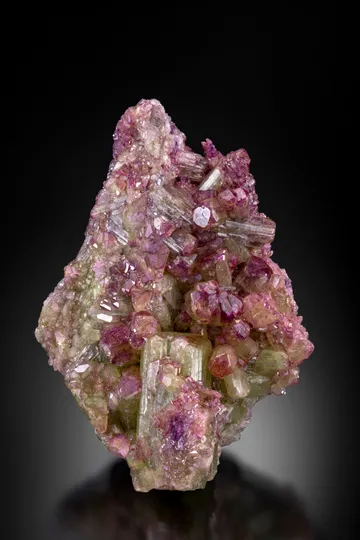
Jeffrey Mine, Canada — storied locality for Ca-silicates from rodingite seams, yielding gemmy orange grossular and vesuvianite; prized by serious collectors.
Key facts
Jeffrey Mine is one of the great paradoxes in Canadian mineral collecting: a vast industrial chrysotile-asbestos operation whose most coveted legacy is not fiber ore, but glittering cabinet and miniature specimens of Ca-silicates from rodingite seams and cavities. The mine lies at Val-des-Sources in Québec’s Estrie region, the town long known to collectors by its former name, Asbestos. In specimen language, “Jeffrey” means gemmy orange grossular and hessonite on dark or pale matrix, green diopside needles, translucent green-to-violet vesuvianite, sculptural prehnite, and the occasional pectolite or apophyllite association that instantly marks the piece as Canadian, old-stock, and classic.
Geologically, the mine exploited chrysotile in a serpentinized ultramafic body—principally dunite and peridotite, with pyroxenite and gabbroic-to-felsic intrusives nearby. The collector minerals formed where calcium-rich metasomatism transformed dikes and their contacts into rodingite assemblages. That setting is why the best Jeffrey specimens have such a crisp, high-contrast look: orange or pink garnet perched on green diopside; violet-capped vesuvianite rising from paler green crystals; cream to greenish prehnite in unusually blocky forms; white albitite, red syenitic rock, and dark serpentine serving as visual backdrops.
Regional View
Country View
For much of the late twentieth century, Jeffrey Mine specimens were familiar sights at North American shows. That availability was deceptive. The finest pockets were episodic, tied to mining benches crossing narrow mineralized zones, and production waned sharply as asbestos mining declined. Today the open pit is inactive and largely water-filled, and the best historic collecting areas are no longer practically accessible. As a result, Jeffrey material has shifted from “classic but obtainable” to a closed-locality specialty: common in modest examples, intensely competitive at the upper end.

Photo: Wikimedia Commons

Photo: Wikimedia Commons

Photo: Wikimedia Commons
Search for specimens: View all specimens from Jeffrey Mine, Canada
Jeffrey Mine is an inactive open-cast chrysotile mine at Val-des-Sources, Les Sources RCM, Estrie, Québec. Its modern coordinates are about 45°46′10″ N, 71°57′00″ W. Older labels may read Asbestos, Shipton Township, Richmond County, Jeffrey Quarry, or Johns-Manville Mine; all can be legitimate historical label variants for the same collecting district when paired with the Jeffrey locality.
The mine worked a large chrysotile stockwork in serpentinized ultramafic rock. The orebody was described in the specimen literature as broadly cylindrical, roughly 600 by 900 meters in plan and dipping steeply southwest, while the ultimate open pit reached roughly 2 kilometers across and about 350 meters deep. The main rock sequence includes pyroxenite, serpentinized dunite, and serpentinized peridotite against a steep slate wall. Chrysotile fiber occurred chiefly in the serpentinized peridotite as cross-fiber and slip-fiber veinlets, commonly with serpentine, brucite, talc, picrolite, and magnetite. For collectors, however, the important rocks were not the asbestos ore itself but the rodingites, albitites, red syenitic rocks, and other altered felsic-to-mafic dike bodies enclosed in the ultramafic mass.
The famous Ca-silicate specimens formed in fractures, seams, and cavities where calcium metasomatism produced grossular, vesuvianite, diopside, prehnite, pectolite, wollastonite, and related minerals. Grossular is especially associated with fractures in red syenite and with albitite and rodingite bodies included in dunite and peridotite. Vesuvianite is especially famous from a rodingite dike in serpentinized dunite near the southeast side of the orebody, including the former 2440 level, a zone whose re-exposure in the early 2000s produced some of the locality’s last great vesuvianites.
Mining history begins with the recognition of asbestos on Webb’s Hill in 1879. Exploitation began soon afterward under William Henry Jeffrey and Canadian Johns-Manville, and the community of Asbestos grew around the mine. The town was incorporated as a village in 1899, became a city in 1937, and changed its name to Val-des-Sources at the beginning of 2021. Industrially, the site became one of the world’s great asbestos mines; socially, it is inseparable from the 1949 Asbestos Strike, when approximately 5,000 asbestos miners at Asbestos and Thetford Mines walked out for five months in one of Québec’s defining labor conflicts.
Specimen recovery followed the rhythm of mining rather than a planned collector schedule. When a bench cut the right rodingite vein or albitite-rich fracture system, fine minerals came out; when the bench moved on, years might pass before comparable ground was exposed again. Workers began collecting seriously in the 1960s as demand for the gemmy orange grossular rose. During the 1970s and 1980s, Jeffrey specimens were abundant enough to build the locality’s international reputation, yet the very best examples were always pocket pieces—small survivals from blast-fractured rock, often retrieved by miners, local collectors, and members of the Asbestos mineral club.
The late 1990s and early 2000s produced several well-documented last chapters. In 1996–1997, workings crossed a classic garnet-bearing rodingite vein and yielded deep orange to nearly red grossular on green diopside, including gemmy rhombic-dodecahedral crystals to about 2.5 cm. On July 5, 1998, a collecting day organized by the Club de Minéralogie d’Asbestos yielded extraordinary deep pink grossular crystals, some on green diopside and white albitite, a matrix combination unusual for Jeffrey garnet. In 1999, collectors found pale pink to colorless grossular with striking green cores, and another discovery produced orange garnets perched on green diopside in a large cavity opened from a dump boulder. In 2000, cream-colored pseudocubic prehnite appeared in notable quality, and in 2002–2003 the re-exposed vesuvianite zone yielded deep green, violet, yellow-green, multicolored, and “purple-cap” vesuvianite crystals from pockets only centimeters to meters apart.
Public collecting in the open pit has historically been prohibited. For a period, mine management maintained a separate “mineral site” near the installations where rocks of potential collector interest were brought for visitors, but that was not the same as free access to the pit. Club excursions were later the primary sanctioned route into the mine, and even those became restricted as instability and flooding increased. Current access should be treated as controlled, changing, and permission-based; no collector should assume that the old pit, dumps, benches, or roads are open simply because the mine is inactive.
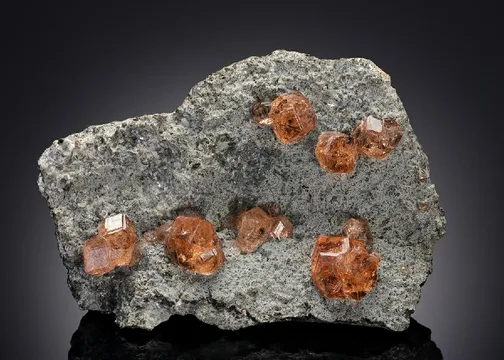
Grossular is the signature Jeffrey Mine mineral: lustrous, gemmy to translucent dodecahedral and trapezohedral crystals in orange, cinnamon, honey, pink, colorless, white, and rare green-zoned habits, typically from fractures in rodingite, albitite, and red syenitic rocks included in the serpentinized ultramafic body. The finest orange hessonitic grossulars were classically collected on dark matrix or on sprays of green diopside, with important late finds in 1996–1997 producing deep orange to nearly red crystals to about 2.5 cm; the celebrated July 1998 pocket produced deep pink crystals to about 1.5 cm, many protected by soft white wollastonite-group fibers and associated with diopside and prehnite; and 1999 finds produced small but superb pale crystals with vivid green cores. Good pieces show sharp, glassy, transparent crystals standing free on contrasting matrix, with minimal blasting damage and visible three-dimensional arrangement; ordinary pieces tend to be drusy, bruised, darkened by matrix, or dominated by small crowded crystals without a focal point.
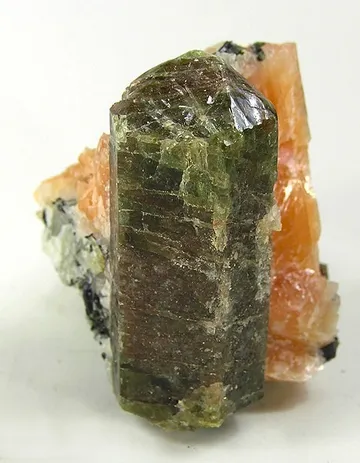
Jeffrey vesuvianite is one of Canada’s most distinctive mineral styles, occurring as prismatic tetragonal crystals from a rodingite dike in serpentinized dunite, especially the former 2440-level area and its later re-exposures. The color range is exceptional: pale green, yellow-green, emerald to dioptase-green chromian material, mauve, pink, violet, amethyst-purple, and multicolored crystals with green prisms and purple caps. Classic examples include doubly terminated crystals, loose translucent singles, clusters with flat glossy purple terminations, and “purple-cap” specimens whose color zoning is instantly recognizable. The 2002 discoveries were especially important, yielding green crystals to about 4.4 cm, yellow-green pocket material including clusters and near-floater cabinet pieces, and multicolored clusters to more than 12 cm across. Top specimens combine saturated color, sharp terminations, partial gemminess, and undamaged prism faces; lesser examples are massive, contacted, dull, or lack the dramatic zoning that made Jeffrey vesuvianite famous.
Prehnite from Jeffrey Mine is prized because it does not merely occur as the familiar botryoidal coating; the locality produced unusual cream, white, and greenish-white blocky to pseudocubic and pseudo-rhombohedral crystals, in places more than 1 cm across and in rare specimens reported to several centimeters. It occurs in the Ca-silicate rodingite assemblage with diopside, grossular, vesuvianite, wollastonite, and pectolite, and late finds around 2000 produced especially attractive cream-colored pseudocubic prehnite associated with acicular white diopside. The best Jeffrey prehnites have distinct individual crystal form, translucency, clean cream-to-green color, and a sculptural clustered habit rather than simply filling space between more glamorous garnets; ordinary pieces are massive, dull, incomplete, or preserved only as pale globules accompanying grossular.
“Garnet” on Jeffrey labels almost always means grossular-group material, especially orange hessonitic grossular, pink grossular, colorless-to-white grossular, or chromium-bearing green grossular; less common garnet-group identifications from the mine include andradite and other chromium-influenced material that should be treated cautiously unless analyzed. The collectible Jeffrey look is a garnet perched on or set among green diopside needles, on white albitite, red syenitic matrix, or dark serpentinized rock, with sharp glassy crystal faces and a lively internal glow. Fine garnet-labeled pieces should be evaluated as mineral specimens, not just as “garnet from a famous mine”: crystal size, exact variety, matrix, association, zoning, and lack of abrasion matter greatly. The vague word “garnet” is acceptable on an old field label, but serious cataloging should refine the identification to grossular, hessonite, chromian grossular, or another species/variety when evidence permits.
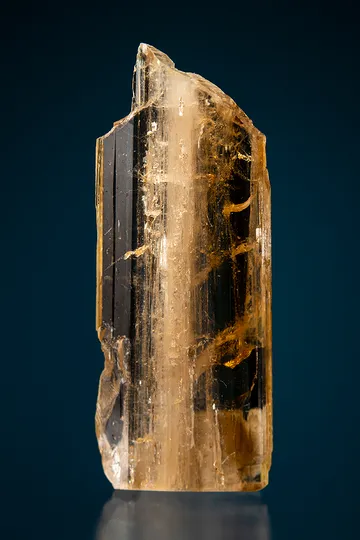
Diopside is both a specimen mineral and the great stage on which Jeffrey grossular and vesuvianite perform. It occurs as green acicular sprays, elongated crystals, tabular colorless crystals, transparent brown crystals, and granular rodingite masses, with documented specimens showing diopside crystals from millimeter needles to loose gemmy blades several centimeters long. In the finest grossular associations, orange or pink garnet crystals rest on, penetrate, or are framed by green diopside needles, creating the color contrast collectors want most; in the vesuvianite zone, diopside may be colorless and tabular, and more rarely accompanies groutite or manganite. Standalone diopside from Jeffrey is scarcer than garnet-associated material and is judged by transparency, crystal length, clean terminations, and freedom from crushing; as an association mineral, its value lies in whether it gives the garnet or vesuvianite an elegant, undamaged architectural base.
Hessonite is the orange to cinnamon variety of grossular that made Jeffrey Mine a household name among garnet collectors. The best hessonites are lustrous, transparent to gemmy orange crystals, commonly dodecahedral or trapezohedral, on contrasting dark syenitic matrix, green diopside, or pale albititic rock. Crystal sizes on collectible pieces range from sparkling millimeter druses to cabinet-quality crystals exceeding 1 cm, with exceptional late-1990s material reaching about 2.5 cm. The strongest pieces show warm saturated color without muddy brown tones, crisp faces, strong luster, and undamaged high points; because the mine was an active blasted industrial operation, edge bruising, missing crystals, contacted backs, and matrix scars are common and must be weighed carefully against color and rarity.
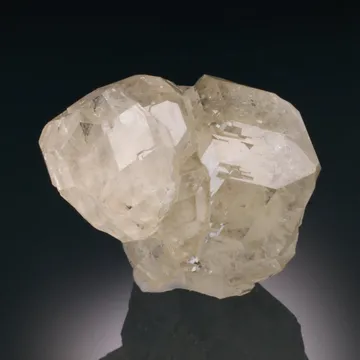
Quartz is a minor but locality-correct member of the Jeffrey assemblage, tied mainly to the felsic intrusive rocks—quartz-albitite, albite-syenite, and related altered dikes—that cut or occur within the serpentinized ultramafic mass. It is not the reason collectors pursue Jeffrey specimens, but it matters because quartz-bearing albititic and syenitic rocks are part of the same contact environment that produced grossular, vesuvianite, diopside, prehnite, and pectolite. Jeffrey quartz is generally best appreciated as matrix or association: clear to whitish quartz in pale feldspathic rock can set off pink or orange grossular, while quartz-rich dike material helps distinguish some pieces from the darker serpentine-hosted material. Fine quartz-only specimens from the mine are much less central to the locality’s reputation than aesthetic association pieces with garnet or Ca-silicates.
Pectolite from Jeffrey Mine occurs in the Ca-silicate rodingite environment and is most collectible when it forms distinct white to pale crystals rather than anonymous fibrous or massive material. Documented Jeffrey pieces show pectolite with prehnite on diopside, pectolite on albite with tiny grossular, and pectolite in association with the same green diopside and pale albititic matrices that make the locality visually recognizable. Crystal sizes can reach miniature-scale importance, with some cataloged specimens noting pectolite to several centimeters. The best pieces show separated, terminated or spray-like crystals with good contrast and recognizable associations; ordinary pieces are easily overlooked because white pectolite can blend into wollastonite, albite, or pale prehnite unless crystal habit and context are clear.
Beyond the familiar species, Jeffrey Mine is a serious locality for rare and type minerals. Spertiniite, Cu(OH)2, was described from the mine and named for mine geologist Francesco Spertini; jeffreyite, (Ca,Na)2(Be,Al)Si2(O,OH)7, was named for the locality; and alumovesuvianite, Ca19Al(Al,Mg)12Si18O69(OH)9, was described from cavities in rodingite at Jeffrey as a new vesuvianite-group member. Other documented or collector-notable minerals include wollastonite, albite, K-feldspar, calcite, fluorapophyllite-(K), apophyllite-group minerals, chromite, native copper, chalcocite, heazlewoodite, magnetite, brucite, talc, picrolite, serpentine, groutite, manganite, pyrite, pyrrhotite, molybdenite, sodalite including hackmanite, actinolite, and several micromount rarities that give the locality far more depth than its famous garnet-and-vesuvianite image suggests.
Jeffrey Mine specimens are generally not faked in the way that some brightly colored global classics are faked, but they are often imprecisely labeled. “Asbestos, Québec” on an old label is not a mineral warning by itself; it is the former town name and can be historically correct. Likewise, Jeffrey Quarry, Jeffrey Mine, Johns-Manville Mine, Shipton Township, Richmond County, and Val-des-Sources may all appear on legitimate labels from different eras. The best practice is to preserve the old label wording while adding the modern locality in a catalog note.
The most important identification issue is the vesuvianite-group material. Older labels may say vesuvianite, mangan-vesuvianite, manganese-bearing vesuvianite, or simply idocrase. Some mauve, pink, colorless, and light green material from Jeffrey may require modern analytical work to separate vesuvianite from alumovesuvianite or other compositional variants; color alone is not proof of species. For the marketplace, “vesuvianite group” or “vesuvianite, not analyzed for alumovesuvianite” is often the most honest wording when a specimen has not been tested.
“Hessonite” is another label term to handle carefully. Hessonite is a variety name for orange grossular, not a separate species. Fine orange Jeffrey garnets are correctly cataloged as grossular var. hessonite when the color and habit fit. Green garnets should not be casually called uvarovite or demantoid without analysis; many attractive green Jeffrey garnets are chromium-bearing grossular.
Condition is critical. The mine was an operating asbestos pit, and many specimens were saved from blasted rock or dump material. On grossular, inspect every high point of the dodecahedra and trapezohedra for frosted bruises, cleaved corners, and broken crystal clusters. On vesuvianite, terminations and prism edges are the value centers; contacted backs are acceptable on some pocket pieces, but a chipped purple cap or broken green termination materially changes desirability. Diopside needles are fragile and commonly snapped. Prehnite often shows contacts or rubs on protruding blocky faces, and pectolite can be deceptively delicate.
Handling deserves special caution because Jeffrey was a chrysotile asbestos mine and specimens may carry serpentine, picrolite, loose mine dust, fibrous chrysotile, or fibrous amphiboles in matrix. Stable garnet, vesuvianite, prehnite, or diopside specimens are normally collected as display minerals, not handled as industrial asbestos, but avoid sawing, grinding, wire-brushing, sanding, compressed-air cleaning, or aggressive ultrasonic cleaning of matrix. Do not trim suspected fibrous material indoors. If a specimen has obvious loose fibers or dusty serpentine matrix, store it in a closed display box or sealed bag, label it clearly, and clean the outside of the container rather than the specimen.
Fluorescence is not the central appeal of Jeffrey material. Hackmanite/sodalite and some accessory minerals may have specialty interest, but collectors should buy Jeffrey primarily for crystal quality, color, association, and locality pedigree. The market still contains a good supply of small orange grossulars and modest vesuvianites from older collections, but high-end material—large gemmy grossular, deep pink grossular, dramatic green-purple vesuvianite, pristine “purple-cap” vesuvianite, blocky prehnite, and strong pectolite associations—has become increasingly difficult to replace.
The origin story has the simplicity of a folktale because it begins with children. In 1879, on a hillside known as Webb’s Hill, they found a curious stone that detached easily from a crevice. The mineral was chrysotile asbestos, soon nicknamed “gray gold” in the local telling. The early mine was not a mechanized spectacle but a human one: men working with sledgehammers, drills, shovels, wedges, picks, chains, horse-powered winches, hand screens, and black powder hauled from Windsor by the Hamilton Powder Company. From that small beginning came a pit so large that the town grew around it—and eventually had to retreat from its edge.
Collectors usually tell Jeffrey’s history through pockets. At the end of 1996 and into early 1997, mining crossed one of the garnet-bearing rodingite veins that had made the mine famous. One pocket, more accurately a series of fractures, produced deep orange to almost red grossular on acicular green diopside. The haul was tiny by world-class standards: only five good cabinet specimens, two miniatures, and some lesser pieces. A miner operating a power shovel collected the material and sold it to Montréal collector-dealer Jonathan Levinger in August 1997. The best small-cabinet piece measured 6.6 cm, the best miniature 3.5 cm, and the grossular crystals reached 2.5 cm—large, gemmy, rhombic dodecahedra rising from green diopside. The rest of the pocket dispersed at the 1997 Denver show into serious private collections.
On July 5, 1998, the Club de Minéralogie d’Asbestos organized a collecting day that became part of Jeffrey lore. Club members found the best pink grossulars known from the mine: lustrous, transparent crystals, many as floaters or on green diopside and white albitite. White albitite was unusual for Jeffrey grossular, which more often sat on darker syenitic matrix. The day’s great pocket was in a large rock found by a former Jeffrey miner. The crystals were deep pink and reached 1.5 cm, larger and richer than other pink material from the same day. They had been enclosed in soft white fibrous wollastonite-group masses, which helped protect them from blasting and collecting damage. Fewer than fifteen very high-quality specimens emerged. No later find matched that July 1998 pink grossular pocket.
Another discovery began not at the face, but with a rock in the dump. In May 1999, a collector cracked open a large boulder and found a cavity measuring about 17 by 40 by 50 cm, lined with green diopside. Some diopside crystals carried orange grossular perched on their terminations. The best specimen measured 7.5 by 15 cm and displayed fourteen orange garnets up to 1.4 cm individually—a perfect Jeffrey composition, found by the simple act of breaking the right rock.
The vesuvianite story has its own geography: the old 2440 level, where purple, pink, yellow, and green crystals had been found in 1978 and 1988. When the mine was expanded in 1988, the roots of the dike were covered. Years later, slumping exposed part of the same zone again near a secondary mine road, and the Asbestos club’s 2002 excursions found that collecting had revived in one of the few safe areas left in the pit. In May 2002, in miserable weather, collectors recovered transparent pink and purple vesuvianite clusters with shiny pink terminations and pale-green prism faces. In July and August came deep green chromian vesuvianite crystals up to 4.4 cm, some loose and translucent with small gemmy areas. Those green crystals came from small vugs in a thin emerald-green vein of massive vesuvianite embedded in a paler green vesuvianite vein.
August 25, 2002 was the vesuvianite day collectors dream about. Two collectors opened a large pocket and recovered more than 100 yellow-green specimens, some with purple cores. The pocket yielded thumbnail, miniature, and cabinet pieces, with the largest about 25 by 35 cm. A cluster of doubly terminated crystals had individual crystals to 3 cm long and 1 cm wide. The filling was fine granular vesuvianite, so many pieces were nearly floaters. In the following weeks, miners using a power shovel recovered more top-quality specimens until management bulldozed over the site. Among the best was a 12.6-cm multicolored cluster with a sharp 1.4 by 1.6 by 6 cm crystal rising from it. The classic pale green crystals with glossy purple flat terminations became known among collectors as “purple-cap” vesuvianite.
Jeffrey’s industrial finale added one of the strangest footnotes in modern mineral-collecting history. After the mine closed in October 2002 amid financial trouble, a NASA contractor arranged for it to reopen briefly to obtain a special-quality asbestos for space-shuttle seals. The mine closed again in April 2003. When pumping stopped, water rose in the pit; by July 2003 the bottom was flooded to nearly 100 meters, and the best grossular areas were underwater.


_(34416990562).jpg)