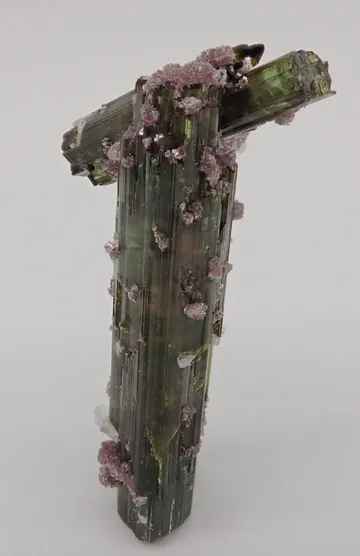
Indicolite from the Pederneira Mine, Brazil - glassy blue tourmaline prized for sharp terminations, vibrant color range, and pocket-grown specimen forms.
Key facts
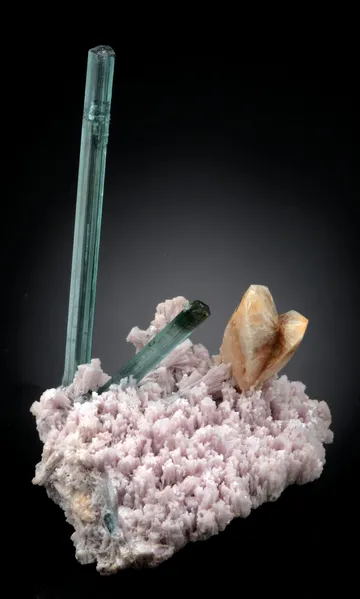
Indicolite from the Pederneira Mine is one of the modern collector world’s signature blue tourmalines: glassy, sharply striated, commonly prismatic, and prized for a color range that runs from teal-blue and blue-green through steely blue to purer deep blue. What sets Pederneira apart is not simply that it produced blue elbaite, but that the mine produced blue tourmaline in highly collectible specimen form—freestanding crystals on lilac lepidolite, cleavelandite, quartz, and feldspar, as well as loose gemmy pencils and etched “rocket” forms with sculptural character.

Photo: Rob Lavinsky / Wikimedia Commons
The mine lies near São José da Safira in Minas Gerais, within the Safira pegmatite district of the Eastern Brazilian Pegmatite Province. Its tourmalines formed in highly evolved granitic pegmatites, especially in miarolitic pockets developed in the geochemically evolved core zones. These pockets could be tight, clay-poor cavities or collapsed chambers filled with broken but astonishingly gemmy crystals, later recovered, matched, cleaned, repaired, and reassembled by specialists.
Pederneira’s fame rests on pocket individuality. Collectors speak of Pederneira not merely by locality, but by pocket: Rocket, Porcupine, Azul Bien Grande, Bi-Color Steel, Blue-Green, Blue Gem, Cranberry Blue, Pink and Blue, Thiago’s Pocket, and others. Each pocket had its own color zoning, termination style, matrix texture, degree of corrosion, and typical condition. For indicolite collectors, the most compelling pieces combine gem transparency with a recognizable Pederneira aesthetic: vertical striations, clean trigonal terminations, teal or steely blue color, and contrast against purple lepidolite or white cleavelandite.

Photo: Rob Lavinsky / Wikimedia Commons
Historically, Pederneira is important because it helped redefine what serious collectors expected from modern tourmaline specimens. Mining began in the 1940s as a mica venture, but the collector-specimen era that began around 1999 put the mine on the world stage. The great Pederneira pieces are not just gem crystals; they are pocket documents, each one reflecting a very specific event underground.
Search for specimens: View all indicolite specimens from Pederneira Mine, Brazil
Pederneira Mine is located at São José da Safira, Minas Gerais, Brazil, historically also known as the Pederneira claim or Lavra da Pederneira. It is a pegmatite mine in the Safira pegmatite district of the Eastern Brazilian Pegmatite Province, a region famous for gem-bearing granitic pegmatites and for the production of tourmaline, beryl, mica, feldspar, quartz, and associated phosphates.
The deposit is a complex, zoned granitic pegmatite system hosted by schist. In the productive workings, large subvertical pegmatitic bodies show well-developed internal zoning: border and intermediate zones, core zones rich in quartz and feldspar, and highly evolved miarolitic cavities where gem tourmaline crystallized. The pocket assemblage most relevant to indicolite collectors consists of elbaite tourmaline with quartz, cleavelandite, feldspar, and lepidolite; other documented minerals at the mine include albite, beryl including morganite, fluorapatite, hydroxylherderite, microcline, muscovite, schorl, spessartine, zinnwaldite, rhodochrosite, and several sulfides and carbonates.
The first mining at Pederneira dates to the 1940s, when a farmer named Pacheco found a muscovite-rich outcrop after a storm. During World War II, demand for mica was high, and Pacheco reportedly hauled barrels of muscovite by mule to São José da Safira, where it was sold to Americans working nearby. The mica venture did not become a major industrial operation, but it established the mine.
The modern tourmaline era began at the end of 1999 with the discovery of what became known as Keké’s Pocket in Dada’s Tunnel, an upper working developed roughly 100 meters above the older workings. That pocket brought Pederneira to the attention of the international specimen trade and led to years of specimen-focused mining rather than ordinary gem-rough extraction. Production through the early and mid-2000s included many of the mine’s most celebrated pockets, with later important activity continuing into the 2010s.
Access is not a casual field-collecting proposition. Pederneira is a working, private, specimen-producing mine, and the underground workings have been operated with paid crews, controlled access, security, and professional preparation of important finds. Collectors should think of Pederneira material as market material with provenance, not as a locality for recreational digging.
Notable Pederneira finds include the Rocket Pocket of 2001, famous for natural sceptered and etched forms; the Porcupine Pocket of 2001, which produced long steely blue crystals and the celebrated Smithsonian “Porcupine” specimen; the immense Azul Bien Grande Pocket of 2004; the Bi-Color Steel Pocket of 2004, including the 28 cm “Bi-Color Steel” specimen; the Blue-Green and Blue Gem pockets; the Cranberry Blue and Pink and Blue pockets of 2011; and Thiago’s Pocket of 2012, a major deep-blue tourmaline discovery after a long interval of disappointing production.
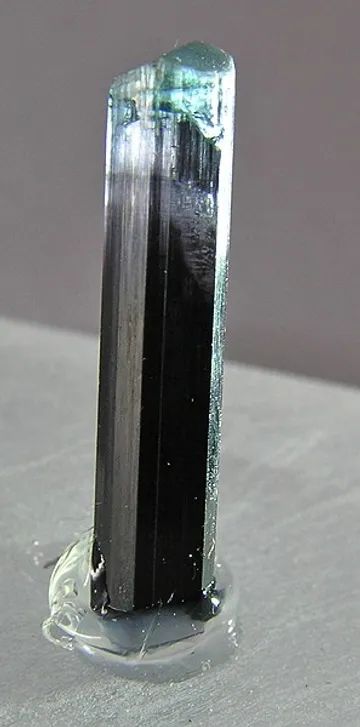
Pederneira indicolite is typically elbaite tourmaline in blue to blue-green hues. Crystals are most often elongated trigonal prisms with strong vertical striations, high vitreous luster, and terminations that may be flat pedions, low pyramids, or complex trigonal pyramids depending on pocket and polarity. The finest examples are transparent to gemmy, with blue or teal color carried through the body of the crystal rather than confined to a thin skin.
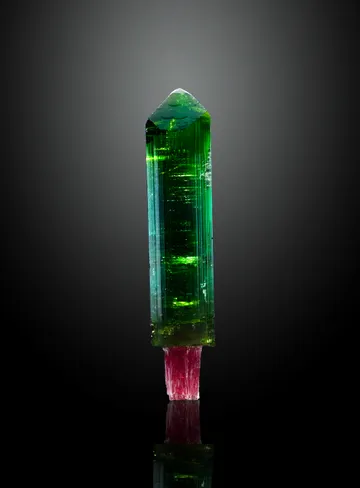
Color is the first cue, but it is not uniform from pocket to pocket. Porcupine Pocket material is known for steely blue crystals, with the longest reported examples reaching about 35 cm and approximately 2 cm thick. Rocket Pocket crystals commonly show a rubellite core changing upward into a gemmy green-blue to blue zone, and selective corrosion created the famous “rocket” and scepter forms. Blue-Green Pocket material shifts from blue to green and back to blue toward the termination. Pink and Blue Pocket crystals may show a pink core with a blue rind, a vivid blue termination, and a final pink edge only a fraction of a millimeter thick. Thiago’s Pocket produced deep blue crystals with a strongly corroded fibrous zone, in some cases leaving brush-like lower ends and superb blue gem areas toward the termination.
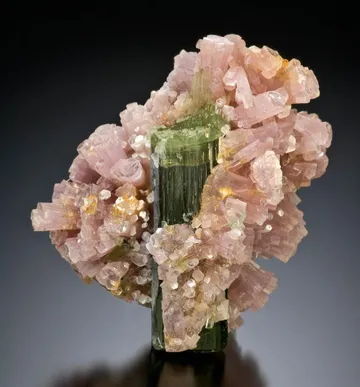
The matrix associations are a major part of the locality’s appeal. Pederneira indicolite is classically seen with purple to lilac lepidolite, white cleavelandite, quartz, smoky quartz, microcline or feldspar, and less commonly hydroxylherderite or morganite. The strongest cabinet pieces use that matrix contrast beautifully: blue-green tourmaline rising from lavender mica, or a bright blue crystal attached to glassy quartz and white albite. Because blue tourmaline on matrix is much less common than loose crystals, matrix indicolite from Pederneira commands special attention.
Size varies widely. Small loose crystals around 3–6 cm are seen in the market, including many from later finds. Fine miniatures and small cabinets may carry crystals in the 5–12 cm range. Large pocket specimens can be far larger: the Porcupine Pocket yielded long crystals up to 35 cm, Azul Bien Grande produced matrix pieces with crystals around 40 cm and whole specimens exceeding 50 cm, and Thiago’s Pocket produced important blue tourmaline specimens and several kilograms of gem rough. Such upper-end pieces are museum-class objects rather than routine collector material.
Quality factors are specific. A top Pederneira indicolite should have strong color, glassy luster, transparency, a complete and natural termination, clean prism faces, and either an elegant freestanding crystal form or a balanced matrix setting. Pocket attribution adds value when well documented. Unrepaired or minimally repaired examples are especially desirable, but repairs are common enough in this mine that condition must be judged realistically: a clean, disclosed repair on a major Pederneira tourmaline may be acceptable, while undisclosed assembly, mismatched repairs, or artificial scepter construction is not.
The central condition issue for Pederneira indicolite is breakage. Many productive pockets collapsed naturally, leaving magnificent crystals mixed with rubble, and additional damage could occur from tectonic movement, mud and water infiltration, blasting, extraction, and transport. Long, slender tourmalines are particularly vulnerable. As a result, repaired Pederneira tourmalines are common, and many major specimens were professionally reconstructed from matching pieces recovered together from the same pocket.
Collectors should distinguish legitimate repair from deceptive fabrication. A repaired crystal that has been accurately rejoined along its own break is normal in high-end pegmatite specimens when disclosed. A composite specimen made from unrelated crystals, mismatched bases, or non-original matrix is a different matter. Pederneira scepters deserve special scrutiny because natural sceptered forms are documented from the mine, especially the Rocket Pocket, yet fake tourmaline scepters from other mines are also known in the broader market. The stem should fit the head exactly, the growth textures should make mineralogical sense, and pocket provenance should be plausible.
Common damage includes chipped terminations, bruised prism edges, basal breaks, contact marks where crystals grew against matrix, and rehealed or etched areas caused by natural corrosion in the pocket. Some crystals have matte, etched, or fibrous zones below gemmy blue tops; these can be entirely natural and even diagnostic of certain Pederneira pockets. Conversely, a too-clean base on a supposed loose crystal may indicate trimming, cutting, or polishing, which should be disclosed.
Treatments are not the defining concern with Pederneira specimen indicolite; assembly, repair, and provenance are more important. Faceted blue tourmaline from Pederneira may enter the gem trade, especially from pockets where crystals had more value as rough than specimens, but specimen buyers should look for natural crystal surfaces rather than polished repairs or recut terminations. Any unusually perfect loose “crystal” should be checked for sawn bases, polished faces, or reconstructed terminations.
Market availability is uneven. Small loose indicolite crystals and modest repaired examples appear with some regularity through dealers and auction platforms. Fine matrix indicolites, unrepaired crystals, and named-pocket pieces are much scarcer. The highest tier—large, gemmy, balanced, pocket-attributed specimens from Porcupine, Rocket, Azul Bien Grande, Blue-Green, Blue Gem, Cranberry Blue, Pink and Blue, or Thiago’s Pocket—belongs in the same conversation as the great modern tourmalines from any locality and is priced accordingly.
Pederneira’s story begins not with blue tourmaline but with mica and a storm. In the 1940s, while World War II made muscovite a strategic material, a farmer named Pacheco walked the hillside after heavy rain and found an outcrop filled with mica. He collected several barrels of muscovite and hauled them by mule to São José da Safira, where Americans working nearby bought the material. They checked the deposit for a larger mica operation, decided it was not worthwhile, and left the mine to local miners. The name Pederneira came from the small river at the base of the mountain.
The modern specimen era began with a more tangled episode. A local miner named Dada, who had once worked in the older lower adit later called Dilo’s Tunnel, found a new pegmatite outcrop about 100 meters above the old workings. He and his sons made a road up the hillside and began working with hand tools. When the job required equipment, Eustacio Neves and landowner José Oliveira Rocha, known as Deca, became involved. Late in 1999, a small but remarkable tourmaline pocket was discovered. It would become Keké’s Pocket, but the story did not unfold cleanly: its contents appear to have been taken and marketed without the knowledge of the original partners.
The material reached Governador Valadares, the regional gem-trade hub, through a dealer named Domingo, who offered it to Saint-Clair Fonseca Jr., known as Keké. Keké was about to leave for the Tucson show and nearly skipped the meeting. Instead he looked at the lot, realized it mattered, and bought it. The trail of that material then drew Wilson Tomich into a two-week hunt through Brazilian mining towns, even while the Tucson show was taking place. A dealer named Lezito finally gave him the clue: the material was from Pederneira. Tomich went to the mine, met Dada, and the unlikely partnership that came to define the great Pederneira era began to form—Tomich, Zé Menezes, Keké, Miranda, and Eustacio working with Dada and Deca.
Getting to the mine was itself part of the adventure. A visitor flew first to Rio de Janeiro or São Paulo, then to Belo Horizonte, then to Governador Valadares, and from there drove roughly three hours north-northwest past São José da Safira, Aricanga, Cruzeiro Mine, and the tiny town of Cruzeiro. The last 50 km were unpaved, with cattle crossings, rough terrain, and occasional landslides. In earlier days, an old ridge-top airstrip allowed a 25-minute flight from Governador Valadares, and valuable specimens were sometimes flown out to avoid the risk of road hijacking. Later, helicopters replaced that old shortcut.
Inside the pockets, the great specimens were often born into chaos. Pederneira cavities were not always clay-filled; some had little clay or none. Many large pockets collapsed, leaving a fresh scar in the roof and a pile of rubble below. Only when miners began removing the broken fragments did the treasure become visible: gem crystals, matrix groups, loose tourmaline sections, quartz, lepidolite, and cleavelandite. A pocket could take a few hours to collect or as long as a month. After the loose material was removed, a diamond chain saw was used to extract matrix groups from the sides and floor, preserving attachment points where loose crystals could later be rejoined.
The Rocket Pocket of 2001 produced one of Pederneira’s most memorable habits. When the partners called Daniel Trinchillo and told him to come back to Brazil immediately, he soon found himself seated before gem-green to blue-green tourmalines with shapes like little spacecraft. The pocket was named for three particularly beautiful “rocket-like” crystals. These crystals had red rubellite cores and outer green-blue zones; selective corrosion dissolved parts of the outer layer, leaving scepter and rocket forms. Some were nicknamed “the Missile,” “the Space Shuttle,” “the Takeoff,” and “Ignition.” The quartz was nearly flawless, the cleavelandite occurred in snow-white rose-like groups, and small purple stacks of lepidolite were scattered through the matrix. Even a morganite crystal pierced by green tourmalines came from this pocket, one of the few fine morganites known from Pederneira.
The Porcupine Pocket, also in 2001, shifted the mine into another register. It produced a new steely blue habit, with long antilogous crystals reaching up to 35 cm by about 2 cm thick. Many were badly broken and needed numerous repairs—some more than ten—but a few survived without damage. The most famous piece, “the Porcupine,” became a Smithsonian specimen, while “the Sailboat” reached 61 cm as the largest crystal group from the pocket. Other named pieces included “The Blue Star,” “Legs,” and “The Hat.” “Legs,” a 20 cm floater with no obvious point of attachment, was described as unrepaired, an extraordinary survival from a pocket famous for broken crystal sections.
In 2004 came Azul Bien Grande, a name that fits the scale of the find. One specimen consisted of crystals averaging 20 to 25 cm long shooting in multiple directions from a cleavelandite and lepidolite matrix, with a three-crystal group rising from the center to more than 40 cm. Other specimens from the pocket measured 59 cm and 62 cm overall. Unlike the Porcupine material, some of the longer Azul Bien Grande crystals had only one or two repairs, many at their bases. The pocket’s contents were so extensive that they were released over several years; some material spent so long in preparation that more than a decade passed between extraction and sale.
The Bi-Color Steel Pocket followed hard on the heels of Azul Bien Grande and produced one of the mine’s supreme trophies. Because it appeared as a stringer from Azul Bien Grande, the miners approached carefully and collected the contents without causing new breaks. The condition was unusually good. From that pocket came “Bi-Color Steel,” a 28 cm crystal cluster on cleavelandite and lepidolite described in the Mineralogical Record as the finest specimen ever recovered from Pederneira. Another important piece, “Bi-Color Star,” combined similar crystal quality with rich red and purple lepidolite. One smaller specimen was created by trimming a crystal spray from the far end of the “Bi-Color Steel” matrix, preserving a burst of vibrant red crystals with flat blue-green terminations and no repairs.
The mine also had darker chapters. In early 2008, after Zé Menezes had been robbed at gunpoint at his Mutuca tourmaline mine and nearly killed, the same group of robbers apparently turned toward Pederneira. The Mutuca robbery had netted more than $250,000 in gem rough. At Pederneira, guards later found a large hole dug near the portal of Dada’s Tunnel, low enough to pass under the gate. Assuming intruders were still inside, they set an ambush. Around 1 a.m., people began emerging from the tunnel. Shouts were exchanged, bullets flew up and down the mountain, and the intruders escaped with nothing. No one was injured, and no specimens were stored on site at the time, but the episode changed the mine. Security upgrades followed: watchtowers, armed guards, and a pause in mining that lasted nearly six months and cost more than $100,000.
Daily life at the mine was less cinematic but equally revealing. The crew typically worked from 7 a.m. to 4:30 p.m., with lunch at 11 a.m. and a half-hour coffee break at 3 p.m. The staff ranged from about 15 to 20 people, with roughly ten miners underground each day. Some worked jackleg drills; others loaded and hauled blasted rock out to the dump; others handled pumps, water, dynamite, tools, compressors, winches, hydraulic splitters, ventilating fans, generators, and diamond chain saws. The tunnels were comparatively dry and cool, around 55 to 65 degrees year-round. A full-time cook named Neuza had been with the mine for nearly 14 years, and everyone from miners to cooks to guards shared in proceeds when a tourmaline pocket was found.
After years of mixed results, Thiago’s Pocket arrived in 2012 with the drama of a reprieve. By mid-September, nothing significant had been found for much of the year. Thiago Menezes, Zé Menezes’s son, was monitoring the operation. After a blast intended to connect two areas and widen another, the miners returned to find an opening into a 2-cubic-meter pocket filled with deep blue gemmy tourmaline crystals. The lower parts of many crystals were heavily corroded, with some bases transformed into irregular “paint brush” forms, while the gemmy upper sections remained sharp and blue. Other crystals showed a silvery sheen for the first half to two-thirds of their length, then shifted abruptly into flawless blue with almost no green component. The pocket produced nearly 4 kg of top blue tourmaline rough, much of it more valuable as cutting material than as specimens, but the crystals that could be returned to matrix became some of the finest late Pederneira pieces.