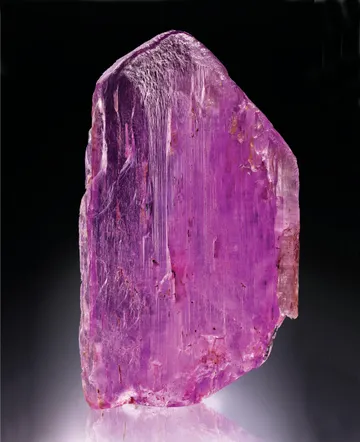
Pala Mining District, San Diego, USA — indicolite blue elbaite tourmaline famed for color zoning, pocket-rich pegmatites, and collector-grade rarity.
Key facts
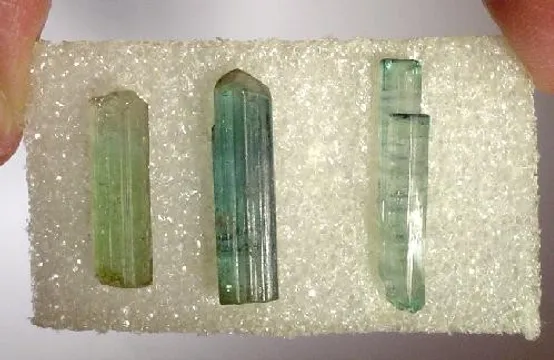
Indicolite from the Pala Mining District is blue elbaite tourmaline with a very Californian personality: sturdy, striated prisms from complex lithium pegmatites, commonly dark in hand until a strong backlight reveals blue, blue-green, or teal internal color. The best crystals are not simply “blue tourmaline” in a gem-trade sense; they carry the district’s signature zoning, with color shifts from dark blue or blue-black into green, pink, purple, or colorless zones, and many belong to the same pocket-pegmatite world that made Pala’s rubellite and blue-cap tourmalines legendary.
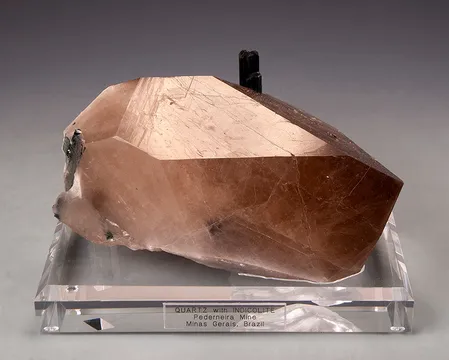
The district lies in northern San Diego County within the Southern California pegmatite province, where lithium- and boron-rich pegmatite-aplite dikes cut mainly gabbroic to mafic tonalitic host rocks of the Peninsular Ranges batholith. In collector terms, that setting matters because it produced a distinctive mineral assemblage: elbaite tourmaline with lepidolite, cleavelandite, quartz, muscovite, perthite, albite, beryl, spodumene, spessartine, and a suite of rare-element accessories. The blue varieties are especially tied to the pocket-bearing parts of the dikes and to lepidolite-rich zones, so fine indicolite from Pala is as much a pegmatite-environment specimen as it is a tourmaline specimen.

Photo: Wikimedia Commons
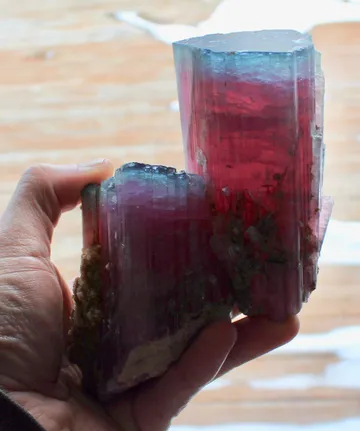
The blue-capped Tourmaline Queen crystals of 1972 dominate the public imagination of Pala tourmaline, and rightly so: pink-to-red elbaite prisms with vivid blue indicolite terminations remain among the most recognizable American mineral specimens ever found. For a collector specifically pursuing indicolite, however, the quieter prizes are the old Tourmaline Queen blue crystals and dark blue prisms that disclose their color under sunlight; blue zones in bicolored and multicolored crystals; and occasional blue-gray, teal, or blue-green material from the district’s renewed late twentieth- and early twenty-first-century workings.
What serious collectors look for is not merely blueness. A good Pala indicolite has a recognizable Pala build: trigonal prism, strong vertical striations, glassy luster where preserved, complex zoning, and believable association with quartz, cleavelandite, lepidolite, or pocket clay. A great one adds depth of color without going dead-black, an intact termination, translucency in strong transmitted light, and old provenance—especially to the Tourmaline Queen, Tourmaline King, Stewart, Pala Chief, Oceanview, or Elizabeth R workings.
Search for specimens: View all indicolite specimens from Pala Mining District, San Diego, USA
The Pala Mining District occupies a compact but extraordinarily productive pegmatite belt near Pala in northwestern San Diego County. Jahns and Wright described the district as a curving belt of about 13 square miles, with at least 400 pegmatite dikes and the principal commercial deposits clustered on Queen Mountain, Chief Mountain, Little Chief Mountain, and Hiriart Mountain. Queen Mountain is the heart of the classic tourmaline story: the Tourmaline Queen, Tourmaline King, Stewart, Gem Star, Mission, and related workings supplied the district’s most celebrated tourmaline specimens and much of its early lithium output.
The deposit type is complex rare-element pegmatite-aplite. The dikes are typically zoned and asymmetrical, with lower garnet-albite aplite “line rock,” upper graphic granite, quartz-feldspar zones, and a central or near-central lepidolite-rich pay streak known to miners as the pocket zone, clay layer, gem seam, or gem strip. In those pocket-bearing zones, open or partly open clay-filled cavities allowed elbaite crystals to grow free enough to develop lustrous prism faces and terminations. True open space is not abundant in every pocket; many so-called pockets were tight clay-rich masses where crystals were partly embedded, broken, healed, or attached to feldspar and quartz.
Formal mining in the district began in the 1870s, and the most active early period ran from about 1900 to 1922. By 1947 the recorded production of the district had reached roughly three-quarters of a million dollars and included 23,480 short tons of lepidolite, 2,480 pounds of tourmaline, and 1,325 pounds of gem spodumene. These figures exclude the large amount of specimen material later collected or high-graded from dumps and workings.
The Tourmaline Queen Mine was claimed by Frank Salmons and associates in March 1903. Early exploratory work reportedly produced about 80 pounds of gem tourmaline, and the mine became the leading tourmaline producer in the Pala district from 1904 through about 1914. The early market was driven heavily by demand for pink and red tourmaline carving material, much of it exported to China. When the Chinese imperial market collapsed after the 1911 revolution, Pala tourmaline mining lost much of its economic force, and the Queen entered a long interval of intermittent high-grading and limited production.
The modern collector era began when Ed Swoboda, Bill Larson, John McLean, José Montes, Bryant Harris, Buzz Gray, and others brought systematic work back to the Tourmaline Queen. The 1971–1972 mining program produced blue, red, and bicolored elbaite specimens, culminating in the famous blue-cap discovery. The “Candelabra,” now associated with the Smithsonian Institution, and other major pieces from that pocket transformed Pala from a historic gem locality into an icon of modern mineral collecting.
The district did not end with the 1972 find. Renewed work at the Tourmaline Queen in the late 1990s and early 2000s exposed new pockets yielding blue, pink, and bicolored tourmaline, including unusual blue and pink cat’s-eye cabochon material. The Pala Chief, Elizabeth R, and Oceanview areas also saw late twentieth- and early twenty-first-century activity, with pockets producing tourmaline, kunzite, morganite, aquamarine, quartz, and related pegmatite minerals. More recently, Tourmaline King work has again brought Pala tourmaline to gem and specimen attention.
Collecting access must be treated as private-property access, not open public land collecting. Historic mines such as the Tourmaline Queen and Stewart are private or restricted. The Oceanview operation has offered scheduled fee digs through screened mine material, and Pala Chief access has been limited to special fee digs in cooler months. Conditions, ownership, safety rules, and access schedules change, so collectors should regard any visit as permission-only and operator-directed.
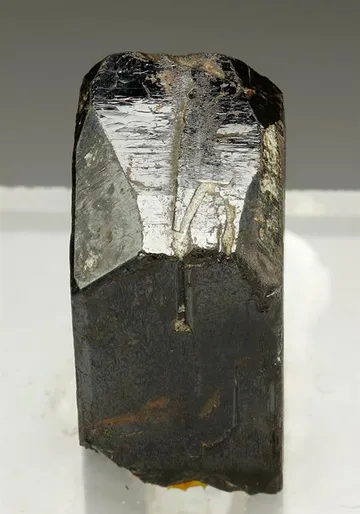
Pala indicolite occurs as the blue variety of elbaite tourmaline, usually in prismatic crystals with strong lengthwise striations and trigonal cross section. Many crystals are stout rather than needlelike, and many are dark enough in ordinary room light to appear blue-black, green-black, or nearly opaque. The reward comes with sunlight or a strong transmitted beam: blue and teal zones often emerge from what first looked like a dark, heavy prism.
Color is the locality’s most important diagnostic pleasure. Jahns and Wright described Pala’s tourmalines as medium- to deep-blue indicolite, pink to pale-red rubellite, green emeralite, colorless achroite, and almost every intermediate tint and shade. In a single crystal, color may be arranged as concentric zoning around the long axis, as transverse bands perpendicular to the crystal length, or as complicated combinations of both. Deep-blue to black cores may carry rims of colorless, green, blue, or pink elbaite. Other crystals change from black to green, black to pink, black to colorless, green to pink, or through multiple repeated color bands. Color boundaries may be sharp, but many intergrade over only a few millimeters.
The famous blue-cap morphology is a special case of this zoning: pink to red elbaite bodies capped by blue indicolite terminations. True 1972 Tourmaline Queen blue-caps are a narrowly defined historical find, not a generic label for every blue-ended tourmaline. Their visual power comes from the abrupt meeting of saturated rubellite and glassy blue termination, often in crystals thick enough to appear nearly black at the cap unless the luster and transmitted color are ideal.
Pala indicolite crystals range from tiny needles and small broken pocket pieces to substantial prisms. Jahns and Wright recorded tourmaline individuals in the district from minute needles up to single prisms 6 inches in diameter and at least 4 feet long, though most tourmalines were less than 1 inch in diameter and 4 inches long. Collectible indicolite specimens are commonly miniatures to small cabinets; truly fine, complete blue crystals or blue-zoned specimens with undamaged terminations are much scarcer than pink fragments or black schorl.
Associated minerals are essential to reading the locality. Quartz, cleavelandite, albite, pocket perthite, muscovite, and lepidolite are the classic companions. Blue and colorless tourmalines are especially characteristic of pocket-bearing zones and are most abundant in and near concentrations of lepidolite. Schorl is widespread in upper dike portions, pay streaks, line rock, and rosette aggregates; it may occur near gem tourmaline or as dark cores within multicolored crystals. Beryl, including morganite and aquamarine, appears in several district mines, and spodumene, particularly kunzite from Chief Mountain, belongs to the broader Pala gem suite.
Quality turns on four factors: color, transparency, form, and history. The strongest specimens show a blue that is visible without heroic lighting, or at least becomes vivid when backlit. Lustrous, sharply striated prism faces are preferred over etched or clay-altered surfaces. An intact pinacoidal or complex termination adds major value, especially if the color is concentrated there. Matrix is rare and important when natural, balanced, and not overwhelmingly repaired. Provenance to the Bill Larson, Ed Swoboda, Tourmaline Queen, or old Pala International era can matter as much as size, because the best pieces carry the district’s story as part of their identity.
The main authenticity issue is locality and terminology. “Blue cap” should be reserved for the historic Tourmaline Queen style, especially the 1972 discovery, rather than applied casually to any blue-tipped elbaite. Similarly, not every dark Pala tourmaline is indicolite; schorl, dark green elbaite, and heavily saturated multicolored crystals can look deceptively similar without transmitted light. For significant purchases, collectors should ask for locality provenance, old labels, prior collection history, and photographs under both reflected and transmitted light.
Condition is the central collecting challenge. Pala pocket tourmalines formed and survived in clay-rich cavities, but many broke naturally before mining, detached from pocket roofs, fractured along basal planes, or were later repaired from pocket fragments. A repaired specimen is not automatically undesirable—many great Pala pieces have some restoration history—but disclosure is essential. Check terminations, basal contacts, and matrix junctions carefully under magnification and long-wave UV. Look for glue lines, filled chips, reconstructed bases, and unnatural junctions between crystal and quartz or feldspar.
Dark indicolite requires especially careful lighting. A crystal that photographs as rich blue may be nearly black in normal display conditions; conversely, a piece that looks subdued in a dealer case may open into superb teal or blue when backlit. Serious collectors should evaluate the specimen the way it will be displayed: reflected light for luster and surface, transmitted light for color, and oblique light for repairs and edge wear.
Matrix specimens deserve extra caution. The finest Pala tourmalines with quartz, cleavelandite, lepidolite, or morganite matrix are far rarer than single crystals. Because matrix increases value dramatically, old repairs and reconstructed associations are common enough in the high-end tourmaline world that due diligence is mandatory. A clean single crystal with honest edge wear is often preferable to a dramatic but poorly disclosed composite.
Market availability is uneven. Small dark blue fragments, blue-zoned sections, and old miniatures appear periodically. Fine complete Tourmaline Queen indicolite crystals from old collections are uncommon, and blue-cap specimens of consequence are museum-grade or six-figure-level objects when they surface. The best buying opportunities often come from old San Diego County collections, Pala International provenance, and documented auction archives rather than from fresh production.
The Tourmaline Queen story begins, in Bill Larson’s telling, not with triumph but with the gloomy conviction that Pala was finished. By the 1950s, local collectors were saying the area had been worked out. They could recite who had tried which drift, why each attempt failed, and where the pay streak had supposedly pinched away. Larson drew the opposite lesson: a good collector knows “there is always something more to be found in every locality.” That stubborn optimism became the hinge on which the Queen turned.
Ed Swoboda had acquired the Stewart Lithia, Tourmaline Queen, and Pala Chief mines, and Pala Properties had been working the Stewart since 1968 with only mild success. The plan had always been to learn the mining trade at the Stewart and then move uphill to the more promising Queen. Economics finally forced the decision. A bulldozer was ordered to repair the road, create a working pad, and move the compressor. Then the bulldozer was delayed for a week.
That delay produced one of the great “last blast” moments in Pala lore. With nothing better to do, foreman John McLean put a final shot into the Stewart between two adits where a rich lepidolite zone was exposed. When the fumes cleared, a tourmaline “a full 10 inches by 4 inches” lay in the rubble pile. John thanked the mine spirits; José Montes at first thought it was quartz, then saw the red and began jumping in celebration. After three and a half years, the Stewart had given up what Larson called its crowning glory.
The move to the Tourmaline Queen was not glamorous. The old adits were in terrible condition after years of rain and neglect. Silt filled the upper workings so badly that the crew had to crawl on hands and knees. The lower workings had been completely filled with water, leaving the walls coated in mud. To understand the pegmatite again, they had to chip through the mud skin and read the wall rock. The equipment was minimal: compressor, jackleg, drill, rubber hose, electric generator, pick, shovel, wheelbarrow. Each blast meant more hand mucking. A winch had to be installed just to haul the wheelbarrow up the adit on the 12- to 15-degree dip of the pegmatite.
By September 1971, John McLean was drilling and blasting. Water for dust suppression had to be placed in the drill holes manually. After two weeks of that work, only 20 feet of new tunnel had been carved down-dip. Then, while Larson and Buzz Gray were away in Seattle at the National Gem and Mineral Show, Karla Larson called: a pocket of dark blue tourmaline had been hit.
When Larson returned, the pocket had already yielded four fine tourmalines. One was a doubly terminated single crystal about 3 by 2 inches; three others were matrix pieces with single crystals attached to quartz. The pocket clay was sticky and red. The quartz crystals had montmorillonite inclusions that gave them a white to pink opaque exterior. Most exciting of all, the tourmalines were dark blue outside but deep rubellite within. The Queen had passed its test.
The main discovery unfolded through doubt and mud. After one barren 40-foot stretch that Larson later admitted he might not have continued through, John McLean noticed slightly softer material near what looked like a fault plane. A shot uncovered lepidolite. A week later, a small pocket appeared. Then another pocket showed a red-glowing tourmaline about 2 by 2 inches. Larson probed the clay with a 10-inch screwdriver and could bury it to the handle. He removed globs of sticky clay by hand and with ice picks, pulled out powder boxes of clay and quartz, and finally freed the exposed crystal. When he rubbed it clean with his thumb, the termination came up smooth, glassy, and bright indicolite blue over a deep rubellite body.
The next day, Ed and Kumja Swoboda came down early. Foam pads were brought in so the men could lie in front of the pocket. Ed worked for hours with his fingers, pulling out glob after glob of red clay. The tools became so coated they were hard to pick up. Gloves were useless because the work required touch, and the clay loaded them until they weighed pounds. The clay also carried shards of quartz and feldspar sharp enough to cut fingers. Ed removed six or seven powder boxes of clay without finding a single tourmaline. The pocket had grown to more than 3 by 2 by 2 feet and still had yielded only the first crystal.
At about 3 p.m. they gave up. Ed had a two-and-a-half-hour drive back to Los Angeles. Larson went home with the one good crystal. Then John came in, muddy, with the line every field collector dreams of hearing. Did Larson remember the little tourmaline left in the pocket? Larson said he did not want it, thinking it was a one-inch scrap. John grinned and said, “Well, it grew,” then handed over a perfect 3 by 1 inch crystal. “You quit too soon,” he added, and pulled out another crystal, and then another, until five beautiful bicolored tourmalines lay in front of them.
It was 6:30 p.m. Ed would just be arriving home. They phoned and caught him at the front door: “We quit too soon.” John said there were more. Ed’s answer was immediate: “See you at 9:30!” Karla asked whether that meant 9:30 the next morning. It meant 9:30 that night.
At 9:30 p.m., Ed, Buzz, Karla, Bryant Harris, Carl Larson, and Bill Larson assembled, took a quick brandy, and piled into the yellow truck for the two-mile road from the Stewart to the Queen. At night, Larson wrote, the road was “treacherous and dangerous.” The headlights shot into space as the truck bounced over boulders. At one point the front left tire dropped into a ditch; the only harm was to bounce the passengers in the back and shake someone’s beer.
They reached the mine, started the generator, and hurried down the adit. For ten minutes nothing appeared. Then Ed’s fingers met a large crystal—at least four inches. Beside it was another of similar size. For a while they hoped for a matrix pair, but the crystals proved to be singles. Still, they were the finest yet: vivid blue-capped bicolors, large enough that whoever worked the pocket had to crawl into it. Around 4 a.m., exhausted and elated, they stopped. Karla had fallen asleep curled around the two crystals.
The work continued for days. John prepared the surrounding pockets with half- and quarter-sticks of dynamite. Photographer Dean Luxton moved in with a camper full of equipment and stayed at the Stewart for several weeks, documenting the find with more than a thousand photographs. The American Museum of Natural History later planned to show his slide presentation continuously beginning in February 1973. Museum people understood, almost immediately, that this was not just another gem pocket.
The “Candelabra” came out on a generator-failure night. Larson had exposed a single earlier and asked his father, Carl, to help remove it. The generator refused to start; no pulling, fiddling, cursing, or good-luck kick worked. Carl had brought a large flashlight, so they entered with that. The exposed tourmaline glowed red. It was tightly attached, and Larson had to use a double jack and chisel in a cramped position for nearly an hour. As he worked around the crystal, a quartz crystal began to appear behind it. Then, at the rear, a second tourmaline appeared. A gentle pressure with a small bar moved the mass, and Larson reached in with both hands and pulled out the now-famous specimen: more than a foot long, with tourmalines at either end and a place on top where a third had once been attached. Forty minutes later they found the third tourmaline, and it fit perfectly.
Another night brought an even stranger moment. Two pockets, about 18 inches apart and each roughly 2 feet across, turned out to connect. Ed and Bill lay stretched into the same working face, each removing crystals without competing for the same ones. Singles came steadily. After each had taken out three or four superb crystals, Ed leaned over and said, “You know, I can die happily now!”
The men broke for dinner around 9 p.m., then returned into fog that made the mountain feel like a legend. Working only with fingers, too afraid to risk tools against perfect crystals, they exposed one crystal under another until ten lay visible in the pocket. Then Larson’s fingers brushed what he thought was quartz, but it showed deep salmon pink. “Morganite,” he shouted. Another morganite appeared, and when the pieces came out, the matrix was tourmaline. “Morganite on tourmaline? Impossible!” Larson wrote, but there it was.
At home, the kitchen table was covered with newspaper and the earlier tourmalines lay clean in a row. Five dynamite boxes of mud and specimens were unloaded. They clogged every drain in the house washing the clay. Broken fragments became “jigsaw nightmares,” but the important pieces fit together. A second tourmaline matched the morganite cluster. A quartz crystal they had first dismissed revealed attachment points for two tourmalines; those crystals were found and fitted, and the finished specimen took everyone’s breath away.
On February 7, 1972, more than 100 people gathered at the Stewart for a mine party before the Tucson show. Champagne and beer were consumed; questions were answered; the Queen was celebrated. Later, at the Collector Shop, Larson remembered Paul Desautels on his knees examining the Candelabra, with Dr. Peter Embrey on one side and Dr. Pierre Bariand on the other. Two weeks after Tucson, Dr. Vince Manson of the American Museum of Natural History visited and gave the find its enduring verdict: “In terms of color and degree of perfection, This is the find of the Century.”