






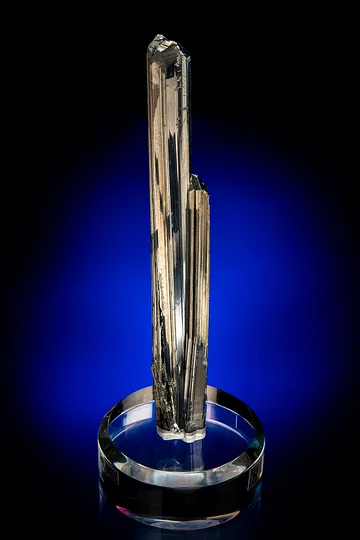
Ichinokawa Mine, Japan — historic antimony locality renowned for dramatic stibnite prisms, old provenance labels, and enduring collecting appeal.
Key facts
Ichinokawa Mine is one of the great names in mineral collecting: the Shikoku antimony mine whose stibnite crystals became the Japanese standard of the species. The locality lies in Saijō City, Ehime Prefecture, close to the Median Tectonic Line, where stibnite-quartz veins cut Sanbagawa crystalline schists and the locally famous Ichinokawa conglomerate or breccia. The specimen story is inseparable from that structure. In ordinary vein matter, stibnite was ore; in open cavities within brecciated graphite-schist country rock, it grew as dramatic metallic prisms and bladed clusters.
The best Ichinokawa specimens have a reserved, almost architectural grandeur: lead-gray to bluish-black metallic crystals, strongly striated lengthwise, commonly grouped as diverging blades or thick parallel bundles, sometimes with quartz druse sparkling between the ribs. They are not merely “large stibnites.” They are nineteenth-century classics, many recovered before destructive modern drilling dominated the mine, then dispersed through Japanese, European, and American institutions during the Meiji era. In collectors’ shorthand, “Ichinokawa” still means old, important, lustrous, and difficult.
Regional View
Country View
The mine’s historical reach is unusually long. Japanese sources connect antimony from Iyo Province with early imperial records, though the attribution to Ichinokawa is necessarily cautious; the securely recorded mine history resumes in the Edo period, and the locality reached its collecting fame in the late nineteenth century. Crystals were exhibited at major domestic and international exhibitions, and fine groups entered museum collections around the world. For the collector, this is a locality where geology, mining practice, and provenance all matter: an old label reading “Iyo,” “Saijo,” “Shikoku,” “Yokohi,” or “Ichinokawa” can be nearly as important as the crystal itself.

Photo: James St. John / Wikimedia Commons

Search for specimens: View all specimens from Ichinokawa Mine, Japan
Ichinokawa Mine was an antimony mine in the Ichinokawa district of Saijō City, Ehime Prefecture, on Shikoku. The old workings are close to the Kamo River drainage and only a few kilometers from the modern city, an unusually accessible setting for a mine of such international mineralogical reputation. The district is geologically tied to the Median Tectonic Line: north of the great fault zone are Cretaceous Izumi Group sedimentary rocks, while the mine area south of it is in Sanbagawa metamorphic terrain, especially graphite schist, with local Ichinokawa conglomerate or breccia composed largely of schist fragments.
The deposit is best understood as fracture- and breccia-filling stibnite-quartz veins. Antimony-bearing hydrothermal fluids rose along fractures related to fault movement, and stibnite was deposited with quartz as temperature and pressure dropped. Where those veins remained tight, the ore was massive or veinlike. Where open cavities formed in broken country rock, the stibnite had space to develop as free-standing crystals. Those cavities, locally described as gama, produced the great mate, the columnar crystals for which the mine is famous.
The vein system was not a single lode. Historical descriptions divide it into steeply inclined “vertical” veins and low-angle “horizontal” veins. The vertical group included northern veins such as Taisei, Senga, and Saiwai, and southern veins such as Tsuru, Kame, and Noboritate. The horizontal vein system on the north side of the river included branches such as Tenjo-hi, Naka-hi, and Sui-hi. Veins commonly ranged from about 20 cm to 1 m wide, swelling and pinching in a chainlike pattern. Some were only a few hundred meters long, while the longest were described as reaching roughly 1,000 m.
The old adit names are important because they appear in historical accounts and sometimes in specimen provenance. South-bank workings included Tokorogo, Ohira, Nuta, Keyakidani, Senga, and Taisei; north-bank workings included Noboritate, Asahi, Kanamizu or Kinsui, Oo-jiki, and Unagi. The Senga-ko portal became a symbolic remnant of the mine, while the Taisei level was associated with lower workings and heavy ore haulage. A celebrated 90 cm stibnite crystal was reportedly recovered near the junction of the Asahi, Oo-jiki, and Unagi workings, an underground meeting point remembered as sankaku-gumi, or “triangle point.”
The mining history is layered. A traditional account records rediscovery in 1679 by Chikanobu Uemonnojo of the Sogabe family. Private operation continued for generations, with periods of difficulty caused by smelting problems and volatile antimony prices. In 1841 management passed to Komatsu Domain. After the Meiji Restoration, ownership shifted through the new prefectural administration and private groups, and the 1870s and 1880s brought disputes over mining rights, prospecting claims, and surrounding leases. These “mountain troubles” became notorious enough in contemporary accounts to be remembered as a major social problem of the period.
Ichinokawa’s first great modern producing period came from 1882 to 1897. Municipal sources record production from 1875 to 1957 of about 36,700 tons of concentrate containing about 19,000 tons of antimony metal, with the 1882–1897 peak accounting for roughly half of Japan’s annual antimony output in some years. The mine prospered again during wartime demand, especially around the Sino-Japanese War, the Russo-Japanese War, and World War I, because antimony alloys were used in ammunition and related military materials. In 1915 a hydroelectric plant was installed at Gomahara, and by the Taishō boom the operation had winches, pumps, ore-separation machinery, and remodeled furnaces.
Operations declined after World War I. In the Shōwa period the mine was reopened and worked on a smaller scale by private operators including Takehei Ito and Fusakichi Takahashi, later Fukumatsu Yano. Sumitomo Metal Mining acquired ownership after World War II. Work was suspended in 1947, revived in 1951 for renewed investigation and hand mining, and mechanical exploratory work began in the mid-1950s. Operations ceased in 1957, after which mine buildings, sorting plants, machinery houses, storehouses, bathhouses, tenements, and related structures were removed or disappeared.
Collecting access today is effectively closed in the practical sense. The mine is abandoned, adits are sealed or dangerous, and Saijō City has specifically warned against approaching the Senga-ko area because of collapse danger. The old veins are heavily worked, and reliable modern finds are not a meaningful source of collector specimens. Fine pieces on the market almost always come from old collections, museum deaccessions, historic dealer stock, or specimens that left Japan decades ago and have later reappeared.
The notable specimen finds belong chiefly to the open cavities in the horizontal and vertical vein systems. Former miner Yazo Yano claimed he could tell crystal origin by appearance: vertical-vein crystals were remembered as beautiful, horizontal-vein crystals as hard, Tsuru-hi crystals as containing mica impurities, and Kame-hi crystals as containing quartz. Whether every such distinction can be applied specimen by specimen today is doubtful, but the observations are valuable because they show how intimately miners knew the material. The finest surviving Ichinokawa stibnites tend to be those saved as crystals rather than broken as ore: large, bright, naturally terminated, and accompanied by old locality history.
Ichinokawa stibnite is the locality’s defining mineral: Sb2S3 in thick prismatic to bladed crystals, metallic lead-gray to bluish-black, deeply striated, and commonly arranged as divergent clusters or parallel bundles, with quartz as the most important association and minor calcite, pyrite, arsenopyrite, cinnabar, and antimony oxidation products in the broader assemblage. The legendary crystals came from open cavities in stibnite-quartz veins cutting brecciated graphite schist and Ichinokawa conglomerate; documented sizes include ordinary cabinet singles of several centimeters, major Japanese museum pieces around 30–45.5 cm, and historical accounts of crystals reaching about 90 cm. Good pieces here are separated from ordinary ore by undulled metallic luster, strong ribbing, honest natural terminations, minimal bruising or cleavage loss, and credible old provenance; even a modest 7–12 cm Ichinokawa single with a sharp termination and old label is a significant classic, while large undamaged groups are museum-grade objects.
Other documented minerals from the mine are subordinate but mineralogically useful. Quartz is the principal gangue and the visual partner of the stibnite pockets; calcite occurs in small amounts, and pyrite and arsenopyrite are reported especially in vein envelopes. Cinnabar is listed with stibnite and pyrite, while stibiconite and valentinite represent antimony alteration products. Modern locality records also include rare secondary antimony minerals such as coquandite and klebelsbergite, both confirmed from the locality in small collector material rather than as the large display specimens for which Ichinokawa is famous. Magnesite is also recorded from the broader locality. No recognized type-locality mineral is what makes Ichinokawa important; its status rests instead on being a world-class historic source of stibnite and a reference locality for the look of classic Japanese antimony mineralization.
Ichinokawa stibnite should be bought first with the eye and second with the label, but never without both. The mine’s fame has caused vague Japanese stibnites, old “Iyo” pieces, and even non-Japanese stibnites to be compared with or attributed to Ichinokawa. A genuine old label may read Ichinokawa, Ichinokawa Mine, Saijo, Ehime, Shikoku, Iyo Province, or occasionally refer to Yokohi; those old names can be legitimate, but they should still be judged against the specimen’s style and provenance chain. Modern Chinese stibnite is usually more abundant and can be spectacular, but its habits, freshness, and commercial history differ; Romanian, French, Nevada, and other classic stibnites also require care when labels are weak.
No well-established locality-specific enhancement tradition is associated with Ichinokawa stibnite, but repairs must be expected and examined carefully. Large stibnite crystals are soft, brittle, cleavable, and easily bruised. Look for glued terminations, reattached blades, filled cracks, old adhesive in grooves, disguised base repairs, and mounted or trimmed areas hidden in quartz or dark matrix. A broken end may be shiny and convincing, so do not mistake every chisel-like end for a natural termination. On single crystals, a complete termination and undamaged longitudinal edges are major value factors.
Condition is central. Stibnite has low hardness and perfect cleavage, and Ichinokawa crystals often show edge bruising, cleaved tips, oxidized patches, or dull blackened surfaces from age and exposure. Saijō sources emphasize that long exposure to air and light can dull the bright metallic surface; important local specimens are kept in sealed cases for that reason. For cabinet care, avoid open shelves, direct sunlight, water cleaning, ultrasonic cleaning, chemical dips, or vigorous brushing. Dust with an air bulb or the softest possible brush, and support long crystals so that vibration or a shifting base cannot snap them.
Handling should also respect the chemistry. Stibnite is antimony sulfide. Normal display of an intact specimen is not the same as exposure to soluble antimony compounds, but collectors should avoid creating or inhaling dust, washing residues down a sink, licking or wetting the specimen, or allowing children to handle it. Gloves are sensible for valuable pieces, less because the mineral will poison a careful adult through brief contact and more because oils, pressure, and accidental knocks degrade the specimen.
Market availability is limited and uneven. Small singles and repaired fragments appear with some regularity from old collections, but fine, bright, naturally terminated Ichinokawa crystals are scarce, and large aesthetic groups are genuinely rare. A specimen with old Japanese, European, or American institutional or dealer provenance can command a premium even at modest size. Conversely, a dull, cleaved, undocumented stibnite should not be priced as Ichinokawa merely because it looks “old” or because the label says Japan.
The best Ichinokawa stories begin underground, not with sight but with sound. Former miner Yazo Yano, who began work at the mine in 1893, remembered that the stibnite pockets could be found because the cavities were hollow enough to echo the footsteps of workers passing above or beside them. A great crystal, in that telling, was first heard. Once the cavity was located, only a skilled chisel worker could remove the crystal intact. The miner might cut roughly 90 cm around it, slowly freeing the stibnite from its pocket rather than blasting it to pieces.
The old miners spoke of the crystals as if they were alive. Inside the cavity, large stibnites were remembered as flexible enough to bend by hand, and miners would say, “It’s still growing.” Modern mineralogists would describe this more carefully as flexibility or curvature rather than literal softness that hardened on exposure, but the miners’ phrase survives because it captures the strange physical experience of working a metallic-looking mineral that was not a hard metal at all. The crystal looked like steel, yet it could bruise, cleave, curve, and break.
Ichinokawa’s mining method shaped the specimens that survived. Before the Meiji period, miners worked mainly with hammer and chisel; hard rock was sometimes heated with charcoal. Later, gunpowder was used, but not in the shattering style of modern dynamite work. A miner bored a hole about 60 cm deep by hand, packed it with grain-sized pellets, and fired it with a fuse. Yano believed the famous 90 cm crystal recovered in 1880 was removed by hand using a tagane chisel. Had the mine depended earlier on powerful boring machines and dynamite, many of the crystals now admired in museums would likely have ended as broken ore.
The lighting was as memorable as the crystals. When Yano started, miners still used simple seashell lamps, probably turban shells filled with rapeseed oil and fitted with cotton wicks. Iron lamps were used too, and acetylene lamps came later. One surviving work song, Settobushi, preserves the hierarchy of light with a sharp little joke: “Hand lamps are too nice for third-class miners / Let’s buy them some turban shells.” In two lines, the song gives the reader the mine’s darkness, class structure, poverty, and humor.
Above ground, Ichinokawa was not a lonely mountain adit but a boom settlement. During the Meiji golden age, people used the phrase Shirome sengen, the “many houses of Ichinokawa.” Apprentices Ichitaro Bunno and Yazo Yano remembered at least 1,000 workers. Near the mountain-god shrine, two-story tenements about 18 m long stepped up the slope. Fish markets, restaurants, bathhouses, theaters, geisha, and policemen all belonged to the mining landscape. People climbed from Saijō before dawn by lantern light, carrying lunches and searching in groups for antimony ore.
When a rich vein was struck, it was called “piercing a great vein,” and the celebration could last two or three days with drinking and singing. Work songs belonged not only to miners but also to ore beaters and the women who separated ore. When 30 or 40 voices sang together, the songs echoed through the adits and sorting places. Most are gone now, but surviving lines still name the pleasures of Saijō: Bujo’s cherry blossoms, Kannon-dō Temple, Tano-ya’s second floor, and Kaga-ya’s udon, soba, and gomoku-meshi.
Sokichi Tokunaga, a Meiji-period mine figure, appears in the sources almost theatrically. In 1880 he donated a torii gate to Shiromeyama Shrine. He was remembered for lavish spending on geishas at Konpira in Kagawa Prefecture, for scattering money on the ground for geishas to pick up, and for donating 1,000 yen, a vast sum at the time. On a sales trip to Osaka, he reportedly tapped the rim of a silver brazier with the head of his tobacco pipe. When a clerk objected, Tokunaga laughed, “Silver is cheap.” The performance worked: the clerk took him for a man of immense wealth, and negotiations moved in Tokunaga’s favor.
The women’s labor was equally specific and physically exacting. A yurifu-san, or female ore separator, wore karusan, a short hakama-like work garment, sat on a large cushion, and shook ore in a shallow round sifter over a waterproof cover on her knees. She lifted a basin from a water tank about 1.2 square meters, separated stibnite from waste, placed the good mineral into a deep container, and reworked the silt at the bottom. Other women, known as kanametataki, broke ore away from waste rock with hammers near the adit entrances. The bright crystals now sitting in cabinets came through a chain of hands, many of them women’s hands.
The rewards could be real. In the 1930s, an average miner was expected to produce about 3.75 kg of ore per day. Skilled miners might produce 187.5 to 225 kg in a month, and rice bonuses were paid for exceeding quotas: 30 kg of rice for more than 187.5 kg, 60 kg for more than 375 kg. A miner producing 700 kg received substantial rewards in both money and rice, the latter brought down from the mountains on horseback. Tsurumatsu Ito remembered New Year’s raffle tickets, with prizes such as clocks, clothing, and jikatabi split-toed work shoes; he won an alarm clock.
The cost was severe. The remembered accounts speak of pale miners, breathing disorders, widows, and lung disease. The small adits were punishing spaces: large passages such as Senga-ko were about 2.5 m by 2.5 m, but unnamed workings could be only about 90 cm by 1.2 m, forcing miners to crouch and drag rock in boxes by ropes over their shoulders. In hard rock, hand work might advance only about 10 cm in a day; after pneumatic drills arrived, advance could exceed 1.5 m.
After the mine ceased operations in 1957, the human landscape vanished faster than the mineral fame. Offices, sorting plants, machinery houses, storehouses, bathhouses, tenements, and the guest house disappeared one after another. By the early 1980s, the site had become grass, earth, sealed portals, and memory. That is why an Ichinokawa stibnite is more than a metallic crystal. It is a fragment of a mine heard before it was seen: footsteps over a hollow pocket, shell lamps in darkness, chisels around a living-looking crystal, songs in the sorting shed, and a mountain town that is mostly gone.
_5_(18923530112).jpg)
