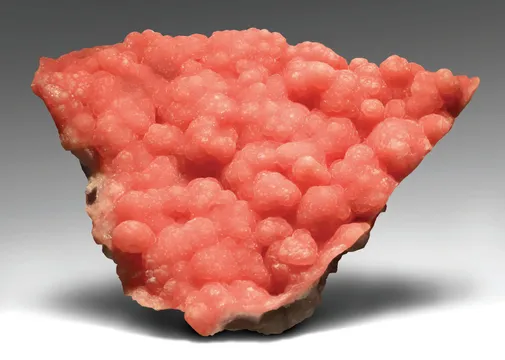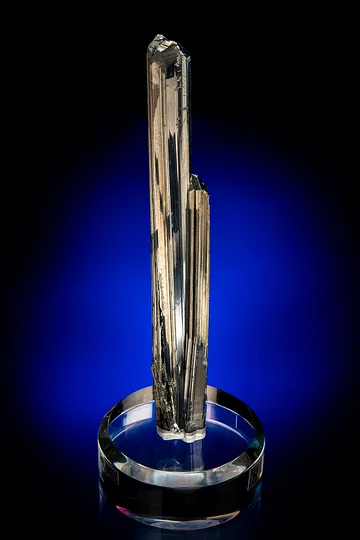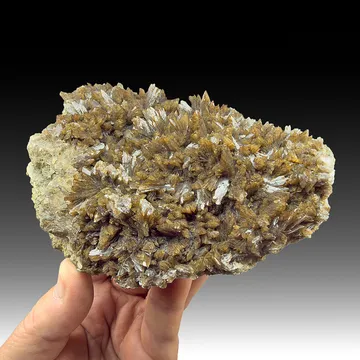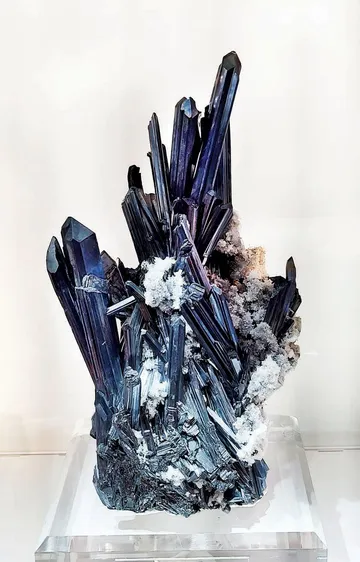
A collector's guide to Fuka mine, Japan: its geology, mining history and notable minerals, illustrated with the 23 specimens documented from this locality on EarthWonders.
Key facts
Fuka mine is one of the great “small” localities of modern mineralogy: not a metal mine that became famous for showy ore, but a calcite and crystalline-limestone operation whose skarn seams yielded an extraordinary suite of calcium silicates, borates, borosilicates, and Cu–Bi rarities. The mine lies at Fuka, in the former Bitchū town area of Takahashi City, Okayama Prefecture, Honshu, where high-temperature contact metamorphism and metasomatism affected limestone along monzonitic to quartz-monzonitic intrusions. For collectors, Fuka’s signature is unmistakable: deep blue-violet henmilite crystals, often scattered over white olshanskyite or calcite, with the richest pieces showing tiny but sharply colored crystals in striking contrast to pale hydrous borate matrix.
Regional View
Country View
Fuka matters far beyond henmilite. It is a type-locality machine: bicchulite, fukalite, oyelite, clinotobermorite, henmilite, kusachiite, takedaite, parasibirskite, okayamalite, numanoite, shimazakiite, and chiyokoite all tie their original descriptions to this mine or to the Fuka skarn system as documented in the mineralogical literature. The locality’s importance comes from the way it records several overlapping stages: primary high-temperature gehlenite–spurrite skarn, later hydration of calcium silicates, boron metasomatism, and late hydrothermal alteration that transformed anhydrous borates into rarer hydrous phases. The best specimens are not large cabinet showpieces in the quartz-and-sulfide sense; they are concentrated, elegant small-cabinet or thumbnail-scale pieces where one reads color, association, paragenesis, and locality specificity under magnification.

Photo: Wikimedia Commons
Search for specimens: View all specimens from Fuka mine, Japan
Fuka mine is recorded at about 34°47′17″ N, 133°26′34″ E in the Fuka district of Takahashi City, Okayama Prefecture. The operation was developed for very pure calcite in crystalline limestone; published mineral descriptions describe it as a marble quarry or limestone mine, and later summaries note that this high-purity calcite was valuable for specialized uses including toothpaste. The scientific fame of the mine, however, comes from the skarn at the contact between the limestone/calcite orebody and intrusive igneous rocks. This is a high-temperature, boron-bearing, extremely low-iron calc-silicate skarn, a setting favorable for unusual calcium silicates and calcium borates rather than the more familiar Fe-rich garnet–pyroxene–magnetite skarns of many metal mines.
The principal skarn assemblage includes gehlenite and spurrite, with rankinite, vesuvianite, wollastonite, grossular-andradite-series garnet, cuspidine, scawtite, xonotlite, hillebrandite, tobermorite-group minerals, and calcite in various zones and veins. The borate mineralization is concentrated in veinlets, irregular bodies, and altered patches in crystalline limestone close to the gehlenite–spurrite skarn. Several papers describe borate minerals cutting the limestone, lining fissures, or occurring along the boundary between crystalline limestone and skarn. One documented borate body rich in nifontovite and pentahydroborite measured roughly 3 m wide by 7 m long, with a calcite vein running through it and carrying accessory henmilite, ettringite-group minerals, cuspidine, cahnite, and related species. Another pentahydroborite-bearing body was described as lenticular, about 50 cm thick at maximum and 120 cm long on an adit wall, with a porcelain-like skarn zone less than 20 cm wide in its center.
Fuka’s paragenesis is unusually well resolved because so many new or rare minerals were described from carefully studied specimens. Early high-temperature reactions produced gehlenite–spurrite skarn and associated calcium silicates. Boron-rich fluids introduced or mobilized boron to form anhydrous calcium borates such as takedaite and shimazakiite. Later hydrothermal alteration hydrated and replaced these anhydrous borates, generating nifontovite, olshanskyite, frolovite, sibirskite, parasibirskite, uralborite, inyoite, hexahydroborite, and priceite in different micro-environments. Copper-bearing late fluids produced the collector-favorite henmilite and rarities such as numanoite, kusachiite, kinoite, and related Cu-bearing phases. The presence of bismuth in kusachiite and sillenite, arsenic in cahnite and johnbaumite, and boron in both borates and borosilicates gives the locality a chemical breadth out of proportion to its physical size.
Published mining information is not perfectly uniform, but the most useful collector-level timeline is clear. The mine was worked for limestone/calcite for roughly three decades before a reported closure in March 2000 in a 2001 description of kinoite from the mine dump. Earlier new-mineral work was tied to active quarrying or mine access: henmilite was described from material found during a survey of borate veins and was reported from the Fuka marble quarry operated by Ootori Seiko Co. at Bicchukogyosho. Japanese mineralogical notes also indicate that the early pentahydroborite and henmilite work came from the second level, while major 1990s borate research concentrated especially on material from the fourth level. Collector accounts and dealer records repeatedly point to early-2000s access by Japanese collectors and researchers as the source of many specimens now circulating, but present collecting access is not open: modern locality listings state that collecting is strictly prohibited except for approved researchers associated with Okayama University.
The most important specimen-producing episodes for collectors are the henmilite discoveries. The original material was extremely small: blue-violet henmilite occurred in small cavities in pentahydroborite veins, commonly as anhedral masses and only rarely as euhedral crystals up to 0.2 mm on or intergrown with pentahydroborite. A later find, reported in 1992, came from a calcite vein cutting the gehlenite–spurrite skarn and produced prismatic henmilite crystals up to 3 mm long, associated with tenorite, sillenite, bultfonteinite, cuspidine, thaumasite, and related minerals rather than the original pentahydroborite-dominant association. Subsequent collector material made Fuka henmilite a coveted thumbnail and miniature species: deep blue to violet crystals, sometimes described in the 1–3 mm range and occasionally larger, arranged on white olshanskyite or calcite. The best pieces are those in which the dark color is saturated, the crystals are undamaged and distinct, and the association tells the Fuka story at a glance.
Henmilite is the emblem of Fuka and remains a locality-defining species: Ca2Cu(OH)4[B(OH)4]2, a hydrous calcium copper borate first described from the mine as tiny blue-violet crystals in cavities in pentahydroborite veins cutting marble. The type material included anhedral masses and rare euhedral crystals only to about 0.2 mm, but the later calcite-vein occurrence in the gehlenite–spurrite skarn produced prismatic crystals up to 3 mm long with a different association that includes calcite, tenorite, sillenite, bultfonteinite, cuspidine, and thaumasite; collector pieces may also show henmilite on white olshanskyite or calcite, and the most desirable examples have saturated deep blue to violet, transparent to gemmy crystals standing proud of a clean pale matrix. Because the mineral is soft, fragile, and intensely pleochroic, a good Fuka henmilite is judged less by size alone than by crystal integrity, color concentration, isolation from bruising or coatings, and the quality of contrast against its borate or carbonate host.
Olshanskyite at Fuka is a rare hydrous calcium borate of the crystalline-limestone borate zones near the gehlenite–spurrite skarns, occurring as anhedral masses and as micro-twinned platy crystals up to 1 cm long. In the Fuka paragenesis it formed by hydrothermal alteration of nifontovite and an anhydrous borate precursor, and it is intimately tied to the same altered borate bodies that carry nifontovite, calcite, pentahydroborite, hexahydroborite, and locally henmilite. As a display species it is usually valued less as a visually dominant mineral than as the snow-white to pale matrix that sets off henmilite’s blue-violet crystals, but fine olshanskyite-rich pieces show clean, compact, undisintegrated borate matrix, bright surfaces, and clear association rather than chalky, abraded, or confused white masses.
Other documented Fuka minerals make the mine one of Japan’s most productive new-species localities. Bicchulite, a natural analogue of gehlenite hydrate, was described from Fuka material; fukalite occurs as pale brown to white crystals in spurrite–gehlenite skarn and was named for Fuka; oyelite was recognized from a 2 cm vein in gehlenite–spurrite skarn with alternating 1–5 mm layers of oyelite and scawtite; clinotobermorite was described as colorless to white tabular or acicular crystals associated with tobermorite, plombierite, apophyllite, and calcite; kusachiite is a black metallic CuBi2O4 in calcite veins with henmilite, sillenite, bakerite, bultfonteinite, apophyllite, cuspidine, and thaumasite; takedaite is a white to pale-gray anhydrous Ca3B2O6 associated with nifontovite, olshanskyite, pentahydroborite, frolovite, sibirskite, calcite, and an unidentified mineral; parasibirskite is a white, weakly pearly hydrous calcium borate formed by alteration of takedaite; okayamalite is a creamy-white boron analogue of gehlenite found as millimetric patches of fine grains in wollastonite–vesuvianite–calcite–johnbaumite aggregate; numanoite is the blue-green to colorless Cu analogue of borcarite, occurring as cores or zones in borcarite crystals and as tiny veinlets; shimazakiite occurs as two polytypes in the Fuka skarn and is closely associated with takedaite and calcite; and chiyokoite is a later-described ettringite-group mineral associated with calcite, henmilite, and tacharanite in hydrothermally altered calc-silicate skarn. Add uralborite, inyoite, hexahydroborite, priceite, frolovite, sibirskite, borcarite, calciborite, cahnite, charlesite, kinoite, sillenite, johnbaumite, fluorite, apophyllite, and a long roster of calcium silicates, and the mine becomes a compact laboratory of boron-rich skarn alteration.
Fuka specimens should be bought as locality specimens first and as show specimens second. Genuine henmilite is essentially a Fuka mineral in the collector market, and the matrix association matters: dark blue to violet crystals on white olshanskyite, calcite, pentahydroborite, or altered borate/calc-silicate matrix are consistent with the known occurrences, while vague “Japanese blue borate” labels should be treated cautiously unless the mine, association, and provenance are clear. I found no well-documented program of manufactured fakes or treatments specific to Fuka henmilite or olshanskyite, but mislabeling is a realistic concern because several Fuka phases are white, fine-grained, hydrous, and visually similar, and because some collector pieces contain multiple rare species that cannot be identified confidently by eye. A white matrix called olshanskyite, nifontovite, pentahydroborite, or calcite may require analytical confirmation if the species name materially affects value.
Condition is critical. Henmilite is soft and fragile; the original description noted that its hardness was below that of associated pentahydroborite, and later work gave low microhardness values. Small Fuka crystals are easily bruised, cleaved, or dulled by careless handling, and even a seemingly minor rub can erase the sharp termination or luster that makes a specimen desirable under magnification. Henmilite is also readily soluble in dilute hydrochloric and nitric acid, so acid cleaning is inappropriate; because much of the matrix may be calcite or hydrous borate, wet cleaning should be minimal and conservative. Store specimens dry, avoid heat, avoid acids, and keep thumbnails in boxes that prevent the crystal faces from touching cotton, foam, or lids. Hydrous borate matrices should not be tested casually with water, acids, or aggressive air abrasion.
Fluorescence and phosphorescence claims need careful wording. Some recent collector specimens on calcite matrix have been described as blue-fluorescent or phosphorescent under shortwave ultraviolet light, but that response is best attributed to calcite unless tested species-by-species. Henmilite’s strongest visual effect is its body color and pleochroism, not a reliable diagnostic fluorescence. Under a loupe or microscope, good crystals may shift from violet to blue depending on orientation and lighting; that optical character is part of the appeal and one reason well-crystallized Fuka material photographs so dramatically.
Rarity remains real, but availability is not zero. Older scientific descriptions emphasize how scarce the original henmilite material was, while later collector material from calcite and borate zones made attractive specimens available in small numbers. Modern market pieces tend to be thumbnails, miniatures, or small hand specimens with millimetric crystals; modest examples with scattered crystals can still appear, but fine pieces with multiple saturated, undamaged crystals on clean white matrix are much harder to replace. Because collecting at the mine is now restricted, new supply should be viewed skeptically unless the seller provides credible provenance and a responsible explanation of how the specimen entered the market.
There is a wonderfully ironic origin story behind Fuka’s fame. Japan, short of domestic evaporite borates, once had reason to care intensely about boron minerals; during the years before and during World War II, strategic borate supply was a real problem, and Japanese geologists looked to unusual non-evaporite sources such as skarn minerals. Yet the boron-rich Fuka skarn itself stayed hidden under forest cover until the 1960s. When mining finally exposed it, the quarry was not chasing rare borates at all. It was working exceptionally pure calcite—an industrial raw material—while the walls and veinlets quietly contained more than a hundred mineral species and a succession of minerals that would later fill journal pages.
The first henmilite story is a microscope story, not a blasting-cap-and-bonanza story. In 1986, while borate veins at Fuka were being surveyed, small blue-violet crystals were noticed close to pentahydroborite. The crystals were so small that the best euhedral examples reached only about 0.2 mm. That was enough. The work showed the mineral to be the first known borate containing both calcium and copper, and the species was named henmilite for Professor Kitinosuke Henmi and Dr. Chiyoko Henmi of Okayama University, whose work on the Fuka skarn had already helped bring bicchulite, fukalite, and oyelite to light. The type material was deposited in the National Science Museum, Tokyo, and a mineral that began as barely visible blue points became the mine’s collector identity.
The next act changed henmilite from an analytical rarity into a collector mineral. In 1992, a different occurrence was reported: a calcite vein cutting the gehlenite–spurrite skarn produced prismatic henmilite crystals up to 3 mm long. The association also changed. Instead of the original pentahydroborite-centered setting, this material came with species such as tenorite, sillenite, bultfonteinite, cuspidine, and thaumasite. That jump—from 0.2 mm type crystals to millimetric prismatic crystals—explains why serious collectors can own visually compelling Fuka henmilite at all.
A third strand belongs to the mine levels themselves. Japanese accounts of the borate research describe the second level as the source of the early pentahydroborite and henmilite reports. Later, beginning in the early 1990s, research centered especially on the fourth level, where calcium borates occurred in vein-like, lens-like, and patch-like forms in crystalline limestone. The names that came out of those studies—nifontovite, olshanskyite, takedaite, frolovite, sibirskite, borcarite, parasibirskite, uralborite, and more—read like a pocket notebook from a mine that had more mineral chemistry than space.
The naming history has a human warmth unusual for such technical minerals. Henmilite honors the Henmi father-daughter team. Chiyokoite later honored Dr. Chiyoko Henmi directly. Collectors have noticed the poetic association when chiyokoite occurs with henmilite on a single Fuka specimen: the mineral names reunite two generations of the same scientific family on one piece of altered skarn.
Henmi, Chiyoko; Kusachi, Isao; Henmi, Kitinosuke; Sabine, Peter Aubrey; and Young, Brian Raymond (1973). “A new mineral bicchulite, the natural analogue of gehlenite hydrate, from Fuka, Okayama Prefecture, Japan and Carneal, County Antrim, Northern Ireland.” Mineralogical Journal, 7, 243–251. A foundational Fuka paper and one of the first signals that the mine’s gehlenite–spurrite skarn would be unusually productive for new calcium silicate species.
Henmi, Chiyoko; Kusachi, Isao; Kawahara, Akira; and Henmi, Kitinosuke (1977). “Fukalite, a new calcium carbonate silicate hydrate mineral.” Mineralogical Journal, 8(7), 374–381. Describes fukalite from Fuka and related Japanese skarns, with Fuka giving the species its name.
Kusachi, Isao; Henmi, Chiyoko; and Henmi, Kitinosuke (1984). “An oyelite-bearing vein at Fuka, the Town of Bitchu, Okayama Prefecture.” Journal of the Japanese Association of Mineralogists, Petrologists and Economic Geologists, 79(7), 267–275. Documents the layered oyelite–scawtite vein and its alteration products in the Fuka gehlenite–spurrite skarn.
Nakai, Izumi; Okada, Hisashi; Masutomi, Kazunosuke; Koyama, Eiji; and Nagashima, Kozo (1986). “Henmilite, Ca2Cu(OH)4[B(OH)4]2, a new mineral from Fuka, Okayama Prefecture, Japan. I. Occurrence and description.” American Mineralogist, 71, 1234–1239. The essential type description of henmilite, including occurrence in pentahydroborite veins, physical properties, and naming.
Henmi, Chiyoko and Kusachi, Isao (1992). “Clinotobermorite, Ca5Si6(O,OH)18·5H2O, a new mineral from Fuka, Okayama Prefecture, Japan.” Mineralogical Magazine, 56(384), 353–358. Establishes clinotobermorite as a new Fuka tobermorite-group mineral from gehlenite–spurrite skarn veins.
Kusachi, Isao (1992). “New data on mineralogical properties of Henmilite.” Journal of the Mineralogical Society of Japan, 21(3), 127–130. Reports the later calcite-vein henmilite occurrence with prismatic crystals up to 3 mm long and a distinct association from the original type material.
Kusachi, Isao and Henmi, Chiyoko (1994). “Nifontovite and olshanskyite from Fuka, Okayama Prefecture, Japan.” Mineralogical Magazine, 58(391), 279–284. The key reference for Fuka olshanskyite, including its occurrence as anhedral masses and micro-twinned platy crystals and its alteration relationship to nifontovite and anhydrous borate.
Henmi, Chiyoko (1995). “Kusachiite, CuBi2O4, a new mineral from Fuka, Okayama Prefecture, Japan.” Mineralogical Magazine, 59(396), 545–548. Describes the black metallic Cu–Bi oxide kusachiite from calcite veins cutting Fuka skarn.
Kusachi, Isao; Henmi, Chiyoko; and Kobayashi, Shoichi (1995). “Takedaite, a new mineral from Fuka, Okayama Prefecture, Japan.” Mineralogical Magazine, 59(396), 549–552. Describes takedaite, the anhydrous calcium borate that anchors important alteration sequences at Fuka.
Kusachi, Isao; Takechi, Yasushi; Henmi, Chiyoko; and Kobayashi, Shoichi (1998). “Parasibirskite, a new mineral from Fuka, Okayama Prefecture, Japan.” Mineralogical Magazine, 62(4), 521–525. Defines parasibirskite as a new hydrous calcium borate formed by hydrothermal alteration of takedaite.
Matsubara, Satoshi; Miyawaki, Ritsuro; Kato, Akira; Yokoyama, Kazumi; and Okamoto, Akiyoshi (1998). “Okayamalite, Ca2B2SiO7, a new mineral, boron analogue of gehlenite.” Mineralogical Magazine, 62(5), 703–706. Describes creamy-white okayamalite from Fuka as the boron analogue of gehlenite.
Kusachi, Isao; Shiraga, Kanako; Kobayashi, Shoichi; Yamakawa, Junji; and Takechi, Yasushi (2000). “Uralborite from Fuka, Okayama Prefecture, Japan.” Journal of Mineralogical and Petrological Sciences, 95(4), 43–47. Documents uralborite as a secondary late-hydrothermal alteration product of sibirskite at Fuka.
Kusachi, Isao; Nishimura, Makoto; Shiraga, Kanako; Kobayashi, Shoichi; and Yamakawa, Junji (2001). “Kinoite from Fuka mine, Okayama Prefecture, Japan.” Journal of Mineralogical and Petrological Sciences, 96(1), 29–33. Reports the first Japanese occurrence of kinoite from a Fuka dump specimen and provides useful mining-history details.
Ohnishi, Masayuki; Kusachi, Isao; Kobayashi, Shoichi; Yamakawa, Junji; Tanabe, Mitsuo; Kishi, Shigetomo; and Yasuda, Takashi (2007). “Numanoite, Ca4CuB4O6(OH)6(CO3)2, a new mineral species, the Cu analogue of borcarite from the Fuka mine, Okayama Prefecture, Japan.” The Canadian Mineralogist, 45, 307–315. Describes numanoite, a Fuka type-locality Cu borate-carbonate occurring in borcarite and tiny veinlets.
Kusachi, Isao; Shiraishi, Naoko; Shimada, Kazumasa; Ohnishi, Masayuki; and Kobayashi, Shoichi (2008). “CO3-rich charlesite from the Fuka mine, Okayama Prefecture, Japan.” Journal of Mineralogical and Petrological Sciences, 103(1), 47–51. Documents charlesite crystals from a calcite vein along the limestone–skarn boundary.
Kusachi, Isao; Kobayashi, Shoichi; Takeuchi, Yasunori; Nakamuta, Yoshihiro; Nagase, Toshiro; Yokoyama, Kazumi; Momma, Koichi; Miyawaki, Ritsuro; Shigeoka, Maki; and Matsubara, Satoshi (2013). “Shimazakiite-4M and shimazakiite-4O, Ca2B2O5, two polytypes of a new mineral from Fuka, Okayama Prefecture, Japan.” Mineralogical Magazine, 77(1), 93–105. Establishes shimazakiite polytypes and their relationship to Fuka’s post-metasomatic borate assemblage.
Kobayashi, Shoichi; Ando, Tamami; Kanayama, Akiko; Tanabe, Mitsuo; Kishi, Shigetomo; and Kusachi, Isao (2014). “Calciborite from the Fuka mine, Okayama Prefecture, Japan.” Journal of Mineralogical and Petrological Sciences. Adds another rare calcium borate to the documented Fuka assemblage.
Ando, Tamami; Kanayama, Akiko; Kobayashi, Shoichi; Miyawaki, Ritsuro; Kishi, Shigetomo; Tanabe, Mitsuo; and Kusachi, Isao (2015). “Roweite from the Fuka mine, Okayama Prefecture, Japan.” Journal of Mineralogical and Petrological Sciences, 110(1), 29–34. Documents roweite in the Fuka borate assemblage, closely associated with uralborite.
Kobayashi, Shoichi; Ando, Tamami; Kanayama, Akiko; Tanabe, Mitsuo; Kishi, Shigetomo; and Kusachi, Isao (2017). “Priceite from the Fuka mine, Okayama Prefecture, Japan.” Journal of Mineralogical and Petrological Sciences, 112(1). Reports the first Japanese occurrence of priceite from the boundary between crystalline limestone and calcium-borate aggregates at Fuka.
Nishii, Toshiki; Kobayashi, Shoichi; Takechi, Yasushi; Naohara, Jun; and Kusachi, Isao (2018). “Isotopic composition of boron and its origin in CaO-B2O3-H2O minerals at the Fuka mine, Okayama, Japan.” Bulletin of the Institute of Frontier Science and Technology, Okayama University of Science, 1. Uses boron isotopes to interpret the origin of the Fuka calcium borates and the role of igneous-related hydrothermal fluids.
Lykova, Inna; Chukanov, Nikita V.; Pekov, Igor V.; Yapaskurt, Vasiliy O.; Pautov, Leonid A.; Karpenko, Vladimir Yu.; Belakovskiy, Dmitry I.; Varlamov, Dmitry A.; Britvin, Sergey N.; and Scheidl, Katharina S. (2020). “Chiyokoite, Ca3Si(CO3)[B(OH)4]O(OH)5·12H2O, a new ettringite-group mineral from the Fuka mine, Okayama Prefecture, Japan.” The Canadian Mineralogist, 58(5), 653–662. Describes chiyokoite, a late Fuka type-locality mineral associated with calcite, henmilite, and tacharanite.
Petrov, Alfredo (2016). “Henmilite: The Dark Blue Borate from the Fuka Mine, Japan.” Rocks & Minerals, 91(1), 54–58. A collector-focused treatment of Fuka henmilite, including specimen photographs and locality context.
Mindat locality page: Fuka mine, Fuka, Bitchū, Takahashi City, Okayama Prefecture, Japan — The broadest live locality checklist, with coordinates, mineral list, type-locality indicators, references, and access warning.
Mindat photo gallery for Fuka mine — Useful for seeing the visual range of Fuka henmilite, olshanskyite, and associated rare-species specimens.
Wikimedia Commons: Henmilite–Olshanskyite from Fuka mine — Freely licensed Rob Lavinsky photograph of a classic blue henmilite on pale olshanskyite matrix.
Henmilite specimen notes by T. Kato — Collector-oriented Japanese page summarizing the 1986 discovery, 1992 calcite-vein material, later specimen production, fragility, and access restrictions.
Peter Andersen, “The best known minerals of Japan” — Readable overview of Japanese collector minerals with a substantial henmilite section and context for Fuka’s collector reputation.
Peter Andersen, “The Japanese Prefectures and their minerals” — Long prefecture-by-prefecture mineral list; the Okayama section is useful for seeing Fuka among regional Japanese localities.
Mineral Localities and Mining Districts in Japan — Concise modern overview of major Japanese localities, with a short Fuka summary and locality photograph credit.
Cambridge Core: “Nifontovite and olshanskyite from Fuka, Okayama Prefecture, Japan” — Primary reference for olshanskyite and nifontovite at Fuka.
American Mineralogist PDF: “Henmilite, Ca2Cu(OH)4[B(OH)4]2, a new mineral from Fuka, Okayama Prefecture, Japan” — Original henmilite description, essential for type material, chemistry, optics, and occurrence.
J-STAGE: “New data on mineralogical properties of Henmilite” — Key short paper on the larger prismatic henmilite crystals from a calcite vein.
J-STAGE: “Kinoite from Fuka mine, Okayama Prefecture, Japan” — Useful for the mine-history note, dump occurrence, and Cu-bearing veinlet context.