Grand Reef Mine, USA - Arizona locality famed for vivid linarite and rare micro-minerals; prized pocket specimens and a type locality for several rare species.
Key facts
Grand Reef is one of the classic small mines whose mineralogical reputation far exceeds its tonnage. Set in Laurel Canyon near Klondyke, on the west side of the Santa Teresa Mountains of Graham County, Arizona, the mine worked a compact epithermal lead-copper-silver deposit in a silicified breccia body that stands as a resistant, cliff-like “reef.” That geology matters directly to collectors: fractured galena, chalcopyrite, fluorite, quartz, and oxidizing copper-lead solutions produced an unusually rich secondary suite, from vivid cabinet linarite and twinned cerussite to a cluster of exceptionally rare lead fluorides for which the mine is the type locality.
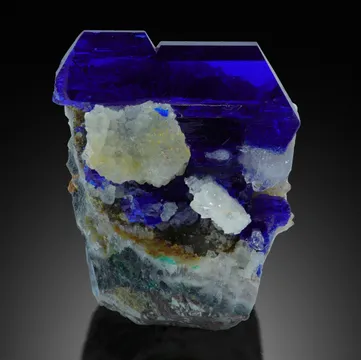
The specimens that built Grand Reef’s name are not broad, mass-produced decorator pieces; they are pocket specimens. The best linarites show a saturated, almost enamel-blue colour in sharp tabular to prismatic crystals, sprays, and drusy linings in quartz-lined cavities. Cerussite, generally white to colourless or faintly tinted, occurs as lustrous twins and sixlings, sometimes set handsomely in open vugs with quartz and iron-stained matrix. The mine’s rarest minerals are much less showy to the naked eye—colourless needles, plates, and tiny blades in isolated galena-fluorite-quartz pockets—but scientifically they make Grand Reef one of Arizona’s great micro-mineral localities.
Regional View
Country View
What separates Grand Reef from most Arizona lead-copper mines is the combination of attractive display minerals and tiny, chemically unusual species formed under narrowly constrained conditions. In the famous bench area near the upper workings, isolated vugs surrounded by galena, fluorite, and quartz created local micro-environments unlike the broader sulfate-rich oxidation zone. In one such vug, collectors and mineralogists recognized grandreefite, pseudograndreefite, laurelite, and aravaipaite; later work added artroeite and calcioaravaipaite to the mine’s suite of Grand Reef lead fluorides. Shannonite, a rare lead oxycarbonate, further broadens the locality’s importance.

Photo: Wikimedia Commons

Photo: Wikimedia Commons
Search for specimens: View all specimens from Grand Reef Mine, USA
Grand Reef Mine lies in Laurel Canyon, northeast of Klondyke in the Aravaipa mining district of Graham County, Arizona. The deposit is a small epithermal lead-copper-silver system hosted by a silicified breccia made of rhyolite and schist fragments, with mineralization localized along a heavily brecciated, nearly vertical fault zone. The “reef” itself is a resistant sheet of silicified breccia that forms a steep cliff in the canyon, giving the mine both its name and its striking field appearance.
The primary ore assemblage was dominated by galena, with chalcopyrite, pyrite, argentite or acanthite, sphalerite, and lesser copper sulfides. Supergene alteration and enrichment added chalcocite, covellite, native silver, and copper, followed by an oxidation suite rich in lead sulfates, carbonates, copper sulfates, and fluorine-bearing minerals. Quartz and fluorite are central to the locality’s paragenesis: fluorite occurs as gangue and as vug material, while quartz-lined cavities provided the clean backgrounds on which linarite, cerussite, anglesite, caledonite, leadhillite, and rarer species could crystallize.
The mine was discovered in 1890 and was developed in the 1890s, with early workings reaching considerable depth before sustained production. Production is recorded for 1907–1908, 1915–1920, and 1929–1931, and district summaries indicate additional activity around the late 1930s and early 1940s. During the 1915–1920 period, about 30,000 tons of ore were mined, yielding crude shipping ore and concentrate; published assays for the crude ore report high lead, appreciable copper and zinc, and significant silver values. The mine was one of the principal producers in the Aravaipa district and was ranked as Arizona’s second lead producer in 1931.
The workings were underground. Historical mine descriptions record a long haulage adit—about 1,200 to 1,400 feet depending on the survey source—an internal shaft or winze extending roughly 300 feet below the adit, and levels at 100-foot intervals. The main ore shoot was stoped above and below the adit level, while other stopes lay north and west of the main stope. Below the adit level, one ore body was described as roughly 40–50 feet long and 10–15 feet wide. The host environment includes fissure veins and replacement bodies in rhyolite and brecciated limestone associated with low-angle fault zones.
For collectors, the most important specimen ground was not simply the bulk ore shoot but the oxidized bench area near the top of the reef, just south of the vertical stope known as the glory hole. A bench blasted there in 1969 produced many of the mine’s well-crystallized oxidation minerals, especially sulfates. The same bench area yielded the type specimen for grandreefite, pseudograndreefite, laurelite, and aravaipaite: a small vug once enclosed by galena, an inner layer of fluorite, and a complete quartz lining. This kind of isolated pocket chemistry explains why Grand Reef could produce both large, visually powerful linarites and microscopic lead fluorides that remain extraordinary mineralogical records.
Collecting today should be approached as a permission-only proposition. Historical and database records treat Grand Reef as an underground past producer with private-property and claim-status complications, and old mine workings in the Santa Teresa Mountains are inherently hazardous. The old road above Waterfall Canyon has long been described as poor, and the mine’s underground stopes, adits, flooded levels, and caved areas are not casual collecting ground. Most legitimate specimens in circulation come from older collecting, professional specimen-mining activity, dealer dispersals, and long-held Arizona collections rather than from casual modern collecting.
Grand Reef linarite is the locality’s signature display mineral: brilliant deep-blue to azure crystals lining quartz cavities in silicified breccia, commonly with cerussite, anglesite, galena, caledonite, chrysocolla, malachite, gearksutite, and other oxidation products. Mindat records describe brilliant druses and splendent groups with crystals reaching about 1 inch, while the 1989 Grand Reef type-mineral paper notes well-formed linarite crystals to 5 cm, an exceptional size for the species; in the collector market, sharp crystals in the 1–3 cm range are already strong pieces. The best examples are not merely blue coatings: they have glassy to adamantine luster, crisp tabular or prismatic form, open placement in a vug, and strong contrast against pale quartz or rusty limonitic matrix. Ordinary pieces are attractive but crowded or bruised; the finest Grand Reef linarites show individual crystals standing free enough for the form, termination, and saturated colour to read at cabinet distance.
Grand Reef cerussite is a classic companion to the mine’s lead-copper oxidation assemblage, occurring in quartz-lined vugs as white, colourless, lightly tinted, and iron-stained crystals, often twinned and locally developed as large sixling twins. Published Arizona mineral references call attention to the Grand Reef occurrence for its varied habits and large sixling-twinned crystals; specimen records show attractive cabinet pieces with fan-shaped or cyclically twinned groups in open cavities, sometimes accompanied by azurite, linarite, quartz, and amethystine quartz. Good Grand Reef cerussite has sharp cyclic twinning, bright adamantine luster, and clean exposure within a cavity; lesser examples are chalkier, heavily stained, broken at the crystal edges, or visually lost in massive matrix. Unlike the linarite, whose colour dominates instantly, the best cerussite rewards close crystallographic inspection and good lighting.
Grand Reef’s broader mineral list is unusually rich for such a small mine. Documented species include anglesite, caledonite, leadhillite, baryte, fluorite, quartz, galena, sphalerite, chalcopyrite, pyrite, acanthite, native silver, chrysocolla, malachite, azurite, antlerite, beaverite-(Cu), brochantite, chalcophyllite, devilline, mimetite, wulfenite, plumbojarosite, plumbogummite, minium, massicot, litharge, pinalite, scotlandite, gearksutite, creedite, and prosopite. Scientifically, the locality is best known as the type locality for grandreefite, pseudograndreefite, laurelite, aravaipaite, artroeite, calcioaravaipaite, and shannonite. Grandreefite and pseudograndreefite are lead sulfate fluorides; laurelite is a lead fluoride-chloride-hydroxide; aravaipaite, artroeite, and calcioaravaipaite are lead-calcium-aluminium fluorides and hydroxide-fluorides; shannonite is a rare lead oxycarbonate that occurs as white porcelainous material. Several of these were found in extremely limited material, making verified Grand Reef micro-specimens more important than their appearance might suggest.
Grand Reef linarite is a high-demand classic, and the primary condition issue is fragility. Linarite crystals from this mine are commonly perched in small cavities in very hard silicified breccia, so trimming damage, bruised terminations, chipped edges, and contact points are common. Even specimens that look excellent in hand should be inspected under magnification for missing terminations, broken sprays, and blue crystal fragments reattached in the vug. Linarite’s colour can resemble azurite at a glance, but Grand Reef examples typically show the more electric lead-copper-sulfate blue, tabular to prismatic morphology, and the classic quartz-lined, galena-bearing oxidation matrix.
The most common authenticity problem is not a famous Grand Reef fakery episode but mislabelling. Blue lead-copper sulfate specimens from Blanchard Mine in New Mexico, Mammoth-Saint Anthony at Tiger, and other Arizona and western U.S. localities can be visually confused with Grand Reef material when labels are lost. Provenance matters: old labels from Wayne Thompson, Southwestern Mineral Associates, Dick Jones-era Arizona dealers, Les Presmyk, Sam Elbin, or other well-documented collections add real value. For high-end pieces, compare the matrix carefully—Grand Reef’s silicified breccia, quartz-lined vugs, galena remnants, and associated cerussite or anglesite are useful clues.
Cerussite from Grand Reef should be judged by crystallography and presentation rather than sheer size. Sixling and cyclic twins are particularly desirable, especially when they sit openly in a vug rather than being partly buried. Condition issues include bruised twin edges, iron staining that obscures transparency, and contact scars where the crystal met the cavity wall. Some Grand Reef cerussite shows yellow fluorescence under shortwave or longwave ultraviolet, though iron staining can mute the response; UV reaction is an interesting supporting feature but should not be used alone to authenticate locality.
The type-locality lead fluorides are almost entirely micromount and research-suite minerals. They are colourless to white, low-hardness, and in some cases water-sensitive or chemically delicate, so they should be kept dry, stable, and away from cleaning acids or aggressive ultrasonic treatment. Grandreefite and pseudograndreefite are reported to decompose in cold water, while laurelite and aravaipaite dissolve very slowly in cold water and react readily with hydrochloric acid; any specimen suspected of carrying these minerals should be handled as a scientific specimen, not cleaned for aesthetics.
Market availability is uneven. Small linarite specimens and old micro material appear periodically, but strong Grand Reef linarites with sharp centimetre-scale crystals, clean matrix placement, and minimal damage are scarce and priced accordingly. Good cerussite matrix pieces are less frequently seen than collectors might expect and can bring strong prices when twinned, lustrous, and well documented. Verified type-mineral material is far rarer still; provenance, analytical confirmation, or publication connection is essential.
One of the great Grand Reef stories belongs to the Australian Museum’s Albert Chapman Collection specimen, registered as D.50720. The piece measures 8 x 9.5 x 7.1 cm and carries linarite crystals reported to reach 2.5 cm—large enough that the museum describes it as “one of the best linarite specimens in existence.” Wayne Thompson first spotted the specimen, but Lee Bridges and Bob Dryer extracted it in 1971 and later traded it back to Thompson. The problem was what to do with it. For more than a year, Thompson and his colleagues discussed trimming, because the linarite was fragile, the enclosing matrix was hard, and the sophisticated trimming tools now taken for granted were not available to them in the early 1970s.
The specimen’s next dramatic moment came after Albert Chapman acquired it from Thompson at the 1975 Tucson Gem and Mineral Show. Chapman traded a Tasmanian crocoite with terminated crystals for the Grand Reef linarite. At the time, part of the blue cavity was hidden under a thin cap of rock. Chapman took a risk that could easily have ruined the specimen: he set a small chisel, tapped gently, and the cap came off cleanly. Under it was the magnificent crystal-lined cavity that made the specimen famous.
The discovery of four new minerals at Grand Reef began in a very different visual register. In 1980, Wayne Thompson recovered an unusual specimen under the auspices of Southwestern Mineral Associates. William Besse recognized that it might contain minerals new to science and brought it to Anthony R. Kampf’s attention. The first assessment suggested two new species; detailed study revealed four: grandreefite, pseudograndreefite, laurelite, and aravaipaite. The type specimen was only 10 x 7 x 4 cm, and the crucial vug was about 2 x 1.5 x 0.5 cm—tiny by display standards, but enormous in scientific consequence.
A second specimen, later loaned by Les Presmyk of Mesa, Arizona, turned out to be part of the same vug. Researchers reconstructed a 27 x 25 x 15 cm block of matrix from the two vug sections and trimming fragments, showing that the little cavity had been enclosed by galena, fluorite, and quartz. This physical reconstruction helped explain why the chemistry was so unusual: the pocket was isolated enough that lead-fluoride minerals formed instead of the more common anglesite- and sulfate-dominated assemblage.
The same paper preserves a collector’s cautionary footnote. Colourless needlelike crystals consistent with laurelite had reportedly been seen by at least two other people collecting at Grand Reef, but the pieces were discarded as insignificant. It is a perfect Grand Reef lesson: the showiest blue crystals made the mine famous, but some of its greatest mineralogical value was hiding in colourless needles that a field collector could easily sweep aside.
The Arizona Geological Survey’s 1942 image gives the mine a different kind of life. In the photograph, two miners walk beside a horse-drawn cart bringing ore from the underground workings toward the mill. It is easy, when looking at modern Grand Reef linarites under case lighting, to forget that these specimens came from a working lead-copper-silver mine with haulage levels, stopes, mills, flooded shafts, and ore cars. Grand Reef’s collector history is inseparable from that older industrial landscape.