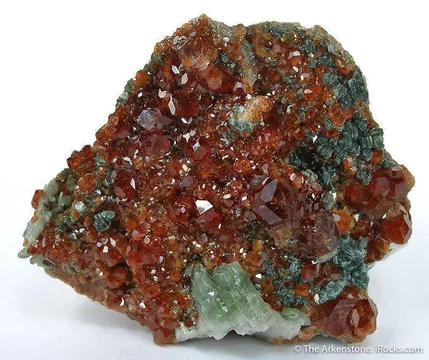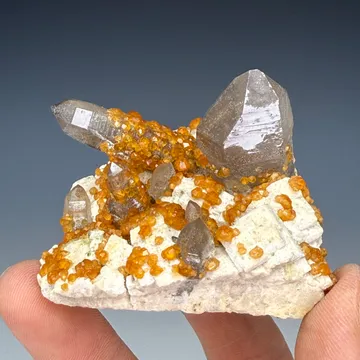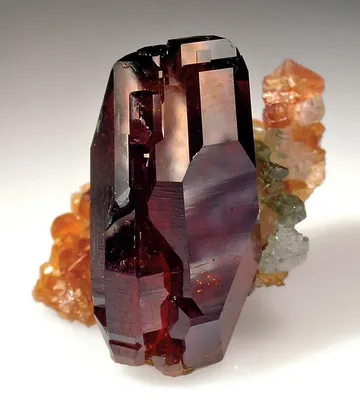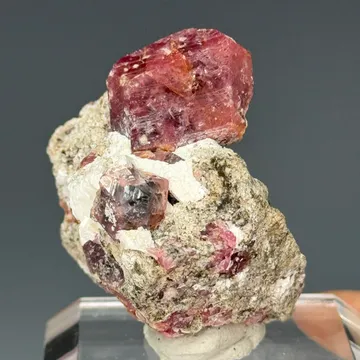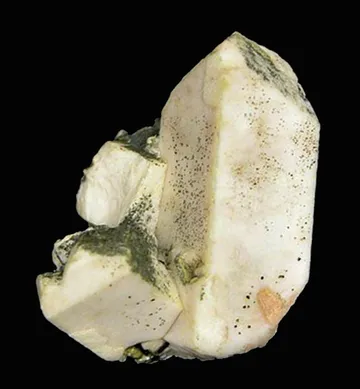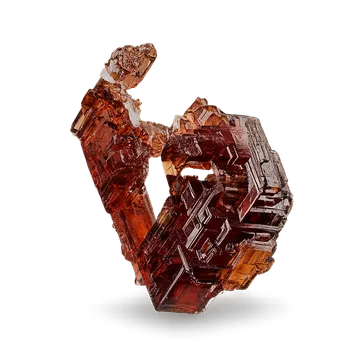
イタリア・ピエモンテ州アラ峡谷産のガーネット — ロディング石中の古典的なアルパインヘッソナイトとグロサリル‐アンドラダイト、ディオプサイドとクリノクロールを伴い、鋭い十二面体の形状。
Key facts
アーラ渓谷のガーネットはヨーロッパアルプスの古典的名品の一つです:単一の結晶だけでなく、オレンジ-赤色のヘッソナイト、茶赤色のグロスラロンドラライト、そして黄色系およびトパゾライトの小さな結晶が、ラントゾ渓谷のロディン石( rodingites )で形成されたものの家族です。最良の標本には、光沢のあるシナモン色からヒヤシンスレッドのガーネットが、淡い緑のディオプサイド上に広がり、しばしばクリノクローレを伴う—非常に特徴的で、古いヨーロッパの標本は一目で識別できることが多いです。
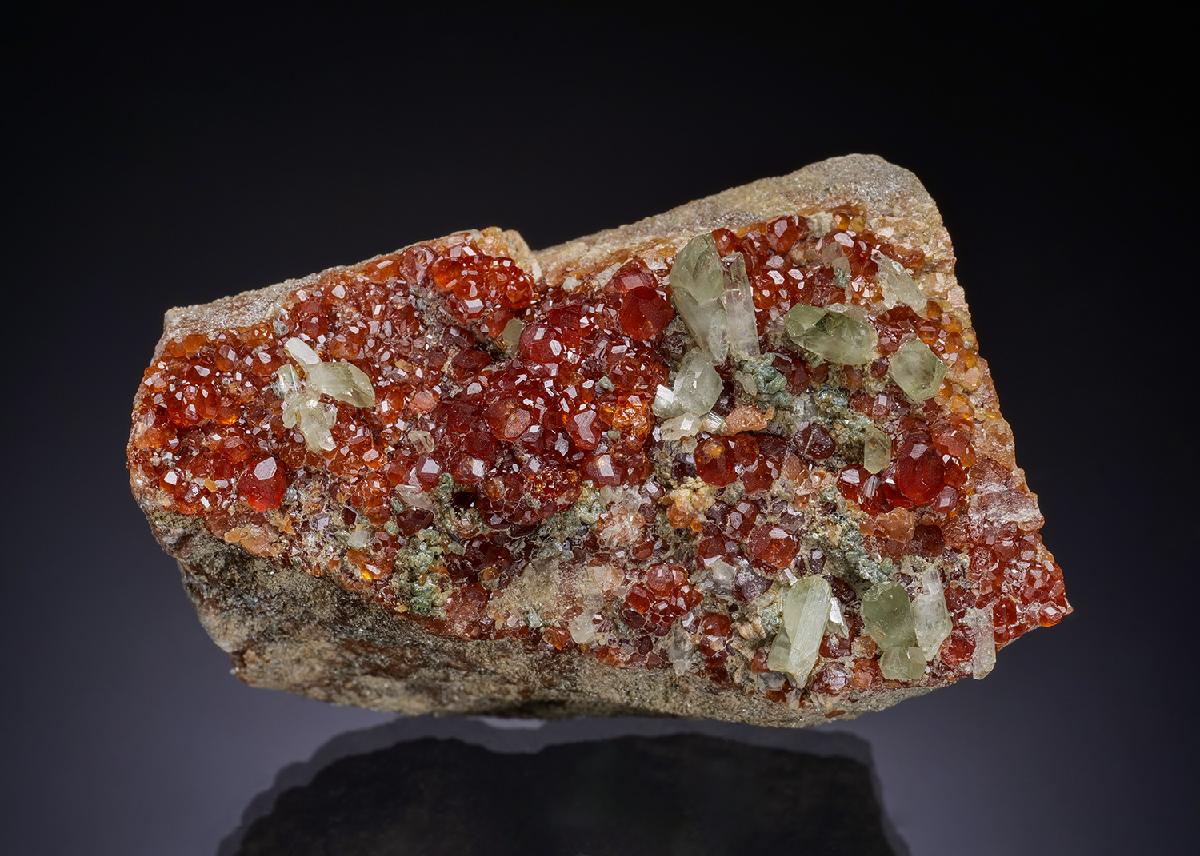
写真: Crystal Classics
この産地の鉱物学的重要性はロディン石にあります:カルシウムを豊富に含み、珪素が飽和していない体相と脈が、 Piemonte Zone の西アルプスの蛇紋岩岩石とメタオフィオリット岩石中に存在します。これらの岩石は海底の改変、アルプスの沈み込み、そして後の露出を記録しており、ガーネットは色の階調、化学組成、結晶形状、破裂紋理にその過去の変遷を保持しています。最も研究された材料では、ガーネットの化学組成はグロソラル高含有のグランドライトからほぼ純粋なアンドラダイトまで幅があり、流体化学組成と変成条件の繰り返しの変化を反映した不規則な帯域を示します。
コレクターは主に、テスタ・キアルヴァおよびロック・ネイル(Roch Neir)で見られるヘッソナイトの鮮やかな赤橙色を挟んだ結晶を知っています。これらの結晶はディオプサイドとクリノクローレを伴って現れます。また学術文献には、特にロック・ネイル産のトップザオライト変種の黄色〜浅黄色のアンドラダイトも記されていますが、これらの結晶は一般に小さく、カットにはあまり重要ではありません。歴史的には、アーラ渓谷ガーネットは単なる科学的好奇心だけでなく、ヘッソナイトとして知られるオレンジ-茶色のグロソラルが地域の伝統的な衣装ジュエリーや谷間の婚約の象徴として使われていました。
最高の標本は三つの要素のバランスです:飽和したオレンジ-赤色、シャープな改変ダデカヘドロン形状、淡い緑のディオプサイドや緑がかったクリノクローレとの強いコントラスト。大きくてクリーンな宝石原石は珍しく、地方の評判は大きなカット石よりも、きらめくアルプスの標本プレートや古くて由来のあるキャビネットピースにあります。
Search for specimens: View all garnet specimens from Ala Valley, Piedmont, Italy
Ala Valley, or Val d’Ala, is the central branch of the Lanzo Valleys in the Metropolitan City of Turin, Piedmont. The classic mineral localities lie around Balme, Pian della Mussa, Testa Ciarva, Roch Neir, and related outcrops and debris areas extending down-valley toward Ala di Stura and Curbassera.
The garnet deposit type is Alpine rodingite hosted by serpentinite. In the valley, antigorite serpentinite is the dominant ultramafic rock, enclosing metric to decametric rodingite lenses, layers, and veins. These rodingites are calcium-rich reaction rocks produced by metasomatic interaction between serpentinite and mafic rocks, later modified by Alpine metamorphism. The relevant assemblage is characteristic: calcium-rich garnet with diopside, epidote, chlorite or clinochlore, vesuvianite, titanite, calcite, magnetite, rutile, and other opaque minerals.
The broader geology belongs to the Piemonte Zone of the Western Alps, between the Gran Paradiso and Dora-Maira Penninic continental nappes. The rocks represent Mesozoic oceanic lithosphere—ultramafites, metagabbros, metabasalts, and calcschists—overprinted by Alpine metamorphism. Studies of the Val d’Ala metaophiolites describe greenschist- and blueschist-facies assemblages, with preserved eclogite-facies relics indicating pressures of at least 1.3 GPa and temperatures around 425–550 °C during subduction.
The best-known grossular localities are Testa Ciarva and Roch Neir near Pian della Mussa, where serpentinite cliffs contain boudinaged rodingite layers locally reaching about 2 m thick. Testa Ciarva is celebrated for the quality and quantity of hessonite-bearing material it produced, particularly specimens of red to orange-brown garnet with diopside. Roch Neir is especially associated with darker red garnet and small, bright yellow andradite/topazolite crystals lining fractures in mussite or diopside-rich rock, commonly with magnetite. Mount Tovo has yielded rounded to globular garnets, and Curbassera is known for grossular concentrations in brown rodingite lenses and in landslide debris.
This is a collecting and specimen locality rather than a garnet ore deposit. The Lanzo Valleys have a separate and much older mining history involving iron, silver, copper, and other metals, with medieval and early modern mining activity documented in the region. The garnet-bearing rodingites, however, entered mineralogical history principally through specimen collecting and study. The minerals of Val d’Ala—garnet, diopside, vesuvianite, epidote, and chlorite—were already well known by the 18th century, and the rodingite dikes were famous to mineralogists by the early 19th century.採集アクセスは以前とは異なります。Testa Ciarvaは過去に大いに開発されており、爆薬の使用を含むこともあり、現代の情報源ではその地域は鉱物採集に対して閉鎖または禁止とされていると記述されています。公表された地質学的研究も、谷の最も開放された鉱床であるTesta Ciarvaが現在は標本市場用の材料とされ、採取サンプリングが禁止されていると指摘しています。コレクターは歴史的な Ala Valley のピースを標本市場の素材とみなし、古典的な採掘地点が野外採集のために開かれているとは想定すべきではありません。## アラ谷、ピエモンテ州、イタリア産ガーネットの特徴
アラ谷ガーネットは主にカルシウムを含むガーネットで、グロシュラー石、ヘソナイト、アンドラダイト、およびグロシュラー-アンドラダイトの固溶体材料である。オレンジレッドから茶赤色のヘソナイト変種のグロシュラー石 Ca3Al2(SiO4)3 はコレクターにとっての古典的な材料である。黄色から淡黄色のアンドラダイトは伝統的にトパゾライトと呼ばれることもあり特徴的だが、一般的にははるかに小さい。谷から記述された珍種のアンドラダイトにはメラナイトやダマントイドがあるが、これらは locality の支配的な標本様式ではない。
典型的な標本の形状は、ルーダナイト中の割れ目、接合面、ポケットに沿って光沢のある結晶の外層またはクラスターである。良好なヘソナイト結晶はしばしば鋭い十二面体で台形変形を伴い、切断・粗野サンプルに関する科学的研究では菱形十二面体と台形十二面体の組み合わせが記録されており、赤みがかった結晶にはキューブ、台形十二面体、菱形十二面体、六十稜(hexoctahedron)を含むより複雑な面を示すことがある。結晶の中には長く伸びたり、変形したり、不規則に成長したものもあり、特に結晶表面が明るく宝石様である場合に重宝される。
色は locality の強みの一つである。研究対象サンプルは淡黄色からジアシント(青紫)を経て濃赤まで幅がある。ロッシュ・ネールIIから観察されたファセット付き石はオレンジ赤色で、テスタ・チアルヴァのファセット付き石は赤みを帯びたオレンジ色であった。標本上、最も魅力的な材料は赤-orange、深いシナモン色、ヒヤシンス赤、あるいはオレンジ茶色で、ガラス光沢と倍率下で光を放つ程度の透明度を有する。いくつかの結晶はやや多色性を示すことがあり、不均一な色は包有物、亀裂、あるいは共成分の重結晶によることがある。
大きさはタイプによって急速に異なる。公表された研究はおよそ1〜3 cmの赤味結晶を記述するが、基板上で見られる多くの標本結晶は数ミリ程度である。淡黄色のアンドラダイト/トパゾライト結晶は通常小さく、 studied material では最大約4 mm、透明、菱形十二面体の形状である。プリンストン大学の標本は基板上に深紅のグロシュラー結晶を3 mmまで記録しており、一方商業品・オークション例では魅力的なキャビネットサイズの板上に位置する3–4 mmのヘソナイト結晶が一般的に記述される。オークションの説明では exceptional なグロシュラー結晶が約20 mmに達する例も見られるが、これは locality の通常の標本ではない。
最良の関連組み合わせは非常に診断的である。オレンジ-赤のヘソナイト上の淡い緑から灰緑の閃石グループ結晶が特徴的な組み合わせである。クリノクロアは緑から青緑の対照を提供し、石灰岩、葉緑族鉱物、ヴェシウビナイト、方解石、霞石群、スピネル、チタン電気石、赤鉄鉱、磁鉄鉱、他の不透明鉱物も含まれることがある。科学的な薄片組成には、ガーネットと輝石、Mg含有クロライト、トレモライト、方解石、磁鉄鉱、赤鉄鉱、チタン電気石、そして後期アンドラダイトが豊富な脈が含まれる。品質はスケールと目的次第です。展示標本の場合は、飽和したオレンジ-赤色、破損していない結晶面、強い光沢、巨大な外皮よりも個々の結晶が見えること、ディオプサイトやクリノクローライトに対する清潔なコントラストを探してください。体系的または産地コレクションの場合、ロック・ネイルの小さな黄褐色のトパゾライトとテスタ・チアルヴァのよくラベル付けされたヘソナイトには特別な関心があります。研磨用としては、アラ・バレーのガーネットは魅力的ですが限られています。研磨済みのファセット石を studied した場合、鮮やかな赤橙色から橙赤色の色調とガラス光沢を示しますが、透明度、内部の亀裂、內包物、および微細亀裂により宝石品質の粗材は希少です。## Collector Notes
Ala Valley garnet is a locality where provenance matters. Old labels naming Testa Ciarva, Roch Neir, Pian della Mussa, or Val d’Ala carry real value, especially when paired with the classic hessonite-diopside association. Broad labels such as “Piedmont, Italy” or “Italian hessonite” should be treated cautiously, because hessonite also occurs in other Italian Alpine rodingite localities, including Val d’Aosta, Val di Susa, Val di Viù, and Ligurian sites.
Most authentic issues are not treatment but mislocality. A genuine Italian hessonite specimen from another rodingite locality may resemble Ala Valley material. The strongest visual clues for classic Ala Valley are orange-red to hyacinth grossular on rodingite with pale green diopside and clinochlore, especially in the old European cabinet style. Still, precise locality should come from a credible label chain, dealer history, museum record, or documented collection provenance.
Condition needs careful inspection. Many crystals are small and sit on exposed seams, so edge bruising, rubbed luster, and broken crystal tops are common. Some specimens show old extraction damage on matrix edges or through crystalized surfaces. Scientific microtomography of faceted material documented widespread microcracking, pores, and fractures inside the garnet, so even attractive translucent crystals may have internal weakness. For specimens, this is part of the locality’s character, but for faceting it limits yield and clarity.
Treatment is rarely the main concern for matrix specimens. Faceted hessonite from Ala Valley should be evaluated like other garnet gems: check for natural inclusions, fractures, and locality documentation rather than expecting routine enhancement. The literature emphasizes inclusions such as clinochlore, diopside, calcite veinlets, and fractures; it does not frame Ala Valley garnet as a treatment-driven market.
Rarity is tiered. Small crusts of hessonite on matrix are obtainable. Good miniature and cabinet pieces with bright color, undamaged crystals, and diopside contrast are less common. Old pieces from major European collections, early labels, and closed or restricted collecting areas are significantly more desirable. Large, gemmy crystals, well-formed yellow topazolite, and major museum-quality hessonite-diopside plates are genuinely scarce.
The market is intermittent rather than abundant. Recent documented sales and listings show a wide spread: modest small-cabinet examples can appear in the low hundreds of dollars, while exceptional old or exhibition-quality grossular with clinochlore has reached several thousand euros. The strongest pieces sell on locality identity, aesthetics, association, and provenance, not just crystal size.## Stories & Field Notes
Ala Valley garnet has a social history as well as a geological one. In the valley, orange-brown hessonite was more than an attractive mineral: it was used in traditional costume jewelry and as a sign of engagement. That small detail explains why the material has always felt different from many Alpine garnets. It was collected, studied, worn, and remembered locally before it became a specimen-market classic.
One of the most evocative surviving threads is the Spada Collection specimen in Rome. The University Museum of Earth Sciences identifies a garnet from Testa Ciarva, Mussa, Val d’Ala, as one of the important samples from the Spada Collection, which entered the Museum of Mineralogy in 1852. Its description captures the old collector’s ideal of the locality: gem-quality transparency and luster, diopside crystals in association, and a red-hyacinth to deep-red color. Testa Ciarva is also given its local name, “Calva,” a reminder that the locality was not just a label on a drawer but a named rock in the landscape.
Testa Ciarva’s fame came at a cost. The locality became known for both the quality and the quantity of specimens it produced, and it was worked harder than any other garnet site in the valley. Museum and geological sources describe abundant past exploitation, including the use of explosives, and the site is now closed or forbidden for collecting. That history gives old specimens a particular gravity: a bright plate of hessonite and diopside is not merely pretty, but a survivor from a locality whose classic production cannot simply be repeated.
Roch Neir tells the complementary story. If Testa Ciarva is the emblem of red-orange hessonite, Roch Neir is tied to small, bright, yellow andradite/topazolite crystals and to the old diopside-rich “mussite” association. The early name “alalite” for diopside came from this region, and old European collections from the late 18th and early 19th centuries commonly contained the instantly recognizable pairing of orange-red hessonite and pale green diopside. On a good specimen the association has an almost theatrical color contrast: a garnet crust like burnt sugar, interrupted by glassy green prisms.現代の記録付き標本は独自の小さなエピソードを付加する。1972年に採集され、フンボルト大学の鉱物博物館にかつて所蔵されたCrystal Classicsの標本は、70 x 43 x 40 mm。ヘソナイト結晶は最大4 mm、ジオプサイド結晶は最大9.5 mm。
Chet Lemanski財団コレクションの MineralAuctions の閉鎖例はおおよそ1980年頃に採取され、11.1 x 8.6 x 4.7 cmを測定し、ジオプサイドとクリノクロアに最大約3 mmの鋭い赤橙色のヘソナイト結晶を帯びていた。
Rossiniオークションの一括には、オレンジ褐色で宝石様の、細長く奇妙に変形したグロサラ結晶が9 x 7 x 5 cmのマトリクス上で20 mmまで見られ、2015年の Sainte-Marie-aux-Minesのプレステージショーで展示された作品である。
このような標本は、アラ・バレー材料の幅を示している。倍率を要するほどの輝く小さな結晶から、結晶が十分な大きさと偏心した形を持ち部屋を支配するほどのレアで古い博物館規模の例まで、さまざまである。## 鉱物学的記録と刊行物- Diella, V.; Bocchio, R.; Marinoni, N.; Caucia, F.; Spalla, M.I.; Adamo, I.; Langone, A.; Mancini, L. “Garnets from Val d’Ala Rodingites, Piedmont, Italy: An Investigation of Their Gemological, Spectroscopic and Crystal Chemical Properties.” Minerals 9, no. 12, 728 (2019). Ala Valleyのガーネット化学組成、宝石学、微細構造、および地質解釈に関する現代の主要な科学論文。