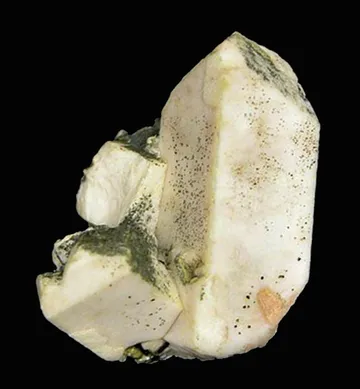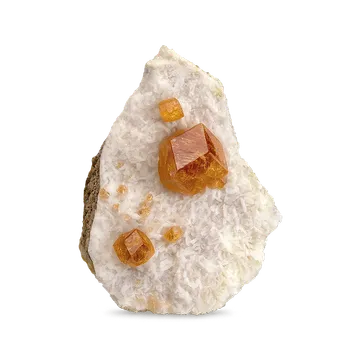
Grossular from Ala Valley, Italy — Alpine hessonite with red-orange crystals in rodingite, prized for color, Alpine locality history, and striking matrix.
Key facts
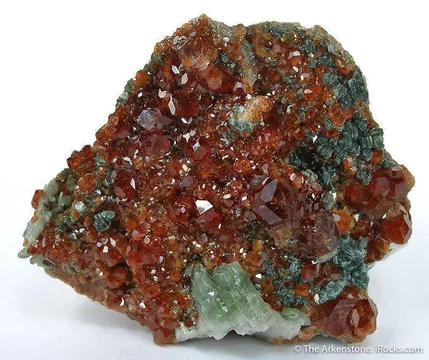
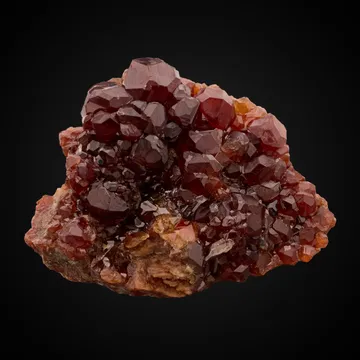
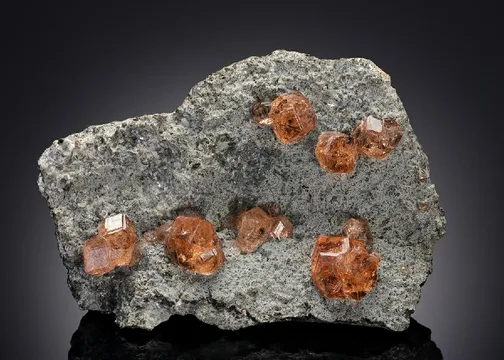
Grossular from the Ala Valley is one of the classic Alpine hessonite occurrences: warm red-orange to dark cherry-brown garnet crystals set in pale rodingite, commonly sharpened visually by green clinochlore, pale green diopside, and vesuvianite. The best pieces have a distinctly Italian Alpine character—small but lively, glossy crystals scattered or clustered across a contrasting Ca-silicate matrix rather than the large isolated garnets sought from some skarn deposits.
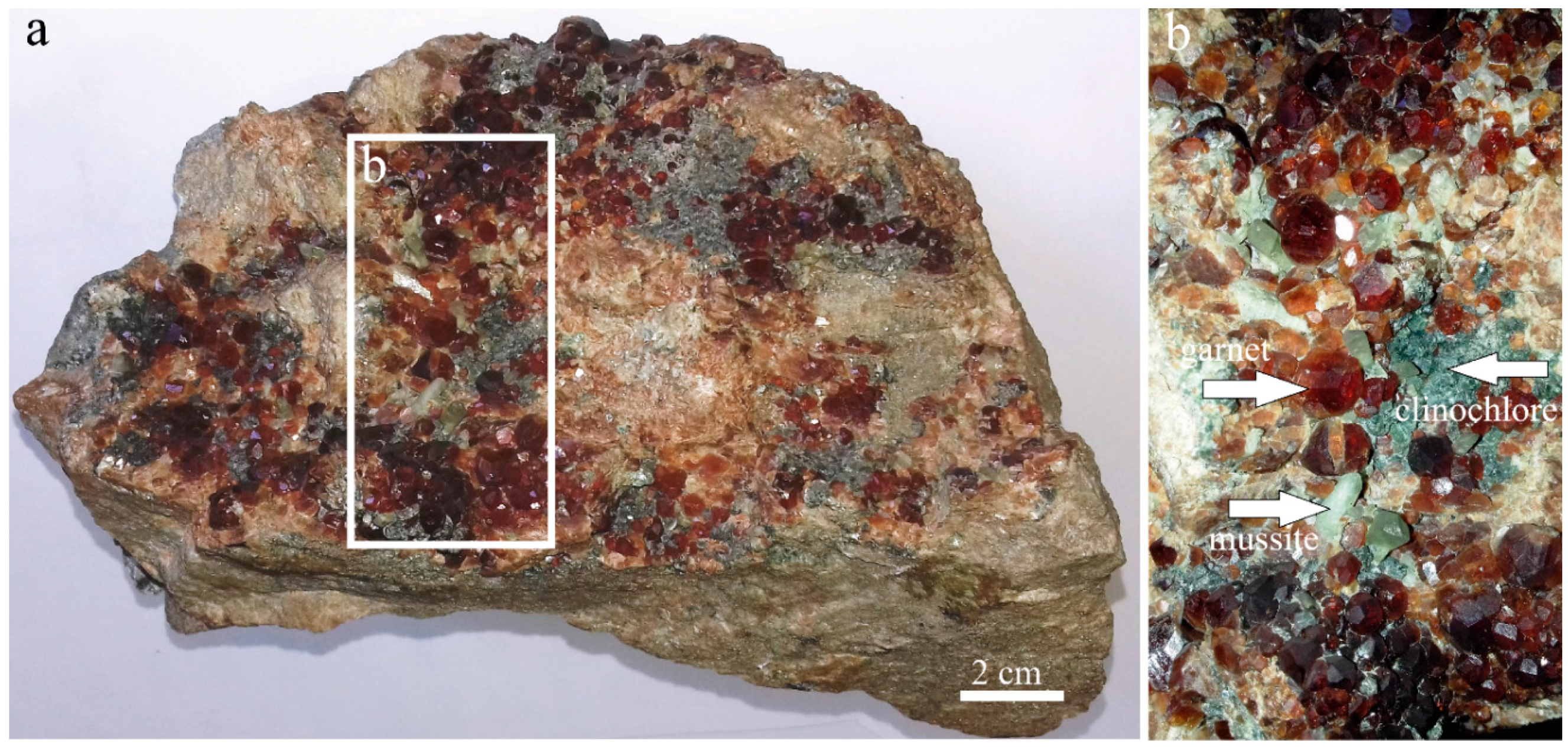
Photo: Diella et al., Minerals 2019
The geological setting is the key to the locality’s personality. The Ala Valley lies in the Lanzo Valleys of Piedmont, in the Western Alps, where serpentinites and metaophiolitic rocks host rodingite bodies—calcium-rich rocks formed by metasomatic alteration of mafic rocks associated with serpentinized ultramafics. In these rodingites, grossular occurs with diopside, epidote, clinochlore, vesuvianite, calcite, titanite, magnetite, rutile, and related Ca-silicate assemblages. The resulting specimens are not just pretty garnets; they are compact records of ocean-floor alteration, Alpine subduction, and later metamorphic overprinting.
Ala Valley hessonite also has cultural weight. Orange-brown grossulars from the valley were used historically as gemstones in local costume and as engagement tokens, and the valley’s minerals—garnet, “mussite” diopside, vesuvianite, and epidote—were already well known by the 18th century. The locality is also closely tied to the history of diopside: Roch Neir and Testa Ciarva, near Pian della Mussa, are recognized as type-locality sites for diopside.
Collectors look for color first: bright reddish orange, sherry, hyacinth-red, and cherry-red crystals are the classic look. The most desirable specimens combine lustrous, transparent to translucent grossular with pale green diopside prisms or rich green clinochlore “books” and rosettes. Good crystals are usually small, but the best matrix pieces have rhythm: repeated garnet crystals, varied crystal forms, and enough matrix contrast to make the color read from across a case.
Ala Valley, or Val d’Ala, is the middle of the three Lanzo Valleys northwest of Turin. Administratively, the valley includes Balme in the upper valley, Ala di Stura in the middle valley, and Ceres in the lower valley. The grossular-producing occurrences are not a single mine but a chain of rodingite bodies and related float blocks distributed along the valley.
The deposit type is Alpine rodingite in metaophiolitic rocks. The broader bedrock assemblage includes ultramafites, metagabbros, metabasalts, calcschists, and serpentinites of the Piemonte Zone between the Gran Paradiso Massif and Dora-Maira Penninic continental nappes. The ultramafic rocks are dominated by antigorite serpentinite bodies, within which metric to decametric lenses and layers of rodingite occur. These rodingites are generally calcium-rich and silica-undersaturated, and their typical mineral assemblage includes Ca-rich garnet, diopside, epidote, clinochlore, vesuvianite, titanite, and opaque minerals.
The most cited grossular localities include Testa Ciarva and Roch Neir near Pian della Mussa in the high valley, where serpentinite cliffs contain boudinaged rodingite layers reported up to about 2 m thick. These occurrences are among the richest and best known for fine grossular. Roch Neir has also produced andradite varieties such as topazolite and demantoid, which complicates old labels on yellow-green garnets from the area.
Curbassera, northeast of Ala di Stura, has a more dramatic origin story. Becchi delle Curbassere consists of two serpentinite peaks, Piccola Curbassera and Grande Curbassera. A major landslide in 1655 produced large blocks that became the historical source for apatite, grossular, and vesuvianite specimens. The classic Curbassera occurrence is considered virtually exhausted, though rodingite dikes at the base of the western face of Piccola Curbassera and near a spur of Grande Curbassera are still noted as mineralized.
Borne del Brous, in the Ala di Stura area, is another important rodingite occurrence. It consists of rodingite dikes and scattered erratic blocks in the upper part of a lateral valley locally called Vallone delle Serpi. Nineteenth-century mineralogist Giovanni Strüver regarded it as a source of some of the best garnet specimens in Ala Valley. It is also a classic locality for the hessonite-diopside-clinochlore association.
Rocca Tovo, sometimes mislabeled in collections as Monte Tovo, contains compositionally varied rodingite outcrops: epidote-rich dikes on the southern slope, diopside dikes near the summit, a chlorite vein with titanite and magnetite on the eastern slope, and a garnet-diopside dike just southwest below the summit. That locality illustrates the fine-scale heterogeneity collectors should expect from Ala Valley material; adjacent rodingite bodies may produce very different specimen styles.
The valley has a long collecting and study history rather than a simple production chronology. Minerals from the rodingites have attracted researchers since the beginning of the 19th century, with important publications appearing through the 19th and early 20th centuries, modern locality monographs in the 1970s and 2010s, and renewed analytical work on garnets and vesuvianite in the 2010s and 2020s. Modern collecting access varies by site. Testa Ciarva, for example, is noted in recent literature as totally forbidden for mineral sampling because of past intense collecting. As with all Alpine localities, legal access, land status, protected-area rules, and safety conditions must be confirmed before any field visit.
Ala Valley grossular is best known in the hessonite color range: dark brown, red-brown, hyacinth-red, reddish orange, orange-red, and sherry to cherry-red. Published analytical work shows that many red-brown to orange hessonites are grossular-andradite solid solutions rather than pure end-member grossular. In studied samples, the hessonite-type garnets ranged broadly in composition, with grossular commonly dominant but accompanied by andradite and smaller almandine components. Testa Ciarva and Curbassera samples yielded some of the higher grossular components in the modern study.
Crystal size is usually modest but highly collectible. Literature on the valley records grossular crystals up to about 2 cm in size in rodingites, while a set of studied reddish crystals included material from 1 cm to 3 cm. Collector-market specimens more commonly show individual crystals in the millimeter range, and older museum or private collection pieces may carry dense crusts of small, lustrous crystals on matrix. Light yellow samples studied from the valley were smaller, up to about 4 mm, clear, and limited to rhombic-dodecahedral forms.
Habits are part of the charm. Reddish garnets may show cube, trapezohedron, rhombic dodecahedron, and hexoctahedron faces, sometimes with deformation, distortion, parallel growth, or complex microfaces. Rhombic dodecahedra are especially characteristic in Alpine hessonites, but Ala Valley pieces can be much more varied than a simple “dodecahedral garnet” label suggests. Some grossulars protrude from garnet seams in rodingite, so only part of the crystal may be fully developed.
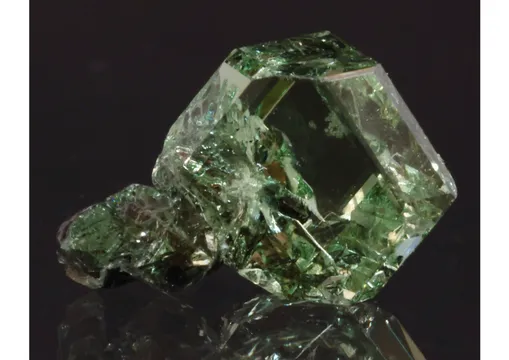
Associated minerals are a major quality factor. Pale green, gemmy diopside prisms create the most recognizable classic pairing. Clinochlore provides a darker green, platy, micaceous contrast and often appears as books or rosettes. Vesuvianite, epidote, calcite, magnetite, titanite, rutile, tremolite, and other Ca-silicates are part of the broader rodingite assemblage. The finest display pieces balance red-orange grossular against green clinochlore or diopside without being visually crowded by massive matrix.
For specimen evaluation, pay close attention to luster, color saturation, crystal separation, and contrast. Translucent to gemmy crystals with a clean vitreous luster are preferable to dull, embedded grains. A few well-placed crystals on green clinochlore can be more desirable than a large, muddy patch of garnet. Damage is especially visible on isolated hessonite crystals, so check edges and high points under magnification. On old specimens, matrix trimming and contact marks are common and should be judged against the age and rarity of the piece.
Facetable material exists but is secondary to specimen interest. Studied faceted stones from Roch Neir II and Testa Ciarva were orange-red to reddish orange, transparent to translucent, vitreous, and inert to both longwave and shortwave ultraviolet light. Their specific gravity was measured around 3.63–3.66, consistent with grossular-andradite solid solution. Internal features include inclusions, fractures, pores, and color inhomogeneity, all of which help explain why Ala Valley hessonite is historically important as a gem material but more celebrated among mineral collectors as a specimen mineral.
The primary authenticity issue is nomenclature, not known treatment. Ala Valley sits in a grossular-andradite environment where visually similar garnets may range from grossular-dominant hessonite to andradite-rich topazolite, demantoid, or melanite. Old labels may say “grossular,” “hessonite,” “topazolite,” or simply “garnet” based on color and habit. Modern analysis has confirmed that some material historically reported as grossular is actually andradite-rich, while many red-orange hessonites are properly described as grossular-andradite series material. For high-value specimens, a careful label should preserve the historic name while noting the likely grandite character if no analysis is available.
Locality precision also matters. “Ala Valley” is acceptable for older pieces, but better labels may specify Testa Ciarva, Roch Neir, Borne del Brous, Becchi delle Curbassere, Rocca Tovo, or another sublocality. Be cautious with labels reading “Monte Tovo” for material from the Pian della Mussa area; Rocca Tovo is the correct locality name in at least some cases, and “Monte Tovo” can be misleading because similarly named mountains occur in the neighboring Grande Valley.
Condition is often the main price divider. Hessonite crystals can have abraded edges, broken high points, or partially embedded faces. Many pieces are naturally crowded in rodingite, so not every irregular surface is damage. Look for fresh breaks, dull spots on the highest crystal faces, and unnatural saw cuts that truncate the matrix too close to the garnets. Because many specimens are older collection pieces, a small amount of edge wear may be acceptable, but clean, undamaged crystals on attractive matrix command a premium.
Rarity is best understood by quality tier. Small Ala Valley hessonites are available with patience, especially as old European collection material, but excellent matrix specimens with sharp, lustrous red-orange grossular, well-positioned diopside, and attractive clinochlore are much scarcer. Curbassera historical specimens have an added cachet because the classic landslide-block source is largely exhausted. Borne del Brous and Pian della Mussa pieces with strong provenance are also desirable.
Current market availability is intermittent rather than abundant. Specimens appear through specialist dealers, European Alpine collections, auction archives, and occasional old-stock releases. Most are thumbnails to small cabinets; larger matrix pieces with multiple species and clean display aesthetics are much less frequent. When comparing prices, weigh the exact sublocality, specimen age, association, and crystallographic quality rather than size alone.
The most memorable Ala Valley story begins not with a miner’s hammer but with weather. On September 17, 1655, after a torrential downpour, a vast landslide broke from Piccola Curbassera and crashed downslope as far as the Stura riverbed. The slide left large blocks that later became the source of historical specimens of apatite, grossular, and vesuvianite. For collectors, that makes Curbassera material unusually tangible: a classic specimen from the locality is not just from a rodingite dike, but from a mountain failure that scattered mineralized blocks across the valley floor centuries ago.
Curbassera also preserves the layered history of early mineral observation. Dark red and hyacinth-red grossular crystals are the familiar prize, but small iridescent crystals were noted as early as Barelli’s 1835 work and later described in detail by Wiser in 1866. The same locality produced vesuvianite in red-brown, light brown, greyish green, and olive-green tones, with early color explanations changing as mineral chemistry improved: Sismonda’s 1834 analysis attributed red-brown vesuvianite color to manganese, while Elena Repossi’s 1942 work pointed instead to titanium, reporting 3.28% TiO2 and only traces of manganese.
Borne del Brous has a more folkloric flavor. The occurrence takes its name from the only nearby landmark, the “Borne del Brous,” two cavities once excavated in a soapstone outcrop. One of those cavities was locally called “Borna del Selvai,” literally “the Savage’s Cave,” because tradition said it had been the dwelling place of a misanthropic dwarf. Around that unlikely landmark, rodingite dikes and erratic blocks yielded garnets that Strüver praised in 1871 as among the best in Ala Valley. It is a reminder that Alpine mineral localities often survive in collectors’ memory through a mixture of science, dialect, landscape, and story.
The human history of the garnets is just as distinctive as the geology. Orange-brown hessonites from Val d’Ala were once used as precious gemstones in the traditional costumes of the valley and as engagement tokens. That local use changes how one looks at a small red-orange garnet from the valley: it was not only a crystallographic object for museum drawers, but also a gem with social meaning in the mountain communities that knew these rocks long before modern analytical papers described them as grossular-andradite series minerals.
Diella, V.; Bocchio, R.; Marinoni, N.; Caucia, F.; Spalla, M.I.; Adamo, I.; Langone, A.; Mancini, L. “Garnets from Val d’Ala Rodingites, Piedmont, Italy: An Investigation of Their Gemological, Spectroscopic and Crystal Chemical Properties.” Minerals 9, no. 12, 728, 2019.
The central modern analytical paper on Ala Valley garnets, with gemological data, EMPA, LA-ICP-MS, XRPD, Raman, DRIFT, and micro-CT work on samples from Roch Neir, Testa Ciarva, Curbassera, and Rocca Tovo.
Caucia, F.P.; Marinoni, L.; Scacchetti, M.; Riccardi, M.P.; Bartoli, O. “The Vesuvianite Gems of the Val d’Ala (Piedmont, Italy).” Minerals 10, no. 6, 535, 2020.
Focused on vesuvianite but highly useful for the same rodingite system, collecting history, locality geography, and mineral associations that frame grossular specimens.
Maletto, G.; Piccoli, G.C. “Minerali in Val d’Ala.” Associazione Amici del Museo “F. Eusebio” di Alba, 2014, 224 pp. + folded map.
Modern locality monograph repeatedly cited in locality records for Ala Valley minerals and sublocalities.
Maletto, G.; Meda, F.; Pelizzone, G. “I minerali della Val d’Ala.” Ellezeta, Torino, 1976, 72 pp.
Foundational collector-oriented reference for Ala Valley minerals, cited across multiple Mindat sublocality pages.
Repossi, E. “La Val d’Ala e i suoi minerali.” Natura 10, 89–132, 1919.
Early 20th-century reference cited in later scientific work; important for the historical mineralogical literature of the valley.
Strüver, G. “Cenni sui graniti massicci delle Alpi piemontesi e sui minerali delle valli di Lanzo (Circondario di Torino).” In Gastaldi, B., Studi geologici sulle Alpi Occidentali, Parte I, Appendice; Memorie per servire alla descrizione della Carta Geologica d’Italia 1, 37–47, 1871.
Nineteenth-century publication tied to early descriptions of Lanzo Valley minerals, including the classic Ala Valley occurrences.
Leardi, L.; Rossetti, P. “Caratteri geologici e petrografici delle metaofioliti della Val d’Ala.” Bollettino dell’Associazione Mineralogica Subalpina 22, 422–439, 1985.
Geological and petrographic study of the Val d’Ala metaophiolites, useful for understanding the host-rock framework.
Princeton University Mineral and Gem Collection, specimen 5353: Grossular, Ala Valley, Piedmont, Italy.
Museum collection record for an Ala Valley grossular specimen in the Archibald M. MacMartin subcollection, described as deep red crystals to 3 mm on matrix.
Mindat: Ala Valley, Lanzo Valleys, Metropolitan City of Turin, Piedmont, Italy — Main locality portal with mineral list, sublocalities, photographs, and bibliography.
Mindat: Grossular from Ala Valley — Species-locality entry for grossular, including associated minerals and photo data.
Mindat: Testa Ciarva, Mussa Alp, Balme — Important high-valley rodingite locality and one of the key Pian della Mussa occurrences.
Mindat: Roch Neir, Mussa Alp, Balme — Classic rodingite locality associated with grossular, hessonite, diopside, and andradite varieties.
Mindat: Borne del Brous, Ala di Stura — Important hessonite-diopside-clinochlore locality with historical notes from Strüver.
Mindat: Becchi delle Curbassere, Ala di Stura — Historical Curbassera locality record with the 1655 landslide account and notes on classic grossular and vesuvianite.
Mindat: Rocca Tovo, Mussa Alp, Balme — Useful for distinguishing Rocca Tovo from misleading “Monte Tovo” labels and understanding the varied rodingite dikes.
Olav Revheim, “Grossular” on Mindat — Broad collector’s overview of grossular, including context for Italian Alpine hessonite, rodingites, and grossular-andradite labeling issues.
Minerals.net: Grossular — General grossular reference that notes Val d’Ala among notable Italian hessonite localities.