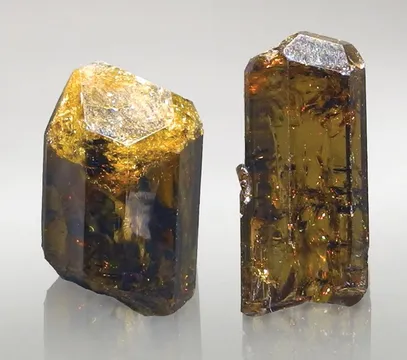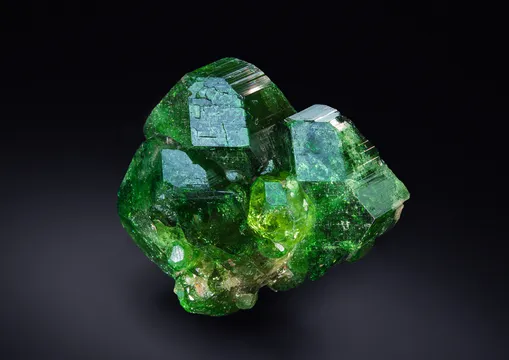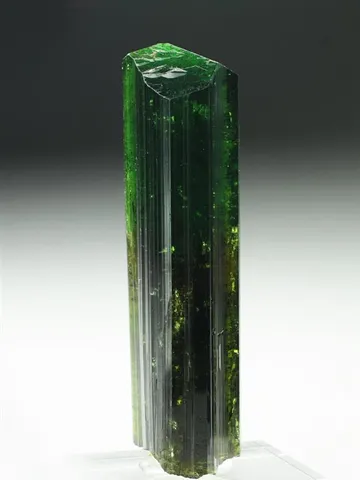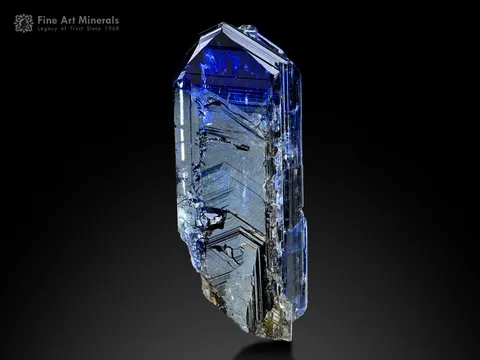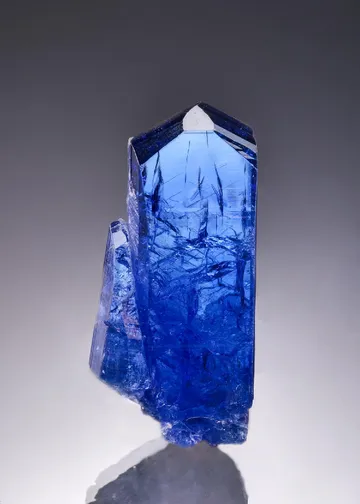
Dravite — Landanai, Tanzania: vivid color zoning from brown-olive to bottle-green, sharp terminations and classic crystal habit prized by collectors.
Key facts
Dravite from Landanai sits in the small but highly desirable family of East African “chrome” tourmalines: crystals that can look nearly black in reflected light, then ignite in transmitted light with bottle-green, emerald-green, yellow-green, honey, or brown-green color zoning. The finest specimens are not merely gem rough with faces; they are sharply crystallized tourmalines with high luster, steep trigonal terminations, and enough internal life that a lamp behind the specimen changes the whole personality of the piece.
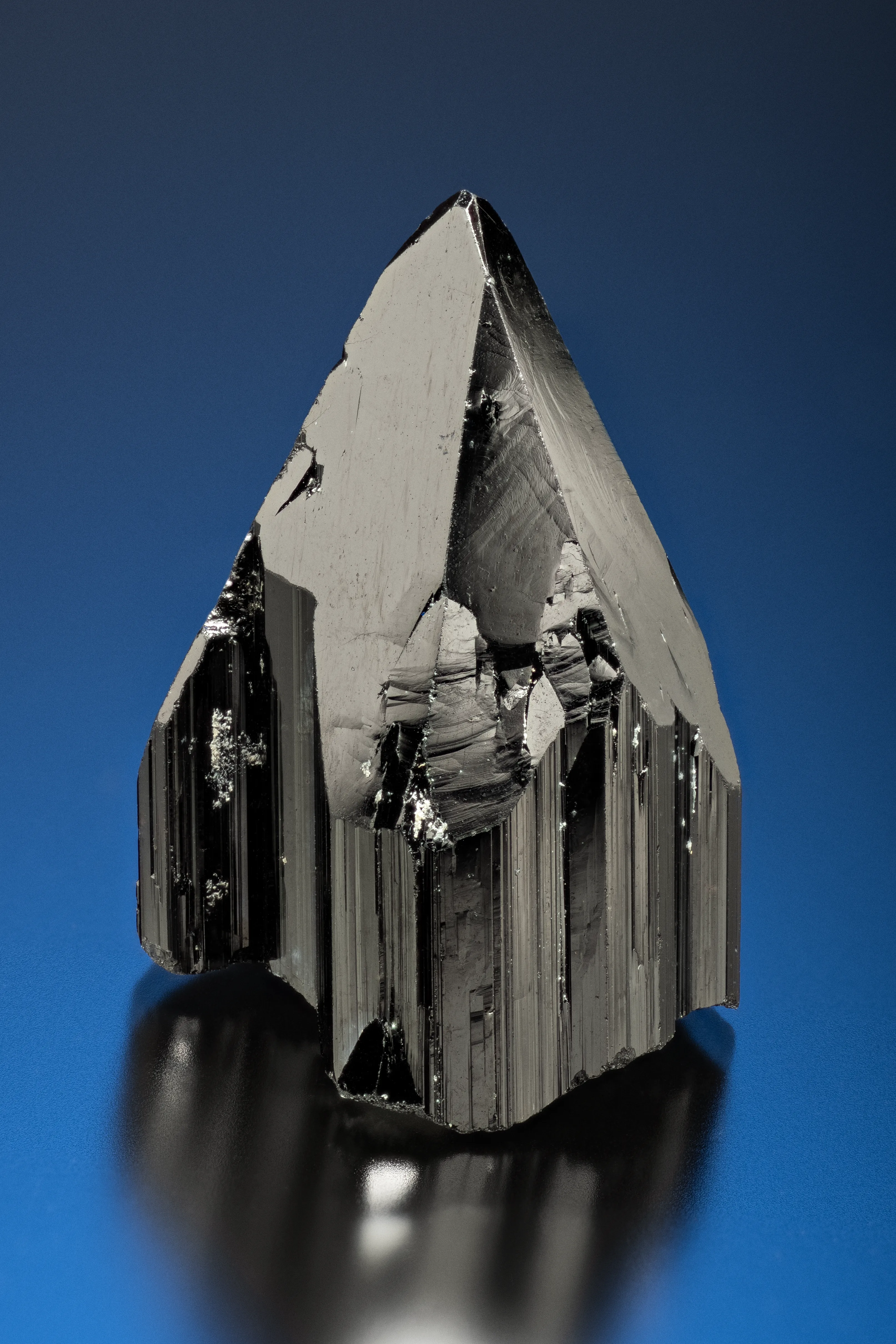
Photo: EarthWonders specimen 94818
The old trade name “chrome tourmaline” is still widely used for Landanai material, but collectors should use it with care. Modern analytical work on closely related Simanjiro material has shown that the famous saturated green is commonly dominated by vanadium, with chromium present only in smaller amounts. In the collector market, the practical result is that “chrome dravite,” “vanadian dravite,” and “green dravite” may all appear on labels for the same visual class of specimen. The mineralogical reality is subtler: many of these green tourmalines lie in the dravite–uvite compositional neighborhood, and laboratory work is needed for a rigorous species-level assignment on individual stones.

Photo: Marin Mineral Company
What makes Landanai material distinctive is the combination of color and crystallography. A good crystal may show a dark brown or olive base grading upward into yellow-green, then into a rich green cap. Some pieces are so dark that they need backlighting to reveal the color; the best are bright enough at the edges, faces, or termination to show green without theatrical lighting. Most specimens are thumbnails, and collectors prize well-terminated floaters, doubly terminated crystals, and the uncommon matrix pieces on pale calcite or carbonate-rich rock.
Geologically, Landanai belongs to the great northern Tanzanian gem province: a metamorphic terrane in the Simanjiro area that is also famous for tanzanite, tsavorite, ruby, and other gem minerals. Dravite and uvite are the tourmalines expected from metamorphic settings involving magnesium- and calcium-rich rocks, rather than the lithium-rich pegmatitic environments that produce elbaite. That setting helps explain both the chemistry and the palette: sodium-magnesium dravite and calcium-magnesium uvite compositions, colored by vanadium, chromium, iron, and titanium in different zones of the crystals.
Search for specimens: View all dravite specimens from Landanai, Tanzania
Landanai is in Simanjiro District, Manyara Region, northern Tanzania. Older labels and articles may place the locality in Arusha Region, reflecting earlier administrative usage and trade-label habits. For collectors, “Landanai” is both a specific locality and, in some dealer usage, a broader trade label applied to green dravite-type tourmalines from the Simanjiro gem belt. The distinction matters: Landanai proper is recorded as a dravite and chrome-tourmaline locality, while the closely related Commander Mine at Nadonjukin is a separate Simanjiro occurrence that has supplied much of the intensely green, vanadium-bearing material seen in recent specimen circulation.
The regional host is metamorphic rather than classic granite-pegmatite tourmaline country. Published summaries of Tanzanian tourmaline note that elbaite is mainly a pegmatitic mineral, whereas dravite and uvite occur in metamorphic rocks. Around Landanai, recorded regional rock types include gneiss, migmatite, and mylonite, and nearby mineral records include corundum, ruby, garnet-group minerals, feldspars, quartz, zircon, and biotite. This is the right geological neighborhood for magnesium- and calcium-rich tourmaline compositions, and it is also the reason the material should not be judged by elbaite standards. The finest Landanai dravite has a denser, more saturated, more directional color than most lithium tourmaline.
The historical record for Landanai tourmaline reaches well before the modern specimen boom. GIA’s 1992 review of Tanzanian gems described most Tanzanian tourmaline production to that time as coming from two small operations in Landanai, plus byproduct tourmalines from alluvial mining at Umba. Production peaked in the 1960s, when several hundred kilograms were recovered, but the same review noted that by the early 1980s only about 2,400 grams of rough were being recovered annually, yielding about 2,400 carats of faceted stones. Since then, production has been sporadic.
A separate Landanai episode added an unusual color to the locality’s reputation. In October–November 2015, yellow dravite rough was reportedly found in the Landanai region. During the 2016 Tucson gem shows, Todd Wacks showed Brendan Laurs an 11.13 ct yellow tourmaline he had faceted from rough obtained by Sir-Faraz Ahmad “Farooq” Hashmi on a buying trip to Tanzania. The rough was described as a rounded nodule with a few crystal faces, and Wacks cut it with a small table and deep pavilion to intensify the color. That stone demonstrated that Landanai is not only a source of saturated green dravite-type material but also part of the East African belt capable of producing yellow to golden dravite.
The most dramatic modern crystal production associated with the same Simanjiro dravite story came from the Commander Mine near Nadonjukin. Although it is not the same locality as Landanai, it is so often discussed with Landanai-type green dravite that serious collectors should know the distinction. The deposit was reportedly first worked in 1997, then abandoned after meager production. In late August 2016, a miner known as “Kamanda” reopened the diggings and encountered a pocket containing about 5 kg of mine-run tourmaline. A larger September 2016 pocket yielded about 3 kg of the best crystals, after miners were advised not to break the well-formed crystals for facet rough. Total production from that find was estimated at about 25 kg, with crystals and fragments up to 10 cm long; less than 600 g was faceting quality.
Collecting access should be treated as private, commercial, and mineral-rights controlled. Landanai and nearby Simanjiro gemstone workings are not casual field-collecting localities. Specimens reach the market through Tanzanian miners, local brokers, Arusha-area gem channels, and international dealers. A collector’s best access is therefore through well-documented specimens with precise locality, provenance, and, when possible, analytical or publication history.
The visual signature is dark, rich green tourmaline that often needs transmitted light to show its full color. In hand, many crystals appear blackish green, brownish green, or olive; under strong light the same specimen may reveal emerald-green windows, yellow-green rims, honey-brown bases, or bicolored zoning. Some Landanai-labeled pieces are almost pure green, while others pass from deep honey-gold or brown at the base into yellow and green toward the termination.
The habit is classic tourmaline but with a particularly sculptural presence in better pieces. Crystals are usually short to moderately elongated trigonal prisms, commonly with lengthwise striations, bright vitreous luster, and modified trigonal terminations. Many are single crystals or small clusters. Doubly terminated crystals occur and are especially desirable when both ends are clean. Floaters and near-floaters are known, but contact points and edge bruises are common because many crystals were recovered loose or from friable pocket material. Matrix specimens are much rarer than loose crystals; examples on calcite or carbonate-rich matrix have a strong display advantage because the pale host sets off the dark green tourmaline.
Size is usually modest. Most collectible Landanai specimens fall in the thumbnail range, roughly 1–3 cm. Dealer records show many examples around 1.5–2.7 cm, with larger miniature crystals and groups appearing less often. The broader 2016 Simanjiro production included crystals up to 10 cm, but fine, intact, lustrous, well-terminated crystals of that scale are exceptional. In the gem market, faceted stones are normally small; historically most Landanai chrome-tourmaline rough yielded stones under 1 carat, though some rough produced 1–10 ct stones, and the 2016 yellow dravite study involved an 11.13 ct faceted stone.
Color is the central value driver. The best green crystals are saturated but not dead-dark. Collectors should look for visible green in normal light, a bright internal glow with backlighting, and color zoning that enhances rather than muddies the specimen. Yellow-green-to-emerald zoning, brown-to-green bicolor crystals, and clean green caps are all attractive. Specimens that look completely black unless pressed against a flashlight are less desirable, unless their form, size, or provenance is exceptional.
Chemistry is part of the locality’s interest. The trade term “chrome tourmaline” is historically entrenched, but Landanai and nearby Simanjiro tourmalines may owe much or most of their green to vanadium. Analytical work on Commander Mine material documented dravite-uvite mixtures, vanadium as the dominant green chromophore, minor chromium, and iron-titanium contributions to brown zones. The green portions trend more dravitic, while more calcium-rich uvite components may increase in brown cores. For the collector, that means old “chrome dravite” labels are not automatically wrong as trade labels, but they are not precise analytical descriptions.
Associated minerals are not abundant on most loose specimens. Calcite is the most important documented association for matrix pieces, and dealer records have also shown a rare and striking combination of green tourmaline with yellow sulfur and calcite. Regionally, Landanai and nearby Simanjiro records include corundum, ruby, feldspars, garnet-group minerals, quartz, zircon, and metamorphic host rocks, but most specimen-grade dravite reaches the market as individual crystals rather than broad paragenetic matrix specimens.
The first authenticity issue is the label. “Chrome tourmaline,” “chrome dravite,” “vanadian dravite,” “green dravite,” and “dravite-uvite” may all be encountered. For Landanai material, the color name is often less exact than the chemistry. If a specimen is expensive because of its alleged chromium content, ask whether that claim is analytical or simply inherited from the traditional trade term. Vanadium-dominant material can be every bit as beautiful and collectible, but the wording should be honest.
The second issue is locality precision. Landanai, Nadonjukin, Commander Mine, Merelani-area Simanjiro, and generic “Tanzania” are not interchangeable. Many green dravite-type specimens from the 2016 find are properly Commander Mine, Nadonjukin; some dealers describe this as near Landanai or market related material under Landanai-style terminology. A serious label should preserve the most specific locality known. If a specimen was sold as Landanai but has the color, habit, and date profile of the 2016 Nadonjukin production, it is worth keeping any dealer notes that clarify the chain of attribution.
Condition is a major value factor. These crystals often show tiny edge nicks, rubbed terminations, scuffed prism faces, small chips on one edge, rehealed-looking fractures, or basal contact scars. Because the material is dark, damage can be surprisingly hard to see until the specimen is rotated under a tight light. Examine terminations carefully: a sharp trigonal termination with no bruising is much better than a broken but gemmier crystal. Also inspect the base and side faces for missing chips that have been visually hidden by the deep color.
Internal fractures and growth tubes are expected in some pieces. They can be attractive, especially where they catch green light, but they reduce cutting value and can create weakness in thin crystals. In the 2016 Simanjiro material, abundant growth tubes parallel to the c-axis were noted in a small amount of material and could potentially produce chatoyancy if cut as cabochons. For specimen collectors, these features are not automatically defects; they become defects when they obscure color, weaken the crystal, or interrupt an otherwise clean display face.
Treatments are not a prominent problem for crystal specimens from this locality. Heating experiments on studied Commander Mine samples produced no color change, so there is no established “heat-lightened” market equivalent to some other gem materials. The more realistic concerns are misidentification, overbroad use of “chrome,” vague locality labels, and repaired or oiled-looking fractures on dark crystals. Ask for disclosure of repairs, and be cautious of unusually glossy fractures or contact areas that do not match the natural luster.
Rarity is real but uneven. Small, dark, chipped loose crystals are available from time to time. Fine examples with strong transmitted green, sharp terminations, clean faces, and precise locality are much scarcer. Matrix specimens are rarer still. Published and dealer records indicate that significant production has been episodic, not continuous. The 1960s were the high point for older Landanai gem rough, while the 2015–2016 period produced important yellow and green dravite-related material in the Landanai–Simanjiro sphere. Current market availability is mostly recycled collection material, occasional dealer stock, and small parcels rather than steady mine production.
The best modern story in the Landanai–Simanjiro dravite world begins not with a corporate mine but with abandoned diggings and a miner known as “Kamanda.” The deposit later called the Commander Mine had first been worked in 1997, but the early effort produced so little that the place was left behind. Nearly two decades later, in late August 2016, Kamanda decided to try it again. This time the old workings answered: he struck a pocket with about 5 kg of mine-run tourmaline.
That first pocket was a mixed blessing for collectors. Fine crystals were present, but many of the best pieces were broken up for valuable facet rough. In a gem field, that decision is understandable; a clean green tourmaline that can be cut may bring faster money than a crystal specimen whose value depends on a specialist buyer. But for mineral collectors, it meant that some of the earliest potential display specimens were lost to the saw and dop stick before the specimen market could fully react.
The second pocket, found in September 2016, changed the approach. A partner of Steve Ulatowski advised the miners not to break well-formed crystals because intact specimens could be just as valuable as gem rough. That advice preserved a remarkable lot: about 3 kg of the best crystals from the new find, plus several kilograms of lower-grade material. Ulatowski was able to secure most of the production from that second pocket. The entire find was later estimated at about 25 kg of tourmaline, as fragments and crystals reaching up to 10 cm long. About 11 kg was set aside as crystals or specimens, while less than 600 g of the total production was faceting quality.
The pockets themselves were kind to collectors at first. The crystals came from soft clayey material, which helped preserve faces and terminations. Then the miners hit hard rock. Once the tourmaline had to be extracted from tougher ground, damage became much more likely, production slowed sharply, and the miners moved on. That sequence—soft pocket clay, a brief flush of crystals, then hard rock and a dead stop—is why the 2016 material has the feel of a sudden appearance rather than a continuing supply.
There is also a lapidary story that anyone who cuts East African gems will recognize immediately: smell. The 2019 study of Commander Mine tourmaline added a special note to cutters, observing that, like tsavorite from the region, the tourmaline produced an unpleasant odor when cut, recognizable as a sulfur compound. The authors could not confirm hydrogen sulfide–sulfur inclusions by Raman spectroscopy, but LA-ICP-MS showed sulfur contents from several hundred to a thousand parts per million through the crystal sections. The proposed possibilities were either sulfur species distributed throughout the crystal or a reaction during cutting, accelerated by frictional heat on the lap.
The Landanai region also produced a quieter but scientifically elegant episode in yellow dravite. At the 2016 Tucson gem shows, Todd Wacks showed Brendan Laurs an 11.13 ct yellow tourmaline he had cut from rough obtained by Farooq Hashmi during a Tanzanian buying trip. The rough was not a perfect crystal but a rounded nodule with a few crystal faces. Wacks deliberately cut a small table and a deep pavilion to build the color. Laboratory work confirmed dravite, with iron and titanium responsible for the slightly orangey yellow color. It was a reminder that Landanai’s tourmaline story is not only green; the same East African metamorphic belt can produce a subtler golden dravite whose beauty is carried by transparency, dichroism, and careful cutting rather than sheer saturation.