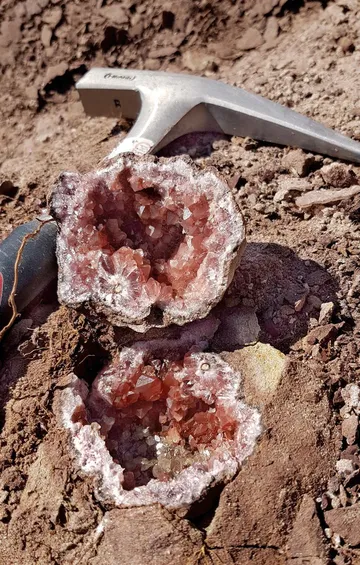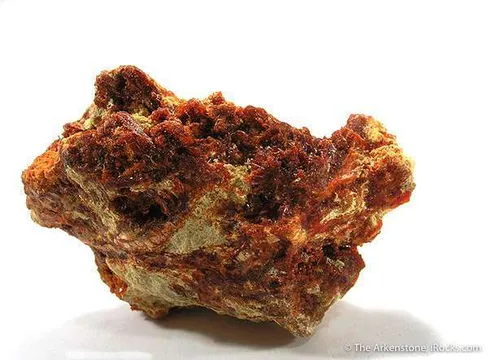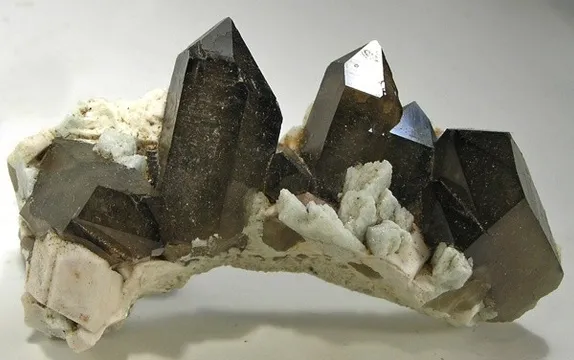
Capillitas mining district, Argentina - famed rhodochrosite, dramatic banding, stalactite cross-sections, and a diverse suite of minerals prized by collectors.
Key facts
Capillitas is the Argentine locality that made rhodochrosite a national emblem and a world-class collector’s material. High on the western slope of the Sierra de Capillitas in Catamarca Province, the district is not a single tidy “mine” so much as a compact, mineralogically crowded epithermal vein system: veins and breccias cutting a Miocene rhyolitic-to-dacitic diatreme and the surrounding Paleozoic Capillitas granite. The deposit belongs genetically to the Farallón Negro Volcanic Complex, the same metallogenic province that includes major porphyry and epithermal systems, but Capillitas is treasured by collectors for something much more intimate than bulk tonnage: its pink, red, white, tan, and brown carbonate banding, its polished stalactite cross-sections, and its bewildering suite of copper, lead, zinc, silver, gold, arsenic, antimony, tellurium, tin, tungsten, bismuth, germanium, cadmium, indium, and thallium minerals.
The classic Capillitas specimen is a slice through stalactitic rhodochrosite: concentric “bull’s-eye” growth rings, raspberry-red zones grading through rose pink and white, sometimes edged or invaded by brown ferroan-zincian material locally called capillitite. Better pieces have strong color saturation, crisp rhythmic banding, multiple joined cylinders, natural rind or matrix where preserved, and a polished face clean enough to reveal the internal architecture without turning the piece into anonymous lapidary stock. The great cabinet specimens can look almost organic—coral, tree rings, rose windows, or cross-sections of pink mineral pipes—while the finest old stalactitic pieces retain the strangeness of an ore-deposit cave rather than the uniformity of commercial carving material.
Regional View
Country View
Capillitas also matters far beyond rhodochrosite. It is among Argentina’s most mineralogically diverse mining districts and the type locality for a suite of rare species, especially Ge-bearing sulfides and related ore minerals that came out of detailed modern work on the La Rosario, Nueva Esperanza, Restauradora, Bordón, La Argentina, and related veins. The field expression is as complex as the specimen suite: a high-altitude underground district, roughly 2,800 to 3,400 m above sea level, with a long and discontinuous history that runs from pre-Hispanic and colonial metal extraction to nineteenth-century copper mining, twentieth-century rhodochrosite production, and present-day controlled extraction of ornamental and specimen material.

Photo: Wikimedia Commons

Photo: Wikimedia Commons
Search for specimens: View all specimens from Capillitas mining district, Argentina
Capillitas is a precious- and base-metal epithermal vein deposit in northwestern Argentina, in Andalgalá Department, Catamarca Province. The mineralization is tied to the Capillitas diatreme, an ellipsoidal volcanic pipe about 1,500 m by 900 m, made up of intrusive and volcaniclastic rocks of rhyolitic to dacitic composition. That Miocene volcanic center was emplaced into the older granitic basement of the Sierra de Capillitas, and the ore system cuts both the volcanic rocks and the adjacent Capillitas granite. The most representative volcanic lithologies described from the diatreme include lapilli tuff, ignimbrite, rhyolite porphyry, lithic tuff, dacite porphyry, rhyolitic dikes, trachytic dikes, and basaltic dikes. The district sits in the broader Farallón Negro Volcanic Complex at the interface of the Sierras Pampeanas and Puna tectonic provinces.
The veins are numerous rather than monolithic. Principal vein names in the district include Capillitas, Carmelitas, La Rosario, Ortiz, Restauradora, 25 de Mayo, Nueve, La Argentina, Nueva Esperanza, La Grande, Luisita, and Bordón. Published work describes veins trending mainly ENE and WNW to NNW, hosted variously in granite, rhyolite dikes within granite, and diatreme volcanics. They are commonly lenticular to tabular, pinch and swell along strike, and show crustiform, colloform, cockade-breccia, vuggy, massive, and banded textures that record repeated opening, brecciation, sealing, and structural reactivation. Some veins can be traced from a few metres to hundreds of metres; one collector-oriented summary records nineteen known rhodochrosite veins, with individual veins up to about 600 m long.
The ore system is best understood as a superimposed sequence of high-sulfidation and intermediate-sulfidation events, later modified by oxidation and supergene enrichment. The high-sulfidation assemblages are especially developed in the central parts of the deposit, including the Capillitas, La Rosario, and Nueve veins, and include pyrite, enargite-luzonite, tennantite-tetrahedrite-goldfieldite, hübnerite, Bi-sulfosalts, Sn-sulfides, tellurides, and native gold, with advanced argillic alteration and silicification. The intermediate-sulfidation assemblages are more Pb-Zn-Ag rich and widespread, with sphalerite, galena, chalcopyrite, pyrite, tennantite, silver minerals, quartz, barite, and the abundant rhodochrosite that made the locality famous. Quartz, rhodochrosite, and barite are the principal gangue minerals in much of the system.
The richest historical copper ores came from the upper and cementation parts of the system. Published accounts note massive bornite-digenite-chalcocite ore in the La Rosario mine averaging about 25% Cu and chalcopyrite-tennantite-rich ores in upper portions of the Restauradora mine averaging about 18% Cu. The same rich upper ore types carried significant precious metals: old copper ingots were reported to yield hundreds of grams per tonne gold and several kilograms per tonne silver. The deeper and more complex ores were lower in copper and harder to beneficiate, a major reason metal mining declined after the richest portions had been exhausted.
Gold at Capillitas belongs both to the history and to the mineralogy. Indigenous miners are considered to have worked alluvial deposits and outcrops before Spanish rule, Jesuit priests mined gold during the seventeenth and eighteenth centuries, and nineteenth-century companies mined principally for copper while recovering gold and silver as by-products. In the mineralized veins, native gold is usually silver-bearing and occurs in high-sulfidation assemblages, in oxidized zones, and locally with tellurides such as krennerite, calaverite, sylvanite, and petzite. The Luisita vein oxidation zone was reported with gold values up to 265 g/t, and modern work confirmed platy native gold aggregates up to 15 mm in oxidized material near Nueva Esperanza. La Rosario was historically associated with free gold as well; old references even record its shaft as the “Gold Shaft,” or pique de oro.
Rhodochrosite mining is the collecting story that survived after the old metal era. Stelzner reported Capillitas rhodochrosite in the nineteenth century, but the carbonate was not always valued: older mining regarded much of it as gangue or waste. Modern ornamental production became important in the twentieth century; one published reserve summary records 2,513 tons of rhodochrosite mined from 1951 through 1979, with remaining reserves then estimated at about 5,400 tons. Later collector literature and specimen provenance point to important late-1980s and early-1990s stalactitic finds, including the famous cavern discovery of November 1986, which produced some of the most memorable rhodochrosite forms associated with the district.
The rhodochrosite occurs as banded, mammillary, brecciated, massive, and less commonly stalactitic material. The most studied stalactites come from the 25 de Mayo and Nueve veins, where single and compound cylinders range from a few centimetres up to 1.36 m in length and up to 8 cm in diameter. Cross-sections can be simple concentric rings or elaborate intergrown tubes; exteriors can be smooth, wavy, or poker-chip textured. The colors range from white to pale pink to raspberry pink, with brown bands and margins representing capillitite. Formation temperatures for banded rhodochrosite in the 25 de Mayo vein, based on fluid inclusions, are around 145 to 150 °C with low salinity, fitting a late, relatively cool epithermal carbonate pulse.
Control of the district has changed repeatedly. Historical work involved Indigenous miners, Jesuit operations, Argentine and English private companies from the nineteenth century, and later state and military-linked management. More recently, Fabricaciones Militares held the mining title for Minas Capillitas, while Catamarca’s state mining company CAMYEN operated rhodochrosite extraction and commercialization under agreement. Current reporting in September 2026 describes CAMYEN as having taken charge of the exploitation of Mina Capillitas after agreement with the national mining authorities and Fabricaciones Militares, with the company focusing on rhodochrosite exploration, equipment, hygiene, safety, health, and reinforcement of mine processes. For collectors, that means Capillitas is not a casual open rockhounding locality: specimens come through licensed mining, local lapidary and artisan channels, dealer inventories, and old collections. Any purported “personally collected” underground material should be treated with caution unless the chain of custody is unusually clear.
Tourism in the broader Capillitas area exists, but it is not the same as collecting access. Provincial tourism material describes the old mining landscape, the Muschaka smelting complex active from 1902 to 1914, remains of furnaces, chimneys, slag heaps, portions of a 33-km cableway, a chapel, and the hand extraction of rhodochrosite at Santa Rita. Visitors may encounter views of old works and mining heritage; they should not assume permission to enter workings, collect on dumps, or remove material from active concessions.
Capillitas rhodochrosite is the district’s signature mineral: a late intermediate-sulfidation Mn carbonate gangue that occurs in veins with quartz, barite, sphalerite, galena, pyrite, marcasite, chalcopyrite, and locally other sulfides, and is best known from banded and stalactitic material in the 25 de Mayo, Nueve, Ortiz, Capillitas, Carmelitas, and related vein sectors. Colors range from raspberry red through saturated rose pink to pale pink and white; brown bands and outer zones are the local ferroan-zincian variety called capillitite. Stalactites may be single or compound cylinders from small hand-specimen sections to tubes more than a metre long, and polished cross-sections reveal simple rings, clustered tubes, lace-like growth, and “tree-form” or rose-window patterns. The best collector pieces combine intense raspberry color, sharp rhythmic banding, attractive multi-core geometry, minimal cracks, well-preserved natural exterior where present, and a polish that shows the structure without excessive rounding or resin-heavy presentation; ordinary pieces tend to be pale, blocky, poorly patterned, overly carved, fractured, or locality-vague “Argentine rhodochrosite” without a Capillitas provenance.
Gold from Capillitas is a real but much scarcer collector mineral than rhodochrosite, occurring chiefly in the high-sulfidation and oxidized parts of the system rather than in the late rhodochrosite-rich carbonate stage. Published work records native gold from the Bordón, La Rosario, Nueva Esperanza, Restauradora, and broader Capillitas workings; it is usually silver-bearing and may appear as minute grains, inclusions, or platy aggregates rather than showy leafs. Notable settings include oxidized outcrops near Nueva Esperanza, where native gold plates up to 15 mm were described, and bornite-chalcocite-rich material from La Rosario, historically associated with free gold and the old pique de oro. Good Capillitas gold specimens are therefore locality and association pieces: small but well-documented native gold in oxidized matrix, vuggy high-sulfidation ore, or telluride-bearing assemblage is more meaningful than an isolated yellow speck with no analytical or provenance support.
Other minerals documented from Capillitas make the district a specialist’s locality even when the hand specimens are not showy. Primary ore minerals include pyrite, sphalerite, galena, chalcopyrite, marcasite, pyrrhotite, tennantite-tetrahedrite, enargite, bornite, stannite, stannoidite, mawsonite, hübnerite, and gold, with tellurides including krennerite, calaverite, sylvanite, petzite, hessite, stützite, goldfieldite, melonite, tetradymite, and possibly volynskite. Silver-rich shoots, especially in La Argentina, carry native silver, acanthite, proustite, pearceite, and argyrodite. The type-locality minerals are especially important: putzite, catamarcaite, ishiharaite, lislkirchnerite, and omariniite all anchor Capillitas in modern descriptive mineralogy. Putzite and catamarcaite are rare Ge-bearing sulfides associated with the bornite-chalcocite ore environment near La Rosario; ishiharaite is an indium- and gallium-bearing sulfide from Nueva Esperanza; lislkirchnerite is a rare Pb-Al nitrate-chloride hydroxide hydrate from Nueva Esperanza No. 1; and omariniite is a Ge analogue of stannoidite found as microscopic rims and veinlets in high-grade bornite-chalcocite copper ore.
The most common authenticity problem is not fake locality labels on world-class crystal rhodochrosite—Capillitas is not a transparent rhombohedral-crystal locality in the Colorado sense—but confusion and embellishment in the banded material trade. “Argentine rhodochrosite,” “Inca Rose,” and “Rosa del Inca” are often used broadly, and not every pink banded carbonate carving with an Argentina label can be confidently assigned to a named vein. Mindat’s locality guidance is conservative: because there may be no reliable visual characteristics to prove the exact vein of origin for many rhodochrosites, many specimens are best labelled simply as Capillitas mining district rather than as 25 de Mayo, Nueve, Ortiz, or another specific vein unless backed by old labels or mine-source documentation.
Fine Capillitas rhodochrosite slices have their own condition language. Sawing and polishing are normal and expected for stalactitic material; the specimen’s value depends on the strength of the exposed pattern, the naturalness of the form, color, and condition. Watch for open cracks, repaired breaks, over-polishing, wax or resin fill in fractures, edge chipping, bruised cleavage, and coatings that make a dull or fractured piece look wetter and deeper in color than it really is. A Mindat-described small-cabinet stalactite notes a sawed, polished base “coated with polyurethane spray or lacquer,” a useful reminder that coatings do occur in the trade and should be disclosed. Stabilization may be acceptable in lapidary objects, but it matters greatly for mineral specimens.
Imitations also exist in the broader rhodochrosite market. GIA documented a pressed gibbsite-and-calcite material sold as a rhodochrosite imitation; it had lower specific gravity, lower luster and transparency, different refractive behavior, and strong long-wave UV fluorescence, while natural rhodochrosite samples were inert under the tested UV conditions. Cheap beads, carvings, and gift-shop pieces may also be dyed calcite, dyed marble, dyed howlite, glass, polymer, or resin composite. Natural Capillitas material should show carbonate heft, appropriate hardness, realistic band geometry, and internal growth complexity rather than flat printed-looking stripes or uniformly saturated candy-pink color.
Rhodochrosite is a soft carbonate, roughly Mohs 3.5 to 4, and good Capillitas pieces scratch and bruise easily. Avoid ultrasonic cleaning, acids, prolonged water soaking, household cleaners, and display in abrasive stands. A dry microfiber cloth and gentle handling are usually enough for polished slices. The pink color is generally stable under normal display, but any carbonate specimen is best kept away from damp acidic environments. Pieces with associated sulfides—especially pyrite, marcasite, galena, or copper sulfides—should be kept dry and checked periodically for alteration.
Specimen availability is uneven. Small polished slices, cabochons, beads, and carvings remain common enough through lapidary supply, tourist, and artisan channels. Good mineral specimens with strong locality provenance, vivid old-stock stalactitic architecture, natural exterior, or matrix are much less common. Large, richly colored, sharply banded slabs from the late-1980s material are now largely recycled through collections and dealer inventories. Capillitas gold is far rarer in collector circles than the rhodochrosite and should be purchased only with excellent documentation; microscopic type-locality rarities such as putzite, catamarcaite, ishiharaite, lislkirchnerite, and omariniite belong mainly to research suites and specialized micromount or polished-section collections.
The Capillitas story begins before the specimen trade had a vocabulary for it. The first miners were not after rose-pink carbonate. They sought metal: alluvial gold, outcrops, oxidized zones, and later copper ore. By the seventeenth and eighteenth centuries Jesuit priests were mining gold in the district, and by the mid-nineteenth century Argentine and English companies had turned the hill into a copper camp where gold and silver were recovered as by-products. In the older upper workings, the ore was rich enough that later mineralogists still wrote of the oxidation zone, cementation zone, and “pique de oro” as distinct historical clues to what had been removed before modern collectors arrived.
One of the more vivid industrial ghosts lies not in a cabinet but in the landscape. Muschaka, the old mining complex on the route to the Capillitas workings, operated intensely from 1902 to 1914 as a smelting center for copper ore extracted from the Capillitas hills. The remains described today are tangible: furnaces, chimneys, slag heaps, the old chapel, and part of a 33-km cableway. For collectors accustomed to seeing Capillitas only as polished pink slices under show lights, those ruins are an important corrective. The “Rosa del Inca” emerged from a hard-metal district, with smelters, transport systems, slag, and underground workings long before it became a national ornamental stone.
The great specimen legend is the rhodochrosite stalactite cavern discovered in November 1986. David Stoudt’s 2018 New Mexico Mineral Symposium abstract preserves the most dramatic version of the episode: an interlocking series of small caverns measuring about 15 m wide by 6 m high, with stalactites up to 45 cm in diameter, photographed by J. A. Saadi in January 1987. Stoudt called its destruction, ordered by Argentine Federal and Military authorities, the “Argentine Day of Infamy.” Even allowing for the passions of collector history, the numbers are unforgettable: a cavern face several metres high, giant pink carbonate tubes in an epithermal ore deposit, and only a small photographic record left after the pocket was destroyed.
There is another, quieter Capillitas irony. The rhodochrosite that now defines the locality was once gangue. Older mining was aimed at gold, silver, and copper, and collector summaries note that rhodochrosite mined earlier was thrown on the dumps as waste. The transformation of waste into national stone is part of the locality’s charm: what nineteenth-century miners broke through on the way to copper became the material lapidaries cut into roses, hearts, slabs, spheres, and collector cross-sections. In the best old slices, one can still read that change in status: a polished face of pink rings, but a rough exterior that belongs to an underground opening, not a jewelry bench.
Capillitas remains a demanding place in the collector imagination because it resists simplification. One vein gave copper-rich bornite-chalcocite ores; another produced silver minerals; another holds indium-bearing sphalerite and ishiharaite; another is remembered for rhodochrosite stalactites. The district’s most famous specimens are instantly recognizable from across a room, yet the exact vein provenance of many pieces cannot be visually proven. That tension—spectacular identity at the district level, uncertainty at the pocket level—is why the best labels matter, and why old collection tags naming Capillitas, Catamarca, and a date or dealer can add as much interest as a deeper polish.