Ask most collectors how their collection is insured and you'll get a shrug and "it's under the house policy." It probably isn't - at least not the way they imagine. The gap between what people assume and what their policy actually pays out is where collections get lost twice: once to the fire or the fall, and again to the claim that comes back a fraction of the value.
Insurance is unglamorous, and this guide won't pretend otherwise. But it rests on something you control completely - documentation - and getting it right is far cheaper than discovering the gap after a loss. (One note up front: coverage rules vary by country and insurer, so treat this as a map, not legal advice, and confirm specifics with a licensed agent.)
Standard homeowner's and renter's policies do cover personal property - but for a collection, the fine print bites in three places:
- Sub-limits. Many policies cap certain categories far below the policy's headline number. Your collection can be quietly lumped into a small per-category limit that doesn't come close to its value.
- Named perils and exclusions. A basic policy may cover fire and theft but not accidental breakage - and breakage is exactly how minerals die. A specimen knocked off a shelf or shattered in a move may not be covered at all.
- "Mysterious disappearance" and valuation. Items that simply go missing may be excluded, and payouts are often actual cash value (depreciated) rather than what it costs to replace the piece today - which, for appreciating collectibles, is the wrong number entirely.
The result: a collector who thinks they're covered for replacement value is often covered for a depreciated fraction, minus a category cap, with the most likely loss (breakage) excluded.
1. Schedule it on your existing policy. A rider or floater added to your homeowner's policy lists valuable items - individually for high-value pieces, or as a blanket amount for the rest - usually with broader coverage and an agreed value you set with documentation. This is often the simplest route for moderate collections.
2. Buy a specialty collectibles or fine-art policy. Insurers who specialize in collections typically offer all-risk coverage (including accidental breakage), agreed values, and often coverage for pieces in transit or on loan. For a serious or growing collection, this is usually the better fit, and not always more expensive than you'd expect.
Within either, you'll choose between blanket coverage (one total for the whole collection, lighter paperwork, often a per-item cap) and scheduled coverage (each piece listed with an agreed value - more work, but far better for signature pieces). Most collectors end up with a hybrid: schedule the top tier individually, blanket the rest.
Every coverage option above depends on the same thing: proof of what you owned and what it was worth. Without it, claims get reduced or denied, because the insurer has no basis to pay. Insurers generally want:
- An itemized inventory - species, dimensions, locality, condition, and identifying details.
- Photographs of each piece (and ideally the labels).
- A valuation, usually at replacement value, with a professional appraisal for high-value items.
- Provenance and receipts where you have them.
This is the quiet truth of collection insurance: the policy is only as good as your documentation. A claim backed by a clean catalog, photos, and defensible values is a formality. A claim backed by "trust me, I had a great suite" is a negotiation you'll lose.
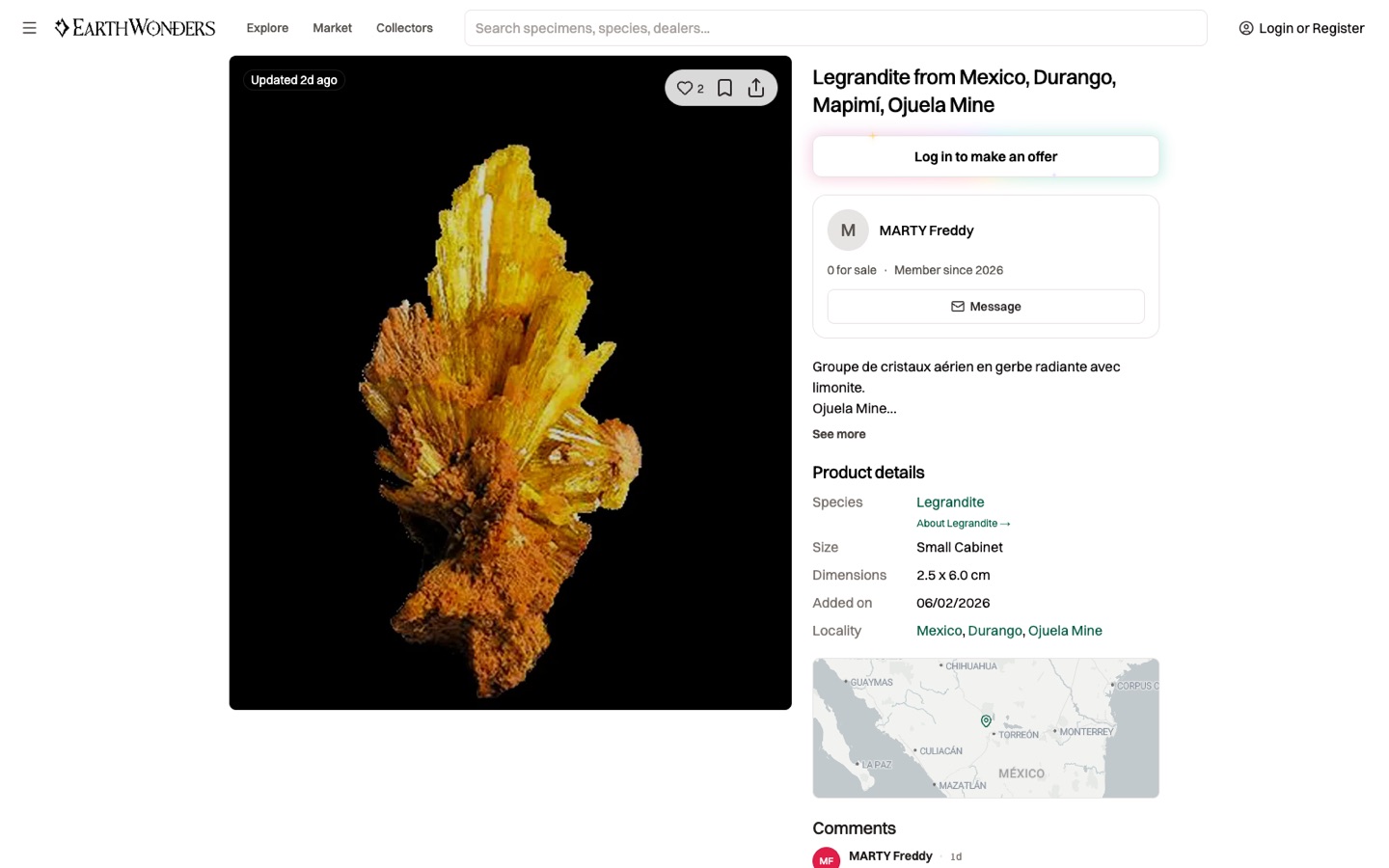
Exactly what an insurer asks for, captured per specimen: species, dimensions, locality, acquisition details, and photos — a record that makes a claim payable instead of arguable. (Start here with our cataloging guide.)
Insurance cares about replacement value: what you'd pay to buy the piece again, at retail, today. That's the highest of the value definitions, and it's not what you paid years ago. Ground it in what comparable specimens actually trade for now, rather than a guess or a stale receipt.
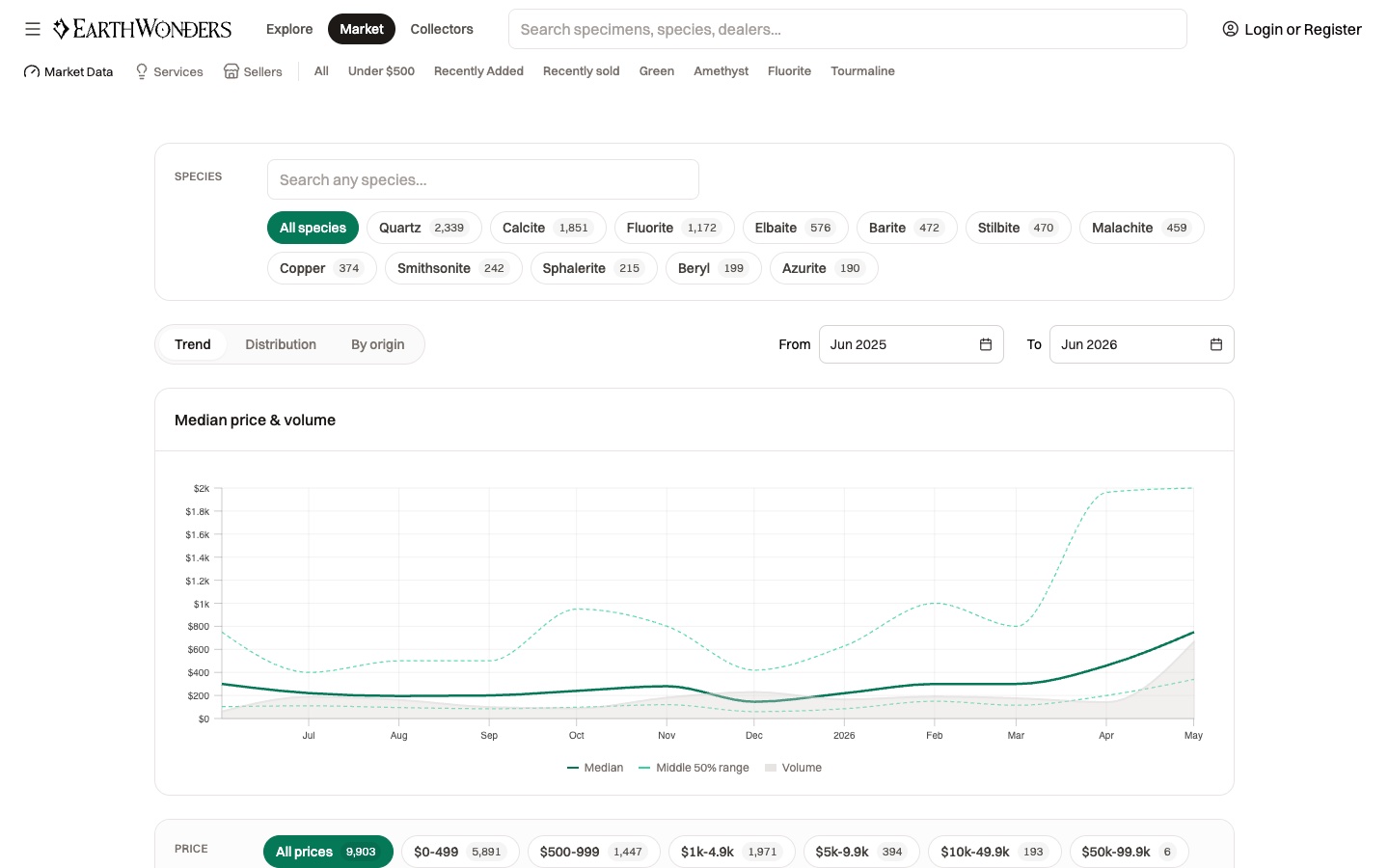
Replacement value, defensible: real sold prices for comparable species and localities. When you can show an insurer (or adjuster) the basis for a number, it stops being an opinion. (How to value a collection.)
A catalog that lives only on the laptop that burns with the house proves nothing. Whatever insurance you choose, your documentation must survive the same disaster the insurance is for - which means a backup that isn't in the building. A cloud-based catalog solves this for free: your inventory, photos, and values are safe off-site by default, and exportable, so you can hand an insurer or appraiser a complete record in minutes.
This is where a connected catalog quietly doubles as your insurance file. On EarthWonders, every specimen's data and photos are stored in the cloud and backed up automatically, your valuations sit next to real market data, and you can export the whole collection whenever you need it - all private, visible to no one unless you choose to share. You're documenting for love of the collection; you end up with an insurance dossier as a side effect.
- Re-value periodically. Markets move and collections grow; coverage set three years ago is probably wrong now. Revisit annually, or after any major acquisition.
- Schedule new signature pieces as you buy them, rather than discovering the gap later.
- After a loss, file promptly and lead with your documentation — inventory, photos, valuations, provenance. The better your records, the faster and fuller the payout.
Don't assume; verify. Read your homeowner's sub-limits and exclusions, decide between scheduling and a specialty policy, and value your pieces at replacement cost backed by real sales. But the foundation under all of it is documentation — a complete, photographed, off-site catalog of what you own and what it's worth. Build that, and insurance stops being a leap of faith and becomes what it's supposed to be: a number you can collect.
Your collection is also your insurance file. Catalog it free on EarthWonders — photos and data backed up in the cloud, valuations beside real market data, exportable any time, and private until you decide otherwise.