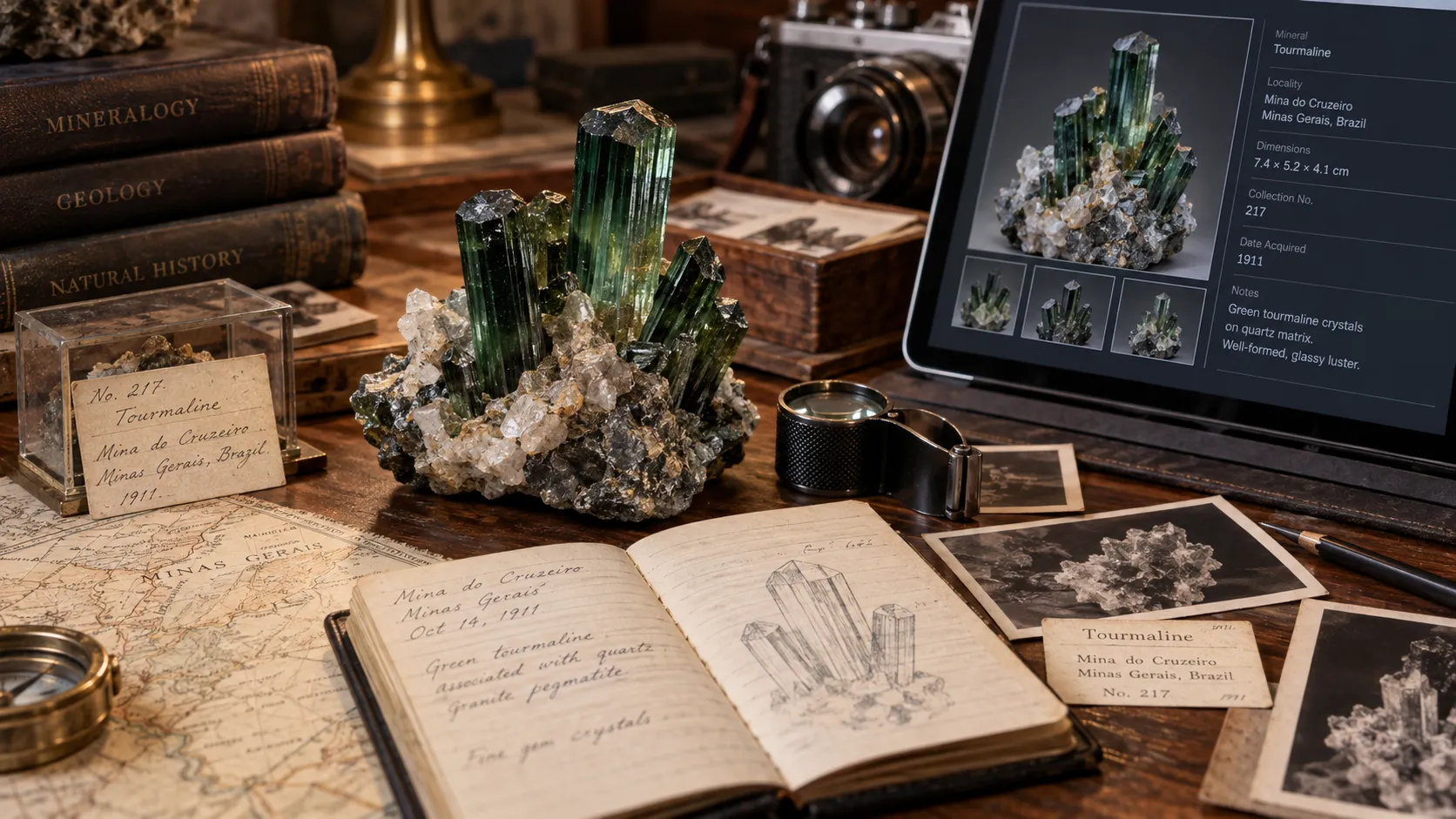
From specimens and old labels to a structured record of a collection
A mineral collection is more than a group of specimens.
Over time, every piece can accumulate information: where it came from, when it was collected, who owned it previously, which labels accompanied it, when it entered the collection, and why it matters to the collector.
The problem is that this information often lives in different places.
A specimen may sit in a cabinet while its acquisition information remains in a spreadsheet. An old dealer label may be stored in a box. Photographs may exist across several hard drives. Locality notes might be written in books, documents, or simply remembered by the collector.
A digital archive brings these different elements together.
It creates a structured record where a specimen can remain connected to its photography, locality, provenance, documents, and history.
The specimen remains the center of the archive.
A useful digital record can begin with a relatively simple set of information:
Mineral species Locality Dimensions Collection number Date acquired Photography
From there, the record can become increasingly detailed depending on the importance of the specimen and the information available.
Previous ownership, historic labels, literature references, exhibition history, acquisition notes, repairs, and associated documents can all be connected to the same record.
This creates something more useful than a simple image gallery.
It gives each specimen an identity within the larger collection.
Photography is usually one of the first steps in digitizing a collection.
A strong primary photograph documents the specimen as a complete object. Additional photographs can show different orientations, crystal details, matrix relationships, labels, or areas that are difficult to see from the main view.
For some specimens, macro photography can preserve details that may otherwise receive very little attention.
A digital archive can therefore contain several visual layers:
Full specimen → alternate views → close details → labels and documents.
This is useful not only for presentation but also for documentation.
The photographs create a record of what the specimen looked like at a particular point in the history of the collection.
Old labels can be some of the most important objects accompanying a specimen.
Handwritten collector cards, dealer labels, museum tags, collection numbers, and locality notes may provide information that is difficult—or impossible—to reconstruct later.
Digitizing these labels allows them to remain connected to the specimen even if the original paper becomes damaged or separated from it.
For older specimens, several generations of labels can sometimes reveal the movement of the piece between collections.
Presented chronologically, they can form a visible provenance history.
The archive then becomes a place where the mineral and its documentary history can be examined together.
A locality should not always be treated as a single line of metadata.
For many collectors, the mine or district is a fundamental part of why a specimen is important.
An archive can therefore connect individual specimens to dedicated locality records containing maps, geological information, historical photographs, collecting history, or references.
This creates two natural ways to explore the collection.
A visitor can begin with a specimen and discover its locality.
Or they can begin with a locality and see all the specimens associated with it.
For geographically focused collections, this can become one of the most useful parts of the archive.
Provenance is not equally extensive for every mineral specimen, but when it exists, preserving it can add significant context.
A record might include:
Instead of keeping these details scattered between physical files and digital folders, the archive allows them to remain associated with the specimen itself.
This becomes increasingly valuable as a collection grows.
The collector may remember the history of many important specimens, but relying only on personal memory becomes more difficult across hundreds or thousands of pieces.
Collections are shaped by people.
Two collectors can build completely different collections even when they are interested in the same mineral species or locality.
One may focus on crystallography. Another may prioritize aesthetics. Another may document a specific mining district over several decades.
The reasons behind those decisions are part of the collection's history.
A digital archive can therefore include field photographs, personal notes, stories of discoveries, important acquisitions, collector biographies, or reflections on particularly meaningful specimens.
This human element helps explain not only what the collection contains, but why it exists in that form.
Different collections require different systems.
A locality-focused collection may organize the archive around mines and districts.
A systematic collection might prioritize mineral classification.
A historic collection may need provenance and documentation to be more prominent.
A large private collection may need powerful filtering and search tools, while a smaller collection may benefit from a more editorial presentation.
The archive should follow the character of the collection rather than forcing every collection into the same template.
A digital archive cannot reproduce the experience of seeing a mineral specimen in person.
It does something different.
It preserves the relationships surrounding the specimen:
the relationship between the mineral and its locality, between the specimen and its labels, between the object and previous collectors, and between an individual piece and the collection as a whole.
That is where digital documentation becomes particularly valuable.
A mineral specimen may survive for generations.
The information surrounding it should have the same opportunity.