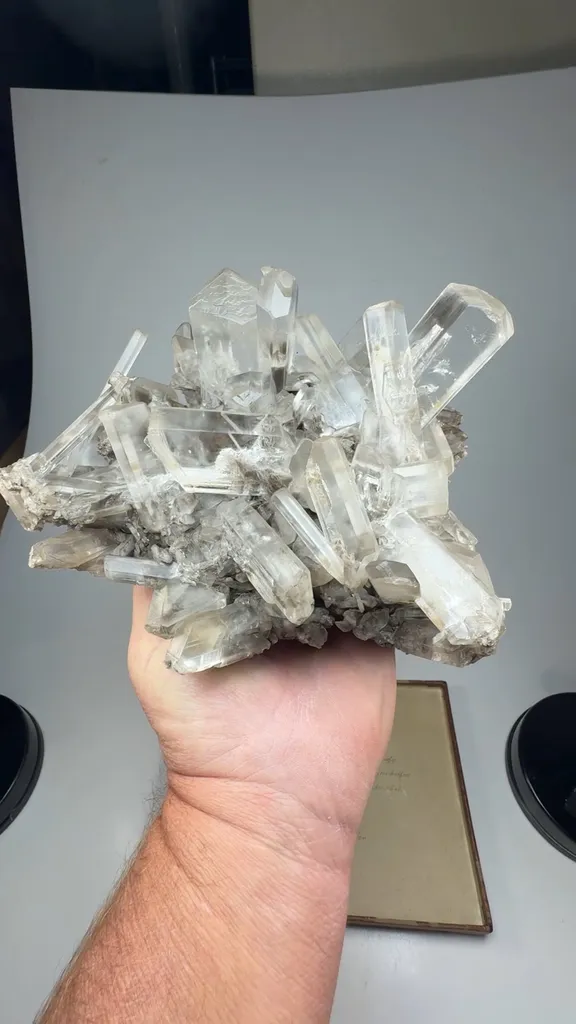
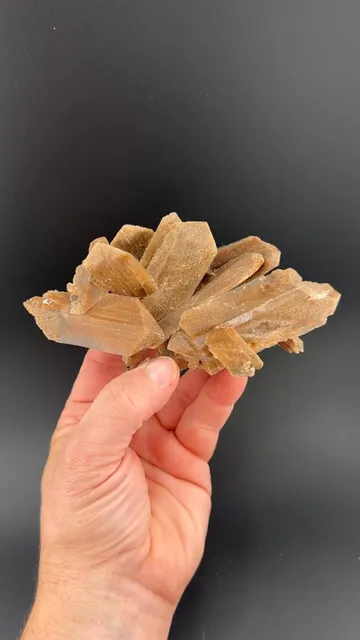
A spectacular large specimen showing glassy gem quality colorless crystals of gypsum measuring to 6.0 cm in size across the top of matrix. This is in remarkably good condition. The specimen comes with an antique label as shown at the end of the video with an original acquisition date of 1909.The town of Eisleben, located in the Mansfeld region of Saxony-Anhalt, Germany, is situated within a geological landscape defined by the thick evaporite sequences of the Permian Zechstein Sea. In this area, massive layers of gypsum and anhydrite were deposited approximately 250 million years ago, forming a significant part of the regional stratigraphy alongside the famous copper-bearing Kupferschiefer shale. Historically, the quarrying and mining of gypsum in and around Eisleben have been vital for the local construction industry, providing raw materials for plaster, mortar, and alabaster since the medieval period. While the region is best known for its intensive copper mining that spanned over 800 years from 1199 to 1990, dedicated gypsum extraction intensified during the 19th and 20th centuries to meet industrial demand. Geologically, these deposits are noted for their karst features and the occasional presence of well-formed selenite crystals found within subterranean cavities.



 Ships from USA

Comments