Yunchangping Mine, Dadongla, Guizhou, China — a premier cinnabar locality yielding jewel-red crystals on white dolomite and quartz, highly valued by collectors.
Key facts
Yunchangping Mine is the collector-facing name attached to one of the most attractive cinnabar localities in the Dadongla Hg-Zn ore field of Bijiang District, Tongren, eastern Guizhou, China. It sits in the same borderland mercury country that made Tongren, Wanshan and the western Hunan–eastern Guizhou belt famous: low-temperature hydrothermal mineralization in carbonate rocks, with cinnabar as the visual prize and pale carbonate or quartz as the stage. For collectors, its importance is not as a broad species locality but as a sharply defined source of jewel-red cinnabar on white dolomite and quartz-rich matrix, the kind of Chinese cinnabar that changed Western expectations of what HgS could look like as a display mineral.
The geological story is two-layered. The Dadongla ore field belongs to a carbonate-hosted Zn-Pb-Hg mineral province, and published work on the Dadongla Zn-Pb deposit places the main lead-zinc mineralization in lower Cambrian Aoxi Formation dolomite, with bedded to para-bedded ore bodies and MVT-style ore-forming temperatures. The specimen story is more focused: Yunchangping labels are sought for cinnabar crystals, commonly with dolomite and quartz, with a few records adding aragonite and minor baryte. The best examples show saturated red to dark cherry-red cinnabar, often translucent on thin edges, rising from ivory-white dolomite rhombs or sparkling quartz-lined cavities. Good pieces have the unmistakable contrast that makes Tongren-area cinnabar so collectible: dense red crystals, pale matrix, strong luster, and a believable natural seat at the crystal base.
Historically, Dadongla is not merely a mine name on a specimen label. Yunchangping itself was formerly known as Dadongla and Poxi, and local histories describe it as a mercury and cinnabar trading settlement by the Ming period. In the twentieth century it became part of the organized Tongren mercury-mining system, at one point a major industrial and penal-enterprise mining district. That human history matters to collectors because specimens from this area are survivors of an ore economy built around mercury rather than cabinet minerals; fine pieces were incidental finds from a working mercury district, not the product of a specimen mine designed for careful pocket extraction.
Regional View
Country View
The locality is especially satisfying when the cinnabar is not isolated as a single showy crystal but integrated into the matrix: red crystals tucked among dolomite blades and rhombs, scattered across quartz-lined pockets, or perched on creamy carbonate mounds. A documented 2006 Dadongla/Yunchangping specimen in the Crystalline Treasures project measured 7.3 cm overall and showed the classic red-on-white composition; another photographed example measured 6.5 cm. Dealer and collector records show a wider range, from thumbnail and miniature specimens with 6–9 mm crystals to cabinet pieces carrying multiple cinnabars approaching the 2–3 cm class.
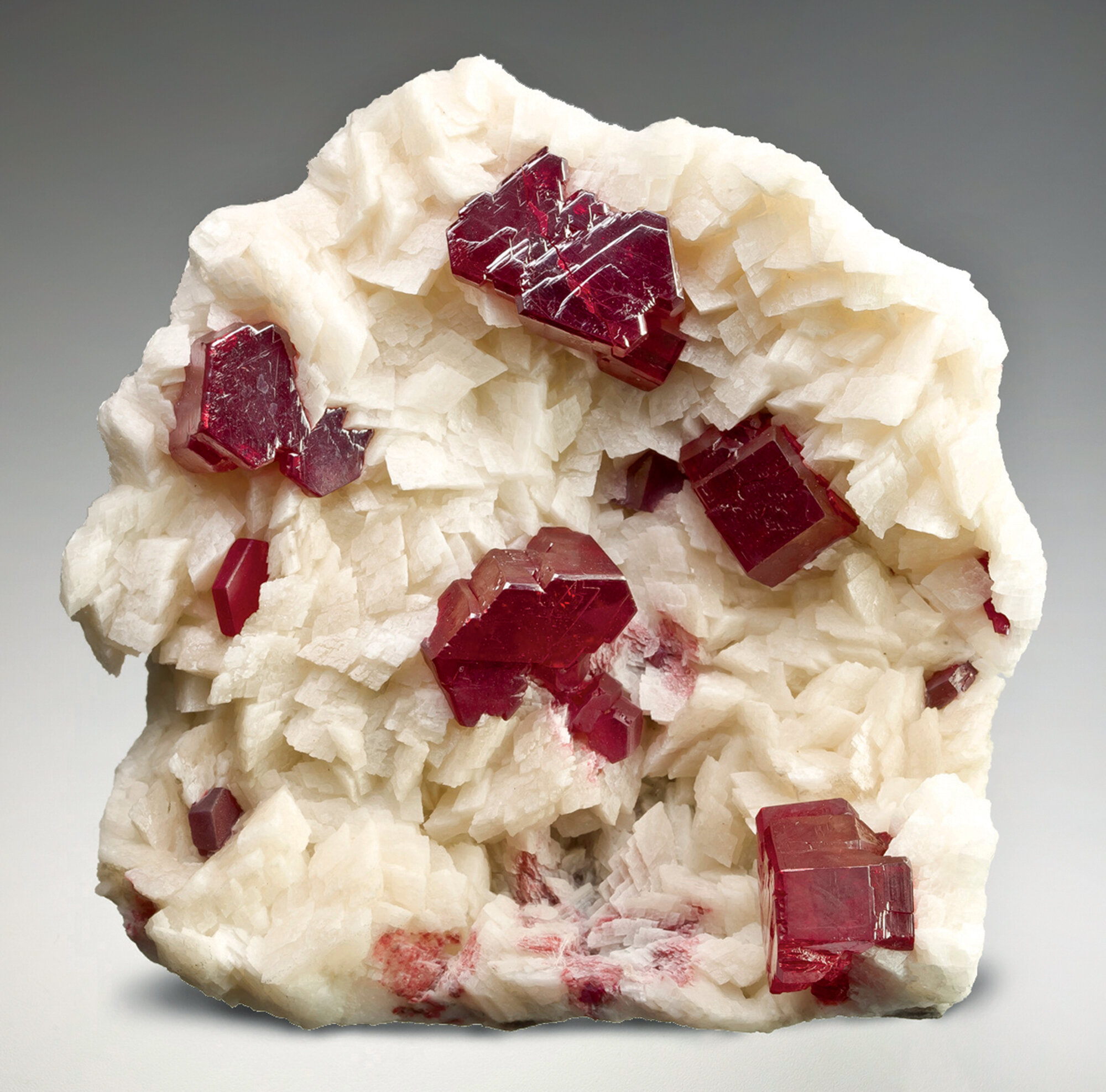
Photo: Crystalline Treasures
Search for specimens: View all specimens from Yunchangping Mine, Dadongla, null
Yunchangping Mine is recorded in the Dadongla Hg-Zn ore field, Bijiang District, Tongren, Guizhou, China, northeast of Tongren. Mindat gives the locality at 27.74389, 109.34333 and treats it as a mine within the Dadongla ore field. The closest named settlements in the database are small villages and townships on the Guizhou-Hunan borderland, which is significant because collector labels have historically drifted among Yunchangping, Dadongla, Tongren, Wanshan and nearby Hunan-side mercury localities.
Geologically, the Dadongla ore field lies within the western Hunan–eastern Guizhou Zn-Pb-Hg metallogenic belt. Published LA-ICP-MS work on sphalerite from the Dadongla Zn-Pb deposit describes a carbonate-hosted system in lower Cambrian Aoxi Formation dolomite, with ore bodies occurring as bedded to para-bedded mineralization broadly conformable with the wall rock. That study interprets Dadongla as Mississippi Valley-type lead-zinc mineralization, with calculated sphalerite ore-forming temperatures from 79.9°C to 177.6°C. The ore-field assemblage is simple by economic-geology standards: sphalerite dominates the Zn-Pb ore, with minor pyrite and galena, while dolomite and calcite are the principal gangue minerals and bitumen and barite occur in lesser amounts.
The cinnabar specimens that interest collectors come from the mercury-bearing part of this carbonate-hosted district. Regionally, the Tongren–Fenghuang mercury belt is known for low-temperature cinnabar mineralization in Cambrian carbonate rocks, with disseminated, fracture-fill, vein, breccia and cavity styles reported from the broader Wanshan mercury field to the south. At Yunchangping itself the verified specimen assemblage is narrower: cinnabar, dolomite and aragonite are listed as standard minerals, while quartz and baryte are documented in specimen and photo records. The most attractive pieces are cavity specimens rather than ore chunks: cinnabar crystals scattered on white dolomite, seated in open quartz pockets, or accompanied by minor baryte.
The mining history is unusually deep for a locality best known to mineral collectors from relatively modern specimens. Local histories state that Yunchangping was formerly called Dadongla and Poxi, and that a mercury office was established there in the early Ming period. By the Ming and Qing periods it belonged administratively to the Sizhou region; in 1932 it was set as Dadong Town before later administrative changes. Local accounts record foreign control of mining rights in 1899, their recovery in 1908, and about three decades of private mine-owner extraction before the late Republican period. In 1952 the town area came under the Guizhou mercury-mining system, and in September 1953 Tongren Mercury Mine was established as an enterprise under the provincial prison-administration system.
Industrial production reached substantial scale. In 1988 the mine reportedly had more than 2,100 workers, annual mercury output of 150–180 tonnes, cement output of 50,000 tonnes, annual production value above 10 million yuan, and fixed assets of 31.38 million yuan at year end. More than 60% of the town’s labor force was connected with mercury mining and processing, and local villagers also participated seasonally in picking cinnabar-bearing material and roasting mercury. After the 1990s, long exploitation left the old mine openings near depletion, and the main mining focus shifted elsewhere, including to Huashigu’ao, while the old town’s mining-centered economy contracted.
For specimen collectors, there is no evidence that Yunchangping is a practical casual field-collecting destination today. Chinese institutional sources describe the Dadongla mining district remains as a protected cultural-relic or heritage site with old adits, plant ruins and buildings from the mercury-mining period. Abandoned mercury mines are also inherently hazardous: unstable workings, mercury-bearing waste, roasting residues, and legally managed land status all argue against casual collecting. Realistically, Yunchangping is a market locality. Good labels, old dealer stock, specimen photos, and honest disclosure of repairs are more important than any modern prospect of visiting and collecting fresh pockets.
The best documented collector finds include the Dadongla/Yunchangping cinnabar-on-dolomite specimens illustrated in Crystalline Treasures, including a 7.3 cm specimen recorded as found in 2006. Dealer records also document small-cabinet quartz-pocket specimens with red cinnabar averaging about 0.5 cm, a quartz-with-cinnabar-inclusions specimen with 1.0 cm gemmy quartz, and a 10.2 cm specimen with dark red cinnabar crystals to 1.5 cm scattered over white quartz and dolomite with minor baryte. These are not huge by Chinese cinnabar standards, but they define the locality’s collector identity: red HgS crystals in pale, open, carbonate-quartz cavities.
Yunchangping cinnabar is best known as lustrous red to dark cherry-red crystals on pale dolomite or quartz-rich matrix, commonly in small-cabinet to cabinet specimens where the cinnabar crystals range from a few millimetres to around 1–1.5 cm, with exceptional Tongren-area collector pieces approaching the 2–3 cm class. The forms include sharp terminated crystals, modified rhombs and twinned or intergrown crystals, and the finest examples show translucency at the edges rather than a merely painted red surface. Dolomite is the classic matrix here, usually white to ivory and crystallized; quartz-pocket specimens are also documented, including open cavities lined with sparkling quartz and cinnabar crystals averaging about 0.5 cm. What separates a good Yunchangping cinnabar from an ordinary one is the naturalness of the placement as much as the color: the crystal should be seated convincingly in dolomite or quartz, with bright luster, minimal bruising on edges, no smeared red rubbing on the matrix, and strong red-white contrast.
At Yunchangping, dolomite is not usually collected as an independent species specimen; its importance is as the pale carbonate architecture that makes the cinnabar visually compelling. It occurs as white, off-white or cream crystallized matrix, commonly described as rhombic or “crystallized dolomite,” with cinnabar crystals rising from or partly nestled among the carbonate. Some cabinet pieces are reported with substantial dolomite coverage, including collector-described specimens where roughly one-third of the matrix is covered by dolomite rhombs. Good dolomite matrix here is clean, three-dimensional and undamaged enough to frame the cinnabar without distracting from it; poor examples are iron-stained, bruised, powdery, or suspiciously carved around the cinnabar base. Dolomite also provides an important authenticity clue, because natural contact textures at the crystal base are far more convincing than a red crystal apparently planted into a neat white socket.
Quartz from Yunchangping is documented chiefly as a matrix and association mineral for cinnabar, rather than as the primary show species. The most useful collector records describe open pockets lined with sparkling quartz carrying red cinnabar crystals, white quartz-dolomite matrices with cinnabar crystals to about 1.5 cm, and at least one specimen in which a 1.0 cm gemmy quartz crystal contains crystallized cinnabar inclusions and sits on white dolomite with additional cinnabar. Quartz can be colorless, milky or sparkling white, and it commonly shares the matrix with dolomite and occasional baryte. The best quartz-bearing pieces have open vugs with intact, bright quartz points that make the red cinnabar read clearly; ordinary pieces tend to be visually busy, with scattered small cinnabars, broken quartz, or a matrix that looks more like ore rubble than a natural pocket lining.
Other minerals documented from Yunchangping itself include aragonite, a real rarity for the locality, and baryte as a minor associated mineral in cinnabar-quartz-dolomite specimen records. The broader Dadongla ore-field literature records sphalerite, pyrite and galena in the Zn-Pb ore system, with gangue dolomite, calcite, bitumen and barite, but those should not automatically be transferred onto a Yunchangping specimen label unless the specific specimen supports them. No type-locality mineral is established for Yunchangping in the locality records reviewed; the collector interest is instead concentrated in its classic cinnabar-dolomite-quartz associations and in the occasional aragonite record.
Yunchangping cinnabar requires unusually careful authenticity screening. A dealer-disclosed fake from this exact locality consisted of a real, lustrous red cinnabar crystal group only 0.7 cm across that had been artistically glued onto a crystallized quartz and dolomite matrix. That example is important because it shows the typical danger: the cinnabar crystal may be genuine, the matrix may be genuine, and the finished object may still not be a natural matrix specimen.
The broader Chinese cinnabar market has long had problems with glued or constructed specimens, especially Tongren-Wanshan-Yunchangping style pieces. Look closely at the crystal bases under magnification. Warning signs include glossy adhesive, a neat drilled or carved socket, powdered dolomite or quartz packed around the base, a crystal whose contact footprint does not match the surrounding matrix, mismatched luster at the join, suspiciously perfect isolation of a single red crystal on an otherwise unrelated matrix, or little quartz/dolomite chips arranged to hide a gap. Ultraviolet light can sometimes reveal adhesive, but it is not a guarantee; some glues do not fluoresce, and some joins are hidden with powdered matrix.
Condition is the second major issue. Cinnabar is soft, dense and brittle enough at edges that small chips, rubbed corners and cleaved-looking bruises are common, especially on protruding twins. The red color makes damage conspicuous when it exposes dull or darkened surfaces. Dolomite matrix is also easily bruised, and quartz points in open pockets are often chipped. Because good Yunchangping specimens depend on contrast, even small amounts of red smearing, dust, glue residue or dolomite bruising can reduce the piece sharply in collector value.
Handling should be sensible rather than fearful. Cinnabar is HgS, a mercury sulfide, and intact crystalline specimens are far less hazardous than mercury vapor or soluble mercury compounds, but they should not be abraded, heated, sawn, powdered, licked, soaked casually in household chemicals, or handled by children. Wash hands after handling, keep specimens out of reach of pets, and store them where soft cinnabar edges will not rub against harder quartz or other minerals. Tongren-area cinnabar is recorded as non-fluorescent, so fluorescence is not normally part of the display appeal here.
Market availability is moderate for ordinary pieces and selective for fine ones. Small Yunchangping cinnabars on dolomite or quartz appear in dealer archives and marketplace inventories often enough that the locality is not obscure, but top examples with sharp, undamaged, translucent red crystals naturally seated on clean white matrix are much scarcer. The best buying strategy is to pay for integrity: a slightly smaller natural matrix specimen is preferable to a larger, theatrical piece with suspicious contacts.
Yunchangping’s older name, Dadongla, is not just a geological label. Local histories describe the town as a mercury and cinnabar place long before mineral collectors cared about red crystals on dolomite. It lay on the eastern edge of Tongren, only one mountain away from Chatian in Hunan’s Fenghuang County and about 21 km from Tongren city. Because Yunchangping produced cinnabar and mercury, people gathered there; by the Ming period it had become a market town centered on those products, grouped with Wanshan and Yanwuping in the local idea of a “China Mercury Capital.”
The mining rights passed through a turbulent history. Local accounts say a mercury office was set up there in the early Ming. In 1899 the mineral rights were taken by British and French imperial interests; in 1908 they were recovered. For roughly thirty years afterward, private mine owners worked the deposits. Then the early People’s Republic remade the district. In 1952 the town area came under the Guizhou mercury-mining system, and in September 1953 the Tongren Mercury Mine was founded under the provincial prison-administration enterprise. That administrative fact left physical traces: not only mine openings and industrial ruins, but prison-site buildings, work-unit compounds and walls marked by slogans from an earlier political era.
One remembered beginning is particularly stark. A Guizhou prison-administration account describes the predecessor of the Dadongla prison and mercury operation in the early People’s Republic: under Teng Shirong and others, more than 700 prisoners were brought to the site to mine cinnabar and mercury ore. The phrase is bureaucratic, but the image is not—hundreds of convicts taken into the high, remote Guizhou-Hunan border mountains to open a mercury mine whose products would later be measured by the tonne.
By 1988, the mining town had become a full industrial settlement. The figures from local history are precise: more than 2,100 mine workers, annual mercury output of 150–180 tonnes, cement output of 50,000 tonnes, production value above 10 million yuan, and fixed assets of 31.38 million yuan. More than 60% of the town’s labor force was engaged in mining and processing. The economy spilled beyond the official shafts. Villagers, especially in slack agricultural seasons, picked cinnabar-bearing material and roasted mercury as side work. On market Sundays, 5,000 people could fill the town; at peak times, more than 10,000 came. Cinnabar, mercury and mercury products were among the goods traded, and buyers came from around the country.
The place later changed again. After decades of extraction, the old mine openings approached exhaustion in the 1990s, and mining focus shifted away from the original core. What remains today is a heritage landscape as much as an ore field: old adits, broken factory buildings, the former mine office area, and the physical memory of an enterprise that served both industrial and penal functions. A retired officer named Wu Songqing, who lived through the flourishing decades of the district, guided new prison officers through the old site and identified the former office building. His account emphasized that the old institution had carried two roles at once: execution of criminal sentences and production of metallic mercury. For a mineral collector holding a clean red cinnabar on white dolomite, that background gives the specimen a second gravity. It is not only a beautiful sulfide crystal; it is a remnant from a borderland mining town where cinnabar was medicine, pigment, ore, trade good, state product and livelihood.






