






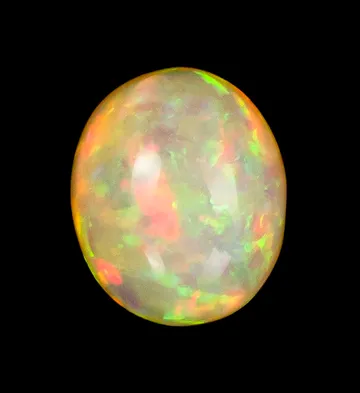
South Wollo Zone, Ethiopia opal — hydrophane precious opal from weathered rhyolitic ignimbrite, vivid play-of-color and notable production shaping the market.
Key facts
South Wollo Zone, in the older collector vocabulary of “Welo,” “Wello,” or “Wollo” opal, is one of the localities that changed the modern opal market. The material for which the district is famous is hydrophane precious opal from weathered rhyolitic ignimbrite in Ethiopia’s high volcanic plateau. Its best specimens are not merely bright cutting rough: they are sculptural pieces of opal-in-matrix, seam fragments, and irregular nodules in which milky white to honey, crystal, orange, brown, and occasionally dark bodycolor opal flashes electric green, orange, yellow, blue, and red from inside a porous silica body.
The locality matters because it brought large volumes of vivid play-of-color opal into the trade after the 2008 Wegel Tena–Tsehay Mewcha discoveries, with production soon organized through local artisanal mining cooperatives and then distributed into cutting centers and world gem markets. Geologically, the celebrated opal is tied to a thin, laterally persistent horizon within a thick Oligocene volcanic succession of basalt and rhyolitic ignimbrite. In the most studied deposits, silica-rich fluids derived from the weathering of volcanic glass and feldspar moved through a soil-like, altered ignimbrite layer and precipitated opal in voids, fractures, fossil plant structures, and spaces among volcanic debris.
Regional View
Country View
For collectors, the South Wollo label is also a lesson in locality language. Older publications, dealer labels, and marketplace descriptions often use Wollo Province, South Wello, Welo, Delanta, Wegel Tena, or Tsehay Mewcha for material from the broader opal field. Administrative boundaries and database treatments do not always match older gem-trade labels, so a good label should preserve the specific mine or village if known, while retaining the historically important “Wollo/Welo” reference.

Photo: Dpulitzer/Wikimedia Commons

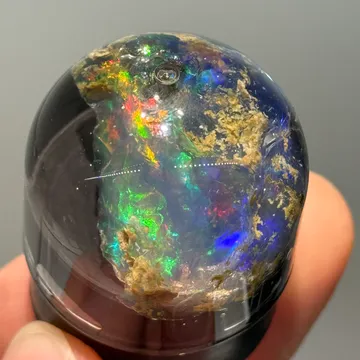
Photo: James St. John/Wikimedia Commons
The great appeal of the finest specimens is the contrast between ordinary-looking volcanic rind and a surprisingly luminous interior. On the bench, much of the rough looks chalky, pale, porous, and irregular; under a point light it can flare into broad-spectrum play-of-color. The prized collector pieces are those that retain enough matrix or natural surface to tell the volcanic-soil story, while exposing a clean opal face with strong pattern, saturated colors, minimal sand, and no post-mining cracking.
Search for specimens: View all specimens from South Wollo Zone, Ethiopia
The South Wollo/Wollo opal deposits are volcanic-hosted but not simply “volcanic opal” in the Mexican fire-opal sense. The most influential studies interpret the opal as having a strong pedogenic component: it formed in weathered horizons developed during pauses in volcanic activity, when volcanic glass altered to clay, feldspars partly dissolved, plant life grew, and silica-bearing fluids precipitated opal in a soil-like layer. In the Delanta–Wegel Tena field, the host is a weathered rhyolitic ignimbrite within a thick plateau sequence of basalt and rhyolitic ignimbrite. The broad volcanic pile is measured in kilometers, while the opal-bearing seam is thin by comparison—less than a meter in early descriptions at the classic Wegel Tena workings, and described in some later Delanta work as a mineralized altered layer less than a few meters thick.
The ore body is not a pipe, vein swarm, or placer. It is a nearly horizontal opal-bearing horizon exposed along the sides of steep valleys and canyon walls. At the classic Tsehay Mewcha area near Wegel Tena, the mineralized layer lies hundreds of meters below the plateau top and is reached by steep foot trails. The opal occurs as cement between volcanic debris, as fillings in fractures and cavities, as lenticular pockets, and in places within plant-fossil textures. This is why rough from the locality commonly has irregular forms rather than the clean, discrete nodules familiar from some other volcanic opal fields.
The surrounding rocks and inclusions are important to the locality signature. The opal-bearing ignimbrite contains quartz, plagioclase, and alkali feldspar phenocrysts in an altered glassy matrix, with clay, minor mafic minerals, opaque grains, and lithic fragments. Within the opal itself, researchers have documented black micro-inclusions interpreted as pyrite, coatings and fissure fillings of barium-manganese oxides such as hollandite-like material, graphitic carbon, silica tubes that may represent chalcedony-replaced plant structures, and clay-related textures. White opal from Wegel Tena is especially notable for unusually high barium contents for opal-CT, a useful clue when paired with Raman data and microscopic texture.
Mining began in earnest after farmers discovered high-quality white precious opal near Wegel Tena in 2008. By January 2009, roughly two hundred local miners were working the deposit, and early reporting described more than 1,500 kg of rough extracted with rudimentary tools. Later field accounts describe multiple active mining areas around Wegel Tena and Tsehay Mewcha, including names such as Gelbate, Nech Gedel, Koke Woha, Alwat, Dima, and related local workings. South Wollo listings also include the Ajebar mine in Tenta Woreda, another opal occurrence within the broader Wollo collector geography.
The work has remained overwhelmingly artisanal. Miners follow the thin horizon laterally into the hillside, cutting narrow tunnels by hand rather than blasting. Hammers, picks, chisels, and shovels dominate; government agencies and cooperatives have played roles in supplying basic tools, organizing miners, and moving rough into the formal market. The absence of timbering, ventilation, and engineered support in early workings made the mines dangerous, and published field reports record fatal collapses and cliff hazards. Recent engineering studies focus on tunnel stability, pillar design, and support systems precisely because the opal seam is mined underground in weak, altered volcanic rock.
Collecting access should be regarded as commercial and permission-based, not as casual field collecting. The active workings are cooperative and artisanal mining sites on difficult terrain, with steep approaches, unsupported openings, and falling-rock hazards. Specimen collectors normally encounter the material through miners, Ethiopian dealers, export channels, gem shows, and international dealers rather than by visiting pockets themselves. Locality precision varies sharply in the trade: “Welo opal” may be a useful market term, but a specimen labeled with a specific mine, village, district, and date is significantly more valuable to a locality-focused collection.
The notable finds are those that show the opal as it actually occurs: seam pieces with pale altered ignimbrite still attached, opal cementing volcanic fragments, pockets with strong columnar “digit” play-of-color, large translucent white-to-blue opal masses, and uncommon brown or chocolate opal with play-of-color. Published examples include rough masses over 500 g and a celebrated 965 g chocolate-brown play-of-color specimen on permanent display in the natural history museum in Nantes, France. In gem form, high-quality cabochons above 20 ct have been described, including white stones with vivid fire, rare fire-opal examples, and pieces showing the peculiar vertical finger-like zoning that has become an unofficial visual hallmark of Ethiopian opal.
South Wollo/Wollo opal is a hydrophane opal-CT material formed in weathered rhyolitic ignimbrite, most famously as white to translucent precious opal from the Wegel Tena–Tsehay Mewcha field and related Delanta-area workings, with additional yellow, honey, colorless crystal, orange fire-opal, brown, chocolate, and rarely dark material. It occurs as irregular seam pieces, cement between volcanic grains, cavity and fracture fillings, and opalized plant textures rather than as neat vein crystals, and rough ranges from small chips to large hand specimens and massive chunks; pieces over 500 g are documented, while cut stones in the tens of carats are well known. The best collector specimens combine a truthful volcanic matrix rind or seam context with clean, bright play-of-color—especially full-spectrum red-green flashes, broad rolling patches, or well-developed digit patterns—while ordinary pieces are chalkier, sandier, more fractured, weakly colored, or attractive only after heavy cutting.
The documented mineral list for South Wollo itself is narrow, dominated by opal and trade varieties such as precious opal, precious fire opal, and white opal. The real “rarities” are therefore not a suite of named type-locality species, but the inclusions and textural companions preserved inside and around the opal: pyrite microcrystals, barium-manganese oxide coatings, graphitic carbon, chalcedony-like silica tubes after plant material, smectite-group clay alteration, quartz and alkali feldspar from the rhyolitic ignimbrite, and iron oxide staining. No well-established type-mineral species is known to collectors from South Wollo in the way that a classic ore district might be tied to a named new mineral; the locality’s mineralogical importance rests on opal genesis, opal-CT geochemistry, hydrophane behavior, and exceptional play-of-color textures.
The first rule with South Wollo/Welo opal is to take the locality label seriously but not literally without context. “Welo,” “Wollo,” “Wello,” “Wegel Tena,” “Delanta,” “Tsehay Mewcha,” “South Wello,” and “South Wollo” appear across older gemological literature, dealer labels, and databases. A good specimen label should preserve the old wording if that is how it arrived, but it should also record any specific mine or village attribution separately. Mislabeling is especially common between Wegel Tena-type white opal, Shewa/Mezezo older Ethiopian opal, and darker material from later Wollo discoveries such as Stayish-type black opal.
Authenticity concerns are real because hydrophane opal absorbs liquids. Dyed Ethiopian hydrophane opal has been documented in unnatural purple and other colors, and Wollo material is commercially treated by smoke, sugar-acid carbonization, oil, resin, and Opticon-type impregnation. These treatments can darken bodycolor, improve apparent contrast, or alter transparency. Dark “black Welo” should be approached with caution unless the seller provides credible disclosure and, for high-value stones, laboratory support. Natural dark Ethiopian opal exists, but a large share of inexpensive black or very dark material in the trade has been smoke-treated or otherwise color-modified.
Condition is the second major issue. Many South Wollo opals are hydrophane: they absorb water, become more transparent, gain weight, and then return toward their original appearance as they dry. This behavior alone is not a defect, but it complicates care. Immersion can change the look of a specimen temporarily and may enlarge pre-existing microcracks in vulnerable pieces. Do not store Welo opal in water unless you know exactly why you are doing so for a particular unstable specimen; routine wet storage can obscure play-of-color and create drying risks. Avoid ultrasonic cleaning, steam cleaning, oils, perfumes, solvents, and prolonged soaking.
Compared with some older Ethiopian opals, the opaque to translucent white Wegel Tena-type material has a good reputation for stability, and published cutting experience found many pieces surprisingly tough. That does not make every specimen safe. Transparent crystal opal, pale yellow-to-orange fire-opal zones, very porous pieces, and stones with visible fractures are more vulnerable. Collectors should examine rough and cabochons under strong oblique light for incipient crazing, “egg” destabilization zones, open cracks, sand seams, and healed-looking internal partings. For specimens in matrix, check whether the opal is well supported or merely a thin bright skin on friable altered tuff.
Fluorescence is variable and can help characterize but not authenticate on its own. Non-brown Wollo opals may show weak bluish-white to greenish-white fluorescence with weak phosphorescence; some fine white play-of-color stones fluoresce more strongly, while brown zones may be inert. A UV lamp can be useful for observing zoning, cracks, and repairs, but hydrophane behavior, microscopy, Raman/FTIR spectroscopy, and trace-element work are more meaningful for serious identification and treatment questions.
Market availability remains relatively good compared with classic Australian or Mexican localities of equivalent color impact. Small cabochons, beads, and calibrated stones are common; fine natural specimens in matrix with precise locality data are much scarcer. The most desirable pieces for a mineral collection are not necessarily the cleanest gems, but those that retain geological context: opal cementing volcanic clasts, seam sections showing the altered ignimbrite contact, natural surfaces with vivid windows of color, or unusual digit, honeycomb-like, turtle-shell, contra luz, or chocolate-brown patterns. Pay a premium for stable, untreated, strongly patterned material with honest disclosure and a label more precise than simply “Ethiopia.”
The best South Wollo opal stories begin not at a dealer table, but on the high plateau between Dessie and Lalibela. Field gemologists described a country cut by wide, steep valleys roughly a thousand meters deep, with opal mines strung along the same narrow level in the canyon walls because the seam itself is nearly horizontal. The direct line between Lalibela and Wegel Tena is only about 50 km, yet crossing the Bashilo canyon turned the journey into nearly seven hours by vehicle. In the dry riverbed below, seasonal floods had left house-sized boulders—silent evidence of what a few weeks of concentrated rain can do to volcanic highland country.
At the mine, the logistics are as memorable as the gemstones. The opal-bearing layer sits hundreds of meters below the plateau surface. Goats and sheep can manage the steep trails, but pack animals and vehicles cannot reach the seam. That means equipment must be carried down, and opal-bearing rock must be carried back up by hand. This is not the romance of a shallow tourist dig; it is highland labor, step by step, on trails cut into cliff country.
Inside the workings, teams of roughly 10 to 20 miners follow the opal horizon into the hillside. Some tunnels have been reported at more than 70 m long and, in places, only about 40 cm wide. The rock is soft enough that explosives are unnecessary, but the work is still punishing: cool air, high humidity, reduced oxygen, narrow passages, and the constant calculation that only opal-bearing rock is worth removing. Waste rock is not just unprofitable; it is weight, time, and breath.
Early accounts of the Wegel Tena discovery have a stark edge. Farmers found the new white play-of-color opal in 2008, and within a year about two hundred local miners were working the deposit. The seam was productive enough that more than 1,500 kg of rough had already been extracted by 2010, but the workings were shallow, unsupported, and dangerous. Published reports record at least twenty miners killed by collapsing rock in the early period. The same thin layer that made the deposit traceable for hundreds of meters also tempted miners to drive into weak ignimbrite without timbering or engineered support.
The stones themselves produced surprises equal to the field conditions. A parcel once thought to be older Mezezo material was set aside in 2005 because it looked unusual; later, it was recognized as Wegel Tena, and the pieces were still intact years after cutting concerns would have condemned many Ethiopian opals. Researchers also reported an accidental drop test that became an impromptu toughness experiment: Wegel Tena cabochons fell about 1.5 m onto concrete without visible damage under the microscope, while comparison stones from Mezezo and white Australian opal broke in the repeated test. No collector should repeat that experiment with a prized specimen, but it explains why the best opaque-to-translucent white Wollo material gained a reputation for being tougher than its porous appearance suggests.
Another story belongs in every collector’s mental image of the locality: the “digits.” In some stones, columns of transparent play-of-color opal rise through a more turbid common-opal network like rounded fingers, perpendicular to the apparent layering. They can be spectacular under a point light, with spectral patches aligning in vertical zones rather than random pinfire. The pattern resembles synthetic opal columns just enough to worry the unwary, yet the rounded, irregular, two-material character of Ethiopian digits has become one of the most recognizable natural signatures of the deposit.
Benjamin Rondeau, Emmanuel Fritsch, Francesco Mazzero, Jean-Pierre Gauthier, Bénédicte Cenki-Tok, Eyassu Bekele, and Eloïse Gaillou, “Play-of-Color Opal from Wegel Tena, Wollo Province, Ethiopia,” Gems & Gemology, Vol. 46, No. 2, 2010, pp. 90–105 — The foundational gemological study of the 2008 Wegel Tena discovery, covering occurrence, mining, hydrophane behavior, inclusions, chemistry, stability, and digit patterns.
Boris Chauviré, Benjamin Rondeau, Francesco Mazzero, Dereje Ayalew, “The precious opal deposit at Wegel Tena, Ethiopia: Formation via successive pedogenesis events,” The Canadian Mineralogist, Vol. 55, No. 4, 2017, pp. 701–723 — A key peer-reviewed interpretation of the opal as the product of repeated soil-forming events in unwelded ignimbrite.
Boris Chauviré, Benjamin Rondeau, Anne Alexandre, Sarah Chamard-Bois, Carole La, and Francesco Mazzero, “Pedogenic origin of precious opals from Wegel Tena (Ethiopia): Evidence from trace elements and oxygen isotopes,” Applied Geochemistry, Vol. 101, 2019, pp. 127–139 — Trace-element and oxygen-isotope evidence for low-temperature opal precipitation from waters moving through an Oligocene soil horizon.
Mulugeta Milkias, Tesfaye Demissie, and Daniel Meshesha, “Geochemical insight on gem opal formation and highly weathered rhyolitic ignimbrite layer from Delanta area, south Wollo, northern Ethiopia,” Arabian Journal of Geosciences, Vol. 16, Article 335, 2023 — Petrographic and geochemical study of Delanta-area host rocks and opal, tying silica precipitation to intense alteration of rhyolitic ignimbrite.
Mulugeta Milkias, “Geochemical Insight on Gem Opal Formation in Highly Weathered Rhyolitic Ignimbrite Layer from Delanta Area, South Wollo, Northern Ethiopia,” National Academic Digital Repository of Ethiopia, 2021 — Thesis record with field sampling from three local mining sites and a detailed host-rock/opal geochemical model.
Wim Vertriest, Patcharee Wongrawang, Ungkhana Atikarnsakul, and Kevin Schumacher, “Land of Origins: A Gemological Expedition to Ethiopia,” Gems & Gemology, Vol. 55, No. 1, 2019 — Field report with first-hand observations of Wollo opal mining, transport, tunnel dimensions, production, and market context.
“Ethiopian Opals,” Gemological Institute of America — Embedded GIA field video accompanying the 2019 expedition report, showing the Wollo opal mining environment near Wegel Tena.
“Extract the treasure,” Boris Chauviré, Imaggeo — Field photograph and media record of a miner with black opal near Wegel Tena, submitted to the European Geosciences Union’s Imaggeo collection.
“The Real Gemology of Ethiopian Opals in ‘Uncut Gems,’” Russell Shor, GIA — Accessible media-style gemological explainer connecting the film’s Ethiopian opal premise with real Wollo opal geology and market history.
Mindat: South Wollo Zone, Amhara Region, Ethiopia — Mineral locality database entry listing opal varieties, rock types, locality hierarchy, and references for the South Wollo record.
Mindat: Opal from South Wollo Zone, Amhara Region, Ethiopia — Occurrence page focused specifically on opal from the South Wollo locality record.
Mindat: Wegeltena, Delanta Woreda, North Wollo Zone, Amhara Region, Ethiopia — Useful for reconciling modern administrative locality data with the older Wegel Tena/Wollo labels used in gemological literature.
GIA: Play-of-Color Opal from Wegel Tena, Wollo Province, Ethiopia — GIA article landing page for the major 2010 study of the Wegel Tena opal discovery.
GIA: Land of Origins: A Gemological Expedition to Ethiopia — Field report with unusually good locality, mining, and market context for Ethiopian opal.
Springer: Economic potentials, challenges and opportunities for sustainable mining in Wollo opal mining, Ethiopia — Recent review of Wollo opal mining methods, local economic role, production challenges, and sustainability issues.
Springer: Stability Assessment and Pillar Design of Underground Drift in Opal-Bearing Rock Masses: A Case Study from Wollo Opal Mining, Ethiopia — Engineering-focused study of tunnel stability and support design in Delanta/Wollo opal workings.
Wikimedia Commons: Rough Welo Ethiopian Opal — Open-license image of rough Welo opal with matrix, useful for visualizing ordinary field appearance.
Wikimedia Commons: Precious opal from Delanta District, South Wello, Ethiopia — Open-license close-up of opal in matrix from Delanta/South Wello collector labeling.
Nathan Renfro and Shane F. McClure, “Dyed Purple Hydrophane Opal,” Gems & Gemology, Winter 2011 — Important treatment-identification paper showing that unusual purple opal sold under another origin was strongly consistent with dyed Wollo hydrophane opal.
Nathan Renfro, “A Useful Technique to Confirm the Hydrophane Nature of Opal,” Gems & Gemology, Fall 2013 — Practical lab note on confirming hydrophane behavior with a safer water-drop method rather than full immersion.
Ratima Suthiyuth and Vararut Weeramonkhonlert, “Hydrophane Opal Treatment,” Gems & Gemology, Spring 2016 — GIA laboratory treatment experiments on Ethiopian hydrophane opal using oil and Opticon, with FTIR and Raman detection notes.
Opal, Catalog Number NMNH 175053, Smithsonian National Museum of Natural History — Museum record for a Wello, Ethiopia opal specimen in the U.S. National Mineral Collection.

_6_(29689581672).jpg)