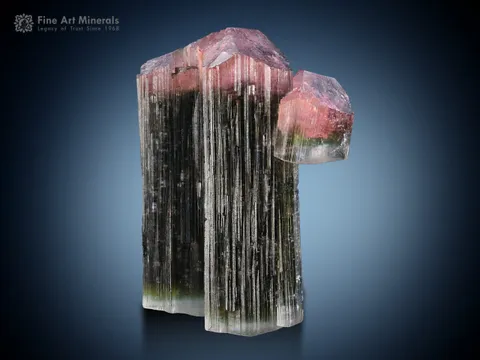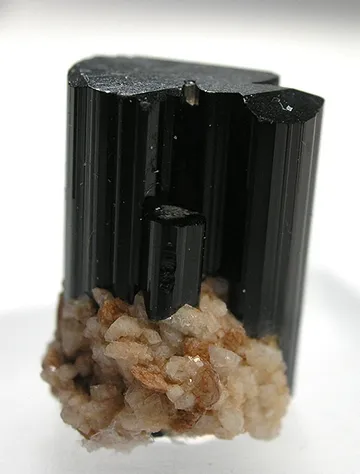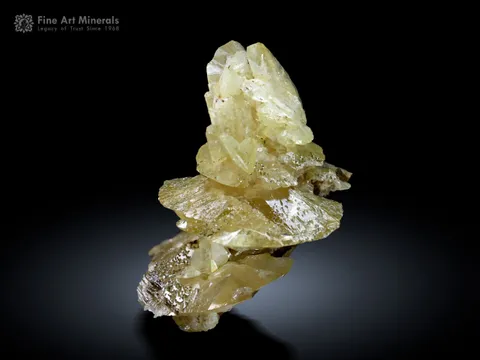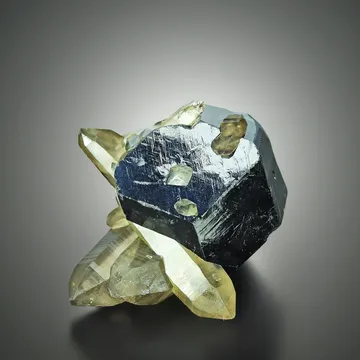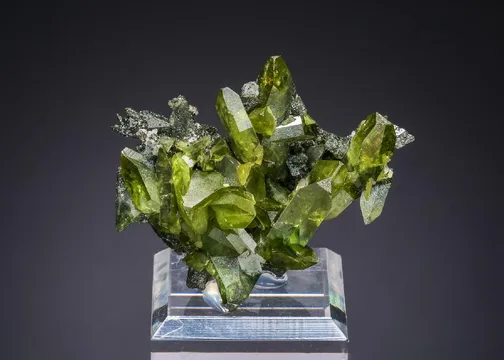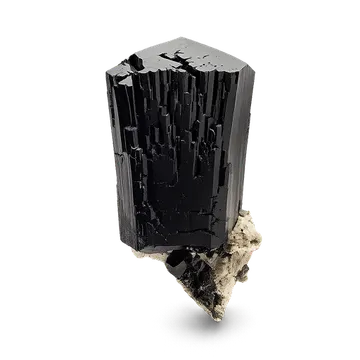
Schorl from Stak Nala, Pakistan — dark tourmaline with prisms grading into green, blue, or pink elbaite; prized for sharp terminations and vivid color zoning.
Key facts
Schorl from Stak Nala is best understood as the dark, iron-rich architecture behind one of Pakistan’s most recognizable tourmaline styles. The celebrated Stak Nala specimens are rarely just “black tourmaline” in the ordinary sense: their black to very dark green schorl bodies commonly pass into lighter green elbaite, and in the most coveted crystals into pale pink, colorless, pale blue, or indicolite-toned terminations. That contrast—black prismatic mass below, gemmy colored cap above, often set in white cleavelandite with quartz—gives Stak Nala material an instantly legible look on a collector’s shelf.

Photo: Wikimedia Commons
The locality lies in the Stak valley of the Nanga Parbat–Haramosh Massif of northern Pakistan, where miarolitic granitic pegmatites cut high-grade gneissic rocks. The pegmatites are famous for their orderly internal zoning: a narrow border zone gives way inward to a coarse wall zone rich in K-feldspar, oligoclase, quartz, and schorl, then to a core zone containing blocky feldspar, quartz, local aplite, and pockets. In those pockets, schorl-elbaite tourmaline occurs with albite, quartz, K-feldspar, muscovite or lepidolite, topaz, fluorite, and other accessory minerals.
What makes the schorl significant is not merely its presence, but its role in the pegmatite’s evolution. Abundant early schorl in the outer zones stripped iron and titanium from the evolving melt and fluids, helping create the Fe-poor conditions that allowed later pale pink and colorless elbaite to form in pockets. In collector terms, the black base is not an afterthought; it is the visual and geochemical foundation of the classic Stak Nala tourmaline.
Collectors look for sharp, lustrous, striated prisms with undamaged terminations, especially crystals showing a dark schorl body grading cleanly into green, blue, colorless, or pink zones. Matrix pieces are strongly preferred when the tourmaline is well exposed but still naturally nestled in white cleavelandite blades, with a quartz crystal or lepidolite accent adding balance. The best specimens have the crisp “Stak Nala silhouette”: slender to moderately stout vertical tourmalines projecting from white albite like chimneys, often doubly terminated or naturally rehealed at one end.
Search for specimens: View all schorl specimens from Stak Nala, Pakistan
Stak Nala is a valley locality in the Haramosh Mountains of Gilgit-Baltistan, historically cited under Skardu District or the Northern Areas, and now generally placed in Roundu District. The tourmaline-bearing pegmatites are on the west side of the Stak valley, north of the Indus River, near Toghla or Tookla village. The main workings are reached from the Gilgit–Skardu road by a rough road to the village and then by foot or mine tracks up toward the pegmatites, which lie roughly 2 km north of the valley floor and about 400 m above it, at approximately 2,800 m elevation.
The deposit is a miarolitic granitic pegmatite system emplaced in gneiss of the Nanga Parbat–Haramosh Massif. The Stak Nala pegmatites are flat-lying to gently dipping sills, commonly less than 1 m to more than 3 m thick, with a strikingly symmetrical internal zonation. The border zone contains medium- to coarse-grained oligoclase, K-feldspar, and quartz. The wall zone is very coarse-grained and characterized by K-feldspar, oligoclase, quartz, and schorl. In the best-exposed descriptions, schorl occurs as inward-pointing sprays and prismatic crystals that grow larger toward the core. The core zone contains blocky K-feldspar, oligoclase, quartz, sparse schorl or elbaite, local sodic aplite, and the pocket cavities that produced the famous specimens.
Two named production areas are central to the locality’s history: the main mine and the south mine. Most production came from a single sill at the main mine, described in detailed geological work as about 1 to 1.3 m thick. The south mine lies roughly 500 m away at the same elevation and follows a thicker, 3–4 m pegmatite, but has produced much less tourmaline. At the main mine, the richest pocket zone followed a broad, open antiformal structure; productive pockets were concentrated where the sill thickened to more than 1 m. That structural trap is part of the reason Stak Nala became more than just another schorl-bearing pegmatite: it focused late volatile-rich fluids into the pocket zone.
Mining began after local villagers discovered tourmaline in the early 1980s. Exploration by the Gemstone Corporation of Pakistan soon confirmed abundant tourmaline mineralization in two pegmatite bodies about half a kilometer apart, with similar pegmatites extending southward. By the mid-1980s, Stak Nala was producing the specimens that established its international reputation: dark green to black schorl-bodied tourmalines with colored elbaite terminations, many wrapped in cleavelandite. Geological estimates made in the 1990s placed total tourmaline production since 1984 in the tens of thousands of crystals, though production had already slowed by then as reserves dwindled and organized work by the Gemstone Corporation of Pakistan ended.
Later accounts from dealers, field visitors, and mining reports indicate that production did not cease entirely. Classic mid- and late-1980s material remained the benchmark, but Stak Nala continued to release occasional pockets into the 2000s and beyond. A late 2005 find produced especially colorful tourmalines, and fine specimens from old and later finds have continued to appear sporadically in the mineral market. Recent offerings show that fresh or recently circulated Stak Nala material still exists, but fine matrix specimens with intact, colorful, well-positioned crystals are no longer abundant.
Collecting access should be regarded as mining access, not casual field collecting. The area is remote, mountainous, locally worked, and tied to village or claim ownership. Workings are tunnels, pockets, and steep pegmatite exposures, and safe access depends on local permission, local guides, and current conditions. Serious collectors are much more likely to encounter Stak Nala schorl through dealers, auctions, old collections, and Pakistani supply chains than through self-collecting.
The schorl at Stak Nala occurs in several closely related forms. In the pegmatite border and wall zones, it forms black prismatic crystals, slender needles, sprays, and disseminated crystals associated with feldspar and quartz. Along the hanging-wall side of the pegmatites, schorl is especially abundant, locally radiating inward toward the core. These wall-zone crystals can increase from only a few millimeters in diameter to nearly 1 cm as they approach the core zone; they are commonly fractured perpendicular to the c-axis, with quartz or sodic plagioclase filling the fractures.
The collector specimens most often described as “Stak Nala schorl” are actually schorl-elbaite or schorl-cored elbaite tourmalines from pockets. They are typically striated, trigonal prisms with dark black, dark olive-green, or greenish-black lower sections. The dark portions may be opaque to translucent, while the terminations may transition into gemmy green, pale blue, colorless, or pale pink elbaite. In some crystals the zoning is perpendicular to the c-axis, producing a dark base and colored termination. In others, especially material associated with the south mine, concentric zoning is reported, with a black core surrounded by green, pale pink, or colorless zones.
Typical pocket tourmalines range from about 1 to 10 cm long and may reach roughly 1.5 cm across, with an average cited around 4 cm long and 1 cm in diameter for the elbaite-bearing crystals. Cabinet specimens can carry multiple crystals, and classic examples show several parallel or intergrown prisms rising from a white cleavelandite matrix. A documented mid-1980s combination specimen measured 9.2 x 6.8 x 5.4 cm and carried four intergrown tourmalines up to 8.9 cm long, with teal-blue indicolite terminations, bladed cleavelandite, and a doubly terminated quartz crystal.
Associations are part of the locality’s identity. The most typical matrix mineral is albite var. cleavelandite, which forms white bladed jackets around tourmaline and quartz. Quartz may occur as clear, colorless, or smoky crystals; good quartz associations are less common than albite-rich tourmaline specimens and can add significantly to aesthetic appeal. K-feldspar, microcline or orthoclase overgrowths, muscovite, lepidolite, topaz, fluorite, fluorapatite, hambergite, spessartine-almandine garnet, and rare minerals are also known from the locality. In the broader pegmatite, minor löllingite and garnet occur, but the best pocket assemblages are dominated by albite, quartz, K-feldspar, tourmaline, mica, topaz, and fluorite.
Quality in Stak Nala schorl is judged differently depending on whether the specimen is a pure schorl piece or a schorl-elbaite combination. For pure black schorl, collectors want sharp terminations, glossy luster, strong striations, and an aesthetic association with quartz or cleavelandite. For the classic schorl-elbaite material, the highest premiums go to distinct color zoning, especially a black or very dark green body that transitions to gemmy green, blue, colorless, or pink. Doubly terminated crystals, natural rehealed terminations, and crystals cleanly displayed above white albite are especially desirable.
The classic color sequence is a major authenticity clue: dark schorl or very dark green lower body, then lighter green or olive-green, sometimes a colorless zone, and a pale pink, pale blue, or indicolite termination. Stak Nala crystals are often highly lustrous and longitudinally striated, but many are internally fractured and included, which is one reason the locality is more important for mineral specimens than for clean gem rough. Inclusions, healed breaks, and cleavelandite jackets are not flaws in themselves; they are part of the locality’s normal pocket history. What matters is whether damage interrupts the main display faces and terminations.
Stak Nala tourmaline is common enough in old collections that ordinary examples remain obtainable, but fine schorl-bearing matrix pieces with intact, colorful terminations are genuinely selective. The market separates modest black or dark-green schorl fragments from classic schorl-elbaite combinations. A simple loose dark prism may be affordable; a balanced miniature with clean zoning and cleavelandite commands much more; a cabinet specimen with multiple sharp, undamaged crystals, quartz, and strong provenance can move into high-end territory.
No well-documented, locality-specific treatment industry is associated with Stak Nala schorl comparable to the treatment issues seen in some gem materials. The real concerns are repairs, reattachments, constructed matrix pieces, incomplete locality data, and loose tourmalines marketed too broadly as “Stak Nala style.” Repairs are not unusual in pegmatite specimens, and several published sale descriptions of Stak Nala material openly note clean repairs or one repaired crystal. A repair is not automatically disqualifying, but it should be disclosed and reflected in price, especially if it affects a principal termination.
Condition issues are predictable. Tourmaline crystals from Stak Nala may have broken pocket-wall attachment points, natural rehealed ends, edge wear on trigonal or pinacoidal terminations, cross-fractures, and bruising where crystals were embedded in or extracted from cleavelandite. The white albite matrix can be delicate, and cleavelandite blades may be chipped or incomplete. Quartz can show frosted, pitted, or etched faces, and some quartz faces may have later thin clear overgrowths; these textures can be natural and should not be mistaken for damage without close inspection.
Be cautious with loose black tourmaline sold as “Stak Nala schorl” without provenance. The locality’s most distinctive material is not merely black: it usually has a specific combination of schorl to green or colored elbaite zoning, bladed albite, and northern Pakistan pegmatite associations. Plain black schorl prisms occur worldwide, and unless accompanied by old labels, reliable dealer documentation, or diagnostic matrix, locality confidence can be weak. Conversely, not every Stak Nala tourmaline with a black base should be labeled pure schorl; many are compositionally zoned schorl-elbaite crystals, and the colored portions are elbaite rather than schorl.
The strongest buys are specimens with a clear locality label, old collection provenance, undisturbed cleavelandite matrix, and visible color zoning. For advanced collectors, the most interesting examples are those that show the geological story in one hand specimen: black schorl body, colored elbaite cap, cleavelandite jacket, and perhaps quartz or lepidolite. Such pieces show both the early iron-rich phase and the later volatile-rich pocket phase that made Stak Nala famous.
The Stak Nala story begins not with a corporate discovery but with local villagers finding tourmaline in the early 1980s. The formal geological accounts are unusually precise about what followed: the Gemstone Corporation of Pakistan investigated soon afterward and found abundant tourmaline mineralization in two pegmatite bodies about 0.5 km apart. Similar pegmatites extended 3 km farther south, but the fame of the district concentrated around a much smaller mining reality—a single thin sill at the main mine, roughly a meter thick, that supplied most of the tourmaline and associated minerals.
The physical scale of that production is striking. Since 1984, geologists estimated that Stak Nala yielded tourmaline crystals in the tens of thousands. Yet the principal source was not an enormous open pit or a wide orebody. It was a narrow, structurally favorable pegmatite sill, thick enough in the right places to form pockets, and positioned so that late fluids could gather near the crest of an antiform. Much of the locality’s beauty came from a geological bottleneck: a place where fluids accumulated, schorl had already removed iron from the system, and the remaining pocket environment could grow green, pink, colorless, and blue tourmaline over dark bases.
Field descriptions make the pockets feel more like rooms than seams. Individual cavities ranged from tiny vugs only about 1 cm across to irregular openings as much as 0.5 m high and 3 m long. The floors of some pockets were littered with broken crystals that had projected inward from the walls: albite, quartz, K-feldspar, tourmaline, mica, topaz, and fluorite. That image explains why repaired and rehealed Stak Nala tourmalines are so often encountered. Pocket rupture and crystal breakage were part of the mineralizing system itself, not only the result of later mining.
The best crystals preserve a record of injury and recovery. In many pocket tourmalines, a broken end was later overgrown by pale pink elbaite, forming a pyramidal termination, while the opposite end received a colorless or pale blue overgrowth on a flat termination. This is why some Stak Nala crystals are naturally doubly terminated even when one end began as a break from the pocket wall. In a top specimen, the apparent perfection may actually be a history of rupture, overgrowth, and sealing written in color zones.
The human mining story is less polished. Later field accounts describe Tookla village as the practical base for work, with Kaska and Zoa Lungma named as two important mining areas. One local account says an outside company stayed in Tookla for more than a year in the 1980s, built a temporary zigzag road toward Kaska, and relied on local people to move machinery and supplies. Tunnels were driven into the rocky mountain in different directions, reportedly 100 to 300 feet inward, with openings only 3 to 8 feet high and wide. Afterward, the mountainside was described as having been turned into “hundreds of holes,” giving it the look of a beehive.
Another field report gives a harder-edged picture of what happened after organized work ended. The Gemstone Corporation of Pakistan reportedly worked Stak Nala systematically in the 1980s and, when it left, blasted its tunnels closed. By the time of that visit, only one tunnel was said to be open again, apparently reopened by local miners. The miners wanted to work it, but each blast caused more caving. The observer suggested building rock walls to shore up the fractured ground, which had been weakened by earlier over-blasting.
The broader northern Pakistan mining context is sobering. Pegmatite miners in the region commonly worked with basic drills, blasting, ropes, and little ventilation. In some areas, miners used gasoline-powered drills underground, stopping only when they could no longer light a fuse because of low oxygen or polluted air. The hazards were not abstract: rockfalls, cliff falls, dust, and carbon monoxide were part of the working environment. Against that backdrop, a Stak Nala specimen is more than a bright cabinet object. It is the result of high-altitude labor in fractured pegmatite, narrow tunnels, and remote village-controlled workings.
The market history has its own chapters. Mid-1980s Stak Nala specimens set the standard: dark schorl or olive-green bodies, white cleavelandite jackets, and pink, blue, or colorless terminations. Dealers repeatedly describe those finds as the classic production, and later specimens are often compared against them. A late 2005 find revived interest with especially colorful crystals, and a 2011 mineral-show report noted loose yellow-zoned Stak Nala elbaites that departed from the familiar pink, pale blue, and pale green theme. Even after decades of mining, the locality could still produce a new variation on its own grammar.