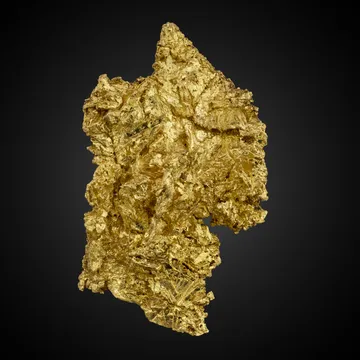
Round Mountain Mine, USA — Nevada’s classic modern gold locality famed for crystallized gold specimens, electrum-rich coloration, and strong collector appeal.
Key facts
Round Mountain is one of the classic modern gold localities of the American West: a giant volcanic-hosted, low-sulfidation epithermal gold-silver system in the southern Toquima Range of Nye County, Nevada, with a collecting reputation far larger than its simple mineral list might suggest. The mine sits at the edge of Big Smoky Valley, where Oligocene rhyolitic ash-flow tuffs, caldera-ring structures, older Paleozoic metasedimentary rocks, and later Basin-and-Range faulting combined to make one of Nevada’s great bulk-tonnage gold deposits. For the ore geologist it is a large, long-lived producer; for the specimen collector it is the locality that made pale, highly crystallized Nevada leaf gold a category of its own.
The best Round Mountain gold is not nugget gold in the ordinary placer sense. It is crystallized gold to electrum-rich gold, commonly a light yellow to straw-gold color because of its silver content, developed as flattened spinel-law twins, herringbone leaves, plates, skeletal cubic growths, wire-like forms, and delicate arborescent sprays. Many pieces look at first like torn metallic foil, but under a lens the good ones resolve into sharp stepped faces, twinned growth ridges, hoppery cubes, and serrated crystalline edges. Matrix pieces typically show gold on or in quartz, altered rhyolitic tuff, clayey sericite-rich rock, iron oxides, and adularia-bearing vein material.
Historically, Round Mountain matters twice over. It began as an early-twentieth-century Nevada camp built on visible free gold, high-grade little veins, and workable placer gravels at the foot of the mountain. Decades later, it became a large open-pit and heap-leach operation, and during the modern mining period it released some of the finest crystallized gold specimens to reach the collector market from any active U.S. mine. The locality’s specimen fame is especially tied to material recovered from the late 1980s through the 2000s, including celebrated pocket production around 2006.
Regional View
Country View
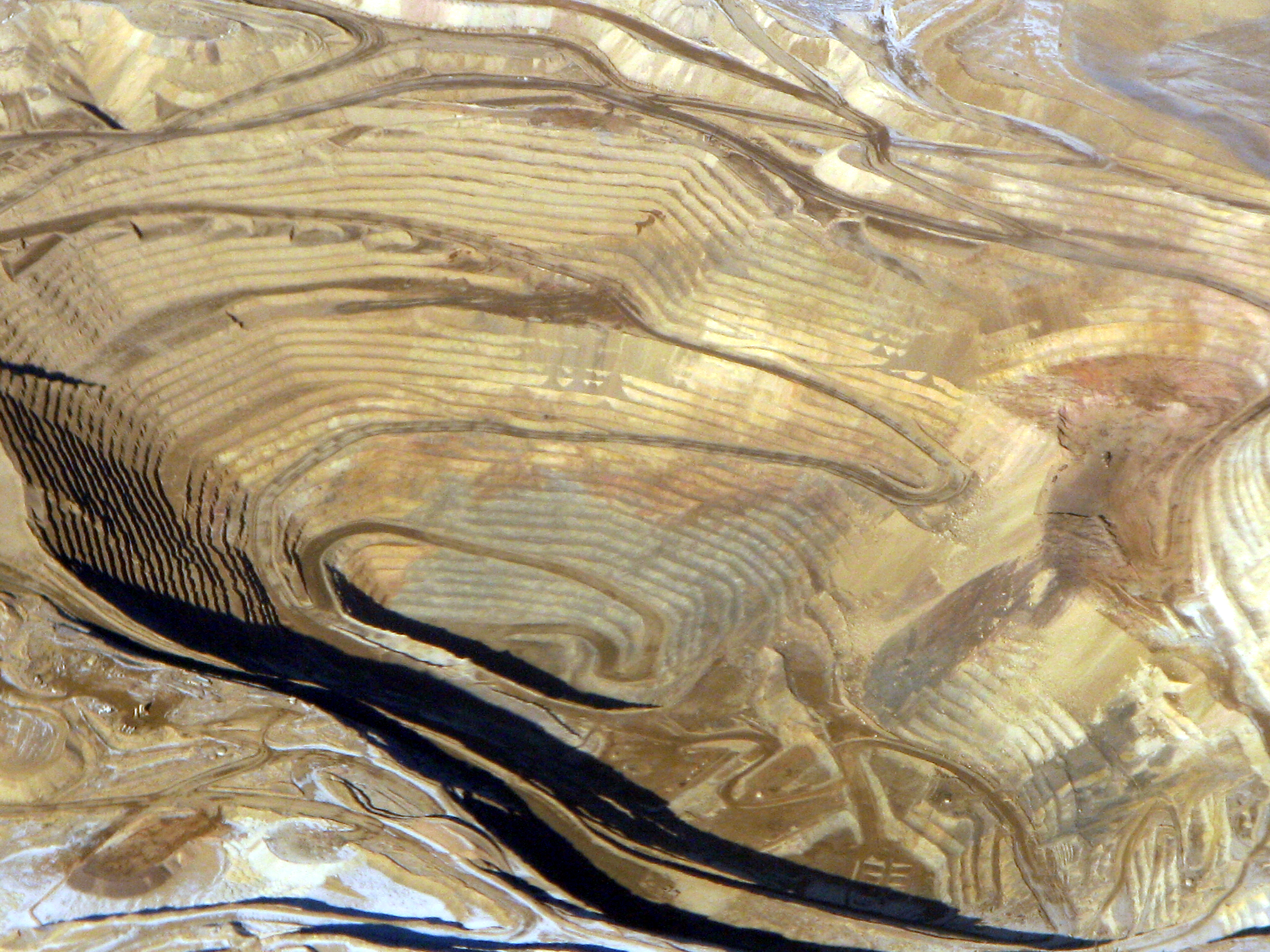
Photo: Wikimedia Commons
The mine’s visual setting explains much about the deposit. Round Mountain is not a narrow romantic vein mine tucked in timbered hills; it is an enormous desert open pit cut into volcanic and basement rocks, surrounded by leach pads, waste-rock facilities, haul roads, and the broad sagebrush floor of Big Smoky Valley. Yet the specimens that emerged from this industrial environment are intimate and intricate: thumbnail leaves, miniature plates, sculptural small-cabinet clusters, and rarer cabinet pieces whose value lies in form rather than mere gold weight.

Photo: Wikimedia Commons
Search for specimens: View all specimens from Round Mountain Mine, USA
Round Mountain Mine is in the Round Mountain mining district on the western side of the Toquima Range, Nye County, Nevada, north of Tonopah and east of Big Smoky Valley. Modern locality records commonly treat Round Mountain Mine and the historic Sunnyside Mine area together, with older names including Round Mountain Gold Mine, Sphinx glory hole, Great Western tunnel, Rattlesnake, Keane vein, and Los Gazabo vein. The present operation includes the main Round Mountain open pit and the Gold Hill area to the north.
The deposit is a very large volcanic-hosted, low-sulfidation epithermal gold-silver system, also described in older literature as an adularia-sericite type deposit. The principal host package is Oligocene rhyolitic ash-flow tuff related to the Round Mountain volcanic center and caldera architecture. The tuffs were ponded within the volcanic center and mineralization is closely tied to caldera structure, permeable volcanic facies, ring-fracture and fault zones, and underlying Paleozoic metasedimentary basement. The older basement rocks include phyllite, quartzite, limestone, argillite, schist, and related sedimentary rocks locally metamorphosed near Cretaceous granitic intrusions.
Ore at Round Mountain occurs in several contrasting styles. Disseminated electrum is abundant in porous, poorly welded pumice-rich tuff, where permeability allowed mineralizing fluids to penetrate large volumes of rock. Fracture-controlled and vein-style mineralization occurs in more competent welded tuff and in Paleozoic metasedimentary rocks, with quartz, adularia, pyrite, iron oxides, and clay/sericite alteration. Coarse visible gold and crystallized specimen gold are most closely associated with fractures, veinlets, structural intersections, and later open-space growth, rather than the ordinary finely disseminated ore that made the mine economic on a bulk scale. Placer gold at the base of Round Mountain formed by erosion of those lode sources and was important in the early history of the district.
The alteration zoning is characteristic of a low-sulfidation epithermal system: propylitic alteration, potassic adularia-rich alteration, silicification, quartz-sericite alteration, argillic clay alteration, and iron-oxide overprinting. The soft clay alteration is not just an ore-geology footnote for collectors. It helped preserve and later release delicate crystalline gold; in many specimens, clay and decomposed volcanic matrix could be washed away more gently than hard quartz could be broken, leaving intact leaves and wires that might otherwise have been destroyed.
Mining began in 1906 after lode and placer gold were recognized on the lower slopes of Round Mountain and Stebbins Hill. Early work included hand mining of small, rich veins, underground stopes, milling of lower-grade lode ore, dry washing of placer gravels, and later hydraulic mining after water was brought across the valley by pipeline. The camp’s early fame rested on visible free gold: ore that could be mined selectively, sacked, milled, panned, or high-graded with unusually direct results.
After the early underground and placer era, production continued intermittently through leases, small operators, and later mechanized placer work. Modern large-scale mining followed exploration from 1970 to 1976, which outlined a substantial hard-rock resource. Open-pit mining and heap leaching began in late 1976, and the first doré bar from the modern operation was poured in 1977. A mill added in 1997 allowed processing of more complex, less oxidized ore that was not as well suited to simple heap-leach recovery.
The modern mine has passed through several ownership structures. Kinross acquired an initial 50% interest in 2003 through the Echo Bay transaction, and in January 2016 it acquired the remaining 50% interest from Barrick affiliates. As of the 2025 reporting year, Round Mountain was owned and operated by Kinross through its wholly owned subsidiary Round Mountain Gold Corporation. In 2025 the mine was in a transition year, completing Phase W mining while initial Phase S ore began in the third quarter. In January 2026 Kinross announced construction of the Phase X underground project beneath the Phase W open pit, with underground production planned to begin in 2028 and extend Round Mountain production to 2038.
Collecting access today is not a casual rockhounding matter. Round Mountain is an active industrial gold mine with controlled entry, permitting, blasting, haulage, and processing hazards. Specimens in the collector market come from mine-saved material, historic collections, dealer dispersals, and earlier production periods when specimen recovery was possible. Visitors should not expect legal collecting in or around active mine facilities without explicit permission from the operator.
The notable specimen finds are chiefly modern mine discoveries of crystallized gold, especially material recovered from the late 1980s through 2006. The 2006 pocket material is particularly associated with sharp, pale, crystalline gold leaves and sculptural groups. These were not the everyday product of the mine; they were exceptional by-products of a huge ore operation whose ordinary gold is microscopic or finely disseminated. That tension is what gives Round Mountain specimens their appeal: a mine measured in millions of ounces, remembered by collectors for grams of exquisitely crystallized metal.
Round Mountain gold is typically pale yellow to light golden electrum-rich native gold, with an average appearance quite different from the deep buttery color of high-purity California or Australian gold. The classic habits are flattened elongated spinel twins, herringbone leaves, thin plates, parallel wires, skeletal to hoppery cubic crystals, and arborescent crystalline groups, from small thumbnails to cabinet-size clusters in the best preserved pieces. Quartz, adularia, altered rhyolitic tuff, clay/sericite, pyrite, goethite, hematite, and limonitic iron oxides are the most important associations, with the collector-quality gold most strongly tied to fracture and vein environments rather than routine disseminated ore. Good pieces show intact edges, obvious crystal structure, sharp stepped luster, and open sculptural form; ordinary pieces may be bent, mashed, rounded, overly thin, or interesting mainly as bullion. The finest Round Mountain specimens are prized because they retain the mine’s unmistakable combination of light color, leaf-like silhouette, twinned crystallography, and fragile epithermal growth.
Other minerals documented from Round Mountain Mine are mostly ore and alteration minerals rather than showy collector species. Quartz and adularia are the principal gangue minerals tied to the gold-bearing veins and veinlets; pyrite is the common sulfide, much of it oxidized or encapsulated in silicates; iron and manganese oxides such as goethite, hematite, limonite, and pyrolusite occur in oxidized zones; clay and mica minerals such as sericite, illite, smectite, kaolinite, montmorillonite, muscovite, and chlorite-group minerals record alteration. Alunite, fluorite, calcite, realgar, scorodite, jarosite, and related minor species are reported from the deposit or its upper altered zones. Aguilarite, Ag4SeS, is a notable microscopic association as blebs in gold and electrum, but it is not normally a visible accessory on display specimens. The broader Round Mountain district includes rarer species and separate type-locality interest, but the mine itself remains, overwhelmingly, a gold locality for collectors.
Round Mountain gold is one of those localities where form matters more than weight. A sharp, open, half-gram twinned leaf may be a better specimen than a heavier but mashed or shapeless piece. The most desirable examples show obvious crystallization without magnification: herringbone ribbing, stepped spinel twins, parallel growth lines, bright reflective faces, skeletal cubic development, or crisp leaf margins. Pieces with two-sided crystallization, a clean natural outline, and stable contrasting matrix are especially strong.
The locality has not developed a well-documented fake tradition of its own comparable to the broader market in glued, assembled, or manufactured gold-on-quartz specimens. Nevertheless, general gold-specimen caution is essential. Examine matrix contacts under magnification, look for glue in crevices, unnatural solder-like junctions, suspiciously embedded flakes, tool marks, acid-etched “windows,” and gold that does not match Round Mountain’s pale electrum-rich color and crystallized habit. Because the mine produced both off-matrix leaves and gold in quartz-rich or clay-altered rock, either format can be genuine, but the contact should make geological sense.
Mislabelling is common in a softer way. Old labels may say only “Round Mountain, Nevada,” “Sunnyside,” “Round Mountain Mine,” or “Nye Co.” Modern collectors should try to preserve any chain of provenance, especially for pieces attributed to the 1990s or 2006 specimen production. Confusion with other Nevada gold localities is possible, but Round Mountain’s pale color, thin twinned leaves, herringbone forms, and altered volcanic matrix are useful clues. The term “leaf gold” is convenient but imprecise here: the best pieces are crystallized gold that happens to have a leaf-like outline.
Condition is the major collecting issue. Round Mountain gold can be extremely thin, and the finest leaves bend, crease, or tear easily. Points and serrated crystalline margins are vulnerable. Matrix pieces may contain soft clayey alteration that sheds grains or weakens when soaked, brushed, ultrasonically cleaned, or handled too often. Avoid ultrasonic cleaning, strong acids, aggressive mechanical preparation, and repeated flexing of off-matrix leaves. Store delicate pieces in a fitted box, not loose in a gem jar where the metal can rub against plastic or cotton.
Fluorescence is not a meaningful collecting feature for Round Mountain gold specimens. The metal itself is stable and chemically resistant under normal cabinet conditions, but associated clays and altered tuff can be friable. Handle specimens by the matrix whenever possible, and keep thin leaves away from pressure points in mounts. For high-value examples, a custom acrylic base or box with a shaped support is preferable to mineral tack applied directly to fragile gold.
Market availability is moderate but finite. Small leaves and crystalline fragments appear regularly, while excellent miniatures and small-cabinet pieces with strong form are much less common. Top cabinet specimens, especially those with dramatic sculptural shapes or 2006-era provenance, are genuinely scarce. Since active mine operations no longer supply collector specimens in the volume seen during the great modern recovery period, the market is increasingly dependent on recycled collections.
Round Mountain’s early story begins with the kind of gold that makes orderly production records unreliable: free, visible metal that a miner could see, select, and sometimes pocket. The Sunnyside ore body was described in the early literature as about 300 feet long and 6 to 20 feet wide, carrying ore that averaged roughly $10 to $15 in gold per ton. That was not a hidden geochemical anomaly. It was gold in veins and stringers, workable with hand tools, with enough visible metal to make the camp famous and enough temptation to make high-grading almost inevitable.
In 1908, mining writer George A. Packard called Round Mountain a millman’s “paradise.” The phrase was not romantic exaggeration. The ore was soft, and more than 90 percent of the gold could reportedly be saved. In the first rush, ore was hauled to Manhattan for milling, but by the end of 1906 the Round Mountain Mining Company had its own mill running on Shoshone Creek about a mile from the mine. The mill was soon moved closer to the workings, enlarged to 60 tons per day, and by 1911 expanded again to 100 tons per day. Even the tailings could be worth attention: after a second run they were sometimes sacked for shipment, concentrates were refined further by panning, and black sand was removed with a magnet.
Before water arrived in quantity, the placer ground at the base of Round Mountain was dry-washed. The figures have the flavor of a camp where every yard of gravel could be argued over. Two men working one dry washer for ten and one-half hours could handle about 17 tons of gravel. In 1906, dry washing probably recovered about 70 percent of the gold values, with returns reported at roughly $2 to $10 in gold per cubic yard. It was hard, dusty work, but it proved that the gravels were rich enough to justify something bigger.
The bigger idea was water. In 1907 the Round Mountain Hydraulic Mining Company was organized by Wilson and Henry J. Bartlett. They leased water from the Daisy Mining Company and brought it from Jefferson and Shoshone Creeks to placer claims leased from the Round Mountain Mining Company. The first 8-inch pipe was soon replaced with 12- to 15-inch pipe hauled from Austin by 20-mule teams. By August 1907, 400 inches of water under heavy pressure was being delivered from Jefferson and Shoshone Creeks and from Indian Ranch. By October, the first giant hydraulic placer nozzle was ripping 600 to 1,000 tons of gravel through the sluice boxes every 24 hours.
By May 1908, three giant sluice operations were at work: two on the Sunnyside ground and one below the Sphinx. The gravels could be astonishingly rich in streaks. One pay zone reportedly yielded $2,000 in gold from 100 yards of gravel. In June 1908, a hydraulic nozzle uncovered 150 feet of gravel just below the surface; the first 20 feet ran around $1 per ton and the rest averaged about $10 per ton. These are not the numbers of a marginal experiment. They are the numbers of a camp briefly able to turn a dry Nevada hillside into a water-powered gold machine.
The water problem never truly went away. In 1911, Key Pittman, later a U.S. senator from Nevada, leased a placer operation from the Round Mountain Mining Company and was joined by his brother Vale Pittman, who later became governor of Nevada. In 1914, the company began a far more ambitious project: a 45,336-foot pipeline from Jett Canyon on the east side of the Toiyabe Range, directly across the valley from the placers. The pipe ranged from 15 to 30 inches in diameter and was buried 42 inches deep to protect it from freezing. The line cost $150,557, and the water rights cost another $28,410. The elevation difference from source to discharge was about 650 feet. Hydraulic operations using Jett Canyon water began in July 1915, but by September the creek flow had dropped enough to prove the new source inadequate by itself. Round Mountain’s gold was abundant; its water was always conditional.
The 1930s brought a different kind of Round Mountain miner: the leaser, the chlorider, the sniper who knew where to look after larger companies lost interest. When Goldfields pulled out in 1937, the property went nearly quiet, but not empty. A few selective miners kept working for Gordon and other leaseholders, taking only the best ore. Norman Coombs, one such leaser, remembered that there were “a few snipers like myself,” and that when he got hungry he could go back to the ground and “beat wages.” That sentence is the old Round Mountain in miniature: not a continuous paycheck, but a place where knowledge of the veins could still feed a man.
The Dodge Construction Company tried a more mechanized placer operation in 1938, setting up a plant on the town side of Round Mountain. It had less water than the south side of the mountain but did not require the torrents demanded by the old hydraulic giants. Its plant could process about 1,000 tons per day. Dodge made money while it followed a rich streak of placer gold running uphill, but when the streak ran out profits became difficult. The company quit in 1939 after digging out roughly $600,000 to $700,000 in placer gold. About 18 men were employed, and contemporary accounts noted extensive high-grading by employees—an almost predictable problem in a district where gold could occur as visible nuggets and specimen-grade pieces.
The modern specimen story is quieter but just as compelling to collectors. In a mine designed to move hundreds of thousands of tons, the best crystals were accidents of preservation: gold that grew in fractures, survived blasting and excavation, and was recognized before it went to the crusher or leach circuit. That is why Round Mountain specimens have the feeling of rescued objects. Their airy herringbone leaves and fragile wires are the opposite of bulk mining. They are the delicate crystalline signature of a giant orebody, saved one piece at a time.