







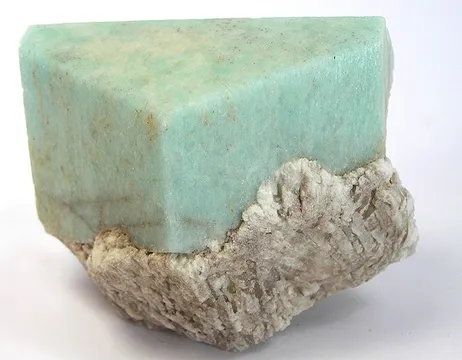
Kenticha, Ethiopia — a rare-element pegmatite locality yielding emeralds and amazonite; zoned crystals with mica inclusions, prized by collectors.
Key facts
Kenticha is one of the few African pegmatite localities that matters simultaneously to ore geologists, gemologists, and cabinet-specimen collectors. In mining literature it is the Kenticha rare-element pegmatite of the Adola Belt in southern Ethiopia: a large, shallowly dipping LCT pegmatite system enriched in lithium, cesium, tantalum, niobium, beryllium, rubidium, and gallium. In specimen literature it is better known for two very different visual signatures: intense blue-green amazonite microcline from the older tantalum-pegmatite workings, and, from the 2016 emerald discoveries around Kenticha and nearby Dermi, lustrous green emerald crystals with mica-rich skins, schorl or biotite inclusions, and occasional doubly terminated forms.
The locality sits in a belt of Neoproterozoic rocks where granitic pegmatites intruded serpentinite, talc-tremolite schist, mica schist, gneiss, and related mafic to ultramafic units. That contact is the key to Kenticha’s appeal. The pegmatites supplied beryllium and the evolved volatile-rich melt; the wall rocks supplied chromium and iron. Where the chemistry was right, beryl crossed the line into emerald. The best crystals are not Colombian-style transparent prisms on calcite, but robust African schist-pegmatite emeralds: glassy to silky, medium to deep green, often with a darker rind or mica-coated root, sometimes zoned, and commonly included with biotite, phlogopite, quartz, or black tourmaline.
Regional View
Country View
The tantalum mine gave Kenticha its scientific identity long before emeralds made it visible to the gem trade. Studies of the pegmatite describe a giant, internally zoned body, with alaskitic and aplitic lower zones, muscovite-quartz-albite-microcline pegmatite, spodumene-bearing upper zones, and discontinuous quartz and replacement bodies. Columbite-tantalite chemistry tracks that zoning, with tantalum-rich manganese members concentrated upward into the more evolved parts of the system. For collectors, this means Kenticha is not a single-pocket curiosity but a differentiated pegmatite field whose accessory minerals—spodumene, amblygonite, lepidolite, pollucite, wodginite, topaz, beryl, amazonite, and tantalum-niobium oxides—are part of the same geologic engine that later made the emerald discovery intelligible.

Photo: Wikimedia Commons
Search for specimens: View all specimens from Kenticha, null
Kenticha lies in the Guji Zone of Oromia, southern Ethiopia, in the broader Kenticha pegmatite field near Shakiso. The principal mine locality is usually described as the Kenticha mine or Main Kenticha pegmatite sheet. Coordinates commonly given for the mine locality are about 5°31′N, 39°02′E. Older specimen labels may read Sidamo-Borana Province, Seba Boru district, or simply “near Shakiso,” reflecting administrative naming and trade practice rather than separate geology.
The ore body is a rare-element LCT pegmatite: lithium-cesium-tantalum in petrogenetic family, and spodumene subtype in the common pegmatite classification. Published descriptions emphasize its large, sheet-like form. The Main Kenticha pegmatite is exposed for roughly two kilometers or more along strike, with reported widths from hundreds of meters in some scientific descriptions and a principal tantalum-bearing exposed belt on the order of tens of meters wide in mining summaries. Thickness values reported in the literature commonly fall in the 40–100 meter range. The body is shallowly dipping, locally subhorizontal, and emplaced in ultramafic to mafic host rocks, especially serpentinite and talc-tremolite schist, with associated pelitic, graphitic, and mica-rich schists nearby.
Internal zoning is unusually important here. From the base upward, the pegmatite has been described as a granitic to aplitic wall zone, a lower intermediate zone rich in muscovite, quartz, albite, and microcline, and an upper intermediate zone carrying albite, quartz, spodumene, muscovite, microcline, beryl, apatite, amazonite, amblygonite, lepidolite, and related rare-element minerals. Discontinuous quartz cores and lepidolite-rich greisen or replacement bodies occur in the more evolved upper parts. Late to postmagmatic alteration—albitization, sericitization, microclinization, amazonitization, greisenization, and kaolinitization—overprinted parts of the pegmatite and helped shape both ore mineral distribution and specimen appearance.
Tantalum mineralization is centered on columbite-tantalite group minerals, particularly Mn-rich tantalite in the evolved upper zones and core-related parts of the pegmatite. The weathered regolith was historically especially favorable for open-pit extraction because feldspar and many lithium minerals were deeply altered while resistant tantalite survived as recoverable heavy mineral grains. Mining accounts describe bulldozer-assisted open-pit work, washing, gravity concentration, tabling, and magnetic separation to recover tantalum concentrate, with quartz and feldspar as by-products. Government promotional material and technical papers also note lithium minerals, beryl, sulfides, columbite, and nearby related rare-metal pegmatites such as Bupo, Kilkile, and Dermidama along the same structural trend.
Exploration and development at Kenticha go back to Ethiopian state work in the 1980s. The Ethiopian Mineral Resources Development Corporation, later associated with Ethiopian Mineral Development Share Company and related state entities, identified the Kenticha tantalum deposit during exploration in the 1983–1987 period and established a processing plant around 1990. For years Kenticha was cited as Ethiopia’s principal tantalum source and one of the important tantalum producers in Africa. Production figures vary by source and period: scientific work from the 2000s cites annual production around 80–120 tonnes of tantalum concentrate, while Ethiopian promotional summaries later cite 200 tonnes of tantalite per year and a significant share of global consumption.
The lithium era added legal and operational complexity. Kenticha Mining Plc became associated with the effort to redevelop the former tantalum operation as a lithium-tantalum project, using both tailings and hard-rock pegmatite. Public company and Ethiopian press reports from 2023–2025 describe planned spodumene concentrate production, partnership structures involving Abyssinian Metals and Oromia interests, and an unresolved dispute with Ethiopian governmental authorities. For collectors, the practical conclusion is simple: this is not an open collecting locality. It is an active or strategically sensitive mining district with state, cooperative, private, and local-community interests; access requires permission, and mine-area entry and buying have been subject to enforcement.
The emerald-producing area is closely tied to the small mining village of Kenticha and nearby Dermi in the Seba Boru district. Gem News International reported the new deposit to the trade in 2017, with early material gathered in Shakiso after a November 2016 visit by Michael Nemeth and Daniel Kifle. More than 100 kilograms of emerald rough had reportedly been produced by the time of that report. Early mining was artisanal, in hand-dug shafts that followed emerald-bearing zones down from surface pegmatite exposures. GIA’s later field report describes a rapid transition from a chaotic rush to cooperatives and larger open-pit extraction, especially the Bua Obsa cooperative, which expanded from a small gold-and-tantalum group into the dominant local emerald operation.
The best specimen emeralds appear to have come from a relatively short-lived burst of production beginning in late 2016 and entering the international mineral and gem market in 2017. Many crystals were cut, cabbed, or trimmed for gem rough, so intact single crystals and matrix pieces survived in much smaller numbers than the rough production might imply. Dealer and museum-style specimen records show crystals commonly in the 1–4 cm range, with weights from teens of carats to more than 100 carats for fine thumbnails and miniature crystals; GIA reported rough crystals over 20 grams and accounts of pieces approaching 100 grams, while later field reporting noted that some large crystals exceeded 600 grams. For specimen collectors, the prized pieces are terminated or doubly terminated crystals with strong green body color, lustrous faces, translucency or transparent zones, minimal root damage, and intact association with mica, quartz, feldspar, calcite, or schorl.
Kenticha emeralds are classic schist-pegmatite emeralds rather than carbonate-hosted Colombian-style material: they occur with mica-rich reaction zones near pegmatite and mafic-ultramafic wall rock, and the better crystals combine pegmatitic beryl habit with chromium-bearing wall-rock chemistry. Specimens are typically prismatic, stout to elongated, medium to deep green, and commonly translucent rather than fully transparent. Many show biotite or phlogopite coatings, dark mica or schorl inclusions, quartz or kaolinite matrix, and color zoning; crystals may be broken or included at the root with one cleaner, brighter termination. The best Kenticha pieces stand out for undamaged terminations, doubly terminated or parallel-growth forms, strong saturated green seen in both reflected and transmitted light, and enough translucency to glow without losing the locality’s characteristic mica-rich texture. Ordinary examples are paler, more included, rooty, or merely fragments of gem rough; fine examples retain the geological story in miniature, showing green beryl emerging from the dark reaction-zone environment that made it emerald.
Beyond emerald, Kenticha is a rare-element pegmatite locality of real mineralogical breadth. Mindat and the scientific literature document albite including cleavelandite, microcline including amazonite, quartz, muscovite, lepidolite, spodumene including kunzite, petalite reported with uncertainty, amblygonite, lithiophilite, beryl, schorl and elbaite, spessartine and almandine, topaz, pollucite, holmquistite, cassiterite, rutile, ilmenite, magnetite, pyrite, arsenopyrite, columbite-(Fe), columbite-(Mn), tantalite-(Mn), wodginite, tapiolite-group material, microlite-group minerals, uranmicrolite of older usage, uraninite, meta-autunite, zircon, talc, tremolite, actinolite, phlogopite, kaolinite, and swinefordite. The most collectible non-emerald Kenticha specimens are the bright amazonite microcline crystals, some on pale feldspar or albite matrix, which entered the international mineral market before the emerald rush and remain among Ethiopia’s best-known pegmatite display specimens. The tantalum-niobium oxides are more important scientifically than visually, but they are central to Kenticha’s identity because their chemistry records the upward fractionation of the pegmatite and the concentration of Ta in the evolved zones.
Kenticha emeralds should be judged as specimen emeralds first and gem rough second. A crystal can be highly desirable even when it would cut poorly, provided it has strong color, readable crystal form, lustrous faces, and a pleasing association with mica, quartz, calcite, feldspar, or schorl. Conversely, a bright green fragment with no termination or only a sawn or broken root is best treated as rough, not as a high-grade mineral specimen.
The most common condition issue is internal fracturing and inclusion density. Ethiopian emeralds from the Shakiso-Kenticha district frequently contain mica, multiphase fluid inclusions, growth zoning, quartz, and healed fractures. Many crystals are broken or heavily included at one end, with only the cleaner termination suitable for cutting. On specimens, watch for cleaved or bruised prism faces masked by mica, resin, oil, or wet-looking coatings. Emeralds are routinely clarity enhanced in the gem trade, and GIA specifically noted that some Ethiopian emerald material requires fracture filling. Any unusually clean Kenticha crystal should be examined under magnification for filled fissures, surface-reaching fractures, oiling, and polish or trimming.
Fluorescence is generally not a useful selling point. GIA testing found Ethiopian emeralds from this production to be inert to both long-wave and short-wave ultraviolet light, consistent with relatively high iron content. A strong red Chelsea-filter reaction should not be expected; lack of reaction is not by itself a warning sign. Better origin testing relies on inclusions and trace-element chemistry. Ethiopian emeralds are rich in alkalis and iron relative to some classic sources, and laboratory LA-ICP-MS data can separate many of them from Brazilian, Zambian, Russian, and Colombian reference fields, although overlap among schist-hosted emeralds can occur.
Mislabelling is a real risk because the trade often uses “Shakiso,” “Kenticha,” “Seba Boru,” and “southern Ethiopia” loosely. Shakiso is the trading hub, not necessarily the exact mine. “Kenticha” may refer to the village area, the emerald district, the pegmatite field, or the older tantalum mine, depending on the label. Older mineral labels reading Sidamo-Borana Province are plausible for historic amazonite and pegmatite specimens. A precise modern label should ideally state Kenticha or Dermi, Seba Boru, Guji Zone, Oromia, Ethiopia, but collectors should expect a range of legacy and trade names.
Documented fake Kenticha emerald specimens are not prominent in the literature, but the same general risks that affect emerald specimens elsewhere apply: repaired crystals, glued crystals on matrix, dyed pale beryl, green glass or synthetic emerald sold as rough, and oiled or polymer-filled fractures described as untreated. Because the 2016–2017 material entered both gem and mineral channels quickly, provenance from reputable dealers, old invoices, and comparison with known GIA or Mindat-style material matter. Strong mica association, biotite/phlogopite inclusions, schorl needles or inclusions, and the right schist-pegmatite look support—but do not prove—locality.
Market availability is uneven. Small, included Kenticha crystals and fragments appear periodically, but choice, intact, lustrous crystals from the early finds are much less common because much of the better color was cut or cabbed. The most attractive miniature emeralds from the late-2016 production were already being described as a limited and largely depleted find in dealer records only a few years after discovery. Amazonite from Kenticha is still recognizable in collections and sometimes appears from older stocks or estate material, but top saturated blue-green crystals on matrix are no longer everyday pegmatite-show inventory.
In late 2016, emeralds from the Shakiso-Kenticha area began doing what good new gem finds always do: they moved faster than the paperwork, faster than the geology, and faster than the rumors could be sorted. In November of that year, Michael Nemeth and Daniel Kifle visited Shakiso, the trading town where Ethiopian dealers were gathering to buy and sell rough mined several kilometers away near Kenticha and Dermi. The new production was organized through local “associations,” each with a manager and members controlling extraction and distribution. Rough moved first through Shakiso, then on to Addis Ababa, and finally into the wider world. By the time GIA reported on the find in 2017, more than 100 kilograms of emerald rough had already been produced.
The early crystals must have been confusing and exciting in equal measure. Many were completely coated in dark biotite, looking more like mica-clotted pegmatite debris than the source of fine green gems. Held to transmitted light, however, some glowed an attractive green. The problem was inside: dense mica inclusions ran through much of the material, and many crystals were clean only at one end. GIA reported rough crystals over 20 grams and accounts of pieces nearly 100 grams. The best stones did not need clarity enhancement, but the average parcel was commercial—lighter, fractured, and included. For a specimen collector, that is precisely the tension that makes Kenticha interesting: the locality produced emeralds large and vivid enough for the cutting trade, but weird, mica-armored, and geological enough that the surviving crystals can look unmistakably Ethiopian.
The discovery also produced a rush on the ground. Local diggers found emerald while searching for other precious minerals, and by the first months of 2017 an artisanal mining community had formed. The area was already used to mineral work: gold, tantalum, and coltan minerals had long been part of local extraction, and Kenticha itself was famous for tantalum. At the peak in spring 2017, more than 10,000 miners were reportedly active in the small area. Early work was done with hand tools, crews sinking vertical shafts until they reached the emerald-bearing rock, sometimes at depths of about 20 meters.
Then came the shift from rush to organization. The Bua Obsa cooperative, which GIA visited during its field expedition, had been mining gold and tantalum for more than 15 years before emerald changed the village. It grew from 15 members to more than 300 after the discovery. The cooperative had people trained in finance, law, export procedures, and management, but colored stones required different instincts. Rather than learning everything by costly mistakes, Bua Obsa brought in outside experience, including a foreman from the Zambian emerald mines and a geologist with an academic background at Addis Ababa University. By the time of GIA’s visit, more than seven cooperatives and many smaller operations were active; by the second half of 2018, Bua Obsa had become the dominant cooperative.
The mine itself was no romantic hillside scratch by then. GIA described a large open pit on the hill where emeralds were first found, about 25 meters deep and roughly 50 by 50 meters in plan at the time of the visit. Bulldozers and excavators stripped overburden; emerald picking, sorting, and washing remained manual. The pit exposed the relationship collectors care about: dark mafic host rocks and white pegmatite intrusions, with emerald concentrated not simply in clean pegmatite but especially in reaction zones where mica, chromium-bearing wall rock, and beryl-forming fluids met. The mine geologist described two emerald types: paler, lower-quality beryl in pegmatite, and deeper green reaction-zone emerald where chromium was more abundant and open space between mica crystals allowed growth.
The field approach to Kenticha was memorable even before the pit. From Shakiso, the mines lay more than 60 kilometers away, yet the drive could take over five hours. Recent rain had turned dirt roads into mud tracks, and even rugged four-wheel-drive trucks slipped and slid toward Kenticha. This was not the arid drama of Ethiopia’s sapphire or opal fields. Around Shakiso, the land is at medium elevation, roughly 1,600–2,000 meters, with cloudy, misty conditions, dense forest, grassy bogs near creeks, and rapid tropical weathering that makes bedrock geology difficult to read. That weathering helps hide the rocks, but it also concentrates resistant minerals in secondary deposits—usually gold and coltan minerals rather than gemstones.
One of the more striking human details is how quickly emerald changed the village economy. During the rush, miners poured into Kenticha and expanded the village dramatically; after the rush, many left again. GIA recorded Kenticha as a community of about 1,000 people, mostly from the surrounding area, after the initial frenzy. The Bua Obsa cooperative regarded the emerald find as “a gift from God,” and within a year it had reportedly built roads, medical outposts, and churches with emerald-mining profits. That is a rare thing in specimen lore: a modern emerald find whose best crystals went to Tucson, Bangkok, Hong Kong, Bangkok labs, Carlsbad labs, Addis dealers, and cabinet drawers—but whose first transformation was local and immediate.
Küster, D., Romer, R. L., Tolessa, D., Zerihun, D., Bheemalingeswara, K., Melcher, F., and Oberthür, T. (2009). “The Kenticha rare-element pegmatite, Ethiopia: internal differentiation, U-Pb age and Ta mineralization.” Mineralium Deposita, 44, 723–750. A key modern paper on Kenticha’s LCT classification, internal zoning, U-Pb tantalite age, and tantalum mineralization.
Tadesse, S. (2001). “Geochemistry of the pegmatitic rocks and minerals in the Kenticha Belt, southern Ethiopia: implication to geological setting.” Gondwana Research, 4(1), 97–104. One of the important geochemical studies framing Kenticha as the Horn of Africa’s major rare-element pegmatite repository.
Zerihun, D., Garbarino, C., and Valera, R. (1995). “Granite pegmatite system in Kenticha (Adola, Sidamo, Ethiopia) rare metal pegmatite belt: petrochemistry, regional pegmatite zoning and classification.” SINET: Ethiopian Journal of Science, 18, 119–148. Frequently cited foundational work on the regional pegmatite system and its zoning; cited in later Kenticha summaries and field-symposium material.
Tadesse, S., and Zerihun, D. (1996). “Composition, fractionation trend and zoning accretion of the columbite-tantalite group of minerals in the Kenticha rare metal field (Adola, southern Ethiopia).” Journal of African Earth Sciences, 23, 411–431. The principal cited work on columbite-tantalite group evolution and Ta enrichment trends in the field.
Huang, Z., Li, G., Weng, L., and Zhang, M. (2023). “Gemological and Mineralogical Characteristics of Emerald from Ethiopia.” Crystals, 13(2), 233. Open-access gemological study covering Ethiopian emerald chemistry, spectroscopy, inclusions, and origin-separation criteria.
Renfro, N., Sun, Z., Nemeth, M., Vertriest, W., Raynaud, V., and Weeramonkhonlert, V. (2017). “A New Discovery of Emeralds from Ethiopia.” Gems & Gemology, Spring 2017, 53(1), Gem News International. The essential early trade and laboratory notice for the Kenticha-Dermi emerald discovery.
Vertriest, W., Weeramonkhonlert, V., Raynaud, V., and Bruce-Lockhart, S. (2019). “Land of Origins: A Gemological Expedition to Ethiopia.” Gems & Gemology, Spring 2019. Field-report treatment of Ethiopian emerald mining, trading, geology, inclusions, and cooperative organization around Kenticha.
Desta, M. T., et al. (2019). “The mineral chemistry of gahnite, garnet and columbite-group minerals (CGM): Implications for genesis and evolution of the Kenticha Rare-element granite-pegmatite, Adola, Ethiopia.” Journal of African Earth Sciences. A later mineral-chemistry study using gahnite, garnet, and columbite-group minerals to refine interpretations of Kenticha pegmatite genesis.
Mindat: Kenticha mine, Kenticha pegmatite field, Oromia Region, Ethiopia — The core collector locality page, with coordinates, mineral list, photographs, and bibliography.
Mindat: Kenticha pegmatite field, Oromia Region, Ethiopia — Regional pegmatite-field page useful for separating the mine locality from the broader rare-element belt.
Mindat: Emerald from Kenticha mine — Emerald occurrence record tied specifically to the Kenticha mine locality.
GIA: A New Discovery of Emeralds from Ethiopia — Early gemological report on the Kenticha-Dermi discovery, rough production, inclusions, trading route, and market appearance.
GIA: Land of Origins: A Gemological Expedition to Ethiopia — The best narrative field report on the Shakiso-Kenticha emerald district and its mining cooperatives.
Crystals: Gemological and Mineralogical Characteristics of Emerald from Ethiopia — Open-access analytical study of Ethiopian emerald chemistry, spectroscopy, and inclusions.
Ethiopian Minerals: Kenticha Tantalum Fact Sheet — Government summary of the tantalum-lithium pegmatite deposit, production history, and mining significance.
Wikimedia Commons: Category Kenticha Mine — Freely licensed images of Kenticha amazonite and related pegmatite specimens.
Mineralogical Record: Tom Moore’s What’s New Online Report 46 — Includes a contemporary mineral-show note and photograph reference for a 4.5 cm Kenticha emerald specimen.