






A collector's guide to Kavanayen, Venezuela: its geology, mining history and notable minerals, illustrated with the 21 specimens documented from this locality on EarthWonders.
Key facts
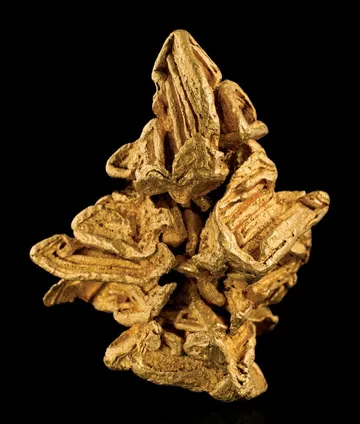
For collectors, “Kavanayen, Venezuela” is best understood as a Gran Sabana label tied to one of the most unusual native-gold provinces in the mineral world: the southeastern Bolívar alluvial and eluvial gold-diamond fields around Icabarú, Santa Elena de Uairén, and the Roraima Shield margin. The region’s collecting fame rests not on ordinary placer nuggets, but on bright, sculptural native gold that can preserve recognizable crystalline architecture after liberation into gravels—hopper octahedra, skeletal forms, ribbed spinel-twin-like growths, cavernous leaves, and locally twisted wires. The geological stage is the ancient Venezuelan Guayana Shield, where Early to Middle Proterozoic Roraima Group rocks, especially conglomeratic horizons of the Uairén Formation, shed gold and diamonds into modern and older placer systems. Kavanayén itself is a Pemón community in Canaima National Park on the Gran Sabana; the specimen trade, however, often uses broader Gran Sabana or Kavanayen-area wording for golds whose more precise mineralogical locality is the Icabarú River placers, particularly the Zapata claims.
Regional View
Country View
The best pieces have the immediate visual authority collectors want in native gold: saturated yellow colour, metallic luster, all-around three-dimensional form, and enough sharpness that they read as crystals rather than merely as waterworn metal. The paradox of the locality is that many specimens are alluvial, yet the finest retain delicate concave hopper faces and crystalline ribs that soft gold should not easily survive after long transport. That preservation is part of the locality’s importance. Scientific work on Icabarú and Mina Zapata gold has used diffraction and neutron-imaging methods to address exactly that problem—how natural placer gold can look crystalline, show complex surface recrystallization or cold-working effects, and still represent genuine natural crystal growth.

Photo: Didier Descouens, Wikimedia Commons
The associated diamond placers are not incidental background. Icabarú and neighboring Uaiparú river gravels have yielded gem and industrial diamonds studied for colour, morphology, nitrogen aggregation, dissolution features, and inclusions. In specimen terms, however, diamonds from the district are usually small alluvial stones; the collector identity of the locality is overwhelmingly defined by crystallized native gold.

Photo: Veronidae, Wikimedia Commons
Search for specimens: View all specimens from Kavanayen, Venezuela
The mineral-specimen locality is connected to southeastern Bolívar State, in the Gran Sabana sector of the Venezuelan Guayana Shield. Kavanayén, formally Santa Teresita de Kavanayén, is a Pemón settlement in Canaima National Park, while the world-class crystallized gold specimens most often associated with the collector label come from the Icabarú River placers and their sublocalities, especially the Zapata claims. On precise labels, expect wording such as “Zapata claims,” “Zapata Mine,” “Icabarú River placers,” “Santa Elena de Uairén,” or “Gran Sabana Municipality, Bolívar, Venezuela.” Those should not be treated as interchangeable on a serious label: Kavanayen is the broad marketplace/regional label, whereas Zapata and Icabarú are the tighter mineral-locality designations.
The deposit type is placer to eluvial/alluvial gold and diamond mineralization derived from older sedimentary source rocks. USGS and CVG-TECMIN work on the Venezuelan Guayana Shield identifies three main gold-diamond settings in the southern Gran Sabana: modern placer deposits downstream from exposures of the Uairén Formation, colluvial-alluvial placers adjacent to those exposures, and paleoplacer horizons associated with conglomeratic lenses and beds in the lower 500–600 m of the Uairén Formation of the Roraima Group. The relevant bedrock package includes quartz sandstones, quartzites, conglomerates, and associated Roraima Group sedimentary rocks resting in the wider framework of Proterozoic volcanic and intrusive units of the shield.
The Zapata claims are recorded mineralogically as a claim within the Icabarú River placers. Mindat lists gold as the exploitable commodity there, with native gold and diamond as documented minerals. The Icabarú River placer system itself contains several named sublocalities familiar to collectors and dealers, including El Infierno, Trompa, Los Brasilerous, La Maricutana, and Zapata. Specimen labels from the wider district may also cite El Polaco, Surucún, Mosquito, Uaiparú, and other nearby placer names; these are part of the broader Santa Elena–Icabarú placer province but should be kept separate when provenance is known.
Mining in the district has been a mixture of small-scale placer exploitation, garimpeiro-style workings, indigenous and local activity, concessionary claims, and intermittent corporate or government-linked title histories. Reports on the upper Caroní basin describe the Icabarú mining village as having seen decades of gold and diamond activity, with better-known 1980s sectors including Playa Blanca, Zapata, Trompa, Hacha, Los Caribes, El Polaco, La Faisca, and La Hoyada. By the mid-1990s, Venezuelan authorities and CVG-TECMIN mapping recorded numerous mining plots in the Icabarú basin, including Zapata 1 through 5. Later corporate filings described acquisition of rights in the Pacaraima region, including Cerro Trompa northeast of Icabarú and the San Miguel, Mosquito, and Zapata mines, but also stated that no extraction activities had commenced under that company’s ownership and that reserve evaluation was not current.
Production figures specific to the Zapata specimen pockets are not well documented in public mineralogical literature. The USGS resource inventories record productive placer gold localities in the Guayana Shield and list the Icabarú placers as a known placer gold occurrence, but the specimen-grade crystallized gold appears to have emerged episodically through small-scale alluvial work rather than from a continuously documented specimen mine. For collectors, the most important “production periods” are therefore not mine-production campaigns so much as pulses of specimen availability—older 1980s material, notable pieces entering the market by the 1990s and 2000s, and later documented finds such as 2014 Zapata gold and 2019 El Infierno gold on quartz.
Collecting access today should be regarded as highly restricted and sensitive. The region lies in and near protected landscapes, indigenous communities, active or former mining zones, and areas affected by modern security, legal, and environmental concerns. Casual collecting or independent prospecting is not appropriate. Any field access would require legitimate permission from landholders and indigenous authorities, compliance with Venezuelan law, mining and park restrictions, and a realistic assessment of safety. For most collectors, responsible acquisition means relying on established provenance, reputable dealers, documented old collections, and specimens already circulating legally in the mineral market.
The best pockets and recoveries have produced free-standing golds with sharp or semi-sharp hopper forms, ribbed skeletal surfaces, bright buttery-yellow colour, and complex negative spaces. Some specimens are matrixless floaters; others show quartz association, and some lateritic-sediment association has been reported from Mina Zapata material. Top pieces are prized when they combine recognizable crystallography with minimal alluvial rounding, because that combination is what separates the district from ordinary nugget localities.
Gold from the Kavanayen/Gran Sabana collector label is most significant when it can be narrowed to the Icabarú River placers, especially the Zapata claims, where native gold occurs as bright yellow alluvial and eluvial pieces that may preserve hopper octahedral, skeletal, arborescent, cavernous, ribbed, and rarely wire-like habits. Documented specimens range from small thumbnails of around a centimeter to exceptional multi-centimeter crystals; published Icabarú research suites included crystals from about 0.75 cm to roughly 2.5 cm in maximum dimension, while famous market examples are larger still. Quartz is a notable association in some pieces, and Mina Zapata material has also been described with lateritic sediment. The finest examples are not simply heavy gold for weight value: they show sculptural three-dimensional form, sharp crystalline edges, concave hopper interiors, deep hollows, strong metallic luster, and minimal flattening or rounding from placer transport.
Other documented minerals from the precise Icabarú–Zapata placer system include diamond and, in the wider Icabarú gold suite, porpezite, the palladian variety of native gold. Diamonds from the Icabarú and Uaiparú placers have been studied in large analytical suites and include colourless, yellow, brown, green, black, coated, and polycrystalline varieties, with dissolution features and inclusions such as olivine, ilmenite, garnet, and graphite reported in regional studies. Kavanayen itself also appears in USGS mineral-occurrence tables as a bauxite occurrence, but bauxite has no meaningful specimen-market identity here compared with the gold and diamond placers. No accepted mineral species was found to have Kavanayen or Zapata as its type locality in the sources used for this guide.
The central collecting issue for Kavanayen/Gran Sabana gold is authenticity. Large, sharp single crystals of gold have long invited suspicion because gold is soft, malleable, and relatively easy to cast or manipulate compared with most collectible minerals. The Venezuelan golds were historically caught in that controversy: surface etching and X-ray work could suggest polycrystallinity, which some interpreted as evidence of artificial manufacture. Later diffraction and neutron-based studies showed that at least some morphologically impressive Venezuelan gold crystals could be genuine natural crystals, with surface effects explained by cold working, recrystallization, or deformation in the placer environment rather than casting. That history makes the locality unusually important but also means collectors should be careful: buy pieces with old provenance, good photography, credible labels, and, for major specimens, analytical or expert documentation when possible.
Mislabelling is common because the same material may be sold under “Kavanayen,” “Santa Elena,” “Icabarú,” “Zapata,” “Gran Sabana,” or simply “Venezuela.” A label reading only “Kavanayen” is less precise than one citing Zapata claims or Icabarú River placers. Conversely, not every Venezuelan gold crystal should be upgraded to Zapata without documentation. Serious collection records should preserve the exact dealer or old-collection wording and, where possible, add a modern hierarchical locality note rather than replacing the original label.
Condition is judged differently here than for quartz, tourmaline, or hard metallic crystals. Gold naturally dents, folds, abrades, and burnishes; a completely pristine placer gold crystal is exceptional. Ordinary pieces may show rounded edges, compressed faces, small bruises, smoothed high points, or dark sediment lodged in cavities. These are not automatically defects if they are consistent with alluvial origin, but they reduce value when they obscure the crystal architecture. The best pieces show sharp ribs and hollows on both sides, all-around form, and no obvious tool marks, solder, casting seams, artificial joins, or suspiciously repeated geometry.
Cleaning should be conservative. Gold itself is chemically resistant, but associated quartz, iron oxides, clays, and lateritic material can be part of the specimen’s context. Do not over-polish or mechanically brighten Venezuelan gold; removing natural surface texture can destroy the very evidence that makes these specimens collectible. Fluorescence is not a practical collecting attribute for the gold, though associated diamond from the broader district may show gemological luminescence behavior in analytical contexts.
Market availability is limited. Small golds from the district appear periodically, but fine crystallized examples with unquestioned provenance are not common. Superb Zapata and Icabarú pieces have entered high-end collections, museum displays, specialist gold collections, and major auctions. Prices are driven less by melt value than by form, sharpness, size, provenance, and the degree to which the specimen expresses the locality’s signature crystalline style.
The most memorable story attached to these Venezuelan golds is the one every advanced gold collector eventually hears: the crystals looked too good. Equant hopper gold from the Gran Sabana circulated with such clean geometry that some observers argued they could not be natural. A surface test on a sacrificed crystal reportedly produced a polycrystalline-looking result, and the accusation followed the specimens into the market. The damage was not merely academic; suspicion can freeze a locality, punish a dealer, and cast a shadow over specimens that might in fact be among the finest natural gold crystals known. Later neutron work changed the conversation because neutrons could probe the interior of dense gold in a way ordinary X-rays could not. The result was a subtler and more mineralogically interesting explanation: placer transport and the softness of gold could modify and recrystallize surfaces while preserving or masking deeper crystalline order.
One specimen carried that argument onto the world stage. A large Icabarú native gold crystal acquired by its owner on September 14, 1987, later appeared at auction in 2021 as a 217.78-gram, 7.00-troy-ounce single crystal measuring 5.28 x 4.37 x 2.52 cm. Its description emphasized why it mattered: a skeletal octahedral structure, sharp edges, well-terminated faces, intense luster, and a level of preservation extraordinary for an alluvial gold. The piece had reportedly taken more than 30 years to reach public sale, had appeared on 1998 covers of Lapis Mineralien Magazin and Rivista Mineralogica Italiana, and had been shown at the Houston Museum of Natural Science. It sold on December 8, 2021 for $447,000, a result that confirmed what gold specialists already knew: the best Venezuelan crystals are not bought as nuggets, but as crystallographic sculpture.
A different kind of field reality surrounds the Gran Sabana today. Scientific fieldwork in the Kavanayen area has been interrupted by distrust, shortages, armed presence, and the wider effects of conflict and mining pressure near Canaima National Park. That context matters to collectors because locality romance can too easily erase the ground truth. These specimens come from a beautiful, ancient, culturally significant landscape where gold and diamonds are entangled with indigenous territory, protected-area law, informal mining, and real risk. A fine label should therefore carry more than a locality name; it should carry restraint.
USGS and Corporación Venezolana de Guayana, Técnica Minera, C.A. — Geology and Mineral Resource Assessment of the Venezuelan Guayana Shield, U.S. Geological Survey Bulletin 2062, 1993 — Foundational regional assessment for the Guayana Shield, including tables of gold placers, diamond deposits, bauxite occurrences, and mineral-resource models relevant to the Gran Sabana.
USGS — Geology and Mineral Deposits of the Venezuelan Guayana Shield, U.S. Geological Survey Bulletin 2124 — Includes the Icabarú Sur gold-diamond discussion, Roraima Group/Uairén Formation context, and the placer/paleoplacer framework used for the district.
Dohrenwend, J.C., Yánez P., G., and Lowry, G. — “Cenozoic landscape evolution of the southern part of the Gran Sabana, southeastern Venezuela: implications for the occurrence of gold and diamond placers,” in USGS Bulletin 2124 — Important geomorphic treatment of why gold and diamond placers occur where they do in the southern Gran Sabana.
Rakovan, J., Gasbarro, N., Nakotte, H., Kothapalli, K., and Vogel, S.C. — “Characterization of Gold Crystallinity by Diffraction Methods,” Rocks & Minerals, 84(1), 54–61, 2009 — Key article on Icabarú gold crystals, including crystal size ranges, hopper-octahedral morphology, and diffraction results.
Rakovan, J. — “Neutron Diffraction Analysis Verifies Existence of Some of the World’s Largest Gold Crystals,” Rocks & Minerals, 89, 404–406, 2014 — Short but important publication addressing the authenticity problem for large gold crystals.
Tremsin, A.S., Rakovan, J., Shinohara, T., Kockelmann, W., Losko, A.S., and Vogel, S.C. — “Non-Destructive Study of Bulk Crystallinity and Elemental Composition of Natural Gold Single Crystal Samples by Energy-Resolved Neutron Imaging,” Scientific Reports, 7, 40759, 2017 — Non-destructive neutron-imaging study of gold samples from Icabarú and Mina Zapata, including discussion of Au-Pd alloy areas and lateritic-sediment association.
Newman, J.A., Newman Carvalho, D.T. de, Gandini, A.L., Gomes, N.S., and Rojas, A.J. — “Caracterización mineralógica del diamante de los placeres aluvionales del río Icaburú, Santa Elena de Uairén, Estado Bolívar, Venezuela,” , 64(3), 472–480, 2009 — Study of 458 diamonds from Icabarú and Uaiparú alluvial placers, with data on colour, morphology, FTIR diamond types, and inclusions.
Mindat — Zapata claims (Zapata Mine), Icabarú River placers, Gran Sabana Municipality, Bolívar, Venezuela — Best concise mineral-locality page for the precise Zapata claim locality, listing native gold and diamond.
Mindat — Icabarú River placers, Gran Sabana Municipality, Bolívar, Venezuela — Broader placer-system entry with sublocalities and photo references.
Mindat — Native Gold from Zapata claims — Species occurrence page identifying Zapata gold as world-class and tying it to the Tremsin–Rakovan neutron-imaging work.
Wikimedia Commons — Native gold, Mina Zapata, Santa Elena de Uairén, Venezuela — Freely licensed photograph of a 3.46 x 3.12 x 1.79 cm Mina Zapata gold specimen.
Wikimedia Commons — Kavanayen, Canaima National Park, Bolívar, Venezuela — Useful landscape context for the Kavanayén/Gran Sabana setting.
Heritage Auctions — Native Gold Crystal, Icabarú, Bolívar, Venezuela — Auction record for a famous 217.78 g Icabarú gold crystal sold in 2021.
Revista de la Asociación Geológica Argentina — Icabarú alluvial diamond characterization — Primary diamond-mineralogy paper for the Icabarú and Uaiparú placer system.
Scientific Reports — Energy-resolved neutron imaging of natural gold samples — Technical paper on non-destructive analysis of Venezuelan gold crystallinity and composition.
USGS Bulletin 2062 — Geology and Mineral Resource Assessment of the Venezuelan Guayana Shield — Regional geological and mineral-resource framework.
USGS Bulletin 2124 — Geology and Mineral Deposits of the Venezuelan Guayana Shield — Includes the Icabarú Sur gold-diamond resource discussion.
Newman Fernández, J.A. — Estudos químico-mineralógicos aplicados à caracterização do diamante de Santa Elena de Uairén, Estado Bolívar – Venezuela, 2011 — Expanded diamond study of the Santa Elena de Uairén region, including samples from Icabarú, Uaiparú, Surucún, and Mosquito river banks.

