Indonesia — a vast island-arc locality with vivid grape agate and drusy quartz; copper-gold districts; prized for tropical-arc rarity and collector appeal.
Key facts
Indonesia is not a single-mineral locality in the tidy European sense; it is an immense island-arc mineral province where specimen material comes from volcanic cavities, epithermal veins, porphyry-skarn ore systems, river placers, laterites, and long-lived lapidary districts. For collectors, its name most often calls up two very different worlds: the polished and specimen-grade silica of the batu akik tradition—agate, chalcedony, jasper, drusy quartz, and the famous purple “grape agate” material of West Sulawesi—and the giant metal districts of Papua, Sumatra, Sumbawa, Java, and Kalimantan, where quartz, sulfides, gold-silver minerals, skarn silicates, platinum-group minerals, diamonds, tin minerals, and nickel laterite assemblages define the country’s mineralogical depth.
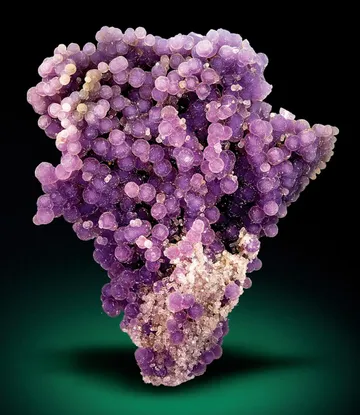
Indonesia’s best collector specimens tend to look unmistakably tropical-arc in origin. The finest silica pieces show vivid translucent color, waxy to glassy surfaces, botryoidal growth, drusy sparkle, plume- and moss-like inclusions, or tight fortification banding cut from volcanic and sediment-hosted silica bodies. The Mamuju material—sold almost universally as “grape agate,” though many examined pieces are better described as spheroidal amethystine quartz—brought Indonesia into the modern mineral-specimen market with lustrous purple, green, blue-green, grey, and bicolored clusters whose rounded beads can look as if a geode had grown a skin of tiny grapes. At the other end of the scale, the Grasberg-Ertsberg district in Papua is one of the great porphyry-skarn copper-gold systems of the world, and although it is an industrial mining district rather than an open collecting ground, it anchors Indonesia’s importance in serious economic mineralogy.
Regional View
Country View
Historically, Indonesia is also a type-locality country of real consequence. Dozyite was described from the Ertsberg East skarn system in Papua and named for Jean Jacques Dozy, the Dutch geologist whose 1936 recognition of copper mineralization in the Carstensz highlands set the stage for the Ertsberg-Grasberg story. Uytenbogaardtite, Ag3AuS2, is tied to the Tambang Sawah gold-silver district in Bengkulu, Sumatra. Laurite, RuS2, has its classic type locality in the Pontyn River placer at Tanah Laut in South Kalimantan. Those are not cabinet-showcase species for most collectors, but they matter because they show how deeply Indonesia is woven into modern mineral nomenclature.

Photo: Wikimedia Commons

Photo: Wikimedia Commons
Search for specimens: View all specimens from Indonesia
Indonesia sits across one of the planet’s most active convergent-plate settings, and its mineral deposits reflect repeated Cenozoic arc magmatism, subduction-related volcanism, strike-slip faulting, uplift, weathering, and tropical erosion. For the specimen collector, this means the country cannot be reduced to one deposit type. West Sulawesi contributes modern collector favorites from silica-rich cavities and clay-filled zones associated with volcanic rocks. Java and Sumatra supply agate, jasper, chalcedony, opal, petrified wood, and epithermal quartz vein material. Papua hosts the giant Grasberg-Ertsberg porphyry-skarn copper-gold system. Sumbawa hosts Batu Hijau, a major island-arc porphyry copper-gold deposit. North Sumatra hosts the Martabe high-sulfidation and low-sulfidation gold-silver district. Kalimantan and Bangka-Belitung add placer, tin, diamond, and platinum-group-mineral history to the picture.
The Grasberg minerals district lies in the Sudirman Range of Central Papua, on the western half of New Guinea. Its mineralization is a combined porphyry copper-gold and skarn system: copper, gold, and silver occur in potassic-altered intrusive rocks, stockworks, and prograde to retrograde skarn assemblages, with bornite and chalcopyrite among the key copper sulfides. The district’s published geology emphasizes the Grasberg Igneous Complex and the related Ertsberg skarn systems, including deep ore zones and contact-controlled bodies. The district is famous industrially, not as a source of free-collecting cabinet specimens; access is controlled, remote, and tied to large-scale underground operations run by PT Freeport Indonesia.
The mining history of Papua’s copper-gold province is one of the classic discovery stories in twentieth-century economic geology. Jean Jacques Dozy saw and described the Ertsberg mineralized outcrop during the 1936 Carstensz expedition; his report was neglected for years, then rediscovered in the late 1950s, leading to Forbes Wilson and Del Flint’s 1960 Freeport expedition. Ertsberg production began in the early 1970s, the Grasberg deposit was discovered in 1988, and the operation later shifted from the open pit toward large underground block-cave mining. PT Freeport Indonesia remains the operator of the Grasberg minerals district under Indonesia’s modern mining-permit framework, with Indonesian state-related ownership now the majority position.
On Sumbawa, Batu Hijau is Indonesia’s second great modern copper-gold porphyry district. It is a low-K, calc-alkaline island-arc porphyry copper-gold system in southwest Sumbawa, historically developed by Newmont and now operated by Amman Mineral Nusa Tenggara. Its specimen relevance is mostly geological rather than market-facing: it documents the same broad metallogenic family that makes Indonesia important to ore mineralogists—arc-related intrusive centers with copper-gold mineralization, hydrothermal alteration, and local skarn development.
North Sumatra’s Martabe district is a gold-silver system with high-sulfidation epithermal deposits at Purnama, Baskara, Kejora, and Gerhana and a low-sulfidation deposit at Pelangi. The mine area is in South Tapanuli Regency and is operated by PT Agincourt Resources. The Purnama and Barani work has documented quartz-dominant silicification, vuggy residual quartz, quartz-alunite and quartz-dickite-kaolinite advanced argillic alteration, and quartz veins showing banded, crustiform-colloform, lattice-bladed, vuggy, and massive textures. Those textures are precisely the ones collectors recognize in epithermal quartz, although active mine access is controlled and specimen recovery is not a casual collecting activity.
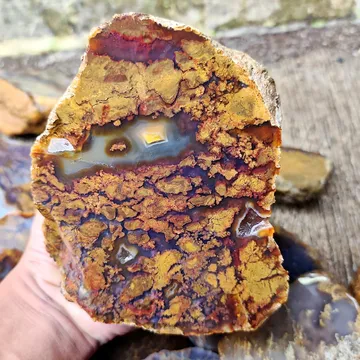
Indonesia’s agate and chalcedony localities are more accessible to the lapidary world than to the formal mine-specimen world. Donorojo in Pacitan, East Java, especially the villages of Gendaran and Sukodono, has long been known as a center of batu akik cutting and trading. Local material includes agate, chalcedony, jasper, onyx, sardonyx, carnelian, drusy quartz-lined pieces, and fossil wood. Baturaja in Ogan Komering Ulu, South Sumatra, is known in the trade for blue, lavender, yellow, orange, and patterned chalcedony sold under names such as Spritus, Blue Sky, Lavender, Sunkis, Terong, and Lumut. Garut in West Java is known for multicolored Pancawarna jasper-agate material, while Bacan in the Maluku Islands is famous in the Indonesian gem trade for chrysocolla-bearing chalcedony commonly called batu bacan.
The most specimen-oriented silica production of recent decades is the West Sulawesi “grape agate” material from the Mamuju area. The published gemological account places its modern discovery in 2014 near Mamuju, first noticed on a beach and then traced up streambeds into nearby jungle. Local miners worked narrow tunnels in steep hillsides in clay-filled zones associated with submarine pillow lavas within a Miocene volcanic sequence of mafic lavas, breccias, and tuffs. Early production was pale grey to brown and friable, but by 2016 higher-grade purple and bluish green clusters were being recovered in situ. Mixed-quality recovery has been estimated at well over 500 tonnes, with the largest clusters reportedly reaching 80 kg, though only a minority of production had strong color and display-grade luster.
Collecting access today varies sharply by material. Major metal mines such as Grasberg, Batu Hijau, Martabe, Pongkor, and nickel laterite operations are industrial sites requiring authorization; they should be treated as closed to casual collectors. Lapidary rough from Java, Sumatra, Sulawesi, and Maluku circulates through local cutters, small traders, and export dealers, but precise source attribution is often weaker than serious collectors would like. The best modern Indonesian specimen purchases are those with full locality, district, and trade-name context: for example, “Mamuju Regency, West Sulawesi, Indonesia” rather than simply “Indonesia grape agate,” or “Baturaja, Ogan Komering Ulu, South Sumatra” rather than “blue Indonesian chalcedony.”
Indonesian agate in the collector trade is a broad field that includes true banded agate, jasper-agate, mossy and dendritic chalcedony, drusy-lined nodules, and material that Indonesian cutters and dealers group under the traditional name batu akik. The most important named producing areas include Pacitan and Donorojo in East Java, where agate, chalcedony, jasper, onyx, sardonyx, carnelian, and drusy pieces have supported a long-running cutting culture; Garut in West Java, known for vivid multicolored Pancawarna jasper-agates; Baturaja in South Sumatra, whose blue, lavender, yellow-orange, and patterned chalcedonies often reach the market under local color names; and the Bacan area of Maluku, famous for green to blue-green chrysocolla-chalcedony gem material. Good Indonesian agate is judged less by size alone than by saturated natural color, sharp internal pattern, translucency where expected, attractive fortification or plume structure, clean cutting or intact drusy faces, and reliable locality attribution; ordinary pieces are often poorly labeled, muddy in color, fractured, over-polished, dyed, or sold under fanciful trade names that obscure the actual silica variety.
Quartz from Indonesia ranges from vein and drusy material in agate districts to economic-gold quartz assemblages and the highly distinctive Mamuju spheroidal material marketed as “grape agate.” At Mamuju, West Sulawesi, individual rounded spheres are commonly a few millimeters across and may reach nearly 2 cm, forming sparkling purple amethystine, grey, whitish, green, blue-green, or bicolored clusters on clayey or volcanic matrix; the best specimens have tight, undamaged orb coverage, fine drusy luster, natural color zoning, and three-dimensional form rather than flat plates of dull beads. In Martabe-style epithermal systems, quartz appears in vuggy, massive, banded, crustiform-colloform, lattice-bladed, and stockwork textures associated with advanced argillic alteration and gold-silver mineralization, while in porphyry-skarn districts such as Grasberg and Batu Hijau quartz is part of the broader hydrothermal and intrusive mineralization rather than a common cabinet-specimen commodity. For collectors, the most desirable Indonesian quartz specimens are either unmistakable Mamuju clusters with honest “quartz var. amethyst, trade name grape agate” labeling, or well-provenanced drusy and vein pieces from recognized lapidary districts.
Beyond agate and quartz, Indonesia’s documented mineralogy includes several species of special interest to advanced collectors and mineral historians. Dozyite, Mg7Al2(Si4Al2)O15(OH)12, was described from altered skarn adjacent to the Ertsberg East Cu-Au-Ag orebody in Papua. Uytenbogaardtite, Ag3AuS2, is tied to hydrothermal gold-silver-quartz vein material from Tambang Sawah in Bengkulu, Sumatra, where it occurs with minerals such as acanthite, electrum, quartz, and other vein assemblage phases. Laurite, RuS2, has its classic type locality in the Pontyn River placer of Tanah Laut, South Kalimantan, and later work on Borneo placer laurite has documented euhedral to rounded grains with Ru-Os-Ir-Pd solid-solution chemistry. Indonesia also has famous non-silica collecting traditions around Kalimantan diamonds, Bangka-Belitung cassiterite and tin-field minerals, nickel laterite material from Sulawesi and Halmahera, petrified wood from Java and Sumatra, and epithermal gold-silver assemblages from districts such as Pongkor, Cirotan, and Martabe.
The first rule with Indonesian specimens is to separate mineralogy from trade language. “Batu akik” is a cultural and commercial umbrella, not a species name. It may refer to agate, chalcedony, jasper, onyx, sardonyx, carnelian, opal, chrysocolla-chalcedony, drusy quartz, or polished silica with inclusions. “Grape agate” is the most important modern example: attractive Mamuju pieces are widely sold under that name, but serious labels should make clear that much of the material is spheroidal quartz or amethystine quartz rather than true banded agate.
Color treatment is a real concern. Poorly colored Mamuju material has been documented as sometimes dyed violet, and Indonesian agate and chalcedony in general can be dyed or stained to intensify red, green, yellow, blue, or purple tones. Warning signs include color concentrated in fractures, pores, clay seams, or matrix; an unnaturally even neon tone; purple or blue staining where no quartz growth should be colored; and color that looks painted rather than internally zoned. Natural Mamuju purple can be strong, so the issue is not saturation alone but how the color is distributed through individual spheres and across the specimen.
Mislabelling is equally common. Baturaja chalcedony may be marketed by local color names as if each were a separate mineral. Bacan material is often described loosely as “chrysocolla,” “chalcedony,” or “gem silica,” and pieces vary in how much copper-bearing material versus silica they contain. Pacitan and Garut material may be sold under invented names, royalty-themed names, or landscape-pattern names that are meaningful in the Indonesian lapidary market but not mineral species. For serious collecting, insist on a label that records the province or regency when possible.
Condition issues depend on the material. Mamuju “grape” clusters are fragile: the bead-like spheres chip, detach, bruise at high points, and lose visual quality quickly if scrubbed or packed poorly. Drusy Indonesian agates may have broken crystal linings, sawed backs, resin stabilization, or oil/wax residues from lapidary handling. Polished cabochons should be judged for cracks, dye, backing, filled pits, and whether the base material is actually chalcedony, jasper, opal, chrysocolla-chalcedony, glass, or composite.
Large Indonesian ore-district specimens with mine names require extra scrutiny because access to active industrial sites is controlled. A label reading “Grasberg,” “Martabe,” or “Batu Hijau” should be treated as a provenance claim that needs history: who collected it, when, and through what channel. Loose quartz, pyrite, chalcopyrite, calcite, or skarn fragments without documentation should not command a premium merely because a famous mine name has been attached.
Market availability is uneven. Mamuju quartz remains widely traded, but top pieces with deep natural color, full orb coverage, minimal bruising, and strong three-dimensional form are much less common than small commercial clusters. Indonesian agate and chalcedony cabochons are abundant, while uncut or specimen-quality pieces with exact locality and old provenance are far scarcer. Type-locality species such as dozyite, uytenbogaardtite, and laurite are specialist micro- or research-level minerals; they should not be expected in ordinary mineral-show stock, and any offered example deserves careful verification.
The Grasberg-Ertsberg story begins with a mountaineering expedition, not a mine. In 1936, Jean Jacques Dozy joined the Carstensz expedition into the high mountains of what was then Dutch New Guinea. In that glacier country he noticed a black, green-stained outcrop that stood out from the alpine landscape. He named the copper-bearing mountain Ertsberg—“ore mountain”—and also recognized the Grasberg, “grass mountain,” farther up the valley. His 1939 report might have changed the course of mining history immediately, but the Second World War intervened, and the paper slipped into obscurity.
Two decades later, the forgotten report resurfaced. In 1959, Jan van Gruisen, of the Oost Borneo Company, was looking through old geological material on western New Guinea. Forbes Wilson of Freeport Sulphur saw the implications at once. Wilson later described how Dozy’s geological setting made him suspect that Ertsberg might be “a unique mineral deposit,” much larger than the few million tons first imagined. In May 1960, Wilson, Delos Flint, and Gus Wintraecken began an overland approach from the south coast village of Omowka. Seventeen days later, aided by mountain Papuan packers and airdrops from Dutch marine pilots flying out of Biak, they reached Ertsberg. Over the next six weeks they collected about 300 kg of samples and made the measurements that confirmed a major copper system.
In Pacitan, East Java, the story is smaller in scale but closer to the hand of the collector. A 2012 account from Donorojo describes the tortuous road into the district: narrow switchback tracks, mountain ridges between Pule and Pacitan, and a journey of roughly 100 km that could demand 10 hours of concentration. At the end of that road was Timbul, a middle-aged agate miner in Gendaran whose workshop floor was scattered with rounded stones and whose dusty cases held brick-red agate, mauve amethyst, white moonstone-like material, merah hati crimson stone, and drusy pieces. Timbul said he began mining stones as a child in 1968, that he was the third generation of his family to do so, and that his ancestors had started in 1935.
Timbul’s most memorable object was not for sale in any ordinary sense. He kept a panca warna stone—multicolored, with what he saw as a perfect yin-yang symbol—and said he had once been offered Rp20 million for it. He would not sell. To discourage buyers, he placed its price at Rp150 million, explaining that the stone brought him luck and seemed to guide him to more stones in the hills. Before digging, he said, miners prayed inwardly in the Javanese way, asking permission from the souls believed to guard the stones. The mining he described was not mechanized quarrying: men dug by hand, moved on when a patch produced nothing, and might recover 1 kg of rough in a day or 50 kg, depending on luck.
The batu akik boom of 2014–2016 turned that older lapidary culture into a national fashion. A field study in Gendaran, Donorojo, recorded the sudden spread of roadside traders, grinding services, and small shops selling and polishing stones. The trend crossed age and gender lines, drawing not only older collectors but younger buyers and people who had never previously thought of themselves as stone enthusiasts. In Pacitan, local identity became part of the story: the study even recorded a local government rule or appeal that civil servants wear batu akik as a characteristic symbol of Pacitan. Like many collecting booms, it mixed genuine craft, folklore, commerce, fashion, and speculation—but in Donorojo it rested on a real local tradition of cutting and selling the stones of the surrounding hills.