Imiter Silver Mine, Morocco — a major primary silver deposit in the Anti-Atlas, yielding acanthite, proustite, native silver and other prized silver minerals.
Imiter is one of the great modern silver localities: a working epithermal Ag-Hg vein system in the eastern Anti-Atlas of Morocco, set in the stark volcanic and sedimentary country of the Jbel Saghro about 150 km east of Ouarzazate. For collectors it matters for three overlapping reasons. First, it is a major primary silver deposit, not merely a base-metal mine with incidental silver. Second, it has yielded an unusually rich suite of silver minerals—acanthite, proustite, native silver, polybasite, pyrargyrite, freibergite and Ag-Hg phases among them. Third, its specimen production since the early 2000s put world-class Moroccan silver minerals into collections at a scale no earlier Moroccan silver locality had matched.
The best Imiter specimens have a look of their own. Acanthite is typically steel-gray to black, often in sharp pseudo-octahedral crystals and open, thorny clusters; the better pieces have crisp form and unusually good luster for the locality. Proustite occurs as small but brilliant ruby-red crystals, commonly on quartz-rich or sulfide-rich matrix, and the most appealing pieces show sharp prismatic crystals with acute terminations and strong translucency. Native silver appears as wires, hooks, laminae, and branching arborescent growths, sometimes erupting from black acanthite or sitting in pale calcite or quartz. On the finest pieces the contrast is dramatic: bright metallic silver against dark silver sulfide, or red proustite scattered across pale quartz and white carbonate.
Regional View
Country View
Geologically, Imiter belongs to the Neoproterozoic metallogenic story of the Anti-Atlas: a structurally controlled system of quartz, dolomite, calcite and sulfide-sulfosalt veins localized along the Imiter fault zone, where lower Cryogenian sedimentary rocks and upper Ediacaran volcanic and volcano-sedimentary rocks meet. The district’s silver was not a single simple pulse. Published models distinguish early pyrite and quartz with Ag-bearing sulfides and sulfosalts, a main silver stage rich in Ag-Hg amalgam, argentite/acanthite, freibergite, polybasite, pyrargyrite and proustite with carbonate gangue, and later quartz-calcite-base-metal sulfide stages. That multi-stage history is exactly why Imiter specimens can be so mineralogically dense: black acanthite, red proustite, gray galena, yellow-orange xanthoconite, quartz, calcite, dolomite and bright native silver may all be crowded into a single hand specimen.
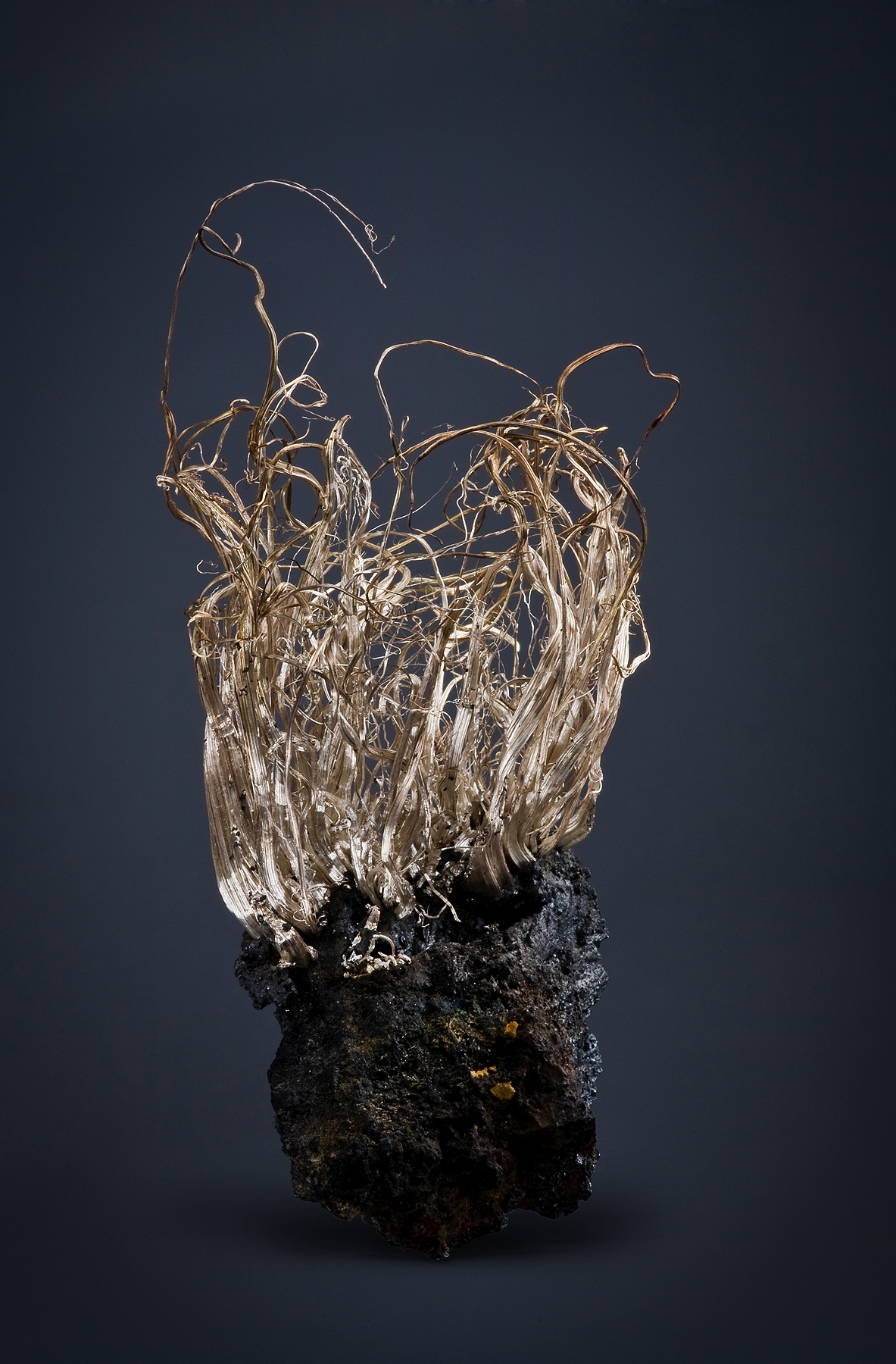
Photo: Wikimedia Commons

Photo: Wikimedia Commons
Search for specimens: View all specimens from Imiter Silver Mine, null
The Imiter mine is in the Imiter mining district of Tinghir Province, Drâa-Tafilalet Region, Morocco, on the Jbel Saghro side of the eastern Anti-Atlas. It is an active underground silver mine operated by Société Métallurgique d’Imiter, a Managem subsidiary. Managem describes the operation as an underground mine exploiting an epithermal vein deposit, worked by fully mechanized cut-and-fill stoping, with ore processed by gravimetric concentration and silver produced as high-purity metal ingots.
The deposit is controlled by the Imiter fault zone, a major Late Neoproterozoic east- to east-northeast-trending structure. The ore field is divided in the literature and mining records into sectors and structures including Imiter I, Imiter II, Imiter III, Imiter South, Puits IV and Igoudrane, with important veins and secondary structures such as F0, B3, R6 and R7. Structural studies describe pull-aparts, tension gashes, breccias, crack-and-seal openings and re-opened veins—exactly the kinds of open-space environments that can make specimen-quality crystallization possible.
The older, richer structural stage is characterized by quartz and pink dolomite veining formed during dextral transpression, with ore minerals including Ag-Hg amalgam, gray copper minerals, galena and polybasite-pearceite. A later pink-dolomite stage re-opened parts of the system under sinistral-normal movement. Subsequent alteration and dissolution created local cavities and boxwork textures and contributed to native silver enrichment. In specimen terms, this explains why Imiter pieces may be massive, brecciated and ore-rich, but also why some pockets produced free-standing acanthite groups, ruby-silver crystals, open silver wires and specimens with etched-looking carbonate relationships.
Historically, silver activity in the Imiter district is documented back to the Almohad period in the 12th century. Modern rediscovery came in 1951 during aerial prospecting by Morocco’s national exploration organization, then known as BRPM. Société Métallurgique d’Imiter was created in 1969 by BRPM and ONA to exploit the silver-bearing dumps at the site; published accounts describe those old tailings as a major resource in their own right. Underground mining began in 1978 and has continued through successive expansions, new shaft work, plant upgrades and additional reserve discoveries. Managem’s company history records key stages: expansion of annual capacity from 25 tonnes of silver metal to 120 tonnes in the 1980s, discovery of Imiter II in 1995, acquisition of Igoudrane in 1998, commissioning of a central shaft in 2002, discovery of 453 tonnes of silver reserves at Imiter South in 2005, more than 700 tonnes of additional reserves in 2007, and further plant expansions through the 2010s.
For collectors, the most important modern specimen period begins around 2000 and accelerates in 2005. The 2005 acanthite find placed several hundred sharp, mostly freestanding or matrix-light acanthite specimens on the international market, from small thumbnails to medium cabinet pieces, with crystals reportedly reaching more than 3 cm on edge. Later, around 2019, particularly striking proustite-silver-acanthite combinations appeared, including vug specimens with transparent red proustite crystals coating hooked native silver wires and associated with white quartz and octahedral acanthite. Imiter silvers from around the same broad modern period range from older laminar and leaf-like forms to dramatic wire sprays and arborescent groups.
Collecting access today should be understood practically: Imiter is an active industrial mine, not an open collecting locality. Serious specimens reach the market through mine-related channels, Moroccan mineral networks, older European collections, dealer inventories and auction dispersals. Locality labels may use older administrative terms such as Ouarzazate Province or Souss-Massa-Drâa, while current locality hierarchy normally places the mine in Tinghir Province, Drâa-Tafilalet Region. Labels may also say Imiter, Imider, Jebel Saghro, Djebel Saghro, Boumalne-Dadès or simply “Morocco,” so provenance and specimen style matter.
Imiter acanthite is the locality’s most immediately recognizable collector mineral, usually occurring as black to steel-gray pseudo-octahedral crystals after high-temperature argentite, in open clusters, toothy rows, arborescent aggregates and isolated sharp crystals; the celebrated 2005 production brought several hundred specimens to market, with sizes from small thumbnails to medium cabinet pieces and individual crystals reported to exceed 3 cm on edge, although many examples are matte to only moderately lustrous. The best pieces here are not merely “more acanthite”—they combine sharp, undamaged octahedral form, open sculptural spacing, strong metallic luster, and, on rarer matrix pieces, associations with calcite, quartz, pyrite, siderite, proustite or native silver; ordinary examples can be blocky, dull, bruised, or too massive to show the elegant thorn-like crystallization that made the 2005 Imiter find so important.
Proustite from Imiter is typically a connoisseur’s ruby-silver rather than a giant-crystal occurrence: most crystals are small, commonly a few millimeters and sometimes around 0.3–0.6 cm, though exceptional combination pieces have shown proustite crystals to about 1.2 × 1 cm; the habit is generally prismatic with acute pyramidal terminations, bright adamantine luster, and deep red to ruby-red translucency on quartz, carbonate or sulfide matrix. Its common Imiter companions include acanthite, native silver, quartz, galena, xanthoconite, imiterite, polybasite and pyrargyrite, and the pieces that stand apart are those with vivid, unfaded color, transparent crystal tips, sharp isolated crystals distributed across an attractive vuggy matrix, or the rare dramatic association of red proustite partially coating hooked native silver wires.
Native silver from Imiter ranges from laminar plates and leaf-like growths to hooks, wires, nests and branching arborescent sprays, often associated with black acanthite, calcite, quartz and Ag-Hg minerals. The most famous modern examples are bright wire-silver specimens that began appearing in quantity around the early 2000s, including rare matrix pieces where sprays of silver wires rise naturally from acanthite and are accented by calcite; older pieces from around the 1990s may show laminar silver with fresh crystalline surfaces on carbonate or rock matrix. The best Imiter silvers have balance, openness and intact wire terminations, not just metal content: many wires are fragile, many pieces are etched or trimmed, and a truly three-dimensional, undamaged specimen with black acanthite contrast or pale carbonate matrix is far scarcer than a dense tangle of loose silver.
Beyond these headline species, Imiter is important for imiterite, Ag2HgS2, a silver-mercury sulfide named for the mine and described from the locality; it occurs as crystals to about 1 cm and anhedral grains, with documented associations including chalcopyrite, sphalerite, acanthite, polybasite, galena and arsenopyrite. The broader documented assemblage also includes Ag-Hg amalgam, freibergite and other tetrahedrite-tennantite group minerals, polybasite, pearceite, pyrargyrite, xanthoconite, fettelites, galena, sphalerite, chalcopyrite, arsenopyrite, pyrite, pyrrhotite, quartz, calcite, dolomite, siderite and fluorite. For advanced collectors, the rarities are not decorative afterthoughts; they record the unusual Ag-Hg-As-Sb chemistry that makes Imiter mineralogically distinct from most other modern silver mines.
Imiter specimens require more scrutiny than casual “Moroccan silver” labels suggest. A reliable label should distinguish the mine from the broader Imiter district and from other Moroccan silver localities such as Bou Azzer and Bouismas, where superficially similar silver-bearing alloys, dyscrasite-like forms, allargentum and other metallic species may occur. Older labels may legitimately use Ouarzazate Province or Souss-Massa-Drâa, but a vague “Atlas Mountains, Morocco” label is weak provenance for a serious Imiter specimen unless the mineral style and chain of custody are convincing.
The most persistent identification problem is metallic silver versus dark silver sulfides and silver alloys. Acanthite can be so metallic that small crystals are mistaken for native silver, while some Imiter “silver” specimens may include Ag-Hg amalgam or kongsbergite-like silver rather than pure native silver throughout. Fabre Minerals noted older Imiter silver specimens whose good preservation argued against significant interstitial mercury, precisely because many Imiter silvers are associated with mercury-bearing phases. When buying important native silver, especially expensive wire specimens, favor pieces with a clear provenance, expert identification, and, when necessary, analytical support.
Preparation is another issue. Silver wires and leafs are commonly exposed from carbonate by acid preparation, and some Imiter pieces sit in or on calcite that has been partly removed or etched. Acid preparation is not automatically fraudulent; it can be a legitimate way to reveal silver that grew inside carbonate. The problem is disclosure and quality. Over-etched pieces may have unnatural-looking matte carbonate, unsupported wire tangles, loosened attachments or “floating” silver with little geological context. On the other hand, a natural matrix association with acanthite, quartz, calcite or dolomite can add both beauty and confidence.
Proustite is light sensitive. Imiter examples owe much of their value to intense red color, translucency and luster, so they should be displayed conservatively: low light, no direct sun, no long-term hot case lighting, and careful storage when not being shown. A faded proustite may still be genuine, but it loses much of the visual power that makes the best Imiter ruby-silvers desirable.
Acanthite is soft and easily bruised. Sharp pseudo-octahedral crystals are the value driver, so inspect edges and terminations carefully under magnification. Many Imiter acanthites are naturally dull or satiny; the premium attaches to pieces that are both sharp and lustrous, a combination that is not the norm. Freestanding clusters are especially vulnerable to repaired points, rubbed high spots and old handling wear.
Native silver wires are among the most fragile Imiter specimens. They bend, catch fibers, snag on packing, and tarnish. Do not clean them aggressively. Avoid sulfurous storage materials, damp display environments, rubber bands, some foams and cardboard with sulfur-bearing components. A slight natural patina can be attractive and stabilizing; an over-bright, stripped surface is not always an improvement.
Market availability is good but uneven. Imiter is not a vanished 19th-century locality, and acanthite, proustite and silver still circulate through dealers and older collections. However, the best 2005 acanthites, rare matrix wire silvers, and high-color proustite-silver combinations are already recognized classics. Ordinary small acanthites and modest proustites can still be obtainable; elite pieces with aesthetics, condition, provenance and unusual associations trade in a much thinner market.
The modern collector story of Imiter has one unmistakable turning point: 2005. A few small and uninspiring lots had already reached the Sainte-Marie-aux-Mines and Munich shows in 2004, enough to alert the specialist community that something was happening in Morocco. Then, between January and June 2005, several hundred acanthite specimens were reportedly found in the mine and held back in Europe. When they finally appeared at the Denver show, they did not trickle out quietly. They arrived through several major dealers, including Dave Bunk, Jordi Fabre, Horst Burkard, Rob Lavinsky and Doug Wallace, with Brad and Star van Scriver of Heliodor reportedly having about a hundred examples. For collectors accustomed to historic European, Mexican and American acanthite, it was a shock: a new Moroccan locality had produced open, sharp, pseudo-octahedral clusters from thumbnail to medium-cabinet size, with crystals reaching more than 3 cm on edge.
The same 2005 account catches the little irony of Imiter acanthite perfectly. Many of the crystals were not especially lustrous—some were frankly dull gray—but the form was so good that collectors had to recalibrate their eyes. These were not glittery cabinet jewels in the usual sense. They were sculptural silver sulfide: open clusters, single bulging octahedrons, rows of two to five crystals all pointing upward, and nervous dendritic forms. The best specimens had the crisp, thorny architecture implied by the name acanthite itself. Even buyers who normally resisted gray metallic minerals found themselves comparing silhouettes and choosing personalities.
A few years later, another Imiter story was being told in the language of silver wires. One widely illustrated small-cabinet specimen, photographed by Rob Lavinsky and nicknamed the “haircut,” came from a 2008 find and measured 7.3 × 4.2 × 3 cm. The nickname was not a flourish: the specimen shows a thick nest of bright silver wires shooting up from black acanthite, like a wild metallic shock of hair. What made it unforgettable was not simply the amount of silver but the contrast—bright metal rising from a dark sulfide base, with little curlicues at the foot of the wires. That is the kind of specimen that made Imiter silvers feel contemporary and classic at the same time.
Another specimen history reads like a miniature travelogue of the mineral trade. Around 2000, Imiter began producing impressive silver specimens “on a scale and quantity” that collectors had not previously associated with Morocco. A large matrix silver with acanthite and calcite, 9.6 × 8.2 × 4.7 cm, was acquired in Morocco by Paul Stahl while he was traveling as an agent to acquire acanthite for Erika Pohl. Stahl kept it in his own collection, later sold it to collector Gabriel Risse, and it eventually reappeared as a documented high-level specimen. Its importance lay in balance: an organic spray of silver wires rising from acanthite, calcite accents still present, and a complete 360-degree composition rather than the more common loose tangle of wire silver.
The 2019 proustite-silver-acanthite combination pieces added a different kind of drama. One standout specimen measured 17.3 × 8.5 × 6.7 cm, with proustite crystals to 1.2 × 1 cm. The description is memorable because it is so unlike the standard mental image of Imiter as gray acanthite and silver: sharp transparent red proustite crystals partially covered hooked silver wires, with white quartz and small octahedral acanthite on matrix. The specimen was published as a new discovery in Mineral Up in 2020. In one object, Imiter’s chemistry became visible—native Ag, Ag2S, Ag3AsS3 and quartz arranged not as a textbook paragenesis, but as a specimen with color, architecture and tension.








