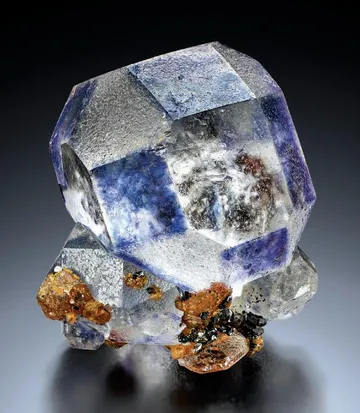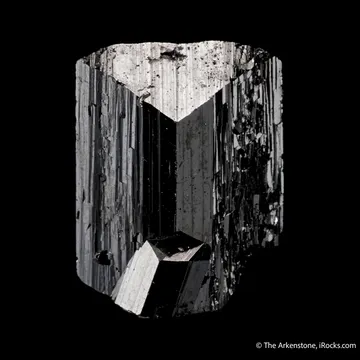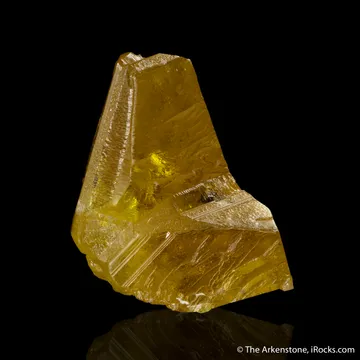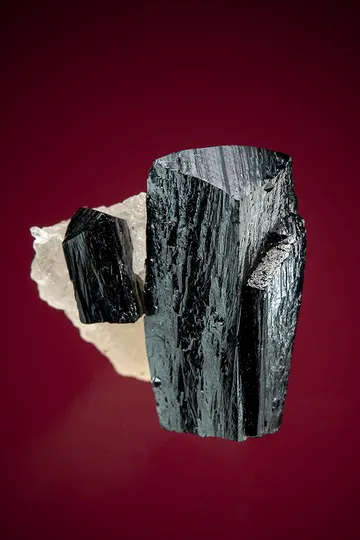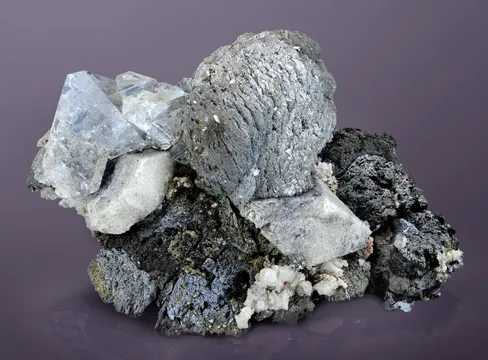
イルヴァイト - 内モンゴル省黄港鉱山の黒曜の多面体結晶、現代の主要なスカルン源の1つ。石英との劇的な対比が特徴で、最大20 cm。
Key facts
黄岗はイルヴァイトが何になりえたかというコレクターの視点を変えた。内モンゴル産の素材が国際市場に到達する前、重要でしばしば優雅だがサイズが小さめ、あるいは視覚的に控えめなものでした。イルヴァイトを大胆な語彙で表現するようになったのは黄岗の素材です—厚く、鉄黒から黒鉄色のプリズム、ブロック状の終端、段階的で筋状の面、強い光下で半金属光沢からほぼ鏡光の輝きを放つ光沢。最良の作品では暗い結晶が淡い石英や方解石に対して際立ち、部屋の中で一目で認識できる清潔なグラフィック対比を作り出します。

この鉱床はHexigten Banner, Chifeng, 内モンゴルの主要なFe-Snスカルン系統であり、花崗岩質の侵入体が炭酸塩に富むペルム紀 rock と反応して発展しました。その環境はイルヴァイトが繁栄する铁・钙・珪素を含む条件にまさに適しています。黄岗のコレクター標本は孤立した Pocket System からの珍品ではなく、鉱物地質学的に複雑な大規模な鉱区の副産物であり、卓越した石英、蛍石、方解石、磁鉄鉱、'])) arsenopyrite、hedenbergite または hedenbergite に類似する角閃石、ヘルヴァイン群の鉱物、スキャーネイト、ホザト、他のスカルン種も生産しています。
最初の優品黄岗イルヴァイトは2010年頃にコレクター市場に現れ、 locality は現代の偉大なイルヴァイト源の一つとして rapidly 認識されました。Mindat は結晶を約20 cm まで記録しており、展示品質のイルヴァイトとしては驚異的な大きさです。ディーラーとコレクターはまたすぐに黄岗の個体が大きく異なることを学びました:単一の厚いプリズムもあれば、平行または放射状の結晶の集塊、二重終端、部分的に自立したものもあります。最も美的な例は艶黒のイルヴァイトと対照的な石英、方解石、または緑がかったスカルン鉱物を組み合わせています。
コレクターが黄岗イルヴァイトを特に評価する三つの品質は、サイズ、光沢、彫刻的な形状です。トップ標本は端がシャープで、三次元的な構造が強く、プリズムのエッジには傷みが最小で、関連鉱物や開放空間からのコントラストが十分にあって黒色結晶がはっきりと読み取れるべきです。イルヴァイトは暗く反射性が高いため、表面の質感も重要です。鈍い、刻まれた、または傷んだ結晶は重々しく見えることがあり、一方で鋭く光沢のあるものはほぼ金属的で建築的に感じられます。## Featured Specimens
Search for specimens: View all ilvaite specimens from Huanggang Mine, Inner Mongolia, China
Huanggang, also widely seen in the mineral trade as Huanggangliang Mine or simply Huanggang Mine, is in Hexigten Banner, Chifeng City, Inner Mongolia, China. Mindat places the deposit at about 43°36'37" N, 117°25'37" E and lists the locality as a deposit rather than a single small mine. The Chinese locality name is associated with 黄岗锡铁矿床 / 黄岗梁锡铁矿床, reflecting the tin-iron character of the ore system.
Geologically, Huanggang is a skarn-type tin-iron deposit in the southern Great Xing’an, or Greater Khingan, Range. The ore and skarn developed along contact zones between granitoid intrusions and carbonate rocks of the Early Permian Dashizhai and Huanggangliang formations. The district includes multiple intrusions, including the Luotuochangliang intrusion and the 204 intrusion, with skarn, magnetite, cassiterite-bearing mineralization, sulfides, quartz, calcite, fluorite, and a broad suite of calc-silicate minerals distributed through the system.
The deposit is large on a collector’s scale and on an economic-geology scale. Published descriptions divide the Huanggang area into seven mine or ore zones over a belt roughly 0.5–2.5 km wide and nearly 20 km long. The western part is described as containing several more iron-rich skarn orebodies worked by mines 1–4, while the eastern part contains a tin-rich skarn-lens belt about 6 km long, worked by mines 5–7. A recent synthesis describes 185 discovered orebodies divided into seven ore zones, with individual orebodies ranging from 10 to 1475 m in length, 2 to 118 m in thickness, and plunging to depths of as much as 500 m.
Mining for iron and tin at Huanggang was underway by the early 1990s, with one published Resource Geology paper noting exploitation by Inner Mongolia Huanggang Mining Co., Ltd. beginning in 1993 at skarn zones II and III. Fine collector specimens, however, became internationally prominent much later. The first major wave of Huanggang collector material appeared around 2010, led by ilvaite, followed by fluorite, quartz, arsenopyrite, calcite, helvine-group minerals, borates, and other skarn specimens.
The locality is a working mine complex, not a casual collecting site. Field collecting access should be regarded as restricted and dependent on mine permission, local regulations, and active industrial conditions. Most collector specimens have reached the market through miners, Chinese dealers, and international mineral dealers rather than through recreational collecting.黄岗ラベルは注目に値します。古いラベルには「包頭区(Baotou District)」と記されていることがあり、現在この材料には誤りと見なされる locality 表現です。「黄岗」「黄岗亮」「黄岗 Fe-Sn 鉱床」および番号付き鉱山ラベルは市場に現れることがあります。最も有用なラベルは、情報が信頼できる場合に鉱山番号または鉱区名を含みますが、多くの標本は正確なサブロケーション情報が広く理解される以前に流通していました。## Huanggang鉱山(内モンゴル、中国)産イルヴァイトの特徴
Huanggang産イルヴァイトは通常、黒色から非常に濃い褐黒色で、結晶面と表面保護状態により半金属光沢、樹脂状光沢、またはガラス光沢を示します。結晶は通常、柱状から塊状で、一般に条痕があり、階段状成長、割れ・弱割れ終端部、平行または放射状の集合体を示すことがあります。いくつかの結晶は孤立した塊状プリズムであり、他は丘状の簇、V字状の散布、または結晶の輪郭を明確に保つ相互結晶の塊を形成します。
古典的なHuanggangの外観は、淡色の石英を伴う黒いイルヴァイト結晶またはクラスターです。石英は乳白色、燻蒸色、灰色がかった色、緑がかった色、あるいは瑪瑙風のクリスタルとして現れ、イルヴァイトの終端部全体、プリズム面に沿って付着、またはイルヴァイトの隣に対照として配置されることがあります。石灰石は別の重要な関連鉱物で、白色の菱形被膜から大きな淡色結晶まで幅があります。ヘデンベンガイト似の暗緑色から茶褐色のスカーン材料もHuanggangイルヴァイトの市場説明で一般的ですが、鉱床から販売されるヘデンベンガイトとしての標本のいくつかは分析によって角閃石であることが示されているため、試験なしに関連付けを仮定してはいけません。
典型的なコレクター品は、光沢のある結晶を1つ持つサムネイル〜ミニチュアの小品から、複数のプリズムを含むキャビネットサイズの群晶まで様々です。公刊物および取引記録には、標準的なイルヴァイトよりもはるかに大きい結晶が報告されており、7〜10 cm級の個体や、約20 cmまでとされる特筆すべき結晶も含まれます。10 cmのHuanggangイルヴァイト群晶は、最近の顕著な収蔵としてフェルスマン鉱物学博物館のコレクションに入り、終端が弱く割れた結晶の簇として記述されました。
Huanggang Fe-Sn鉱床で報告された共生種には、磁鉄鉱、錫石、酸化鉄系鉱物、針鉄鉱、蛍石、石英、方解石、重晶石、陽極鉄鉱、黄鉄鉱、磁黄鉄鉱、輝水鉛鉱、方鉛鉱、黄鉄鉱、モリブデン硫化物、スケイライト、榴輝石、ガーネット、輝閃石、エピドート、ベスベリアン石、デートライト、ヘルヴァイン、ジェンテルヴィット、ヘデンベンガイト、角閃石群鉱物、ホウ酸塩種などです。イルヴァイトコレクターにとって、最も視覚的に重要な共生は石英、方解石、蛍石、陽極鉄鉱、磁鉄鉱、および暗緑色スカーン系ケイ酸塩です。
品質は結晶の完全性から始まります。最高のHuanggangイルヴァイトは終端が完全で、縁が鋭く、損傷が最小限です。光沢が決定的で、明るく光沢のある結晶は、大きくて鈍いまたは細かい表面処理のものよりもはるかに望ましいことがあります。次に形状です。自立するプリズム、放射状の簇、イルヴァイト-石英の組成が均整のとれたものは、塊状または混み合った集合体よりも一般に望ましいです。対比も重要です。イルヴァイトは黒色であるため、最良の品は結晶を包むのではなく、淡色の石英、方解石、あるいはオープンマトリクスを用いて結晶を引き立てます。表面の質感は大きく異なります。いくつかの結晶は鏡面のような面を持ち、階段状の、繊維状の、または刺状の成長を示すものもあります。ほかのものはエッチングされているか、わずかにマットです。これは自動的に欠陥というわけではありません—黄岡イルヴァ石には自然に複雑な表面があることがありますが、コレクターは採掘後の擦傷、断裂した端部、縁の摩耗と自然の成長表面とを区別するべきです。## Collector Notes
Huanggang ilvaite is common enough in today’s market that a collector can usually find an example, but truly fine specimens remain scarce. The mine produced enough material to establish a recognizable “modern classic” style, yet top cabinet pieces with strong luster, intact terminations, and aesthetic quartz or calcite association are much less abundant than ordinary single crystals or damaged clusters.
The main authenticity issue is not artificial treatment so much as labeling and association. Huanggang material has been mislabeled historically as “Baotou District,” and the name “Huanggang Mine” is often used broadly for a multi-mine Fe-Sn deposit rather than for a precisely documented sublocality. If a specimen is sold as No. 1, No. 2, No. 4, or another specific mine, the label is only as good as its chain of custody. Older pieces may also carry generalized “Inner Mongolia” labels because the locality was poorly understood when the first specimens appeared on the market.
There are also mineral-identification traps around Huanggang skarn specimens. Mindat notes that some specimens sold as hedenbergite from the deposit proved analytically to be amphiboles, and that some datolite sold as Huanggang material may actually come from a mine near Linxi. For an ilvaite specimen, the black ilvaite itself is usually visually distinctive, but the associated “hedenbergite,” “andradite,” “genthelvite,” “helvine,” or “datolite” should be treated carefully if the association adds significant value.
Condition is the most important buying discipline. Ilvaite is not especially fragile compared with very soft or fibrous minerals, but large Huanggang crystals often have exposed corners, splintery prism edges, and complex terminations that chip easily during mining, trimming, washing, and shipping. Check the termination under magnification, then examine the long prism edges for fresh gray chips. On clusters, look into the recesses: broken stubs may be hidden by dark color and complex growth. Quartz on ilvaite terminations can also disguise small contact points, so evaluate whether the quartz is natural overgrowth, natural etching, or damage.
Some Huanggang ilvaite has natural matte or etched areas, and not every dull patch is damage. A fair evaluation asks whether the surface is consistent across crystal growth features or whether it interrupts edges and terminations in a way that suggests abrasion. For display, the highest premium goes to specimens that are naturally complex but visually clean: glossy black crystals, undamaged terminations, good contrast, and a composition that stands without awkward trimming.市場の供給は健全なままです。小さな単晶やミニチュアは比較的手頃ですが、優れたマトリックスミニチュアや小型キャビネット標本は価格が急速に上昇します。複数の光沢があり傷のない結晶と魅力的な石英や方解石を備えた大型キャビネット標本は現代の定番であり、古い産地のより一般的な_ilvaite_ とは異なり、最大の黄崗( Huanggang )の例と比較して評価されるべきです。## Stories & Field Notes
2011年6月、ディーラーでありコレクターのジョン・チェンは、6月6日から17日までの日程で中国 minerals グループと共に黃岡を訪れました。その瞬間、当地はコレクターの間でまだ新鮮な話題であり、チェンは黃岡が2010年頃には良好な標本産地として認識されており、まずイリサイトが現れ、その後すぐに他の種が連続して現れたと記しています—透明な正八面体の蛍石、ピンクまたは赤色蛍石を伴う砒亜砷鉱、石英、ヘデンベル石、黄鉄鉱、緑簾石、海水晶、そしてピンク色の方解石。
彼が描写した情景は、一つのロマンチックな鉱脈ではなく、急速に展開する鉱山地区でした。正確な産地として黄岡鉱山、克什克腾旗、 チフン市、内モンゴル自治区を挙げ、約8つの採掘地区に言及しました。初期の現地分解は、旧ラベルを読む収集家にとって今なお有用です:No.1地区はヘデンベル石、ガーネット、石英、イリサイト、蛍石と関連、No.2地区は砒亜砷鉱、ヘデンベル石、イリサイト、No.5地区は方解石と蛍石と関連します。表現には、まだリアルタイムで解読が進む locality の興奮があり、種が「現れる」量、情報がまだ不完全である感覚、黄岡が突然「中国 Minerals キャリアにとって別の良い産地」になったとの感覚が伝わります。
その初期の混乱は、多くの古いラベルを説明します。黄岡は完成されたモノグラフと整った鉱山地図を通じて市場に紹介されたのではなく、標本を通じて到来しました。イリサイトは先駆的な種であり、西洋のコレクターの注意を引く黒い結晶でした。その後で初めて、蛍石、プリセ様の石英、方解石、砒亜砷鉱、ヘルヴァイン族鉱物、ボロ石、そして異例のスカルン共生などが全体像を結びつけ、地区のより広い同一性が浮かび上がりました。## 鉱物学的記録と出版物- Berthold Ottens and Günther Neumeier, “The Huanggang mine, Inner Mongolia, China,” The Mineralogical Record, 43(5), 529–563, 2012. 地域に関するコレクター志向の代表的な論文で、再訪問を重ねたうえで鉱山複合体と標本鉱物に焦点を当てている。
ResearchGate record for Ottens and Neumeier, “The Huanggang mine, Inner Mongolia, China,” The Mineralogical Record, 43(5), 529–563, 2012. 2010年にコレクター市場へ初めて現れた高品質の Huanggang ilvaite を示す有用な要約。
Li Juan Wang, Hidehiko Shimazaki, and Yoshihide Shiga, “Skarns and Genesis of the Huanggang Fe-Sn Deposit, Inner Mongolia, China,” Resource Geology, 51(4), 359–376, 2001. スカーン区帯、鉱石鉱体、花崗岩侵入、および鉱床の生成に関する基礎的な経済地質学論文。
Open repository record and PDF for Wang, Shimazaki, and Shiga, 2001. 同じ Resource Geology 研究のリポジトリアクセス、完全な PDF 記録を含む。
Wei Mei et al., “Ore genesis and hydrothermal evolution of the Huanggang skarn iron–tin polymetallic deposit, southern Great Xing’an Range: Evidence from fluid inclusions and isotope analyses,” Ore Geology Reviews, 64, 239–252, 2015. 開放アクセスの研究で、スカーン、酸化物および硫化物段階と鉱石形成流体の進化を記述。
Hanwen Xue et al., “Ore Genesis of the Huanggang Iron-Tin-Polymetallic Deposit, Inner Mongolia: Constraints from Fluid Inclusions, H–O–C Isotopes, and U-Pb Dating of Garnet and Zircon,” Minerals, 15(5), 518, 2025. 地球年代学、流体包有物データ、鉱化段階、鉱区情報を統合した最近の総説。
D. I. Belakovskiy et al., “New acquisitions to Fersman Mineralogical Museum in 2011–2012,” New Data on Minerals, 48, 2013. Huanggang ilvaite の結晶が約 10 cm で弱分離したクラスターとして寄贈された記録、D. I. Belakovskiy、Fersman Mineralogical Museum No. 93759。
Mindat reference page for Ottens and Neumeier, 2012. Mineralogical Record 論文と Huanggang No. 1 鉱山の鉱物エントリ(ilvaite、 quartz、 calcite、 fluorite、 magnetite、 hedenbergite、 helvine、 arsenopyrite、 garnet など)を結びつける。
Mindat entry for ilvaite from No. 1 Mine, Huanggang Fe-Sn deposit. No. 1 鉱山サブローカリティにおける ilvaite の特定の出現ページ。
Mindat entry for ilvaite from No. 2 Mine, Huanggang Fe-Sn deposit. No. 2 鉱山の出現ページ。e for ilvaite at the No. 2 Mine sublocality.## さらなる読み物と外部リンク
Mindat: Huanggang Fe-Sn deposit, Hexigten Banner, Chifeng City, Inner Mongolia, China — 座標、別名、鉱物リスト、鉱山区分、ラベリング問題に関する最高のオンラインの単一ローカリティ参照。
John Chen, “China Minerals trip: HuangGang mine, Keshiketeng Qi, ChiFeng, Inner Mongolia, 2011” — 2011年6月の訪問時の初期現地ノート。標本市場へのローカリティの入り方を理解するのに有用。
Marin Mineral Company: Ilvaite from Huanggang Mine, Inner Mongolia, China — Huanggang ilvaite の艶のある黒色、ブロック状スタイルを示すディーラー標本ページ。
Mindat specimen UJF-VMD: Ilvaite, Quartz from Huanggang — 寸法と記述ノートを含む大きな ilvaite-つき quartz 標本記録。
Fabre/Mindat specimen R4A-914: Quartz var. prase with ilvaite, found in 2012 — Huanggang の緑色石英と黒雲母鉄鉱の組成の古典的関係の有用な記録。
FossilEra: 1.7-inch black ilvaite crystal from Huanggang Mines — 市場文脈と典型的な小型結晶材料の入手可能性をまとめたディーラ要約。
MineralAuctions: Ilvaite with hedenbergite, ex Dr. Barratt Phillips Collection — 放射状の Huanggang ilvaite クラスターの記録と由来・状態の注記。
Khyber Minerals: Ilvaite, Huanggang Mine — 市場で大きな影響を与えた最初の Huanggang 鉱物として ilvaite を挙げたディーラーアーカイブ、2010年ミュンヘン出現。