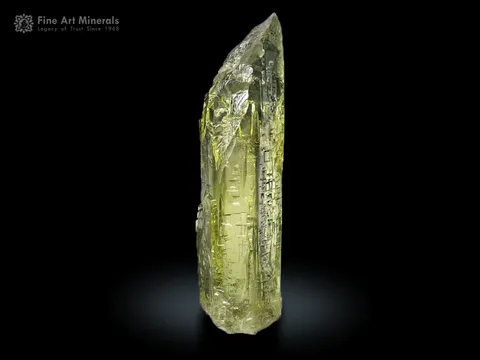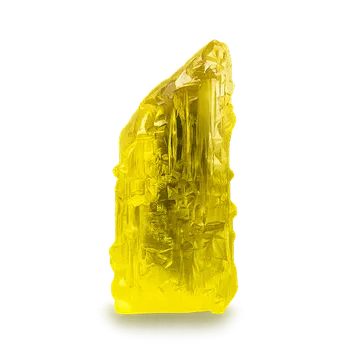
Heliodor from Khoroshiv, Ukraine — transparent yellow-green beryl with etched faces from Volyn pegmatites; famed for miarolitic pockets and collector value.
Key facts
Heliodor from Khoroshiv Raion is one of the defining gem-crystal productions of the Volyn pegmatite field, the old Volodarsk-Volynskii district of Zhytomyr Oblast. Collectors know it by a look before they read a label: transparent yellow to lime-green beryl, often with remarkably sculpted surfaces, rectangular “window” etch pits on prism faces, and complex etched terminations that can make a single crystal look carved by both chemistry and architecture.
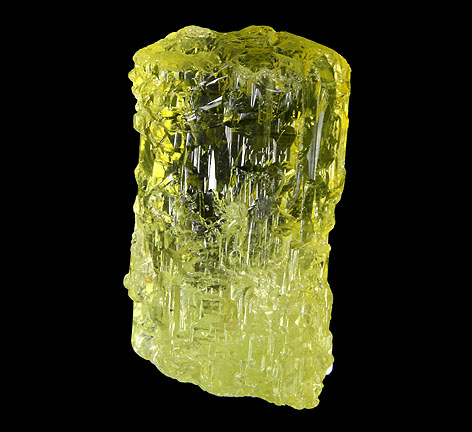
Photo: Wikimedia Commons
The locality sits in the Volyn chamber-pegmatite district near Khoroshiv, formerly Volodarsk-Volynskyi. These pegmatites are genetically tied to the Paleoproterozoic Korosten plutonic complex of the Ukrainian Shield, particularly rapakivi-like granites at the western margin of the complex. Their great collector importance comes from miarolitic “chambers”: open cavities in pegmatite bodies where quartz, topaz, beryl, albite, mica, fluorite, phenakite, and other species had room to grow as freestanding crystals.
Khoroshiv heliodor is not merely yellow beryl from a famous country. Its identity is bound to the physical history of the pockets. The beryl crystals were commonly found loose or semi-loose in clay, mica, and kaolinite-rich masses in and below the chambers rather than as tidy textbook matrix specimens. Late, fluorine-rich fluids attacked the crystals after growth, producing the locality’s hallmark etching: square to rectangular pits on prism faces and hexagonal pits on basal or pinacoidal faces. On the finest crystals these features are visible without magnification and give the surfaces a deep, patterned, almost city-block geometry.
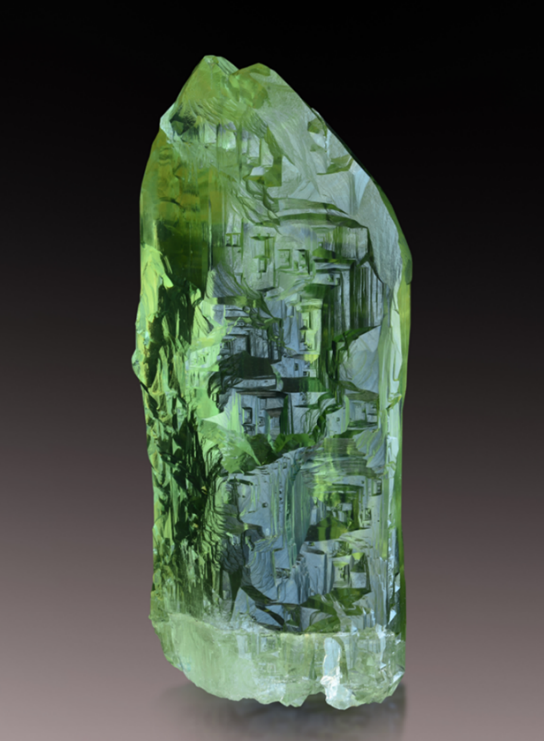
Photo: UK Mining Ventures
Historically, the district was mined for piezoelectric quartz, not for mineral specimens. For much of the Soviet period the quartz was the economic objective, and gem beryl and topaz were byproducts. The collector world came later. Volyn beryl began to reach Western European markets around 1980 and became conspicuous at Tucson by 1987. Since then, the best Khoroshiv heliodors have held a special position among European pegmatite classics: large enough to be dramatic, transparent enough to compete with gem rough, and etched enough to be instantly recognizable.
The most desirable examples combine saturated yellow, lemon, olive-yellow, or lime-green color with high transparency, strong luster, crisp prism form, and attractive natural etching rather than dull corrosion. Fine miniatures and small-cabinet crystals are especially sought after when they are complete all around. Larger crystals are prized even with repairs or contact marks if they preserve strong color and dramatic Volyn surface texture.
Search for specimens: View all heliodor specimens from Khoroshiv Raion, Ukraine
The collector locality “Khoroshiv Raion” corresponds to the historic Volodarsk-Volynskii pegmatite field in Zhytomyr Oblast, Ukraine. Administrative names have shifted, and labels may read Khoroshiv, Volodarsk-Volynskyi, Volodarsk-Volynskii, Volyn pegmatites, or simply Volyn deposit. In specimen practice these names point to the same broad chamber-pegmatite district west of the town of Khoroshiv.
The deposit type is miarolitic, rare-element granitic pegmatite: more specifically, large chamber pegmatites hosted by rapakivi-like granites of the Korosten pluton. The productive belt has been described as extending for roughly 22 km along the contact-zone setting at the western margin of the pluton. Individual pegmatite bodies may be tens of meters across, with strong zoning: graphic-textured outer zones, blocky feldspar zones, pegmatoid and microcline-rich zones, quartz cores, and cavity or chamber zones. In the Volyn style, the chamber is the mineralogical stage. Smoky to black quartz grew into open space; the floor and lower parts of the pocket collected broken quartz, feldspar, mica, albite, clay, topaz, and beryl.
Mining history begins with surface recognition of gem material and formal description of pegmatites in the nineteenth century, but serious mining did not start until 1931. The early and Soviet-period economy centered on quartz suitable for piezoelectric use, with optical fluorite and other materials also of interest. Gem minerals were long subordinate to industrial quartz. Recorded Soviet-era production included thousands of tons of quartz, with beryl and topaz recovered in much smaller but still remarkable quantities.
Beryl is a rare accessory in the field, not a common pocket mineral. Published summaries repeatedly note that only a small proportion of the mined pegmatites carried beryl; topaz-bearing pockets and beryl-bearing pockets often tended to be separate. This matters to collectors because it explains why fine Khoroshiv heliodor has always been less available than the locality’s overall fame might suggest. The deposit is known for many chamber pegmatites, but only a minority yielded the yellow-green beryl that made the field famous.
The great beryl-bearing event of the modern literature is the 1992 underground intersection of a unique beryl-bearing pegmatite at about 70 m depth. More than a ton of collectable and gem beryl was recovered from clayey and fragmental pocket material between large morion and microcline fragments and within clevelandite-albite-microcline aggregates. Such finds produced both cutting rough and specimen crystals, some transparent to semitransparent and several kilograms in weight.
Specimen mining for the collector market revived the district in the 2015–2018 period. UK Mining Ventures documented work in shallow surface pits and underground chamber pegmatites, with auger drilling used to define pegmatite bodies such as No. 206 and No. 521. In the weathered upper zones, hydraulic excavators worked through soft clay-rich material; in underground chambers, crews encountered pegmatite bodies with preserved pocket structures. As of the 2019 UKMV update, the mine was non-operational until further notice, so current supply is dominated by older production, dealer inventories, and intermittent private-collection turnover rather than steady new mining.
Collecting access should be regarded as controlled mining access, not casual field collecting. The known specimen-producing bodies are mine workings, pits, flooded pits, spoil areas, and chamber-pegmatite operations associated with industrial and specimen recovery. Labels with specific pegmatite numbers, especially No. 206, No. 521, and No. 576, are valuable when credible because they anchor a specimen to documented pockets or working areas within the broader district.
Khoroshiv heliodor is beryl, Be3Al2(Si6O18), colored in the yellow to greenish-yellow range principally by iron-related absorption. The locality’s color range is one of its pleasures: pale lemon, acid-yellow, golden yellow, yellow-green, lime-green, olive-green, and saturated brownish green all occur. Most gem-quality yellow-green material is comfortably described by collectors as heliodor, though some specimens sit on the boundary between heliodor and green beryl. The color can be strong without becoming emerald-like; true emerald color is not a recognized Volyn beryl trait, and the district is not a Ukrainian emerald locality.
The typical habit is prismatic beryl, often columnar, sometimes elongated, occasionally more tabular or obelisk-like, and commonly etched enough that the original prism is partly overprinted by dissolution sculpture. Basal pinacoids are not always simple and flat; terminations can be complex, stepped, etched, pyramidal-looking, or irregularly re-formed. Collectors should expect a tension between crystal sharpness and natural corrosion: the finest pieces preserve enough prism architecture to read as a crystal while carrying enough etch texture to read as Volyn.
The diagnostic surfaces are the core of the locality’s identity. On prism faces, etch pits are square to rectangular and may be flat-bottomed or pointed-bottomed. They can align parallel or perpendicular to the c-axis and often form repeated window-like patterns. On basal faces, etch pits may show hexagonal outlines and pointed bottoms. Some pits are large enough to see with the naked eye; smaller generations require a loupe or microscope. In high-grade examples the surface is not dullly eaten away but lustrous, transparent, and geometrically sculpted.
Size range is another strength of the locality. Published collector summaries describe typical collector and gem beryl crystals in the 3–15 cm range, with larger pieces known. Gemdat’s summary of Kievlenko’s description notes jewelry raw material commonly as 3–10 cm crystals, large transparent specimens of 4–5 kg or more, and a named crystal, “Vladimir,” measuring 16 x 18 x 55 cm and weighing 22 kg. GIA’s 2023 discussion of Volyn beryl also notes exceptionally large museum-displayed crystals and gem-quality crystals sold abroad up to 55 cm.
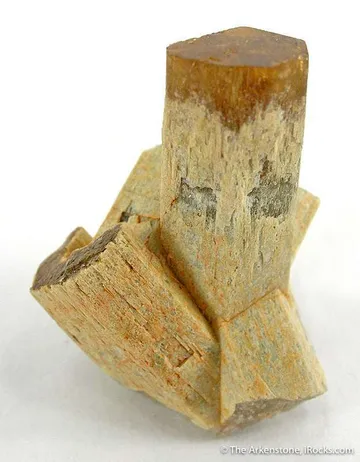
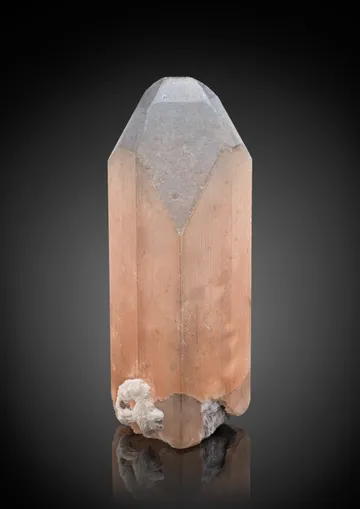
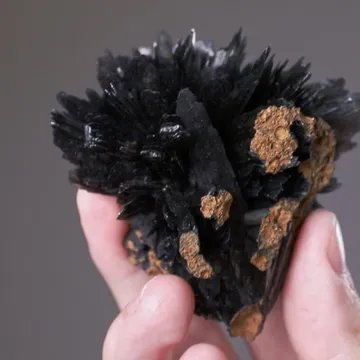
Associations reflect the chamber-pegmatite environment. Beryl may occur with or near morion quartz, smoky quartz, microcline, albite, cleavelandite, mica, kaolinite, topaz, fluorite, phenakite, siderite, and clay-mica-quartz material. Clean freestanding crystals are more common in the marketplace than matrix pieces, partly because many beryls were recovered loose from clay or fragmental chamber fill. Matrix specimens are therefore appealing when natural and well documented, but the classic look is a single gemmy etched crystal.
Quality factors are unusually locality-specific. For a Khoroshiv heliodor, the most important attributes are transparency, brightness of color, luster, completeness, termination quality, and the beauty of the etching. A glassy lemon-yellow or lime-green crystal with crisp, patterned etch windows will generally outrank a larger but cloudy or bruised piece. Complete floaters and doubly terminated crystals are especially desirable. Heavy clay staining can sometimes be cleaned, but dulled faces, internal bruising, cleaved ends, and missing prism sections reduce the appeal unless the specimen is very large or historically important.
Khoroshiv heliodor is a classic locality where the surface is part of the authentication. A strong Volyn attribution is supported by the combination of yellow to greenish-yellow beryl, prismatic habit, large and repeated rectangular prism-face etch pits, hexagonal basal etching where present, and a history tied to the Volyn chamber pegmatites. Color alone is not enough. Yellow beryl occurs from many localities, and yellow color in beryl can be influenced or produced by irradiation in some material. For Volyn specimens, the best protection is a credible old label, documented mine-era provenance, or morphology consistent with the published diagnostic etch-pit work.
The locality is not chiefly a “fake crystal” problem in the way some gem localities are; the more realistic concerns are misattribution, color enhancement, overcleaning, undisclosed repairs, and confused naming. Labels may use heliodor, green beryl, yellow beryl, aquamarine, Volyn beryl, Volodarsk-Volynskii, Khoroshiv, or Zhytomyr. Some greenish-yellow examples are marketed as heliodor even when the hue leans strongly green. Conversely, unusually green photos may exaggerate color; reputable descriptions should distinguish lime-green or yellow-green beryl from true emerald.
Condition requires close inspection. Many crystals were recovered from clay-rich, fragmental chamber fill, where contact with quartz, feldspar, and broken pocket debris could bruise edges. Common issues include cleaved or contacted bases, missing prism sections, small edge chips, internal veils, clay-filled pits, iron or clay staining, and naturally etched areas that may be mistaken for damage. Natural etching should show coherent crystallographic patterning and luster; random abrasion, matte grinding, or fresh conchoidal bruises are a different matter.
Cleaning can improve these specimens, but aggressive cleaning can harm their charm. Clay in etch pits is normal for the locality. Removing it mechanically from deep rectangular pits can leave scratches or a falsely harsh appearance. A fully cleaned crystal should still show natural luster, not a frosted or acid-burned surface.
Rarity varies dramatically by size and quality. Small loose crystals and partial etched pieces are obtainable. Fine miniatures with complete form, strong color, and glassy transparency are much scarcer. Cabinet-size crystals with good aesthetics, especially over 10 cm, are important specimens. Large, clean, richly colored, well-terminated crystals from documented pegmatites such as No. 206 or No. 521 are elite Volyn pieces and trade accordingly.
Market availability has improved in waves rather than continuously. Soviet-era and early post-Soviet material entered Western collections from the 1980s onward. The 2015–2018 specimen-mining period brought a documented modern pulse, including crystals from Pegmatites No. 206 and No. 521. GIA’s 2024 Tucson report shows that Volyn heliodor and topaz remained visible and desirable in the gem trade, including large faceted stones cut to preserve natural etched surfaces. For mineral collectors, however, top specimen crystals remain intermittent; many of the best pieces are already in long-term private or institutional collections.
The first story of Volyn gem beryl is almost absurdly pastoral. Farmers working fields near Volodarsk-Volynskii turned up fine crystallized material with the plough, yet for years the finds were not taken as evidence of a local gemstone district. The explanation offered was glacial transport: exotic crystals must have ridden south from Scandinavia during the Ice Age. Only later did the pegmatite bodies themselves become the focus, formally described in 1851 and then seriously mined beginning in 1931. The field that would later become famous for immense chamber pockets first announced itself as improbable stones in cultivated ground.
During the Soviet mining period, the treasure was not heliodor but quartz. The mine worked the Volyn deposit for piezoelectric quartz, the industrial material that produces an electric charge under pressure and once mattered enormously for instruments and electronics. UK Mining Ventures records 5,200 tons of quartz mined from 1944 to 1993, of which 119 tons was piezo quartz. In the same period, 22 tons of topaz and 4 tons of beryl were recorded. To a collector, the painful detail is that gem material was often discarded on waste heaps because the economic target was quartz. Crystals that would now stop traffic in a show case could once be secondary rubble beside the actual Soviet commodity.
The 1992 beryl pocket has become one of the key modern episodes. Underground workings intersected a beryl-bearing pegmatite at roughly 70 m depth, and the yield was not a handful of crystals but more than a ton of collectible and gem beryl. The beryls were not neatly perched on matrix. They lay in clayey, fragmented pocket fill, in spaces between large pieces of morion and microcline, and in clevelandite-albite-microcline aggregates. It is a perfect Volyn image: giant dark quartz and pale feldspar broken in a chamber, soft clay holding yellow-green beryl like relics in sediment, and miners separating gem crystals from a geological collapse.
The modern specimen-mining years brought a different kind of field scene. In 2015, operations aimed at the collector market began after auger drilling and sampling delineated 12 principal orebodies. By 2017, drilling at Pegmatite No. 206 and work at Pegmatite No. 521 were being photographed and described for collectors. Some of the work took place in the weathered upper zones, where the pegmatite had become soft, clay-rich, and workable by hydraulic excavators. The images are not romantic in the old hard-rock sense; they show pale, sticky, broken ground, pits, clay, drill cores, and people grinning over gem crystals that had come from material looking more like a construction site than a jewel box.
One EarthWonders-documented specimen collected by Martin Števko captures the feel of those workings: shallow surface pits and underground chamber pegmatites, several excavators in the open pits, highly weathered pegmatite held together by kaolinite, and pit floors that could become muddy white quagmires. Out of that unpromising ground came clean heliodor crystals large enough to sit as cabinet specimens. It is one of the great lessons of Volyn: the crystal may be glass-clear and sunlit, but the work that finds it is often white mud, clay, and patience.
Pegmatite No. 206 has its own small 2017 mythology. Mindat and marketplace records show Martin Števko documenting freshly discovered heliodor crystals there in July, August, and September of that year. One 4.2 cm sharp, gemmy crystal with a complex termination was self-collected in September 2017 from the western part of the pegmatite, from a very small pocket that contained only that crystal. Another elongated sharp crystal from August 2017 came from a small pocket that contained several attractive crystals; it was singled out as the most elongated one. These are not giant-production anecdotes, but they matter because they tie individual specimens to exact moments, pocket scale, and a named pegmatite body.
The UKMV photographic archive turns the 2017 field season into a cast of characters. Ian Bruce appears beside a freshly discovered large beryl in shallow surface workings, looking pleased with “a good day’s work.” Diana Bruce is shown helping dig a large beryl from enveloping clay. Ian Bruce and Martin Števko hold a freshly extracted beryl crystal together. Diana is photographed holding a giant beryl. Brian Swoboda appears in a memorable field-photo caption, “about to be pounded with giant Beryl crystals,” with the caption joking, “Don’t panic Brian, don’t panic!” This is how modern mineral history often survives: not only as weights, depths, and pegmatite numbers, but as wet boots, clay-covered hands, and the private comedy of people who know they have just found something exceptional.
Gerhard Franz, Oleksii A. Vyshnevskyi, Volodymyr M. Khomenko, Peter Lyckberg, and Ulrich Gernert, “Etch Pits in Heliodor and Green Beryl from the Volyn Pegmatites, Northwest Ukraine: A Diagnostic Feature,” Gems & Gemology, Fall 2023 — The key modern paper for recognizing Volyn heliodor by its etched morphology; includes SEM observations, gemological properties, geological setting, and discussion of fluorine-rich late-stage fluids.
Peter Lyckberg, Vsevolod Chornousenko, and Wendell E. Wilson, “Famous mineral localities: Volodarsk-Volynski, Zhitomir Oblast, Ukraine,” The Mineralogical Record, 40(6), 473–506, 2009 — The major collector-locality treatment, covering mining history, chamber pegmatites, important pegmatites, and fine specimens.
Leonid Shumlyanskyy, Gerhard Franz, Sarah Glynn, Oleksandr Mytrokhyn, Dmytro Voznyak, and Olena Bilan, “Geochronology of granites of the western Korosten AMCG complex (Ukrainian Shield): implications for the emplacement history and origin of miarolitic pegmatites,” European Journal of Mineralogy, 33, 703–716, 2021 — Geological and geochronological framework for the Korosten complex and the origin of the Volyn chamber pegmatites.
Gerhard Franz et al., “40Ar/39Ar dating of a hydrothermal pegmatitic buddingtonite–muscovite assemblage from Volyn, Ukraine,” European Journal of Mineralogy, 34, 7–18, 2022 — Useful for understanding late hydrothermal alteration and replacement assemblages in the Volyn pegmatites.
A.N. Platonov, V.M. Khomenko, and M.N. Taran, “Crystal chemistry, optical spectra and color of beryl. I. Heliodor and golden beryl — two varieties of natural yellow beryl,” Mineralogical Journal, 38(2), 3–14, 2016 — Important spectroscopy reference for yellow beryl color mechanisms and the distinction between heliodor and golden beryl.
Gemdat locality summary for Khoroshiv Raion, citing E.Ya. Kievlenko, Geology of Gems, 2003 — Concise locality summary with production notes, crystal-size ranges, and the named “Vladimir” beryl crystal measuring 16 x 18 x 55 cm and weighing 22 kg.
Museum record: The Museum of Precious and Decorative Stones in Khoroshiv is cited in the GIA 2023 article as displaying the finest Volyn beryl specimens with color between green and yellow, including very large examples; the article also identifies the 2.683 kg, 18 x 10 x 9 cm deep green crystal named “Professor Pavlyshyn” as a museum specimen.
UK Mining Ventures — “Volodarsk-Volynskii Mine, Ukraine” — A richly illustrated mine page with photographic archives from 2015–2018, including heliodor specimens, etched-surface closeups, shallow surface workings, auger drilling, and field recovery scenes.
GIA Gem News International — “Ukrainian Pegmatitic Heliodor and Topaz,” Jennifer Stone-Sundberg and Wim Vertriest, 2024 — Market-facing media coverage from Tucson showing large faceted Volyn heliodor and topaz cut to preserve natural etched surfaces.
Wikimedia Commons — “Beryl-250336.jpg” — Freely licensed photo of a classic greenish-yellow heliodor beryl crystal from Volodarsk-Volynskii, ex Richard Kosnar Collection, credited to Rob Lavinsky/iRocks.com.
Mindat — Heliodor from Khoroshiv Raion — Core occurrence page with photo galleries, associated minerals from photo data, and locality hierarchy.
Mindat — Heliodor from the Volyn Pegmatites — Pegmatite-field occurrence page with references to the Korosten geochronology work and Volyn pegmatite literature.
Gemdat — Khoroshiv Raion gemstone locality — Useful compact summary of gem beryl, topaz, morion pegmatites, crystal-size ranges, and the “Vladimir” beryl.
GIA — Etch Pits in Heliodor and Green Beryl from the Volyn Pegmatites — Best single scientific resource for diagnostic morphology, color, inclusions, geology, and locality recognition.
GIA — Ukrainian Pegmatitic Heliodor and Topaz — Short but valuable 2024 market report on Volyn heliodor and topaz in Tucson.
UK Mining Ventures — Volodarsk-Volynskii Mine — Detailed collector-oriented account of the deposit, mine history, specimen-mining period, and photographic archives.
ResearchGate — Lyckberg, Chornousenko, and Wilson, Mineralogical Record 2009 Volodarsk-Volynski Chamber Pegmatites — Access point for the landmark Mineralogical Record locality article.
European Journal of Mineralogy / OUCI — Shumlyanskyy et al. 2021 Korosten AMCG geochronology — Geological context for the age and emplacement history of the granites related to the Volyn pegmatites.
European Journal of Mineralogy — 40Ar/39Ar dating of a Volyn buddingtonite–muscovite assemblage — Technical paper on late hydrothermal alteration in the Volyn pegmatite system.
Mineralogical Journal — Platonov, Khomenko, and Taran on heliodor and golden beryl color — Useful for readers interested in the optical spectroscopy and color mechanisms of yellow beryl.