Gyöngyösoroszi, Hungary — a classic polymetallic locality famed for pale to honey calcite, wurtzite, sphalerite and old-mine specimens prized by European colle…
Key facts
Gyöngyösoroszi is one of Hungary’s classic polymetallic ore districts: a Mátra Mountains Pb-Zn-Cu vein field in Miocene calc-alkaline volcanic rocks, worked intermittently from early prospecting times and mined industrially in the twentieth century. For collectors its name carries two quite different meanings. The first is specimen-rich: pale to honey, frosted, jackstraw and scalenohedral calcite; amethystine quartz with carbonate crusts; galena, sphalerite, pyrite, chalcopyrite, barite, stibnite and oxidized sulphates from the vein system. The second is mineralogical: Gyöngyösoroszi is one of the important European localities for wurtzite and for the old “mátraite” problem in ZnS crystallography, where unusual pyramidal ZnS forms from the Károly vein drew sustained study.
The setting is a compact but complicated vein camp between Gyöngyösoroszi, Mátraszentimre, Mátrakeresztes and Gyöngyöspata. Hydrothermal fluids used fractures, breccias and stockwork zones in pyroxene andesite, depositing sulphides and gangue in banded and brecciated veins from centimetres to metres thick. In hand specimens, the best pieces have the unmistakable look of a volcanic-hosted, open-space vein: sharp white or translucent calcite perched on darker sulphides; black-brown wurtzite and sphalerite in quartz and calcite; and late, delicate antimony-bearing associations in upper levels. The locality is not a household name in the way that Freiberg or Baia Sprie is, but serious European collectors know it for old, characterful pieces that combine good aesthetics with a deep literature.
Regional View
Country View
Most collector specimens are old-mine material, particularly from the Károlytáró and associated workings. Good calcites are usually judged by the freshness and arrangement of their crystals: divergent sprays, frosted scalenohedra, clean two-generation growth, or an attractive contrast against sphalerite, pyrite, galena, quartz or iron staining. Wurtzite is the rarer and more locality-defining prize. Gyöngyösoroszi wurtzite ranges from fibrous radial “Strahlenblende” bands to black, lustrous, steep pyramidal or hexagonal-looking aggregates, with the best specimens showing distinct, sharp ZnS forms rather than mere dark sulphide masses.
Search for specimens: View all specimens from Gyöngyösoroszi, Hungary
Gyöngyösoroszi is a Miocene volcanic-hosted base-metal vein deposit in the western Mátra Mountains of northern Hungary. The productive ore field is commonly described as a polymetallic, hydrothermal vein and local stockwork system hosted mainly by calc-alkaline andesite, its pyroclastics, subvolcanic equivalents and related breccias. The host volcanic sequence is Badenian in age, and the principal ore minerals are galena, sphalerite, wurtzite and chalcopyrite, with pyrite and marcasite also important in both ore and alteration assemblages. Quartz and calcite are the principal gangue minerals; barite, siderite, dolomite, kaolinite and other clay minerals belong to particular levels or stages.
The mine field was not a single simple lode. Published summaries describe a 3 km by 4 km mining area, a vertical mineralized interval of roughly 400 m, and about nineteen main ore veins, while later mine-history accounts refer to twenty-eight veins and vein branches recognized by the end of exploration. The ore occurred in banded and brecciated veins, in stockworks and as disseminations in altered andesite. Individual veins ranged from centimetre-scale stringers to bodies several metres thick, and this variability is reflected in specimens: some are dense sulphide-quartz vein fragments, some are vuggy quartz-calcite pieces, and some are late open-space pockets lined by delicate carbonate, antimony minerals or sulphate alteration.
The Károly vein is the essential name for wurtzite collectors. Koch’s work on the ZnS minerals of Gyöngyösoroszi placed the main wurtzite occurrence in the Károly vein, with wurtzite aggregates reported from the 200 m level, the southern drift of the 100 m level, the 50 m level, and locally below the Károly level. These were not merely massive black sulphides: the classic material included thin band rows divided by quartz, dark brown radial fibrous “Strahlenblende,” and unusual pyramidal or columnar ZnS forms associated with quartz, calcite, kaolin, galena, sphalerite and pyrite. A particularly studied occurrence on the 100 m level, roughly 80–90 m from the shaft or pit, produced a sequence of granular quartz with a brown wurtzite band, more quartz with scattered pyrite, then ZnS crystals and aggregates passing into a small cavity with calcite, quartz crystals and kaolin.
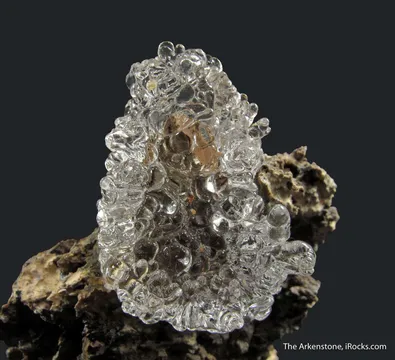
Calcite occurs broadly across the district as a major gangue mineral and as one of the main collector species. The best known specimen styles include translucent to frosted scalenohedra, divergent prismatic groups, two-generation calcite, orange or hematite-tinted calcite, and calcite with tiny sphalerite, pyrite or galena. A documented old collector specimen, for example, was described as two-generation calcite with cream-coloured, manganese-bearing calcite botryoids on hematite-tinted calcite scalenohedra; another well-described older specimen consisted of frosted, translucent scalenohedra in a jackstraw cluster with tiny rubyjack sphalerite and pink fluorescence. These descriptions fit the mine’s multi-stage carbonate history, in which calcite was deposited repeatedly during and after sulphide growth.
Mining history at Gyöngyösoroszi is unusually layered. Regional mining is reported from medieval times, and local historical accounts say written records from 1767 already mention older abandoned workings. Between 1767 and 1769 prospectors examined collapsed adits and pits; in 1767 a hand-cut adit was found at Bánya-bérc and enlarged. Henrik Fazola, known from the Miskolc iron industry, became involved in the Szent János adit in 1769, and in 1770 organized shareholders for the first Mátra ore-mining company, with Empress Maria Theresa named as the principal shareholder in local accounts. The eighteenth-century activity was intermittent: by 1800 Pál Kitaibel found workings abandoned, and further pulses followed in the nineteenth century, including lead and copper extraction by Elek Vass and György Vrányi between 1844 and 1857.
Modern development began after renewed assessment in the 1920s. Urikány-Zsilvölgyi Magyar Kőszénbánya Rt. obtained mining rights and restarted work in 1926 under Zoltán Glück, especially around the central Károly workings. Between 1928 and 1930 the Péter-Pál lower and upper adits were reopened, the Péter-Pál shaft was established, and several old workings and outcrops were investigated. By 1931 about 1,200 m of new development had been driven and 12,000 tonnes of ore produced, but falling world base-metal prices stopped production. In 1945 the mine was sold to the Hungarian state, and by the early 1950s Gyöngyösoroszi had become a state ore enterprise with large-scale exploration, a new access road, a flotation plant in the Toka Creek valley, and deep underground connections through the Altáró.
Industrial production was concentrated from the early 1950s to the mid-1980s. One geological resource assessment states that from the 1950s until closure in 1990 the mine produced about 3 million tonnes of Pb-Zn ore; Hungarian mine-history summaries give 3.7 million tonnes of raw ore over 35 years, containing about 35,000 tonnes Pb and 102,000 tonnes Zn, with saleable concentrates containing Pb, Zn, gold, silver, pyrite, copper and cadmium. Production ceased at the end of 1985 under a government decision for long-term suspension, and the mine was water-filled and physically closed in 1986. The stated reasons were geological, technical, labour and economic: remaining ore was distributed among thin, discontinuous, difficult veins with poor wall-rock conditions and dilution problems; the Mátraszentimre ore was partly oxidized and not easily beneficiated with the rest; and the mine could not meet production expectations after the late 1960s.
Collecting access today must be treated as closed-mine access, not as an open collecting locality. The underground workings have been flooded, sealed, re-opened only for closure or monitoring work in places, and affected by collapses and sludge accumulations. The district has also been a major environmental remediation site because sulphide-rich waste and mine water mobilized Pb, Zn, Cd, As and other metals into the Toka Creek system. The former mine area, waste-rock piles, tailings, water-treatment structures and remediated ground are not appropriate casual collecting ground. Modern specimens on the market are overwhelmingly old material from miners, Hungarian collections, European dealers, or legacy stock from the 1970s and 1980s, with occasional later dump or rail-side finds of small pieces reported but not a dependable or permission-free source.
Calcite from Gyöngyösoroszi is the district’s most available and visually varied collector mineral, typically tied to the quartz-carbonate gangue of the Pb-Zn veins and to late open-space growth in the Károlytáró and related workings. Good specimens may show frosted translucent scalenohedra in jackstraw clusters, divergent prismatic crystals, two-generation growth, cream to orange or hematite-tinted surfaces, and associations with ruby-brown sphalerite, pyrite, galena, quartz, gypsum or stibnite. Documented cabinet and miniature pieces are commonly in the 4–9 cm range, though individual crystal sprays and plates vary widely; a strong example is judged less by sheer size than by undamaged tips, separation of crystal groups, contrast with sulphides or coloured second-generation calcite, and a clean old-mine aesthetic rather than dull massive vein calcite. Some Gyöngyösoroszi calcite is reported as fluorescing pink, and collectors should note that late calcite also acted as a host or support for rarer stibnite and ZnS associations, including the Károly-vein material where calcite, quartz and kaolin filled small cavities around wurtzite-related crystal bundles.
Wurtzite is the signature rarity of Gyöngyösoroszi and the reason the locality appears in serious discussions of natural ZnS polytypes. The classic material is from the Károly vein, especially the 200 m level, the southern drift of the 100 m level, the 50 m level, and related Károly workings; it occurs as dark brown to brownish-black radial fibrous “Strahlenblende,” thin bands and veinlets divided by quartz, and rarer sharper pyramidal to steep hexagonal-looking aggregates. Koch described typical dark brown radial wurtzite bands up to about 5 cm thick on coarsely granular galena, galena-sphalerite or quartz vein filling, with greasy to bright surfaces and small brown sphalerite crystals oriented on the ends of the wurtzite bundles; later specimen records also note black, sharp, bright crystals with quartz, wurtzite in calcite matrix, and dark brown-black hexagonal crystals scattered on pyrite. The best collector pieces show discrete, lustrous, well-defined wurtzite rather than anonymous black sulphide, with quartz or calcite contrast, intact radial or pyramidal structure, and reliable provenance to Károlytáró or the Gyöngyösoroszi mine field.
Other minerals make Gyöngyösoroszi much more than a two-species locality. The principal ore assemblage includes galena, sphalerite, chalcopyrite, pyrite and marcasite, with quartz and calcite as the main gangue; barite, siderite, dolomite, kaolinite, gypsum, jarosite, rozenite, copiapite, halotrichite and melanterite belong to gangue, clay-alteration or post-mining sulphate suites. Rarer reported species include native gold, electrum, native antimony, chalcocite, covellite, malachite, anglezite, cerussite, acanthite/argentite-type silver sulphide, bismuthinite, cinnabar, sulphur, stibiconite and cervantite. The historic type-locality issue is mátraite, originally proposed for unusual Gyöngyösoroszi ZnS crystals named for the Mátra Mountains; later re-examination found the “mátraite” morphology to be densely twinned sphalerite rather than a distinct 3R ZnS mineral species, making old mátraite labels scientifically interesting but requiring modern caution.
Gyöngyösoroszi specimens reward careful label work. The locality name may appear in several forms: Gyöngyösoroszi, Gyongyosoroszi, Károlytáró, Károly-táró, Altáró, Bánya Hill/Bányabérc, Mátra Mountains, Heves County, or older Hungarian mine-level names. A precise old label to Károlytáró or the Károly vein is especially desirable for wurtzite and ZnS-crystallography material, while calcite may be labelled more broadly from the district. Because the mine field contains many named adits and veins, vague “Mátra Mts.” labels should be treated as incomplete rather than wrong.
The most important misidentification issue is not outright fakery but naming. Two-generation orange or pinkish calcites have been sold or collected as “rhodochrosite on calcite,” but rhodochrosite is not well established for Gyöngyösoroszi in the standard locality lists; manganese-bearing calcite, hematite staining, iron oxide films or coloured second-generation calcite are more defensible identifications unless analytical data accompanies the piece. Old “mátraite” labels should also be interpreted historically: they may refer to unusual Gyöngyösoroszi ZnS morphology, but the name has been challenged by later structural work and should not be treated casually as a distinct valid species without context.
Condition is a real issue on Gyöngyösoroszi material. Calcite scalenohedra have easily cleaved tips, and the frosted surfaces that make good pieces attractive can also hide small bruises. Orange coatings and sulphide peppering may be natural and desirable, but aggressive cleaning can strip contrast or expose dull surfaces. Wurtzite specimens are often small and structurally complex; radial fibrous aggregates may be undercut, and sharp pyramidal crystals can be confused with dark sphalerite unless the morphology and provenance are strong. Associated pyrite, marcasite and post-mining sulphates deserve attention: friable sulphates, acidic residues and oxidizing Fe-sulphides should be kept dry, separated from sensitive specimens, and periodically inspected.
Fluorescence is a useful but not universal collector bonus. At least some Gyöngyösoroszi calcite has documented pink fluorescence, which fits the reported manganese-bearing calcite style, but lack of fluorescence does not disqualify a specimen. Avoid acid testing on display pieces: calcite will react, but testing can permanently etch the surface and damage delicate associations such as gypsum, sulphates, clay fillings or small sulphide accents.
Market availability is uneven. Calcite is obtainable, especially as older Hungarian and European collection material, and EarthWonders currently has a meaningful representation of Gyöngyösoroszi calcite. High-quality wurtzite is much scarcer. Good Gyöngyösoroszi wurtzite pieces appeared historically from old Károlytáró production and from about-1980 material, but modern supply is thin; small thumbnails and miniatures with sharp, identifiable wurtzite command more attention than their size might suggest because the locality is so closely tied to the species and to the mátraite literature.
In 1767, the people searching the Mátra hills around Gyöngyösoroszi were not beginning with a blank map. They found collapsed adits and old pits, and at Bánya-bérc they encountered a hand-cut adit already in the mountain. That image—a forgotten, manually carved opening being enlarged by eighteenth-century prospectors—captures the district’s character better than any production table. The ore field had already attracted earlier miners, then drew in entrepreneurs, nobles and state power. Henrik Fazola became involved with the Szent János adit in 1769; the following year he gathered shareholders for a Mátra ore-mining company, with Maria Theresa appearing in the local account as principal shareholder. Few mineral labels hint at that social history, but an old Gyöngyösoroszi calcite or wurtzite sits at the end of a chain that includes hand-cut adits, royal finance and centuries of frustrated attempts to make thin polymetallic veins pay.
The nineteenth-century workings had moments of genuine excitement. In the eastern part of Oroszi, the Pál company worked the Pál and József adits, established a crushing and dressing operation, and opened the Károly adit. They extended the Péter-Pál lower adit to 228 m and mined ore reported at 19.7 g/t gold and 66.25 g/t silver. Those are the numbers that explain why the district kept returning to life after long silences: the veins could be difficult, discontinuous and expensive, but now and then they showed enough precious-metal promise to pull capital and miners back into the hills.
The modern mine had its own rhythm of ambition and disappointment. After Urikány-Zsilvölgyi obtained the rights, the 1926–1931 campaign restarted the central Károly area, reopened old Péter-Pál workings, drove new adits at Vereskő and Pelyhes, and investigated old ground from Hidegkút to Ravasz-lyuk. By 1931, 1,200 m of new workings and 12,000 tonnes of ore were real accomplishments—but the world price of base metals collapsed, and the enterprise stopped. The mine was sold to the Hungarian state in 1945 for 550,000 pengő, then rebuilt after 1949 into the industrial operation that produced most of the specimens now known to collectors.
The Károly vein produced a mineralogical detective story in miniature. In 1951, wurtzite samples from the Károly level showed radial, fanlike aggregates in banded quartz, with sphalerite growing in an oriented way on the wurtzite. Later, larger amounts were found, and Koch’s group examined the paragenesis, morphology, optics and chemistry. The most memorable studied occurrence was on the 100 m level of the Károly vein, about 80–90 m from the pit. In a slice through the vein there was granular quartz, a brown wurtzite band 1–2.5 cm wide, a 6–8 cm quartz layer with scattered pyrite, then another fine wurtzite band passing into ZnS crystal aggregates and crystals. Toward a small cavity, calcite lay on the quartz, with crystal bundles, small crystals, little quartz crystals and kaolin. Koch cautiously dissolved some calcite with dilute HCl and freed black pyramids only about a millimetre across. Those tiny pyramids led to the name mátraite, and later to a re-examination that overturned the original interpretation while making the specimens even more historically interesting.
Gyöngyösoroszi’s afterlife has been as dramatic as its mining life. The mine was put under water in 1986; shafts were backfilled and adits closed, but water and sulphide waste did not respect administrative endings. A 2006 closure-plan response described past water breakthroughs in 1951, 1985 and 1986, and then recorded a concrete disaster: on August 15, 1988, damage to the V-2 dam released roughly 40,000–45,000 m3 of mine water at a rate beyond the treatment plant’s capacity. Untreated water entered the Toka Creek, contaminating the creek and reservoir sediments downstream toward Gyöngyös. For collectors, this is an uncomfortable but essential part of the locality’s story. The same sulphides that made attractive specimens also generated acidic, metal-bearing waters after mining stopped.
Then the old mine acquired an improbable scientific second life. In 2015 the Mátra Gravitational and Geophysical Laboratory was established inside the out-of-operation Gyöngyösoroszi ore mine. The laboratory was placed 1,280 m from the entrance, 88 m below the surface, in the former instruction office near the first shaft. Instruments measured seismic, infrasound and electromagnetic noise, and even cosmic muon flux, as part of research connected to underground environments for future gravitational-wave detection. It is a remarkable turn: a mine driven for lead and zinc, famous among mineralogists for wurtzite and mátraite, later became a quiet underground physics site where the calm of the andesite host rock mattered more than the ore.