Ganzizhou Mine, Sichuan, China — rare locality yielding native gold in quartz-galena and black babingtonite–prehnite crystals, prized by collectors.
Key facts
Ganzizhou Mine—more often spelled Ganzhizhou Mine on specimen labels and in the mineralogical record—is a small but unusually memorable Chinese locality for collectors because its reputation rests on two quite different kinds of specimens: native gold in quartz-galena matrix, and black babingtonite–manganbabingtonite-series crystals perched on pale green prehnite. The locality is catalogued in Meigu County, Liangshan Yi Autonomous Prefecture, Sichuan Province, China, with only estimated coordinates and a broad margin of error; it lies within the mineral-rich southwest China province of the western Yangtze craton and is placed in the Sichuan-Yunnan-Guizhou metallogenic belt. For collectors, the importance is not that this is a large, well-documented industrial gold mine with a thick public literature, but that a small number of handsome specimens emerged from an otherwise obscure source and entered high-end collections.
The most desirable gold specimens are bright, rich yellow, crystallized pieces rather than waterworn nuggets: flattened to rounded crystal clusters, stringers, branching forms, and distorted or hoppered octahedrons, commonly on or in white-to-gray quartz and, in some documented pieces, galena. Good examples have both metal and architecture—the gold rising proud of the matrix, retaining sparkle and relief, and presenting from more than one side. The silicate specimens, by contrast, show glossy black, blocky to tabular crystals on translucent, sea-green prehnite, an assemblage tied to vesicular and fractured zones in altered Emeishan basaltic rocks of the Meigu area.
Regional View
Country View
The locality’s modern collecting story is fragmented, but the fragments are compelling. The Mineralogical Record’s Crystalline Treasures: The Mineral Heritage of China illustrated three native gold specimens from the mine in the 9 to 12 cm range, showing that Ganzizhou is capable of cabinet-scale gold pieces, not merely thumbnails. Dealer records and auction archives also document a limited 2011 find of crystallized miniatures and older gold-in-quartz material attributed to mining in the 1980s–1990s. This makes the locality one of those Chinese occurrences whose market identity is built specimen by specimen: sparse, label-sensitive, and easy to underestimate until a fine piece is in hand.
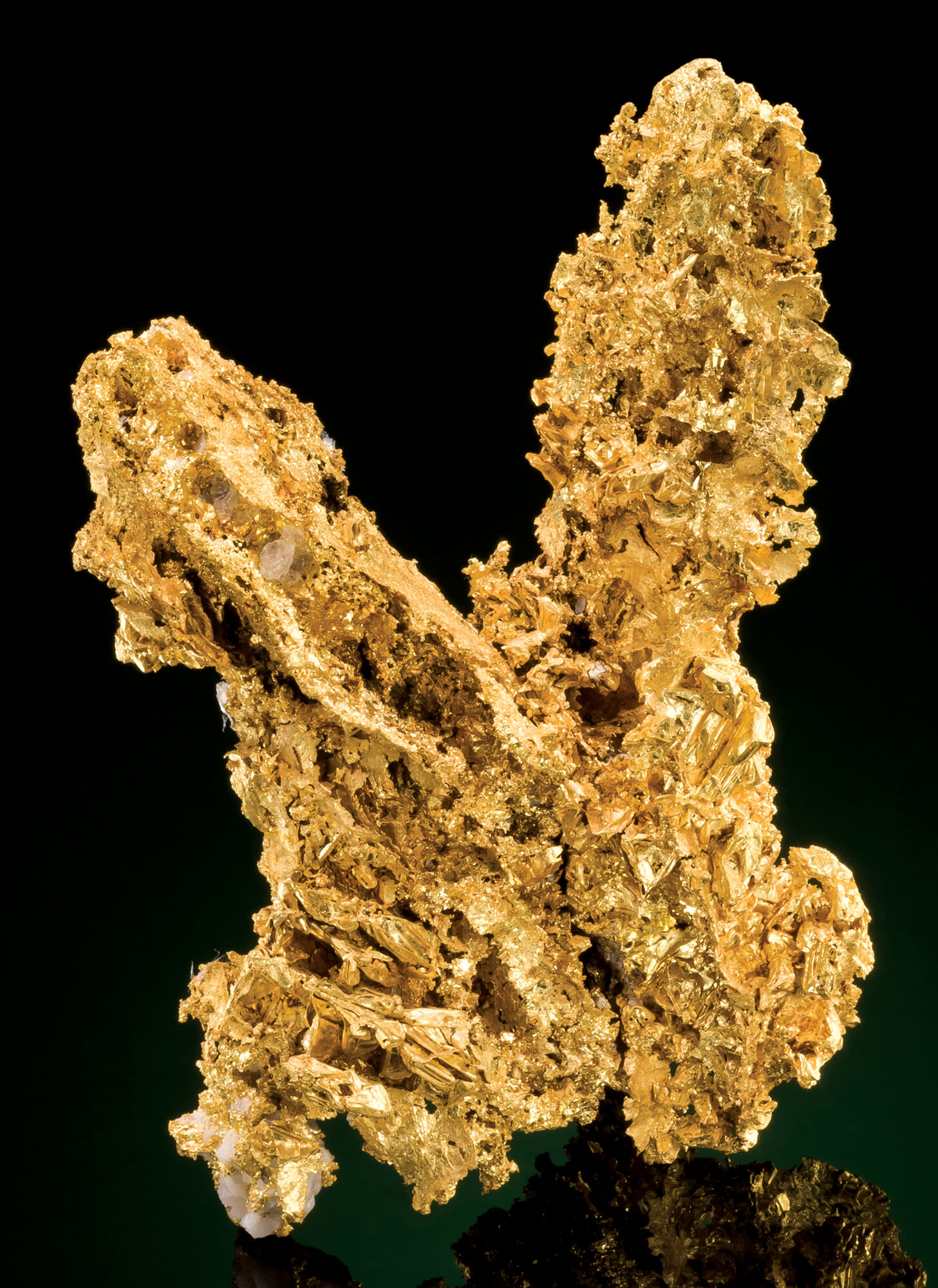
Photo: China Crystalline Treasures

Photo: Wikimedia Commons
Search for specimens: View all specimens from Ganzizhou Mine, null
The locality is recorded as a mine in Meigu County, Liangshan Yi Autonomous Prefecture, Sichuan Province, China, though the publicly available coordinates are only approximate: Mindat places it near 28° N, 103° E with an estimated position and a large margin of error. That matters to collectors because “Ganzizhou,” “Ganzhizhou,” and occasional shortened “Ganzhizhou, Meigu” labels refer to a locality whose field identity is less precise than its specimen identity. The safest catalogue wording is Ganzhizhou Mine, Meigu County, Liangshan Yi Autonomous Prefecture, Sichuan Province, China, with “Ganzizhou” retained where it appears on older labels or marketplace records.
Two mineralizing contexts are represented in the specimen record. The prehnite-babingtonite material belongs to the Meigu-area Emeishan basalt occurrences, where vesicular cavities, fractured zones, and altered basalt host late-stage, low-temperature Ca-Fe-Si-rich mineralization. Published work on Meigu babingtonite describes crystals in drusy cavities and fractured interlayer-gliding zones in altered basalt, produced under weakly oxidizing, alkaline conditions from solutions derived from the alteration and retrograde breakdown of basaltic minerals such as plagioclase, pyroxene, olivine, and specular hematite. In that assemblage, the collectible minerals are not ore minerals in the usual mining sense but vug minerals: glossy dark babingtonite-series crystals, pale green prehnite, and associated quartz.
The gold specimens point to a separate ore-style presentation: native gold in quartz, locally with galena. Documented examples include gold “stringer veins,” flattened to rounded crystal clusters, and crystallized masses protruding from white and gray quartz-galena matrix. The public specimen record does not securely publish a mine-scale ore-body description, named vein system, operator, reserve figure, or production history for the gold workings; the evidence available to collectors is instead specimen-based. That evidence is still useful: it shows that the mine produced crystallized native gold, not merely disseminated ore, and that the best pieces were preserved with matrix rather than all being crushed, smelted, or reduced to bullion.
The mining and collecting chronology is likewise clearest from specimen provenance. Older gold-in-quartz material is reported from mining in the 1980s–1990s, including a notable European-provenance specimen associated with Alessandro Pellegrino. A limited 2011 find produced bright miniature crystallized golds, including branching, flattened, two-sided examples composed of distorted and hoppered octahedrons. By 2013, cabinet-scale native gold specimens from Ganzizhou were prominent enough to appear in the Sichuan section of Crystalline Treasures: The Mineral Heritage of China. Later, individual pieces appeared in dealer inventories, auction archives, and exhibition contexts, but not as a steady mine production.
No reliable public source identifies a current operator or open collecting program for the locality. For practical collecting purposes, Ganzizhou should be treated as a closed or inaccessible commercial mine locality unless a collector has explicit permission from the land and mineral-rights holders. The current market consists mainly of old labels, ex-collection pieces, and dealer-held specimens; recent Chinese gold specimens are especially sensitive because export and ownership rules around gold-bearing mine material are restrictive. The result is a locality where provenance matters almost as much as aesthetics: a fine specimen should come with an old label trail, dealer history, auction archive record, or other documentation tying it to Meigu County rather than merely to “China.”
Gold from Ganzizhou Mine is best known as bright, rich yellow native gold in crystallized masses, branching forms, stringers, flattened plates, rounded clusters, and distorted to hoppered octahedral crystals, commonly associated with quartz and, on some documented matrix specimens, galena. Most collector pieces seen on the market are thumbnails to miniatures, with reported examples around 2.3 to 5.4 cm and weights from single grams to heavy matrix-rich cabinet pieces; the Crystalline Treasures publication illustrates larger native gold specimens of 9, 11.4, and 12 cm, confirming that the locality produced a few truly serious display pieces. The best examples are not valued simply as gold weight: they show sculptural relief, undamaged crystal edges, brilliant luster, matrix contrast, and natural branching or stringer architecture that clearly separates them from ordinary ore fragments or massive bullion-grade material.
Other documented minerals from Ganzizhou Mine include quartz, prehnite, siderite, chalcopyrite, and a babingtonite-manganbabingtonite-series occurrence. The black silicate crystals on prehnite are particularly important for locality specialists, but they come with a caution: the identification as manganbabingtonite has been questioned because published Meigu-area analyses of babingtonite report only minor manganese, commonly on the order of 2–3 wt.% MnO. Mindat also flags the reported chalcopyrite occurrence as doubtful in this basalt-hosted setting, noting that large, well-formed chalcopyrite crystals would be unexpected there and that comparable Emeishan basalt copper occurrences are better known from northern Yunnan. No type-locality mineral is documented for Ganzizhou Mine in the verified locality records.
Ganzizhou is a label-sensitive locality. The first authenticity question is usually not whether the gold is real, but whether the locality is real. The name appears in several forms—Ganzizhou, Ganzhizhou, Gan Zhi Zhou—and specimens may be labelled simply “Meigu,” “Liangshan,” or “Sichuan.” A well-documented piece should reconcile those spellings and ideally include an older dealer label, auction record, collection pedigree, or photograph from a recognized source. Be especially wary of attractive Chinese golds with vague “Sichuan” labels later upgraded to Ganzizhou without paperwork.
No locality-specific epidemic of fabricated Ganzizhou gold is documented in the sources checked, but the usual gold-specimen problems apply with force here: repairs to delicate wires or stringers, trimming that removes context, artificial mounting, glued fragments, and confusion between natural crystallized gold and melted or acid-cleaned ore. On matrix pieces, inspect the contact between gold and quartz or galena under magnification. Natural gold should emerge from fractures and pockets with convincing continuity; suspect pieces may show unnatural adhesive sheen, displaced grains, or gold sitting on rather than growing through the matrix. Heavy matrix specimens also deserve a sober weight/value assessment, because bullion value can influence pricing while still failing to account for crystal quality, aesthetics, or documentation.
Condition is central. Ganzizhou gold commonly has protruding branches, flattened crystal clusters, and thin stringers that can bend, abrade, or break. Even small damage can dramatically reduce the visual and market value of a crystallized gold specimen. The best pieces retain crisp high points, bright metallic luster, and an undisturbed quartz or quartz-galena base. Avoid aggressive cleaning: gold itself is chemically resistant, but associated quartz, galena, iron oxides, and possible clay or carbonate residues may not respond predictably, and overcleaning can make an old specimen look suspiciously raw.
The babingtonite/prehnite material carries a different set of concerns. Identification is the issue: “manganbabingtonite” labels should be treated cautiously unless supported by analysis, because Meigu-area material has been shown to be low in manganese relative to true manganese-dominant material. Black babingtonite-series crystals can also be edge-worn, chipped, or partly detached from prehnite; the prehnite balls and blades may be bruised or dulled. Fluorescence is not a selling point for the documented Ganzizhou assemblage, and neither gold nor babingtonite should be bought on that basis.
Market availability is sporadic. Fine crystallized gold from China is scarce in Western collections, and Ganzizhou material is not continuously produced. Small but attractive miniatures from the 2011 find have appeared at auction, while older matrix pieces from the 1980s–1990s surface only occasionally. Cabinet-scale golds from this locality should be considered exceptional. Serious collectors should expect to compete for pieces with strong provenance, particularly when the specimen combines crystallized gold, visible quartz-galena matrix, and an old collection history.
The most evocative Ganzizhou story begins not underground but in the luggage trail of an Italian collector. One small-cabinet gold-in-quartz piece, later sold at auction, was described as old mining material from the 1980s–1990s that left China with Alessandro Pellegrino, a European collector who was also an airline pilot. The specimen measured 5.4 x 3.7 x 2.5 cm and weighed 107 grams—3.44 troy ounces—with bright gold clusters and stringers running through quartz-galena matrix. Its appeal was partly visual, with yellow metal protruding from both sides of white and gray matrix, and partly biographical: the sort of piece that survived because someone recognized it as a specimen rather than ore. In February 2026, it closed at $16,500 after a rapid sequence of bids, a modern reminder that for crystallized gold the story, the matrix, and the label can lift a specimen well beyond a simple metal calculation.
A second chapter belongs to the limited 2011 find. One documented miniature, ex Greg Kitt, measured 3.8 x 2.3 x 0.6 cm and weighed 8.14 grams. It was not a nugget but a sculptural, two-sided crystallized specimen: branching, bulbous, flattened, and composed of intergrown distorted and hoppered octahedrons. When it sold in October 2023 for $1,008, the listing explicitly compared bullion value with specimen value, noting that crystallized gold can trade at multiples of melt. That is exactly the kind of calculation Ganzizhou pieces force collectors to make. The gold is real metal, but the value lives in form—how the crystals grew, whether they survived, and whether the specimen still reads as a natural object rather than a commodity.
The silicate side of the locality has its own quieter drama. A Wikimedia-hosted specimen photographed by Rob Lavinsky shows black, blocky, striated babingtonite-series crystals set on soft green prehnite, 5.4 x 3.7 x 3.0 cm overall. The original description called it manganbabingtonite, an “ultra-rare silicate,” and emphasized the freshness of the recent find. Later scrutiny made the story more nuanced: Meigu-area babingtonites were reported to contain only minor manganese, so labels using manganbabingtonite require caution. For collectors, that does not make the specimens less attractive; it makes them more mineralogically interesting. Ganzizhou is one of those localities where a label can preserve enthusiasm from the moment of discovery, while later analytical work teaches the collection to speak more carefully.