






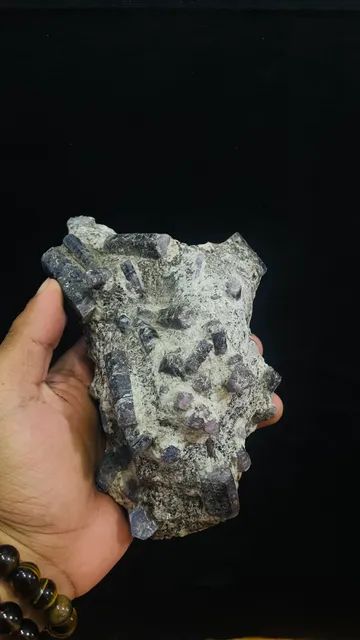
Ganesh Himal, Nepal — high-altitude locality yielding quartz with green chlorite inclusions and marble-hosted ruby and sapphire; prized for rarity and striking…
Key facts
Ganesh Himal matters to collectors because it is not a single tidy mine name but a high, broken Himalayan mineral district: alpine-style quartz veins, marble-hosted ruby and sapphire bodies, and carbonate-hosted zinc-lead mineralization all crowded into the rugged country north of Kathmandu and Trisuli Bazar. Its collector identity rests first on quartz—sharp, lustrous, often doubly terminated, and famously crowded with green chlorite, actinolite needles, phantoms, adularia, albite, titanite, and other alpine associations. The best pieces have the paradox collectors love: internal forests of inclusions and smoky-green veils, yet colorless, glassy terminations that seem to have cleared themselves in the final growth stage.
The locality’s second claim is ruby. In the early 1980s, red corundum from the Ganesh Himal massif established Nepal as a real, if small and difficult, source of marble-hosted ruby and fancy-color sapphire. The best-known deposits, Chumar and Ruyil, are high on the south to southeast flank of the range in northern Dhading District, where corundum occurs in dolomitic marble lenses close to the Main Central Thrust. These rubies are not common commercial rough in the manner of Mogok, Mozambique, or Mong Hsu; they are collector’s rubies—pinkish red to purplish red crystals, commonly zoned, locally gemmy, commonly associated with marble, calcite, dolomite, phlogopite, fuchsite, margarite, rutile, graphite, pyrite, and titanite. On a fine matrix specimen the color can be electric: orchid, magenta, and ruby-red crystals standing against white marble and green mica.
Regional View
Country View
Geologically, the appeal is precisely the collision-zone complexity. The corundum is tied to boudinaged dolomitic marbles within the Nawakot Series below the Main Central Thrust, while the zinc-lead mineralization of the broader Ganesh Himal region lies in crystalline saccharoidal dolomite within a repeated package of garnetiferous mica schist, quartzite, calcareous schist, and amphibolite. The quartz specimens, especially those attributed to Lapa, Tipling, Somdang, and the Ganesh Himal trade district, belong visually to the alpine cleft tradition: elongated crystals, rehealed breaks, scepters, Dauphiné- and Tessin-like habits, chlorite phantoms, and floater groups that look more like specimens from the Alps than the stereotyped “Himalayan crystal” of metaphysical commerce.

Photo: Wikimedia Commons
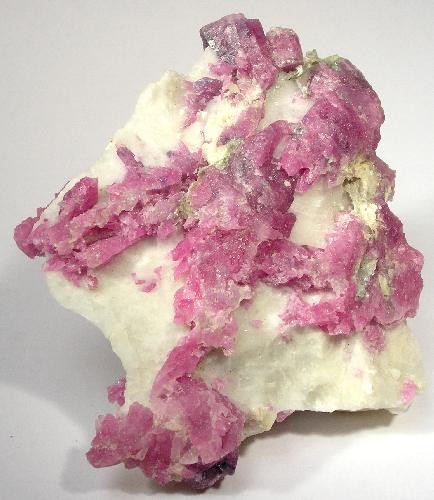
Photo: Wikimedia Commons
Search for specimens: View all specimens from Ganesh Himal, Nepal
Ganesh Himal is best understood as a mountain-range locality with several mineralized sublocalities rather than as one mine. Collector specimens labeled simply “Ganesh Himal” may come from the Dhading-side quartz workings in Ruby Valley, from ruby occurrences such as Chumar and Ruyil, or from the broader Rasuwa-side Ganesh Himal mineral belt around Somdang and Lari. For serious cataloging, “Ganesh Himal” is acceptable as a regional label when that is all the old label preserves, but better specimens should retain the specific source where known: Lapa quartz mine, Tipling quartz mine, Chumar ruby digs, Ruyil ruby digs, Somdang, Lari, Suple, Serkaping, or related prospects.
The ruby deposits are marble-hosted corundum occurrences. Chumar and Ruyil lie high on the south flank of the Ganesh Himal massif at roughly 4,300 m, within Lower Paleozoic dolomitic marble of the Nawakot Series below the Main Central Thrust. The marble bodies are lensoid and boudinaged, separated and deformed during Himalayan metamorphism and tectonism. Chumar is described as an east-west dolomitic body about 550 m long and roughly 150 m thick in the central part; its west end is bounded by a steep northeast-dipping fault, while the east end tapers. The ruby-bearing seams there are spaced on the order of meters apart, average only tens of centimeters in thickness, and locally fold on a small scale. Ruyil, about five kilometers east of Chumar, is smaller and distinctive for its graphite-rich character, an important clue in recognizing some Nepalese ruby and sapphire material.
The corundum is part of a chain of marble bodies in northern Dhading District. The western bodies known as Pola, Chumar, Shongla, and Shelghar have produced corundum, while Ruyil and Sublay are also corundum-bearing. Chumar and Ruyil are the two best-known and most commercially important sources, but “commercial” must be understood in a Himalayan sense: production has been small, intermittent, and constrained by altitude, weather, access, and the difficulty of working steep marble outcrops. Mining has been hand-intensive. Published descriptions of local work refer to Tamang miners using shovels, picks, and crowbars, with blasting used occasionally; at Chumar, hammering after blasting was reported as more common than at Ruyil. No significant secondary placer deposit has been documented for these rubies—the valuable material is primary corundum in marble.
The quartz deposits are a different collector story. Lapa is recorded as the most mined quartz occurrence in Ganesh Himal, west-northwest of Lapa village in Ruby Valley. Lapa and Tipling have produced the familiar chlorite-included alpine-style quartz specimens: colorless to gray-green prisms, doubly terminated floaters, scepters, clusters, sharp single crystals, and specimens with actinolite, chlorite-group minerals, albite or pericline, K-feldspar/adularia, titanite, anatase, rutile, siderite, and occasional other accessories. Some older Ganesh Himal quartz entered Western collections in the late 1980s and early 1990s, and later finds—especially around 2008, 2013–2014, 2018, and more recent small lots—show that the area has produced repeatedly rather than as one single historic pocket.
The broader Ganesh Himal region also contains important carbonate-hosted zinc-lead mineralization, especially around Lari, Suple, Serkaping, Poktanjo/Poktanzo, and related occurrences. These are not primarily specimen localities for the showy quartz and ruby market, but they are essential to the geology of the range. The ore is hosted by crystalline dolomite within a repeated metamorphic sequence of mica schist, quartzite, calcareous schist, and amphibolite, close to the Main Central Thrust. The ore assemblage is comparatively simple: sphalerite with abundant pyrite, subordinate galena and pyrrhotite, rare chalcopyrite, and possible pyrargyrite noted from X-ray diffraction work. Lari was explored most thoroughly; Nepal Metal Company developed underground workings there, including a long main tunnel and supporting side tunnels, but published Nepalese mineral-resource summaries repeatedly note that the deposit remained largely unexploited because of remoteness, climate, complex geology, technical and financial constraints, and lack of sustained production.
Access today is not casual rockhounding access. These are remote Himalayan mineral occurrences in difficult terrain, not public collecting dumps. The quartz localities lie in villages and high mountain slopes where local collectors and traders have historically controlled recovery; the ruby mines are claim-based and primary deposits; and the zinc-lead mine area is an industrial mineral resource with old workings, mine structures, and safety issues. Collectors should treat all Ganesh Himal material as a provenance problem to be solved through reliable labels, dealer reputation, old collection history, photographs, and mineralogical consistency—not by imagining an easy collecting trip.
Ganesh Himal quartz is the locality’s signature collector mineral: sharp alpine-style crystals and clusters, commonly transparent at the terminations and gray-green to mossy internally from chlorite-group inclusions, with reported associations including chlorite, albite/pericline, adularia or other K-feldspar, titanite, actinolite/byssolite, rutile, anatase, and siderite. Lapa is the best-known quartz source in the district, with Tipling important for scepters; older Somdang/Rasuwa-labeled pieces also circulate. Size ranges from thumbnail floaters and slender crystals of a few centimeters to major cabinet groups exceeding 20 cm across, with documented crystals to roughly 15 cm in high-end auction material. The best Ganesh Himal quartz is not merely “clear Himalayan quartz”; it has bright luster, undamaged sharp terminations, dramatic internal chlorite phantoms or sprays, balanced cluster architecture, and enough transparency to let the inclusions read three-dimensionally. Ordinary pieces are often included but not sculptural, water-clear but bland, or damaged at the tips and edges.
Ganesh Himal ruby is best represented by Chumar and Ruyil material: pinkish red, ruby-red, magenta, and violetish-red corundum crystals in dolomitic marble, commonly accompanied by calcite, dolomite, phlogopite, fuchsite, margarite, rutile, pyrite, titanite, scapolite, and at Ruyil, graphite. The crystals are often hexagonal and prismatic rather than simply massive, and the finest specimens show elongated, lustrous ruby crystals—sometimes individual crystals of several centimeters—standing cleanly in or on pale marble with green mica accents. Color zoning is a locality hallmark; Nepal rubies may show straight and angular bands, wedge-shaped blue or violetish zones, cloud-like textures, dense clusters of short rutile needles, and mineral inclusions that help distinguish them from other marble-hosted rubies. Top pieces are judged as mineral specimens first: bright color, crystal form, luster, visibility, matrix contrast, and damage-free terminations matter more than whether the rough would cut a stone.
Corundum from Ganesh Himal includes ruby and fancy-color sapphire, with Chumar producing both ruby and sapphire and Ruyil best known for ruby-bearing graphite-rich marble. As corundum rather than ruby, the locality is especially interesting because specimens can be color-zoned red, pink, violetish blue, and purplish, so a single crystal or cuttable fragment may straddle the collector boundary between ruby and sapphire. Published gemological work describes Nepalese corundum from Chumar and Ruyil as broadly comparable to other marble-hosted Asian deposits but recognizable through the combined pattern of zoning, inclusions, rutile textures, and associated minerals. Collectible corundum specimens range from small isolated crystals to clusters over 10 cm across; individual crystals may reach 5 cm or more, though clean, euhedral, lustrous examples with strong color are much rarer than broken or partially embedded marble pieces.
Chlorite at Ganesh Himal is most important as the visual engine of the quartz specimens rather than as standalone chlorite crystals. It occurs as green to dark green included material, inner coatings, phantoms, dusty veils, mossy clouds, and surface films within or on quartz, especially from Lapa and related quartz workings in Ruby Valley. In the finest specimens, chlorite marks earlier growth stages inside otherwise clear quartz: stems or bases can be saturated gray-green while the final terminations are clean and transparent, a contrast that creates the classic “garden in crystal” look. Collectors should distinguish attractive chlorite inclusions from mud, iron staining, and post-collection grime; the best examples show organized phantoms, sharply bounded growth zones, or aesthetic internal landscapes rather than a uniform dull coating that kills luster.
Other documented minerals from the Ganesh Himal/Ruby Valley locality group include actinolite, albite, pericline, apatite, brucite, calcite, dolomite, dravite, epidote, graphite, hematite, adularia and other K-feldspar, kyanite, margarite, fuchsite, orthoclase, phlogopite, plagioclase, pyrite, prase quartz, sceptre quartz, rutile, scapolite, siderite, sphalerite, talc, titanite, and tremolite. The notable rarities are locality rarities rather than type-locality minerals: apatite crystals from Ganesh Himal are unusual, dravite has been recorded from the district, scapolite is a desirable accessory, and the ruby-associated inclusion suite—uvite tourmaline, anorthite feldspar, diaspore, dense short rutile needles, graphite, mica, and carbonate inclusions—gives the corundum its gemological fingerprint.
The first caution is locality discipline. “Ganesh Himal” is a legitimate locality name, but it is also a trade label. In the quartz market it can be stretched to cover nearly any Himalayan-looking crystal with chlorite, phantoms, etching, or spiritual marketing language. A credible Ganesh Himal quartz should come with an older label, a specific sublocality such as Lapa or Tipling when possible, or a dealer chain that actually handles Nepalese material. Visual style alone is not enough: Pakistan, India, the Alps, and China can all produce clear quartz with green inclusions, phantoms, or alpine habits.
The second caution is the metaphysical quartz market. Ganesh Himal quartz is often sold with language about sacred peaks, “Himalayan energy,” “record keepers,” “self-healed” surfaces, “Nirvana” textures, “Isis faces,” and other non-mineralogical descriptors. Some of these terms may describe real growth or rehealing features in casual language, but they should not substitute for mineralogical description: termination condition, luster, inclusion identity, crystal habit, locality evidence, and damage history. Inclusions marketed as chlorite may in some cases be actinolite, clinochlore, amphibole, mica, iron oxides, clay, or mixed fine material; good labels should be conservative unless analysis was done.
Ruby has a different authenticity problem. The Nepalese deposits produced natural ruby and sapphire, but gemological literature explicitly warns that even in Nepal a buyer should not assume a red crystal is natural; one author reported a synthetic ruby crystal fragment purchased in Nepal. Ruby-in-matrix specimens also deserve close inspection because the global market contains glued, embedded, dyed, or assembled ruby-in-matrix pieces from several countries. For Ganesh Himal, check whether the crystal sits naturally in marble or mica-rich matrix, whether contacts and cavities make geological sense, and whether the color and fluorescence are consistent with corundum rather than dyed carbonate or glass. A loupe, UV lamp, hardness caution, and professional testing are appropriate for expensive pieces.
Condition issues are common. Quartz from this locality may be surprisingly sturdy in compact clusters, but long, thin Tessin-like crystals and scepters are vulnerable at the tips and side terminations. Rehealed bases are natural and can be attractive, but fresh chips, polished damage, and repaired terminations should be disclosed. Chlorite-included crystals often look darker in hand than in backlit photographs; evaluate them under neutral light and from several angles. Ruby specimens are hard in the corundum areas but commonly set in softer marble, mica, or carbonate matrix, so the matrix can bruise, cleave, powder, or undercut around the crystals. Do not clean ruby-in-marble aggressively with acids or ultrasonics.
Fluorescence can be useful. Red to pink zones in Nepalese ruby may fluoresce red under long-wave and short-wave UV, while darker violetish blue zones tend to respond weakly or not at all. UV response is not proof of origin, but it can help confirm corundum behavior and reveal zoning. Handle quartz and ruby specimens as display minerals, not lapidary rough, unless they have already been sold as cutting material; much of Ganesh Himal’s value lies in natural crystal form and matrix contrast.
Rarity is uneven. Ganesh Himal quartz is obtainable on the market in small to medium pieces, and new pieces continue to appear from Nepalese dealers and international resellers, but top cabinet specimens with water-clear crystals, fine architecture, strong chlorite phantoms, and minimal damage are scarce and can be expensive. Ganesh Himal ruby is much less available than quartz. Fine Chumar or Ruyil ruby specimens with distinct crystals, strong color, matrix aesthetics, and old provenance are genuinely uncommon; many specimens are small, massive, partly contacted, or more interesting scientifically than visually. The strongest pieces sit at the intersection of mineral specimen, gem locality, and Himalayan provenance, and they are collected accordingly.
The story most often repeated about Ganesh Himal ruby begins not with a mining company but with Tamang goat herders in 1981. High in the Dhading side of the massif, they noticed red crystals and brought them to Kathmandu, reportedly to sell as attractive objects for shop displays. There the stones were recognized as ruby. That small act—red crystals carried down from steep marble country into the capital—changed Nepal’s gem map. Until then, Nepal was known to mineral people for tourmaline, beryl, quartz, garnet, and other gems, but ruby and sapphire were not a serious part of its mineral identity. After the identification, claims followed, and Chumar and Ruyil became names that entered the literature of Asian marble-hosted ruby deposits.
The early scientific and collecting history has the feel of a frontier mineral episode. Allen M. Bassett, a geologist associated with Himalayan Gems Nepal, and Mache N. Manandhar became central figures in bringing the Chumar and Ruyil occurrences into documented gemological history. The work was not simply a matter of buying a parcel of rough and naming a country. The deposits had to be located, mapped, sampled, compared, and understood in a landscape of steep marble domes, gorges, seasonal weather, and difficult approach. Later gemological study would examine 27 polished samples and 19 rough crystals and mineral specimens, enough to show that Nepalese ruby was not a curiosity but a coherent source with its own zoning, inclusions, and host-rock signature.
Chumar itself is the more dramatic mineral image: white dolomitic marble exposed on steep Himalayan slopes, with ruby seams only a fraction of a meter thick and spaced meters apart. The body is not a simple flat slab. It bends, tapers, faults, and folds, and the corundum-bearing seams follow that contorted architecture. In the hand, a good Chumar specimen translates that geology into color: pink-red corundum crystals and crystalline veins run through pale marble, sometimes with green fuchsite and bronze-brown phlogopite. Some specimens are almost gemmy at the edges of the ruby; others are sculptural, with prismatic red crystals rising from the matrix like small towers.
Ruyil adds a darker note. Its marble carries graphite, reflecting organic-rich material in the original carbonate environment, and that graphite becomes part of the locality signature. In gemological terms, black graphite masses associated with transparent inclusions can point toward Nepalese origin. In specimen terms, graphite can make Ruyil material less clean-looking than the white-marble ideal but more geologically distinctive: ruby formed in a high-temperature collision-zone marble, with carbon still present as a dark witness to the rock’s sedimentary past.
Ganesh Himal quartz has its own, quieter field tradition. Collectors who met Nepalese dealers in Kathmandu and Pokhara in the 2000s and 2010s described a trade built around remote high-altitude workings and long foot approaches rather than roadhead mining. One account from a collector visiting Nepal in 2012 mentions meeting Eric Manandhar, a Nepalese mineral dealer specializing in Ganesh Himal quartz, and being shown exceptional quartz kept back in a private collection. Another field-discussion account noted that reaching the deposit area from Kathmandu could involve about a week of travel, including several days of trekking. That difficulty is part of why fine Ganesh Himal quartz often feels more personal than industrial: pieces emerge in small lots, through local diggers, porters, traders, family businesses, and a chain of labels that can either preserve or blur the precise origin.
The zinc-lead story is a different kind of mountain story. At Lari, Nepal Metal Company drove underground workings into high-grade carbonate-hosted ore, pursuing sphalerite, galena, pyrite, and silver-bearing potential in a terrain more suited to expedition travel than industrial logistics. Trekking accounts describe old structures, equipment, and chariots left at the mine site, a reminder that this was not just a line on a resource map. The deposit had grade, tunnels, and ambition, but remoteness, climate, access, finances, and politics kept it from becoming the kind of sustained mine that transforms a region. For specimen collectors, Lari is a geological backdrop; for Nepal’s mineral economy, it remains one of the country’s most discussed unfulfilled base-metal projects.

