A collector's guide to Faroe Islands, null: its geology, mining history and notable minerals, illustrated with the 50 specimens documented from this locality on EarthWonders.
Key facts
The Faroe Islands are a classic North Atlantic zeolite province: not a mine or single pocket locality, but an entire basalt archipelago whose collectible minerals formed in amygdales, open fractures, quarries, sea-cliff talus, road cuts, and tunnel rock within Paleogene flood basalts. For collectors, the islands matter because the zeolite suite is both widespread and historically important. Mesolite, stilbite, heulandite, chabazite, analcime, thomsonite-Ca, levyne-Ca, apophyllite, gyrolite, mordenite, stellerite, calcite, celadonite, and several rarer species occur in a geological setting comparable in spirit to Iceland, the Hebrides, Antrim, and the Deccan, but with a distinctly Faroese personality: dark basalt cavities lined with green celadonite, white to water-clear zeolite crystals, delicate hair-like sprays, compact radiating balls, and the occasional open cavity large enough to make a serious collector stop breathing for a moment.
The geological setting is the Faroe Islands Basalt Group of the North Atlantic Igneous Province. The exposed islands are built mainly of flood-basalt lava flows erupted roughly 59–55 million years ago, separated in places by volcanic ash, sedimentary breaks, coal-bearing horizons, and later intrusions. Low-temperature hydrothermal fluids and burial metamorphism converted the upper parts and vesicular zones of those lavas into a regional zeolite field. The important point for the collector is that the mineralization is zoned: the assemblages change across islands and with height in the lava pile. Faroese zeolites are not random “basalt cavity minerals”; they record a palaeothermal architecture of chabazite-thomsonite, analcime, mesolite-scolecite, stilbite-heulandite, and laumontite zones.
The best specimens have a restrained, northern beauty rather than the flamboyant color of Indian zeolites. Mesolite may appear as snow-white acicular tufts, felted woolly coatings, radiating balls, or exceptionally long hair-like needles. Stilbite is usually colorless to white, tabular, sheaf-like, or fasciculated, and is most desirable when perched cleanly in open basalt vugs rather than crusting the whole cavity. Heulandite is typically small but lustrous and colorless to white, sometimes sharing cavities with mesolite, stilbite, chabazite, or thomsonite. Chabazite is one of the signature Faroese minerals, occurring as sharp rhombohedra and phacolite-like forms; old and modern accounts repeatedly place it among the symbolic species of the islands. Thomsonite-Ca, historically called “faerolite” or “faroelite,” is another hallmark: white radiating spheres and hemispheres, some of the best known for the species, commonly with only the outer tips of the crystals visible.
Regional View
Country View
The islands also occupy a special place in the history of zeolite mineralogy. Dalsnípa on Sandoy is the type locality of levyne-Ca, named by David Brewster in 1825. James Currie’s early twentieth-century topographic treatment of Faroese minerals described roughly 120 localities, and later work by Volker Betz, Rudy Tschernich, and Ole Jørgensen transformed the Faroes from a romantic old European zeolite field into a well-mapped regional mineral system. Jørgensen’s long programme of work was particularly important: more than 800 localities and about 3000 samples were studied, with material taken from fresh road cuts, quarries, old village paths, mountain traverses, and deep boreholes.
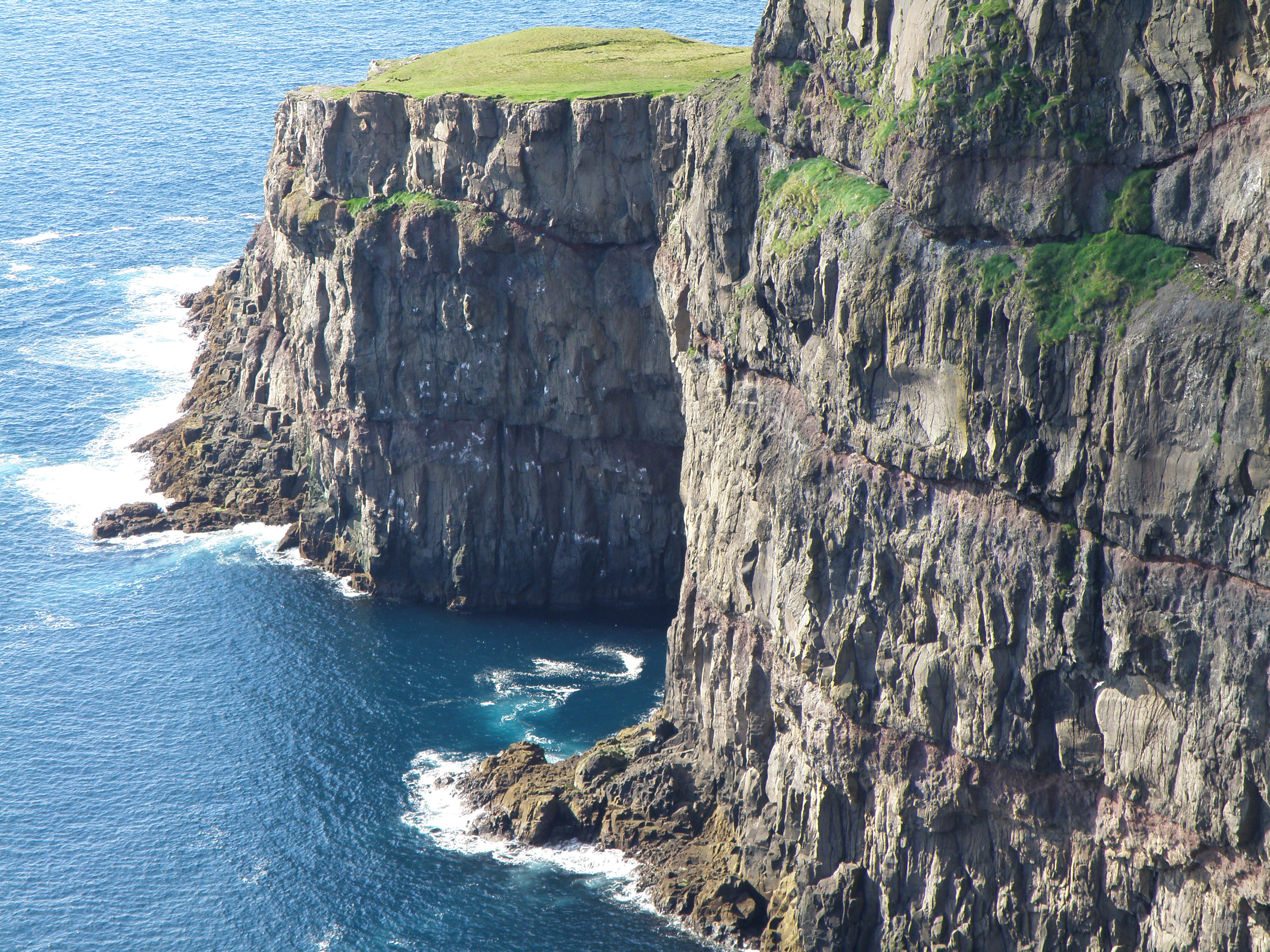
Photo: Eileen Sandá / Wikimedia Commons
Search for specimens: View all specimens from Faroe Islands, null
The Faroes are not an ore locality in the usual sense. There are no specimen-producing lodes, shafts, or economic zeolite mines to speak of, and modern mineral-commodity summaries do not treat the islands as having significant identified mineral resources. Their collector importance comes from secondary minerals in the basalt pile: amygdules, vesicles, open cracks, quarry faces, road-metal workings, harbour quarries, tunnel spoil, and sea-cliff blocks. The “deposit type” is therefore amygdaloidal basalt zeolite mineralization formed during low-grade hydrothermal alteration and burial metamorphism of a thick Paleogene flood-basalt sequence.
The exposed basalt succession has traditionally been divided into lower, middle, and upper basalt formations, with important sedimentary and volcaniclastic breaks between them. A coal-bearing sequence, including clay and coal-bearing sediments, marks a volcanic pause before renewed explosive and effusive activity. Later dykes and sills cut the basalt pile, and the entire succession now has a gentle easterly structural dip. From a collecting standpoint, the vesicular tops and fractured parts of flows are the productive horizons; massive flow interiors can be barren, while a nearby road cut or block may contain numerous lined cavities.
Regional mineral zoning is the key to understanding Faroese specimens. In broad terms, the islands show chabazite-thomsonite, analcime, mesolite-scolecite, stilbite-heulandite, and laumontite zones. Sandoy is especially important because its southern and eastern parts are dominated by a mesolite-zone assemblage rich in chabazite, heulandite, mesolite, stellerite, thomsonite, and calcite, with minor gyrolite, gismondine, and levyne. Vágar is notably well mineralized and includes a northeastern stilbite-heulandite field and a southern to southeastern mesolite-analcime field; around Miðvágur, hair-like mesolite needles may reach 100 mm in larger fractures and cavities. Streymoy is more complex, with northern and central repetitions of mesolite and stilbite-heulandite assemblages, and a southern area dominated by mesolite assemblages. Borðoy exposes mainly mesolite, analcime, and chabazite-thomsonite zones, while Viðoy and the northeastern islands are important for chabazite-thomsonite mineralization.
The history of collecting is inseparable from road building and quarrying. Early naturalists and mineralogists visited the islands in the eighteenth and nineteenth centuries as interest in zeolites grew in Europe. Dalsnípa on Sandoy entered the literature as the type locality for levyne-Ca. Currie’s early survey arranged the minerals topographically; Görgey followed with another systematic contribution; Betz reviewed classic localities and collected widely; Tschernich’s zeolite work preserved further locality records; and Jørgensen’s later mapping provided the regional geological framework. Much of the modern collectible material came not from formal mines but from opportunistic exposures: temporary quarries, abandoned basalt quarries, new road cuts, tunnel excavations, and blocks fallen from mineralized cliffs.
Vikarnes Quarry at Haldórsvík on Streymoy is one of the more collector-recognizable modern names. It was a temporary quarry connected with harbour construction and is recorded as an excellent locality for mesolite; nearby rock south of Haldarsvík produced stilbite and apophyllite. The old Haldarsvík area also produced apophyllite, heulandite, mesolite, and abundant stilbite, with two formerly visible cavities reported at roughly 50 cm in diameter. Gamlarett Quarry at Kirkjubøur on Streymoy is known for chabazite, thomsonite-Ca, heulandite-subgroup minerals, and celadonite; lower parts of the rock walls exposed cavities with chabazite crystals reported up to 4 cm. Skútin on Nólsoy, difficult but reachable by land or sea, is credited with exceptional zeolite specimens. Dalsnípa on southern Sandoy is one of the most famous collecting places in the islands, both for levyne-Ca history and for mineralized basalt blocks below a cliff more than 200 m high.
Access today should be approached conservatively. The most productive settings are quarries, roadside rock, sea cliffs, tunnel spoil, and private or managed land, not public collecting pits. Faroese land access is sensitive, many classic sites are no longer in the same condition described in older literature, some pockets are exhausted or hidden by later work, and sea-cliff localities can be dangerous. Collectors should obtain permission before entering quarries or private land, avoid protected or unstable areas, never hammer on maintained roads or structures, and treat talus below cliffs as a serious hazard rather than an invitation.
Mesolite is one of the defining collector species of the Faroe Islands and is especially characteristic of the mesolite-scolecite and mesolite-analcime parts of the basalt pile, with important occurrences on Sandoy, Vágar, Streymoy, Eysturoy, Borðoy, and Suðuroy. It occurs both as compact or solid mesolite and as hair-like mesolite, and the Faroese material ranges from white radiating spherules and fibrous balls to transparent crystals reaching several centimetres; one published account records crystals to 8 cm, while Jørgensen documented hair-like needles to 100 mm around Miðvágur in larger fractures and basalt cavities. Good specimens are open, undamaged sprays or balls on contrasting dark basalt or celadonite-coated vug walls, ideally with stilbite, heulandite, thomsonite, chabazite, or calcite as subordinate associates rather than crusts that obscure the mesolite; ordinary pieces tend to be matted, bruised, overgrown, or trimmed from dense cavity fillings where the acicular habit has lost its architectural delicacy.
Stilbite is widespread in the Faroes, especially in the stilbite-heulandite assemblages of Sandoy, Vágar, northern and central Streymoy, Eysturoy, and several quarry and road-cut localities, although individual crystals are usually modest in size. Faroese stilbite is commonly colorless to white, transparent to translucent, and tabular with a six-sided outline; some crystals are fasciculated with irregular terminations, and crystals rarely exceed about 1 cm in the Italian field account, though attractive cavity plates are known. The best pieces show discrete, lustrous stilbite tablets or sheaves in open basalt vugs, often with heulandite, mesolite, apophyllite, calcite, or celadonite contrast; collectors should be aware that older labels may simply say “stilbite” or “stilbite subgroup,” and that analytical work on an unspecified Faroese sample indicated a sodium-rich composition corresponding to stilbite-Na, while visually similar stellerite in the archipelago has sometimes been overlooked.
Heulandite-subgroup minerals are most collectible in the Faroes as part of the stilbite-heulandite and mesolite-zone assemblages, appearing on Sandoy, Streymoy, Vágar, Borðoy, Eysturoy, and classic localities such as Dalsnípa, Haldórsvík, Nesvík, and Gamlarett Quarry. The material is usually colorless to white and occurs as small, lustrous crystals in basalt cavities, commonly associated with stilbite, mesolite, chabazite, thomsonite, mordenite, apophyllite, gyrolite, calcite, or celadonite; published field notes stress that crystals larger than 5 mm are rather rare in the archipelago. Fine Faroese heulandite specimens therefore depend less on sheer crystal size and more on sharpness, transparency, clean separation from associated stilbite, and the quality of the basalt-vug setting; mediocre pieces are those where heulandite is only a chalky lining or is indistinguishable from the accompanying tabular stilbite without analysis.
Chabazite is perhaps the most emblematic Faroese zeolite, frequent in the chabazite-thomsonite and mesolite-zone assemblages and particularly well represented in cavities from Streymoy, Eysturoy, Borðoy, Viðoy, Sandoy, and Nólsoy. It appears as white, colorless, or pale crystals, commonly rhombohedral and sometimes phacolite-like; Gamlarett Quarry is especially noted for chabazite, including lower rock-wall cavities with crystals reported up to 4 cm, while other recorded specimens include chabazite to about 1.5 cm and associations with thomsonite-Ca, heulandite-subgroup minerals, and celadonite. Good Faroese chabazite specimens have sharp, isolated crystals set on dark basalt or green celadonite rather than dull cavity fillings, and the very best have the “classic zeolite” geometry collectors want from old European basalt localities: clean form, intact edges, and enough surrounding matrix to show the original amygdale environment.
Analcime is an important index mineral in the Faroese zeolite zoning and is especially associated with the analcime and mesolite-analcime assemblages of the southern islands and parts of Vágar, Sandoy, Suðuroy, Borðoy, and Streymoy. In the field it is usually less visually dominant than mesolite, chabazite, or thomsonite, but its presence is geologically significant because analcime commonly marks a distinct temperature and depth interval in the basalt pile; on Borðoy, analcime and mesolite are described as first-deposited minerals in many vesicles. Collectible analcime from the Faroes is best when it forms sharp, glassy, separate crystals in open basalt cavities with mesolite, thomsonite, chabazite, stilbite, or celadonite, while less desirable pieces are massive, dull, or so intergrown with other white zeolites that the species identity rests more on locality habit than on specimen aesthetics.
Thomsonite-Ca is one of the great Faroese collector minerals and has long been known under obsolete names such as “faerolite” and “faroelite.” It occurs as white radiating spheres and hemispheres, sometimes reaching several centimetres across, typically with crystal terminations poorly visible except at the surface; important localities include Nólsoy, Eysturoy, Borðoy, Viðoy, Streymoy, and road-cut or quarry sites such as Ljósá, Nesvík, Monte Sátan, Lambafelli, and Gamlarett. Fine specimens show bright, undamaged radial balls or hemispheres with strong relief on basalt or celadonite, often accompanied by chabazite, mesolite, stilbite, heulandite, calcite, or apophyllite; the best Faroese thomsonite-Ca has been described as among the finest known, while ordinary pieces are compact white crusts where the radial structure is only visible on broken surfaces.
Beyond the principal collector species, the Faroe Islands have a notable supporting cast. Lévyne-Ca is the locality’s great historical mineral: Dalsnípa on Sandoy is its type locality, and old and modern accounts record water-clear tabular to hexagonal crystals, including rare larger examples. Stellerite is important but easily confused with stilbite, especially on Sandoy. Mordenite occurs in acicular to compact porcelain-white cavity fillings at Dalsnípa, Eysturoy, Streymoy, and between Vestmanna and Kvívík. Gyrolite is recorded in several areas, including Ljósá, and may form attractive associated plates or aggregates. Cowlesite, gismondine, phillipsite, scolecite, natrolite, laumontite, epistilbite, harmotome, opal, cristobalite, chalcedony, quartz, calcite, celadonite, smectites, and rare native copper round out a surprisingly rich basalt-cavity mineralogy; several of these are best regarded as specialist or micromount interests rather than routine cabinet species.
The main authenticity issue with Faroe Islands specimens is not an active fake trade but locality confidence. White zeolites in dark basalt can resemble material from Iceland, Scotland, Northern Ireland, Nova Scotia, Oregon, New Jersey, and especially India, so old labels matter. A convincing Faroese specimen should ideally carry a specific island or locality name—Vikarnes Quarry, Haldórsvík, Gamlarett Quarry, Dalsnípa, Skútin, Ljósá, Nesvík, Kvívík, Miðvágur, Norddepil, Klakkur, Sandoy, Streymoy, Vágar, Eysturoy, Borðoy, Viðoy, or Suðuroy—rather than simply “Faeroe Islands” or “Faroe.” Period spellings such as Faeroes, Færøerne, Føroyar, Dalsnypen, Haldarsvík, and older mineral names such as faerolite, faroelite, chabasite, levyna, mesotype, and thready zeolite can be legitimate rather than suspicious, but they require translation into modern nomenclature.
Species-level mislabelling is common in old basalt-zeolite suites. Mesolite, natrolite, and scolecite are difficult to separate visually when they form fine white needles. Stilbite, stellerite, and heulandite can be confused in small colorless tabular crystals. “Chabazite” on an old label may be chabazite-Ca or a chabazite-subgroup identification rather than a modern analytical determination. “Thomsonite” is usually thomsonite-Ca in the collector literature for the Faroes. If the specimen has significant value, species names should be treated cautiously unless backed by XRD, SEM-EDS, or a modern collection history.
Condition is critical. Mesolite needles snap easily and mat down with careless wrapping. Thomsonite balls bruise at high points. Stilbite and heulandite cleavages are unforgiving, and small edge chips show strongly under magnification. Laumontite, where present, may dehydrate and deteriorate; avoid prolonged dry heat and do not store suspected laumontite pieces in harshly desiccated conditions. Avoid acid cleaning except under expert supervision: old mineralogical literature mentions removal of dark coatings from zeolitic material with dilute nitric acid, but modern collectors should assume that acids can damage calcite, alter luster, undercut delicate zeolite clusters, and destroy useful original surface context.
The best Faroese specimens are much rarer in trade than comparable Indian zeolites. Most available pieces are older collection material, small-cabinet specimens from known quarries, or occasional modern finds from road and quarry work. Choice mesolite with long intact hair-like needles, sharp chabazite on celadonite, aesthetic thomsonite-Ca balls, and locality-specific levyne-Ca from Sandoy are all worth treating as scarce. Market value is driven by three factors: precise locality, freedom from damage, and whether the specimen has the compact, austere look of the Faroes rather than a generic basalt zeolite.
The story of Faroese zeolites begins with a landscape that once seemed remote even to European mineralogists. By the end of the eighteenth century the islands were still “nearly unknown” mineralogically, yet their basalt cliffs and amygdales soon attracted naturalists following the expanding fashion for zeolites. In 1825 David Brewster described levyne from Dalsnípa on Sandoy, giving the archipelago a permanent place in mineral nomenclature. The type locality is no gentle collecting bank: later field accounts describe it as a cliff more than 200 m high at the southern end of Sandoy, with large basalt blocks at its base still holding beautiful crystallizations of apophyllite, chabazite, heulandite, levyne, mordenite, and stilbite. The same accounts warn that access is extremely difficult, which is easy to believe of a storm-facing basalt cliff in the North Atlantic.
One of the most appealing chapters in the modern history of the locality is the way road building opened the basalt. Jørgensen noted that renewal of much of the Faroese road system just before his fieldwork began made it possible to collect from fresh road cuts and new quarries. When those easy exposures had been examined, the work moved onto the older village paths and mountain traverses. The scale became extraordinary: more than 800 localities visited, roughly 3000 samples examined, and the field evidence tied back to private collections, the Geological Museum in Copenhagen, and deep borehole material from Vestmanna-1 and Lopra-1/1A. What a cabinet collector sees as a fine mesolite spray or chabazite rhomb is also a data point in a temperature map of a buried basalt plateau.
Some pockets became famous almost accidentally. At Haldarsvík on Streymoy, a small abandoned quarry yielded apophyllite, heulandite, mesolite, and abundant stilbite. Betz recorded two cavities about 50 cm across—large enough to supply serious specimens rather than just broken chips—but later visitors found those particular cavities no longer visible. That is a recurring Faroese pattern: the pocket appears in a quarry, road cut, or harbour excavation, produces well for a short time, and then vanishes under talus, construction, weathering, or removal.
Vágar adds one of the locality’s most memorable visual details. Around Miðvágur, larger fractures and cavities yielded hair-like mesolite needles up to 100 mm long. For a zeolite collector, that is not just a measurement; it tells you the kind of cavity you are imagining—open enough for long, fragile growth, protected enough that fine needles survived, and mineralized with enough restraint that the mesolite did not simply become a dense white felt.
The Italian field accounts from the 1997 and 1998 trips have the tone of collectors working from old literature and real weather-beaten exposures. They describe Skútin on Nólsoy as the source of many exceptional Faroese zeolite specimens, but also as a locality whose name does not appear on the 1:200,000 map, reachable only with difficulty by land or by sea. They describe a Monte Lambafelli locality marked not by a printed map name but by a metal sign fixed to a large boulder visible from the road. A kilometre southeast, roadside basalt blocks from excavation work yielded an unexpectedly rich suite: analcime, harmotome, chabazite, calcite, cristobalite, erionite, gismondine, levyne, mesolite, mordenite, phillipsite, scolecite, stilbite, native copper, and thomsonite-Ca. That is the Faroes in miniature: small exposures, hard-won cavities, and an outsized mineral list hiding in ordinary-looking basalt.
Ole Jørgensen, “The regional distribution of zeolites in the basalts of the Faroe Islands and the significance of zeolites as palaeotemperature indicators,” Geological Survey of Denmark and Greenland Bulletin 9, 123–156, 2006 — The essential modern paper on Faroese zeolite zoning, based on extensive field sampling, boreholes, and regional mapping.
Mindat: Faroe Islands locality page — The main online locality framework for the archipelago, useful for species lists, hierarchy, and links to sublocalities.
Mindat: Streymoy, Streymoy Region, Faroe Islands — Species and sublocality records for the island that includes Haldórsvík, Gamlarett, Kvívík, Nesvík, and several important zeolite occurrences.
Mindat: Vikarnes Quarry, Haldórsvík, Streymoy — A key modern specimen locality, recorded as a temporary quarry for harbour construction and an excellent mesolite locality.
Mindat: Sandoy, Sandoy Region, Faroe Islands — Includes Dalsnípa, the type locality of levyne-Ca, with species records and references.
S. Ghizzoni and coauthors, “Le zeoliti delle Isole Føroyar (Faroer),” Studi e Ricerche, Museo “G. Zannato,” 2007 — A useful collector-oriented Italian account of Faroese zeolite species and localities, including 1997–1998 field observations and museum notes.
David Brewster, “Description of levyne, a new mineral species,” Edinburgh Journal of Science 2, 322–334, 1825 — The original description of levyne, tied historically to Dalsnípa on Sandoy; the citation is reproduced in later Faroese zeolite literature.
Volker Betz, “Zeolites from Iceland and the Faeroes,” The Mineralogical Record 12, 5–26, 1981 — The classic collector reference repeatedly cited for Faroese zeolite localities and specimen occurrences.
James Currie, “The minerals of the Færoes, arranged topographically,” Transactions of the Edinburgh Geological Society, session 1905/1906, 9, 1–68, 1907 — The foundational topographic mineral listing for the islands.
Jørgensen 2006 GEUS Bulletin paper on Faroese zeolite zones — Best single technical source for the regional zeolite assemblages, palaeotemperature interpretation, borehole evidence, and island-by-island zoning.
Mindat: Faroe Islands — Central database entry for the archipelago and its mineral species.
Mindat: Vikarnes Quarry, Haldórsvík — Specific quarry page for one of the best-recognized Faroese mesolite and stilbite localities.
Mindat: Streymoy — Useful locality hierarchy and species records for the island with many of the named collector sites.
Mindat: Sandoy — Essential for Dalsnípa and the levyne-Ca type-locality context.
Ghizzoni et al., “Le zeoliti delle Isole Føroyar (Faroer)” — Collector-rich locality notes, species descriptions, and bibliography in Italian.
BGS Research Report: Geology of the Faroe–Shetland Basin and adjacent areas — Regional geological background for the Faroe Islands Basalt Group and the wider North Atlantic Igneous Province.
Faroe Islands National Museum — Visitor and institutional context for the geology and natural history of the islands.
Wikimedia Commons: Faroe mesolite stamp — A charming public-domain record of mesolite’s place in Faroese cultural presentation.
R. Görgey, “Ein Beitrag zur topographischen Mineralogie der Färöer,” Neues Jahrbuch für Mineralogie, Beilage-Band 29, 269–315, 1910 — Early systematic work on Faroese mineral localities and zeolites.
Rudy W. Tschernich, Zeolites of the World, Geoscience Press, 1992 — A major zeolite reference that preserves several Faroese locality and species records.
Jóannes Rasmussen and Arne Noe-Nygaard, “Geology of the Faeroe Islands,” Geological Survey of Denmark, 1970 — The standard geological monograph cited in later work on the Faroese basalt succession.
Coombs et al., “Recommended nomenclature for zeolite minerals,” Mineralogical Magazine 62, 533–571, 1998 — Important for modernizing older zeolite names used on Faroese labels, including levyne and related nomenclature.
Faroe Islands National Museum, Tjóðsavnið — The national museum in Tórshavn includes the natural and geological history of the islands and is noted in collector literature as preserving significant Faroese material.