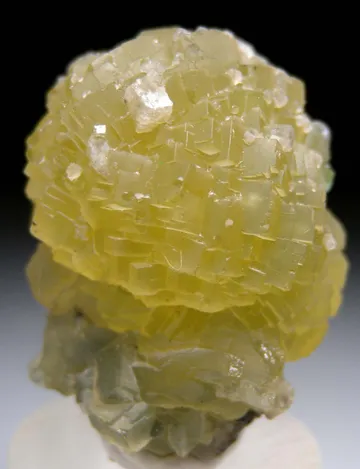
Merelani Hills dravite, Tanzania, a magnesium-rich tourmaline famed for emerald-to-chrome green color, rarity, and fully terminated crystals prized by collecto…
Key facts
Dravite from the Merelani Hills is one of the most distinctive tourmalines in the collector market: a magnesium-rich tourmaline from a locality better known for tanzanite, yet capable of producing small crystals with a saturated emerald-to-chrome green that looks almost improbable beside the graphite-black and calc-silicate matrix typical of the mines. The best examples are not the common brown dravite familiar from many metamorphic terrains, but the vivid green “chrome” or vanadium-bearing dravite of East Africa, colored by trace vanadium and, in some specimens, chromium.
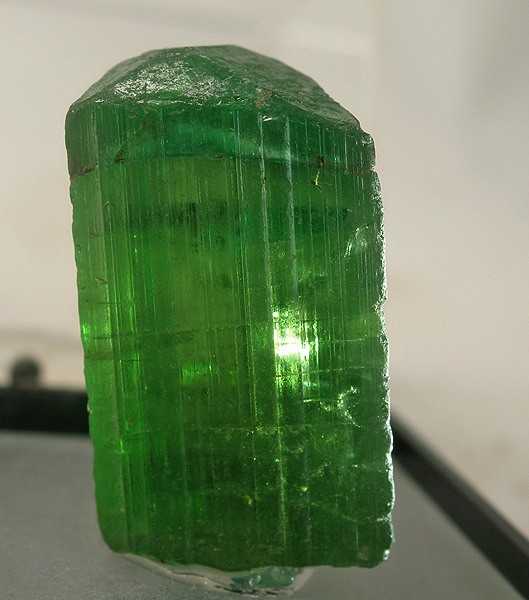
Photo: Wikimedia Commons
What makes Merelani dravite desirable is the collision of rarity, color, and locality context. These crystals come from the same narrow, highly mineralized metamorphic belt that has produced tanzanite, tsavorite, green diopside, tremolite, graphite, prehnite, fluorapatite, wurtzite, alabandite, axinite-(Mg), and several new or highly unusual sulfides. In other words, a Merelani dravite is not just a green tourmaline; it is a small witness to one of the most mineralogically fertile gem districts of the modern era.
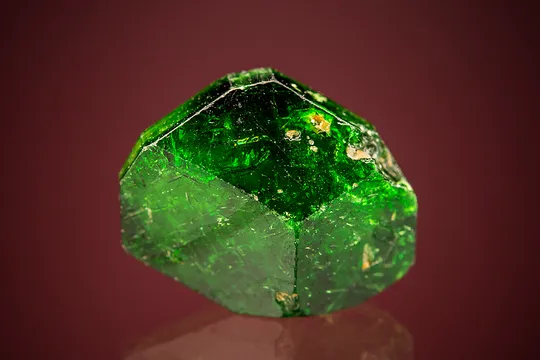
The visual signature is typically a short to stout trigonal prism, commonly strongly striated, with a flat to etched termination and a deep green body color that can appear nearly black in ordinary reflected light. Under strong backlighting, better crystals open into a saturated green glow, sometimes brighter toward the termination. Collectors prize crystals that are complete all around, retain a natural termination, show strong luster, and display enough translucency or gemminess to reveal the color rather than merely suggesting it.

Photo: Wikimedia Commons
Merelani’s geological setting helps explain the unusual color suite. The deposit lies in a high-grade metamorphic belt of metacarbonate, metasilicate, and graphite-bearing rocks that were later reworked by lower-grade retrograde and hydrothermal events. Vanadium-rich and chromium-bearing protoliths in this rock package supplied the chromophores responsible for famous blue-violet tanzanite, green tsavorite, green diopside, and green dravite. That shared geochemical inheritance is part of the appeal: the dravite belongs to the same color story as Merelani’s best-known gemstones.
Search for specimens: View all dravite specimens from Merelani Hills, Tanzania
The Merelani Hills, also spelled Mererani or Mirerani in older and trade usage, lie in the Lelatema Mountains of northern Tanzania, in Simanjiro District, Manyara Region, roughly southeast of Arusha and within sight of the greater Kilimanjaro–Meru landscape. The mining area is best known as the world’s classic source of tanzanite, but collectors know it equally as a prolific source of unusual calc-silicate and graphite-associated minerals.
The deposit is a metamorphic gemstone system rather than a simple pegmatite or vein field. Gem-quality mineralization occurs in a structurally complex package of graphite-bearing gneisses, metacarbonates, and metasilicate rocks that experienced granulite-facies metamorphism and later retrograde overprinting. Tanzanite, tsavorite, diopside, tremolite, fluorapatite, prehnite, graphite, quartz, calcite, and dravite all belong to this broader mineralized environment, although individual pockets and mine blocks may vary sharply in what they produce.
Mining is organized around the famous Merelani tanzanite blocks, generally referred to as Blocks A, B, C, and D, with D-extension also appearing in modern mining discussions. The operating history has combined larger mechanized or medium-scale concessions with artisanal and small-scale workings. Because dravite is a collector by-product rather than the economic target, most specimens reach the market through the same secondary channels that handle associated Merelani minerals: tanzanite, tsavorite, diopside, prehnite, graphite, and rare sulfides.
The modern gemstone story began with the discovery of tanzanite in the late 1960s, when intense blue-violet zoisite from Merelani entered the gem trade and rapidly became a global sensation. As mining advanced and collectors paid closer attention to the matrix minerals, Merelani’s reputation broadened. The district went from “the tanzanite locality” to one of East Africa’s great specimen localities, capable of producing both gem crystals and serious mineralogical surprises. Dravite sits within that second chapter: uncommon, easily overshadowed by tanzanite commercially, but keenly sought when it shows the saturated green and crisp trigonal habit that distinguish the best Merelani material.
Collecting access is not comparable to a casual field-collecting locality. The Merelani mines are active, regulated, and commercially sensitive underground operations. Specimens available to collectors are normally acquired through miners, local dealers, Arusha trading networks, international dealers, auctions, and older collections. For a collector, reliable provenance is therefore especially important: labels should specify Merelani Hills, Lelatema Mountains, Simanjiro District, Manyara Region, Tanzania, and ideally preserve any older block, mine, dealer, or collection history.
Merelani dravite is best known as green dravite or chrome dravite, though in many specimens vanadium appears to be at least as important as chromium in producing the color. The crystals generally belong to the dravite species, NaMg3Al6(Si6O18)(BO3)3(OH)3(OH), with the “chrome” label functioning as a collector and gem-trade descriptor rather than a separate mineral species.
The most desirable crystals are short to elongated trigonal prisms with strong vertical striations, glassy to slightly resinous luster, and flat, pyramidal, or etched terminations. Some are complete miniature or thumbnail single crystals; others sit partly attached to pale matrix. The finest examples are transparent to translucent when backlit, but many look dark green to nearly black in ordinary cabinet lighting. This is a key Merelani handling point: a specimen that seems too dark at first glance may reveal strong green saturation only when light is passed through the crystal.
Common size ranges are modest. Fine thumbnail crystals around 1–2.5 cm are the norm in the specimen market, while well-formed miniatures around 3–4 cm are much less common and command attention. Documented examples include small gemmy crystals around 1.4 cm, terminated crystals near 2.3–2.4 cm, and larger miniature crystals approaching 4 cm. Large, bright, transparent crystals are exceptional.
Color is the chief quality factor. The best Merelani dravite shows a vivid saturated green, sometimes with a bluish or emerald modifier, and may become especially bright toward the termination. Lower-grade pieces may be opaque mint green, dark forest green, bottle green, olive green, or almost black unless strongly illuminated. Uneven color zoning, darker cores, and lighter terminations can be attractive when the crystal remains sharp and lustrous.
Associated minerals help anchor the locality. Merelani dravite belongs to a mineral suite that includes tanzanite, tsavorite grossular, diopside, tremolite, graphite, calcite, quartz, fluorapatite, prehnite, pyrite, wurtzite, alabandite, titanite, and zeolites such as chabazite and stilbite in the broader district. Matrix specimens with pale carbonate or silicate material can be especially attractive because the light matrix contrasts strongly with the dark green tourmaline. However, many of the best dravite crystals circulate as loose singles, reflecting both the way they were recovered and the gem value of the material.
Quality is judged by a combination of saturation, brightness under transmitted light, completeness, termination, luster, and absence of distracting bruises. A sharp complete crystal with a natural termination and visible green body color is far more desirable than a larger dark fragment. Strong striation is typical and not a defect; edge wear, chipped terminations, broken bases, and dull etched surfaces are the more important condition concerns.
Merelani dravite is uncommon but not unobtainable. The market sees intermittent thumbnails and small miniatures, often sold as “chrome dravite,” “chrome tourmaline,” or “green dravite.” Fine examples are chased by both mineral collectors and gem-crystal collectors, so the best pieces tend to disappear quickly. A modest opaque crystal may be affordable, while a bright, gemmy, complete crystal with saturated color is a very different object.
Authenticity concerns center on identification, color description, and locality discipline. Green prismatic crystals from East Africa may be called chrome tourmaline in the trade, but not every green tourmaline is necessarily Merelani dravite. Conversely, saturated green crystals from Merelani may be confused by non-specialists with emerald, tsavorite, or diopside if the trigonal tourmaline habit is not obvious. A secure specimen should show tourmaline morphology, appropriate optical behavior, and a credible provenance trail. For expensive pieces, laboratory confirmation of tourmaline species and chromophore chemistry is sensible.
Documented online collector discussions show that mislabeling can occur: green crystals labeled as chromium dravite from Merelani have sometimes prompted skepticism when the habit suggested another mineral. That is not evidence of a widespread fake industry, but it is a useful warning. The best defense is a combination of morphology, provenance, and, when value warrants it, analytical testing.
No routine treatment is expected for Merelani dravite specimen crystals. The green color is valued as natural chromium- and vanadium-related coloration, and there is no established collector market for heat-treated Merelani dravite crystals. As with any gemmy tourmaline, however, cut stones or polished material should be assessed on their own merits for possible clarity enhancement, surface-reaching fractures, or misleading trade descriptions.
Condition issues are straightforward but important. Many crystals have contacted bases where they were attached to pocket walls, etched or slightly rough terminations, small nicks along prism edges, internal fractures, and dark zones that reduce display brightness. Because the color often depends on transmitted light, photographs may exaggerate or understate the appearance: ask whether the color shown is reflected light, strong backlight, or a combination. For cabinet display, the most satisfying pieces are those that show green in ordinary light yet reward backlighting with a richer glow.
The larger story of Merelani begins with a moment that reads like gemological folklore. In 1967, according to the best-known account, a Maasai tribesman found intensely transparent violet-to-blue crystals weathering from the ground in northern Tanzania and alerted Manuel d’Souza, a local prospector who first hoped the material might be sapphire. D’Souza registered mining claims, and within a short time dozens more claims appeared in the same area. Tiffany & Company soon promoted the new gem under the name “tanzanite,” tying it permanently to Tanzania and transforming Merelani into one of the most famous gem districts of the twentieth century.
Dravite was never the mineral that drove the rush, but it benefited from the same underground expansion. Every new working that followed the blue zoisite seams also had the chance to expose the district’s stranger mineral associations: green diopside on graphite, yellow-green prehnite, tsavorite, fluorapatite, rare sulfides, and the occasional green tourmaline crystal bright enough to make a collector stop thinking about tanzanite for a moment.
One of the most vivid Merelani specimen episodes came from the Karo Mine area in Block D. In December 2007, miners encountered a remarkable pocket of graphite, diopside, and associated minerals. The occurrence became famous enough to earn the title “Miracle at Merelani” in the mineral literature. Graphite, usually dismissed as a dark matrix mineral, appeared as fine platy crystals, some carrying brilliant green diopside and other species. The pocket helped shift collector attention toward the non-tanzanite mineralogy of the district, reinforcing the idea that Merelani is not a single-gem locality but a complex specimen ecosystem.
The underground reality behind these specimens has often been harsh. Artisanal miners have followed narrow mineralized zones to depths of hundreds of meters, working in confined spaces where air, dust, water, and ground stability can become immediate hazards. A 2016 study of ventilation and air pollution in artisanal tanzanite mines documented working fronts hundreds of meters deep, high carbon monoxide readings in sampled mines, respirable dust far above common mining guidelines, and large crews working underground in spaces with inadequate ventilation. Those figures matter to collectors because they remind us that even a small dravite thumbnail may have passed through one of the most difficult gemstone-mining environments in the world.
The most tragic Merelani field story remains the flood disaster of April 9, 1998, when heavy rains inundated mine workings and killed miners underground. A follow-up report the next year described efforts by the American Gem Trade Association’s Tanzanite Miners Relief Fund to support rescue and medical training. Fifteen miners trained with emergency medical technicians, practicing how to bandage, stabilize, and lift a “victim” from a 300-meter-deep pit. Before that training, injured miners had reportedly been hoisted in a large sack with leg holes cut into it; the new instruction emphasized immobilization and safer movement to reduce neck and spine injury. The fund also helped build a 140-square-meter shelter near Block D, intended as both a resting area and a refuge during storms.
That history adds weight to Merelani specimens. The beauty is real—the green of dravite, the blue-violet of tanzanite, the mirror sheen of graphite—but so is the human context. Serious collectors increasingly care about both.
Wilson, W. E., Saul, J. M., Pardieu, V., & Hughes, R. W. (2009). “Famous Mineral Localities: The Merelani Tanzanite Mines, Lelatema Mountains, Arusha Region, Tanzania.” The Mineralogical Record, 40(5), 346–408. — The essential collector-mineralogy reference for the locality; Mindat cites it for Merelani dravite and numerous associated species.
Harris, C., Hlongwane, W., Gule, N., & Scheepers, R. (2014). “Origin of Tanzanite and Associated Gemstone Mineralization at Merelani, Tanzania.” South African Journal of Geology, 117(1), 15–30. — Important geological paper on the metamorphic origin of Merelani tanzanite and associated gemstones, explicitly including dravite among the rare minerals of the area.
Jaszczak, J. A., & Trinchillo, D. (2013). “Miracle at Merelani: A Remarkable Occurrence of Graphite, Diopside and Associated Minerals from the Karo Mine, Block D, Merelani Hills, Arusha Region, Tanzania.” Rocks & Minerals, 88(2), 154–165. — Key article on the celebrated Karo Mine graphite-diopside occurrence that broadened collector appreciation of Merelani’s non-tanzanite mineralogy.
Long, J. M., Rakovan, J., Jaszczak, J. A., Sommer, A. J., & Anczkiewicz, R. (2013). “Fluorapatite from a Remarkable Occurrence of Graphite and Associated Minerals.” Rocks & Minerals, 88(2), 179–183. — Companion study on fluorapatite from the December 2007 Karo pit pocket, useful for understanding the paragenetic complexity of the same specimen-producing environment.
Jaszczak, J. A., Rumsey, M. S., Bindi, L., Hackney, S. A., Wise, M. A., Stanley, C. J., & Spratt, J. (2016). “Merelaniite, Mo4Pb4VSbS15, a New Molybdenum-Essential Member of the Cylindrite Group, from the Merelani Tanzanite Deposit, Lelatema Mountains, Manyara Region, Tanzania.” Minerals, 6(4), 115. — New-mineral description showing how closely examined Merelani specimens continue to yield unexpected species; holotype material is deposited in major institutional collections including the Natural History Museum, London, the A. E. Seaman Mineral Museum, and the Smithsonian.
Harrison, S., Jaszczak, J. A., Wise, M. A., Keim, M., & Rumsey, M. (2014). “Spectacular Sulfides from the Merelani Tanzanite Deposit, Manyara Region, Tanzania.” The Mineralogical Record, 45(5), 553–570. — Major collector reference for the sulfide-rich side of Merelani mineralogy, including species that often travel through the same specimen market as dravite.
Mayala, L. P., Veiga, M. M., & Khorzoughi, M. B. (2016). “Assessment of Mine Ventilation Systems and Air Pollution Impacts on Artisanal Tanzanite Miners at Merelani, Tanzania.” Journal of Cleaner Production, 116, 118–124. — Technical study of underground mining conditions, ventilation, dust, and carbon monoxide exposure in artisanal Merelani workings.
Crown, A. (1999). “Tanzanite Mining Update—A Follow-Up to the Mine Disaster of April 9, 1998 at Merelani, Tanzania.” Gems & Gemology, 35(3), 141–142. — Field update on the 1998 flood disaster, rescue training, and safety efforts in the Merelani mining area.
Williams, C., Williams, J. B., Laurs, B. M., Falster, A. U., & Simmons, W. B. (2017). “Tourmaline (Dravite) from the Simanjiro District, Tanzania.” The Journal of Gemmology, 35(6), 481–482. — Regional Tanzanian dravite note from the broader Simanjiro District; useful comparison material for Tanzanian green, yellow-green, and brownish dravite, though not limited to Merelani.
Mindat: Merelani Hills, Lelatema Mountains, Simanjiro District, Manyara Region, Tanzania — The central locality database entry, with mineral list, coordinates, locality hierarchy, photographs, and references.
Wikimedia Commons: Minerals of Merelani Hills — Open image archive including multiple Merelani dravite photographs and associated minerals.
Wikimedia Commons: Dravite-118599.jpg — Photograph and specimen note for a 2.3 cm green Merelani dravite crystal.
Wikimedia Commons: Dravite-170700.jpg — Photograph and specimen note for a 2.4 cm terminated green Merelani dravite crystal.
Wikimedia Commons: Dravite-38386.jpg — Photograph and specimen note for a small chrome dravite crystal on matrix from Merelani.
GIA: Tanzanite History and Lore — Concise background on the 1967 tanzanite discovery story and the rise of Merelani in the gem trade.
GIA: Merelaniite Inclusions in Tanzanite — Short gemological note connecting the new mineral merelaniite with inclusions in Merelani tanzanite.
MineralAuctions: Chrome Dravite Tourmaline from Merelani Hills — Archived market example documenting a larger green Merelani dravite specimen and collector description.
Quebul Fine Minerals: Chrome Tourmaline from Merelani Hills — Current-style dealer listing useful for seeing how small Merelani chrome tourmaline crystals are described in the specimen trade.
Weinrich Minerals: Dravite from Merelani Hill, Manyara, Tanzania — Dealer archive example of a small deep green Merelani dravite crystal.