
A couple of years ago, well-known New Zealand micromounter Jocelyn Thornton was kind enough to gift me some mineral specimens from Mont Saint Hilaire. Some are labelled, some not. Some have a label with a single species mentioned, whilst the specimen can have multiple species present. Determining what is there can be a challenge!
I periodically go back to specimens from this lot and have a deeper look. This short article is the result (if you can call it that!) of one of these investigations.
The specimen, ex Robin Tibbit and Bob Rothenberg, is labelled as götzenite, a rare silicate with the formula Ca4NaCa2Ti(Si2O7)2(OF)F2, first described from Mount Shaheru, Nyiragongo Volcano, Nyiragongo Territory, North Kivu, DR Congo, in 1957.
The label also says that the götzenite was identified by George Chau.
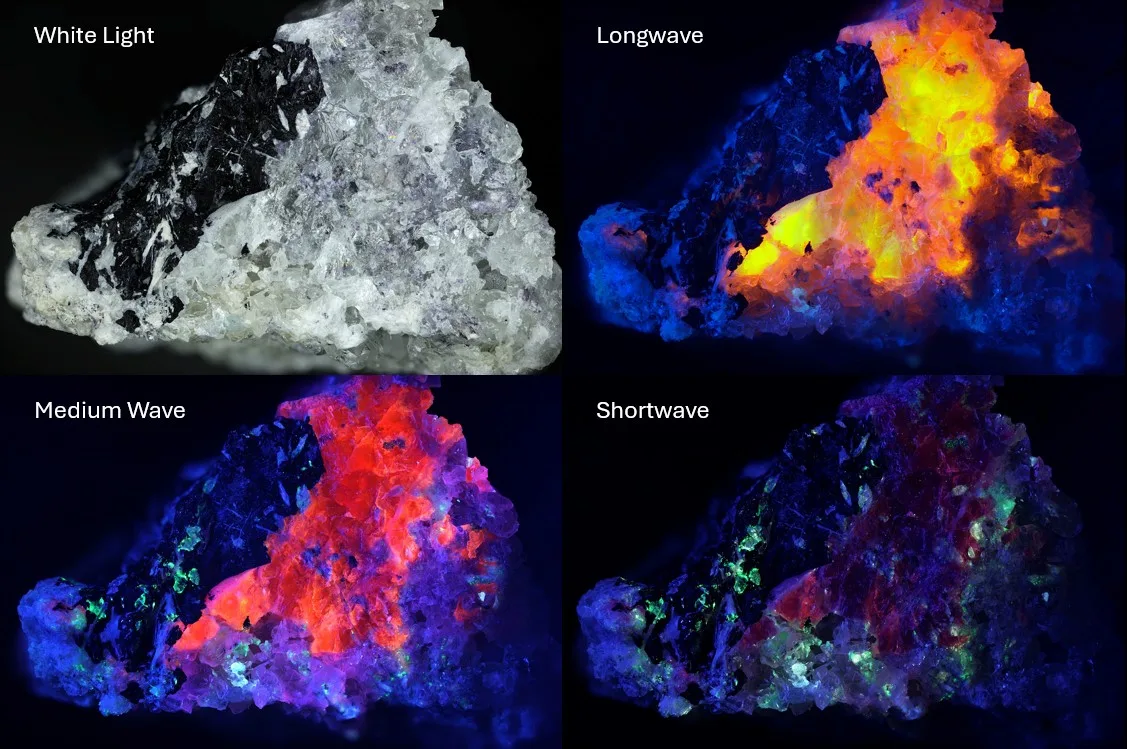
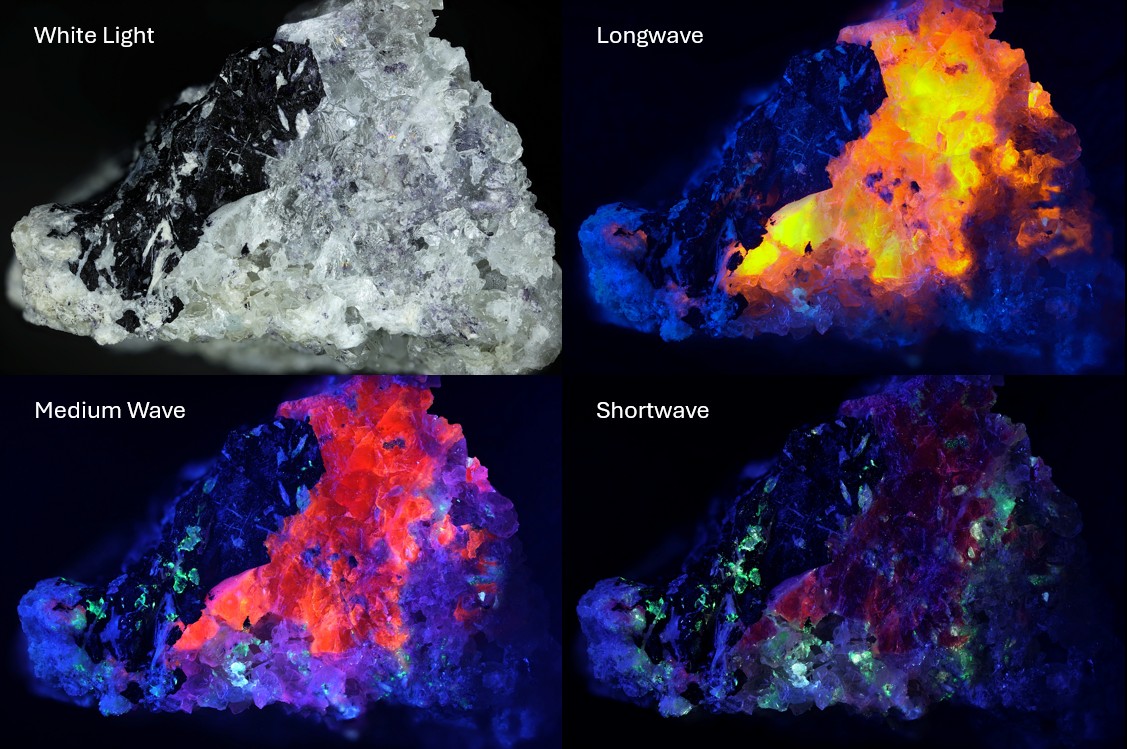
There are very pale acicular crystals of götzenite present, mostly in the bottom left of the specimen (eg: see arrow). The ultraviolet photos show that there are other species present.
Götzenite is reported to fluoresce pale yellow under shortwave, but in each of the UV photos below, it appears light blue, which is probably due to visible light interference.
The orange fluorescence (longwave) is probably sodalite, although the data doesn’t report strong red under medium wave. This is a problem with the improvements in technology. The LED torches available today are generally more powerful and get a stronger response that earlier lamps that were used to create the data sets.
The yellow-orange area in the longwave photo is possibly made up of three different species. You can see different zones in each of the three UV images. I suspect that, aside from sodalite, calcite may also be present. There is a hint of purple in the white light photo, so possible fluorite present. This can fluoresce a weak red under shortwave. I think that I can see that matching up.
Then there is the green response under medium and shortwave (slightly more so with the latter). I can’t make out any crystals, just white patches. It could be one of the zeolites as a few are recorded as having a green response.
Finally, the black material on the left hand side shows perfect cleavage and no UV response. Possibly ferri-kaersutite.
Below: A combination photo showing the specimen in white light, and three different UV wavelengths. Each photo width of view is 13.5mm.
https://mineralmatters.substack.com/p/anatomy-of-a-mineral-specimen-gotzenite