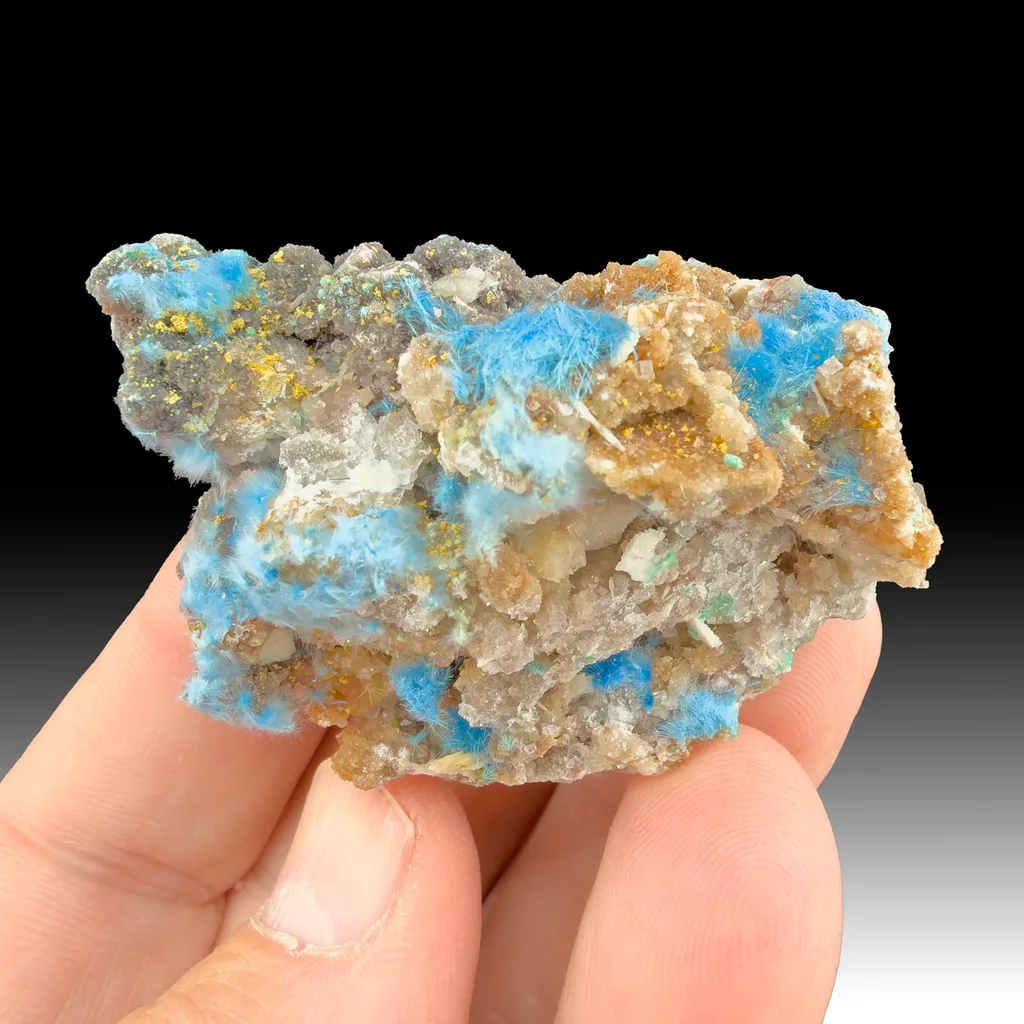
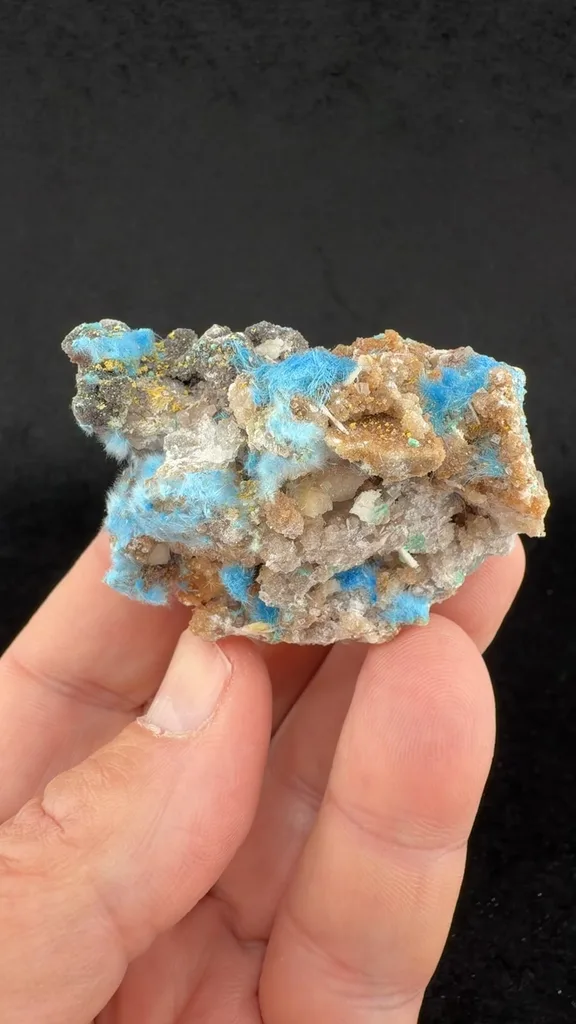
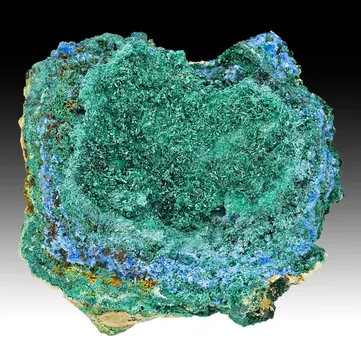
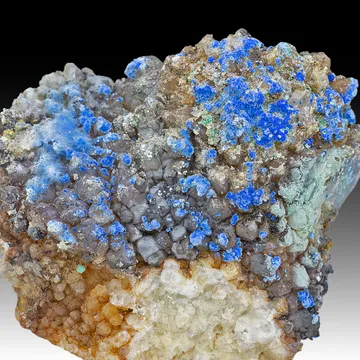
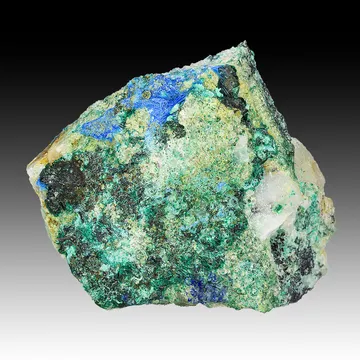
Light blue tufts of acicular cyanotrichite crystals scattered throughout this matrix with colorless crystallized fluorite. Tiny greenish blue sprays of what appear to be carbonate cyanotrichite are present, as well as an unknown yellowish green mineral. The specimen comes with a previous label from the collection Ray DeMark.The Qinglong Mine in Dachang, Guizhou, China, is a major low-temperature hydrothermal antimony and gold deposit whose local extraction history dates back roughly to the late Ming and early Qing periods, with systematic state prospecting beginning in 1953 and continuing today as an active industrial mining district. Geologically, the deposit is situated within the northwestern Youjiang Basin, where mineralization is structurally controlled and primarily hosted in a distinctive altered, siliceous, and argillic horizon known as the Dachang layer. This ore-bearing layer is developed directly at the contact zone between Middle Permian Maokou Formation limestone below and Upper Permian Emeishan basaltic rocks above. The district features extensive faulting, brecciation, and fluid-rock interactions involving organic-rich matter and paleo-oil reservoirs, producing significant concentrations of stibnite, quartz, fluorite, and various secondary minerals.


 Ships from USA
Comments