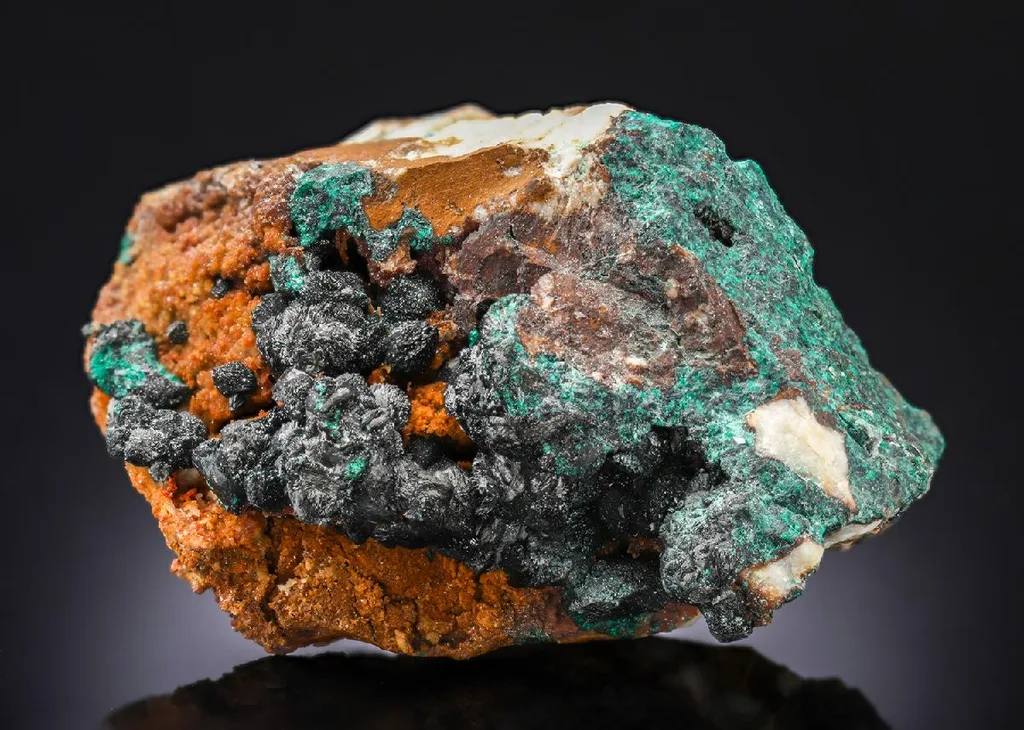
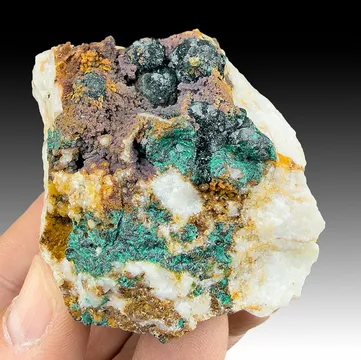
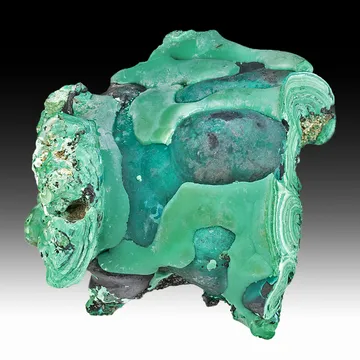
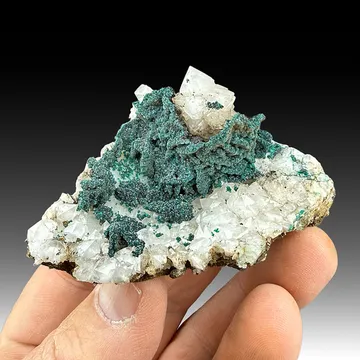
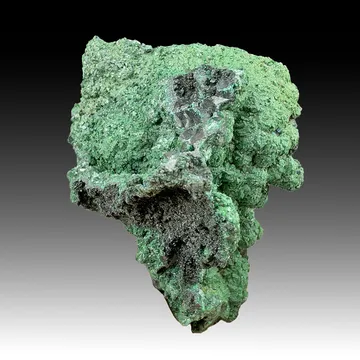
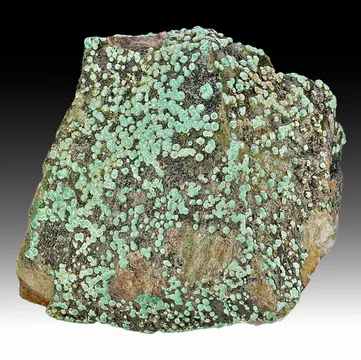
The copper phosphate mineral Pseudomalachite is often thought of as a botryoidal mineral, but old-time specimens from the Type Locality at Virneberg mine, Rheinbreitbach, Rhineland-Palatinate, Germany show that it can, and does occur as distinct crystals. This fine cabinet specimen is remarkable. It consists of Quartz veinstone, in places showing a rusty colour, upon which are rich crystallized somewhat spherical aggregates of deep forest-green Pseudomalachite reaching up to 5 mm in diameter. The individual crystals are scaly to lenticular in form, with a fine glossy lustre. Many of these aggregates coalesce and form a rich coverage some 6 cm in length by up to 3 cm wide, with further massive Pseudomalachite occurring in veinlets throughout the Quartz veinstone. This is an extremely rich and showy specimen of a German classic.


 Ships from USA
Comments