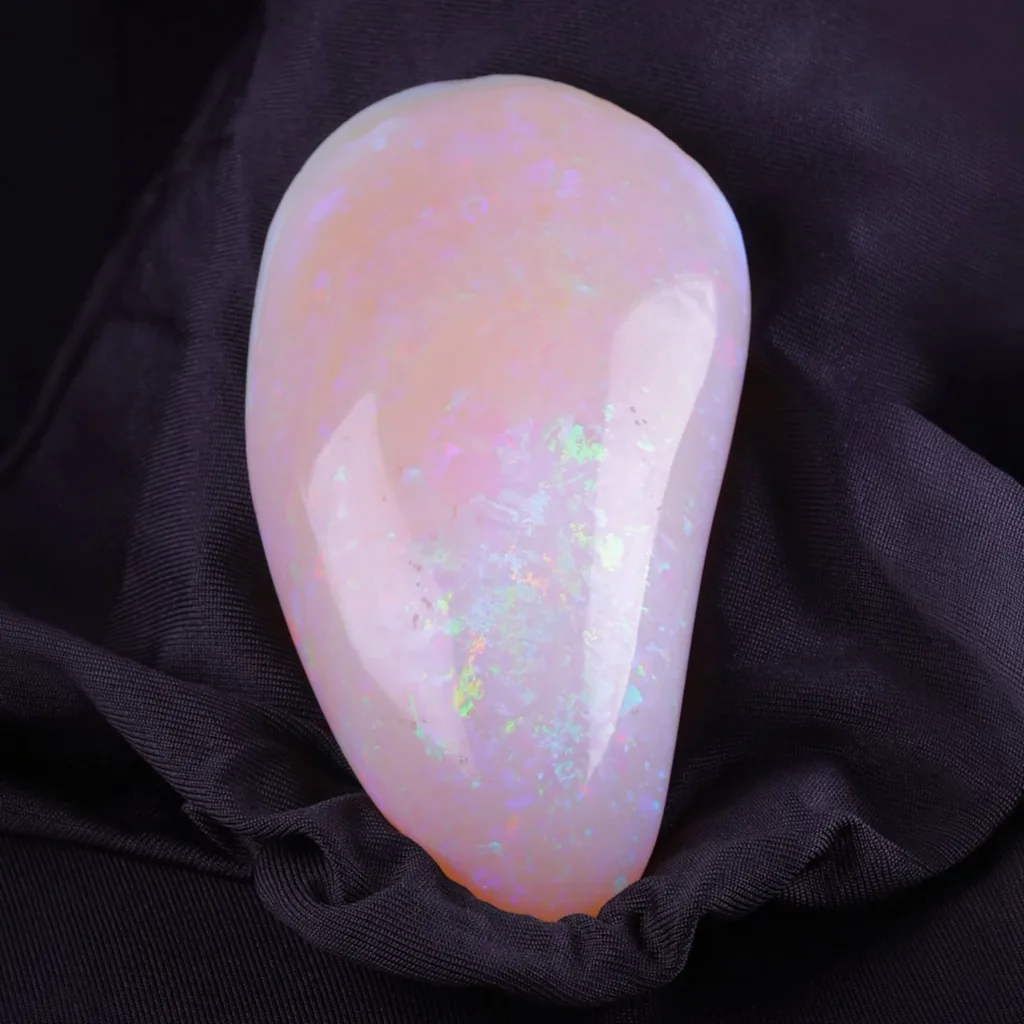
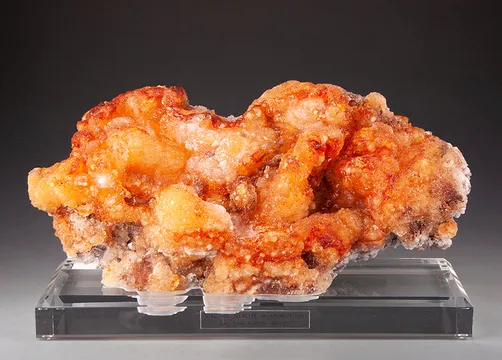
Perhaps the largest known example of this rare and beautiful opal style, it sits at the intersection of both the fossil and gemstone worlds as the opal has completely replaced an ancient mollusc fossil! Coober Pedy fossil opals are world famous and often come as small clams, bivalves, mussels, etc; and sometimes even as seagoing reptile bones. However, any surviving piece of this size, much less complete, is unbelievably rare. This was purchased by Mike Scott in the 1980s. We are not aware of a larger example in this quality. It is approximately 100 to 115 million years old, Cretaceous aged. Weight is 139 grams (695 carats) of pure carving-quality opal and, in fact, that is the fate of all too many of these items. They are often cut for the quick and easy opal "nodule" within. A remarkable survivor. One of many mineral specimens and lapidary oddities only recently deaccessioned (2025) from the estate of a former customer: gem collector, science supporter and donor, and mineral collector, former Apple CEO Michael "Scotty" Scott. The minerals Lavinskyite and Scottyite were first found on the same specimen; and after Lavinskyite was identified, Scottyite was then named in his honor for his long term contributions to research and science through the same laboratory that we also helped support (the NASA-affiliated Bob Downs lab and the systematic mineralogy project RRUFF, at the University of Arizona). It was a great honor to receive some limited amount of minerals from his estate to return back to the mineral collecting public. He was a voracious collector and museum exhibitor (by loans) of, primarily, gemstones; but he also built a companion collection of mineral specimens for his own enjoyment, although they were seldom exhibited outside his home. Michael "Scotty" Scott (1945–2025) was an American entrepreneur, who was the first CEO of Apple Computer from February 1977 to March 1981.

Comments