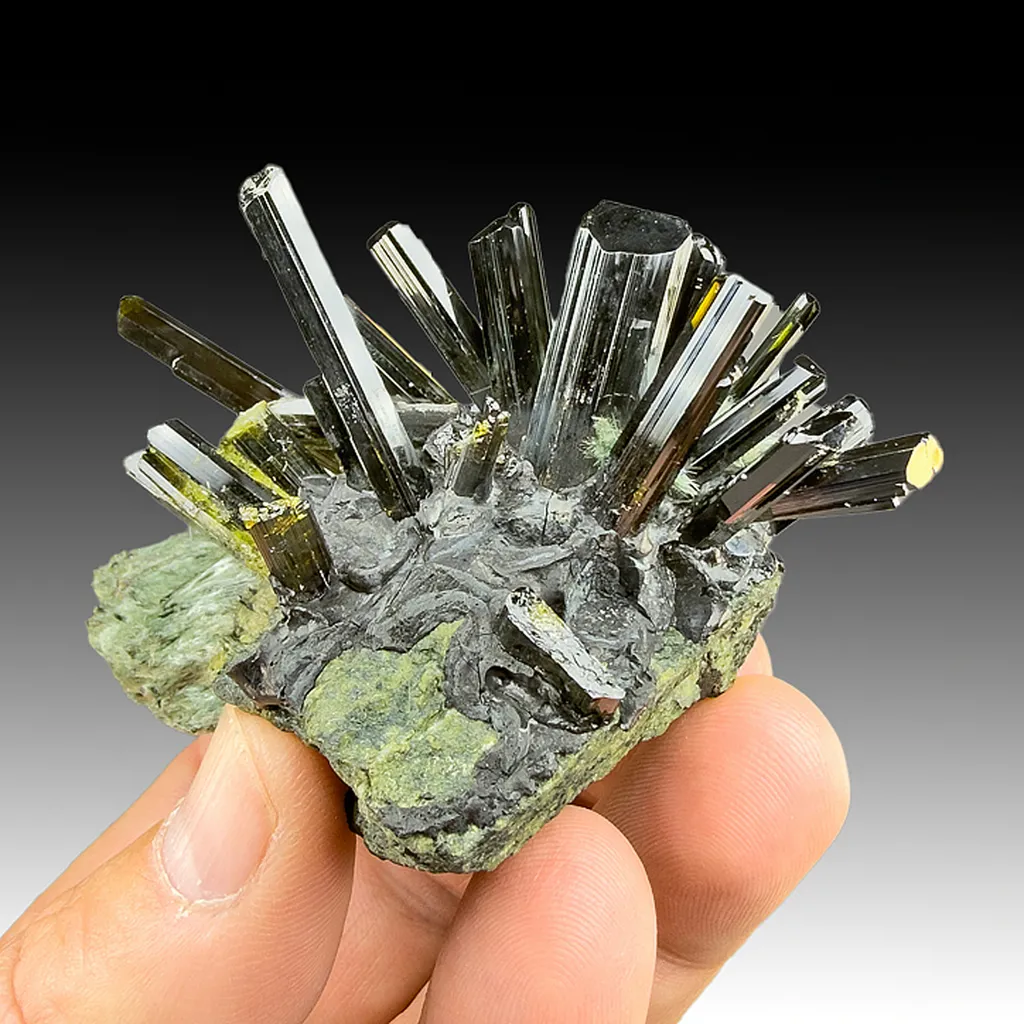
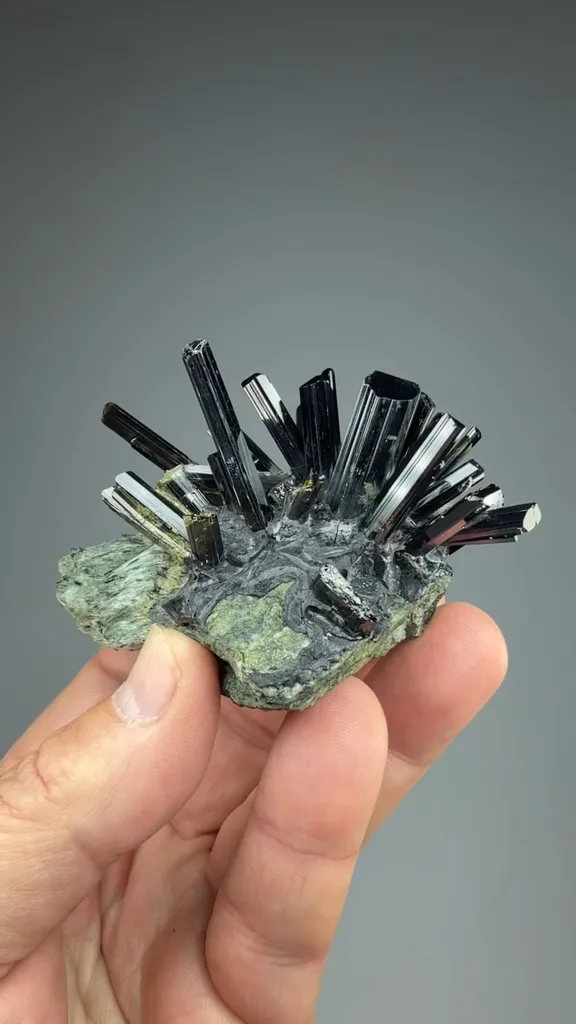
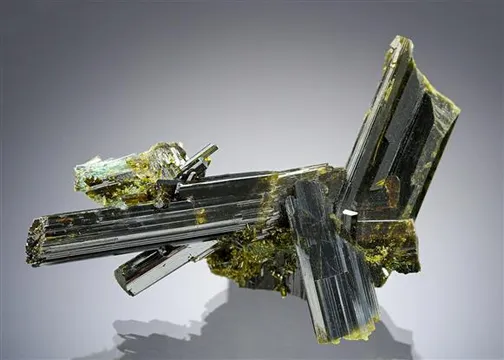
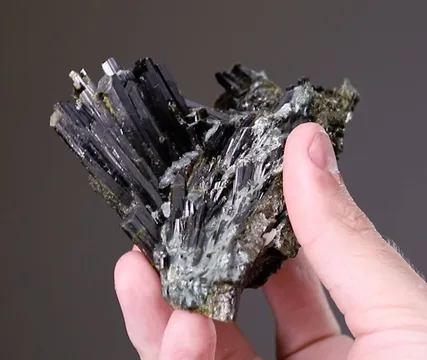
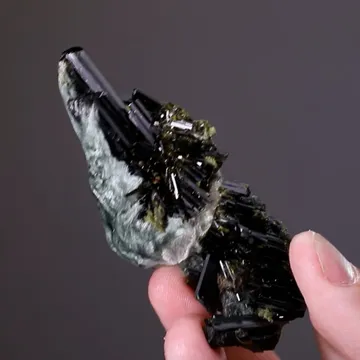
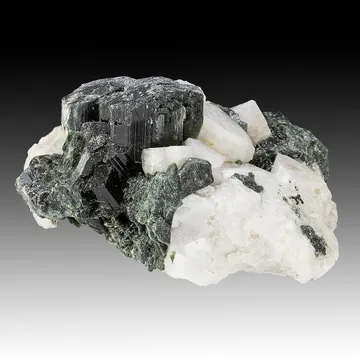
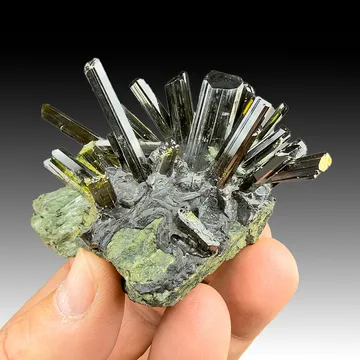
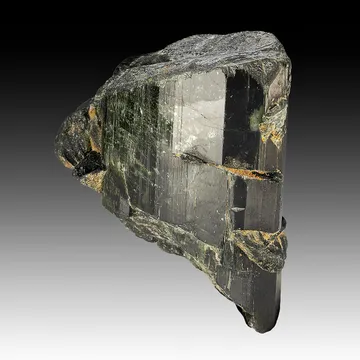
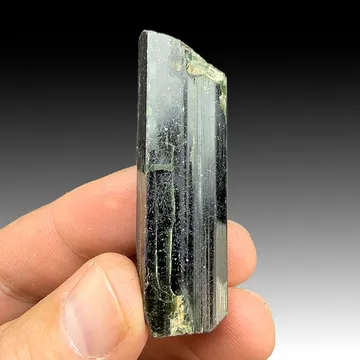
Classic Alpine specimen, this is a very artistic fake. There are at least 15 very good lustrous deep green epidote crystals, these having been artfully stuck into a matrix of actinolite. The price reflects what I believe the 15 loose epidote crystals would bring if sold individually. This is such a neat classic Alpine curiosity from the 19th century, I just could not bring myself to take it apart. Ex collection of Wilhelm Hoyer. The specimen comes with an antique label as shown at the end of the video.The Knappenwand, located in the Untersulzbach Valley of the Hohe Tauern Mountains in Austria, is arguably the world's most famous locality for epidote. Discovered in 1865 by Alois Wurnitsch, the site quickly gained international renown for producing slender, lustrous, and deep green crystals of extraordinary size and quality. Geologically, the deposit is a classic Alpine-cleft system hosted within the "Prasinite" (metamorphic greenstone) of the Habach Formation. These minerals formed during the late stages of the Alpine orogeny, as hydrothermal fluids circulated through open fissures created by tectonic stretching. Beyond epidote, the Knappenwand is known for associated minerals like actinolite, apatite, and titanite.Because of the high value and delicate nature of these specimens, a history of clever "faking" or "repairing" developed among early collectors and dealers. To create more aesthetic pieces, some would take high-quality individual crystals and glue them onto a more attractive matrix using a mixture of pulverized rock, resin, or even hide glue. In some cases, multiple small epidote crystals were attached to a single base to simulate a "cluster" that never existed in nature. Sophisticated fakes sometimes involved drilling small holes into a host rock to perfectly seat a loose crystal, then concealing the seam with a paste of crushed chlorite or local minerals. These "composite" specimens can often be detected under ultraviolet light, which may cause the ancient adhesives to fluoresce, or by careful inspection with a microscope to find unnatural gaps between the crystal and the matrix.



 Ships from USA
Comments