






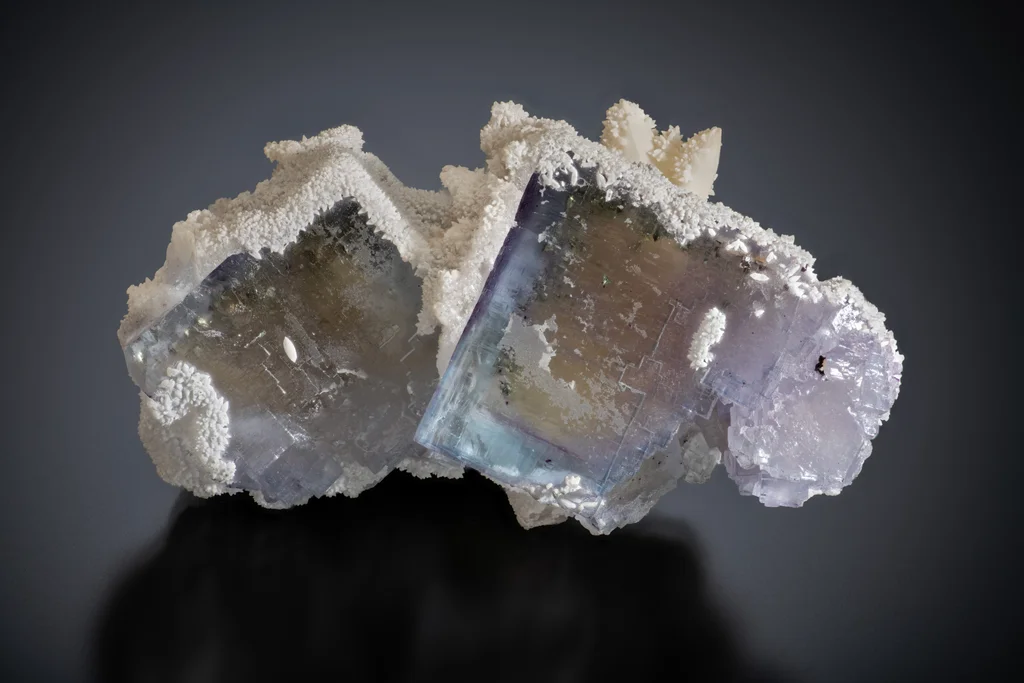
Paralstonite
2 in the gallery
Paralstonite is a rare carbonate mineral with the formula BaCa(CO3)2, typically forming prismatic to tabular crystals that can be transparent to translucent. It exhibits a vitreous lustre and a light, pale color range of colorless to gray, often with a white streak. Crystals can display good cleavage and an uneven fracture, and they commonly occur in prismatic, tabular, or granular habits, sometimes forming in massive aggregates within carbonate-rich environments. The mineral belongs to the alstonite group of carbonate minerals and is stabilized as an anhydrous carbonate, highlighting its carbonate chemistry and relatively high hardness for carbonate minerals. Paralstonite’s crystalline structure is trigonal, contributing to its delicate, elongated forms seen in specimens from suitable hydrothermal or sedimentary carbonate settings.
- Formula
- BaCa(CO3)2
- Rarity
- Rare
- Stability
- Stable
- Collector interest
- High Interest
- Classification notes
- Carbonate; anhydrous carbonate, alstonite group
Key characteristics
- Crystal system
- trigonal
- Mohs hardness
- 4–4.5
- Specific gravity
- 3.64–3.7
- Luster
- vitreous
- Transparency
- transparent, translucent
- Color
- colorless, white, gray
- Streak
- white
- Cleavage
- good
- Fracture
- uneven
- Crystal habit
- prismatic, tabular, granular, massive
Where Paralstonite is found
Top localities
- Minerva No. 1 Mine1 specimen
About Paralstonite
Collectors seek Paralstonite for its rarity and its clean, well-formed crystals that can be displayed singly or in small clusters. Notable specimens are valued for their transparency and the crisp edges of prismatic faces, which contrast with the mineral’s pale coloration. Localities that yield well-formed Paralstonnite crystals provide desirable material for cabinet displays and meticulous thumbnail or small cabinet pieces. As a rare carbonate with a stable composition, Paralstonite remains of interest to collectors who favor accessory minerals associated with carbonate deposits and the diverse suite of minerals in the alstonite group.