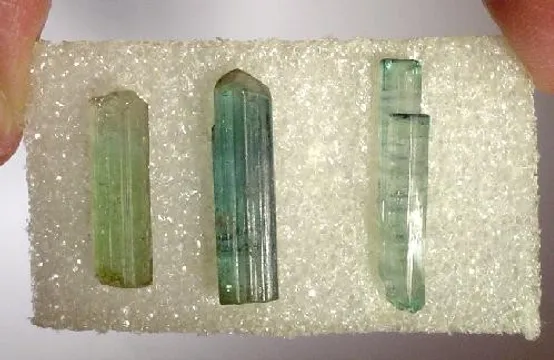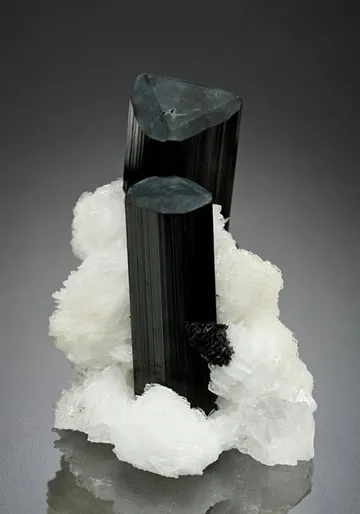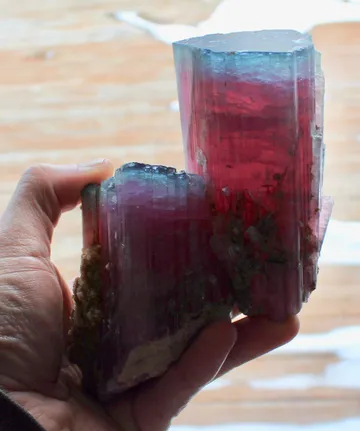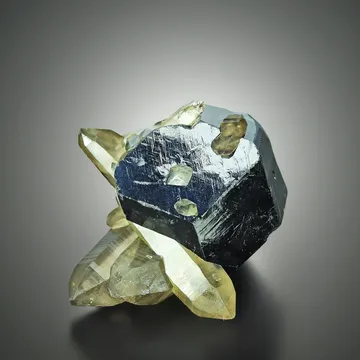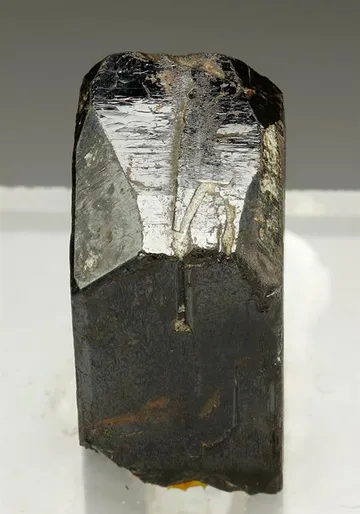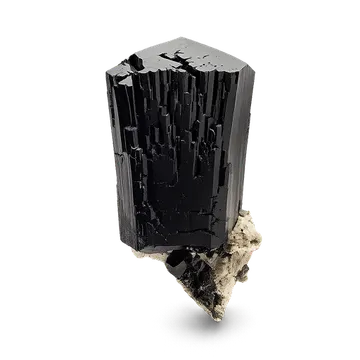
Schorl from the Pala Mining District, California — jet-black, striated tourmaline prisms in pegmatite pockets; prized for contrast, form, and locality history.
Key facts
Schorl from the Pala Mining District is the dark architectural counterpoint to southern California’s famous palette of rubellite, watermelon tourmaline, kunzite, morganite, aquamarine, lepidolite, and pocket quartz. The best pieces are immediately recognizable as pegmatite specimens: jet-black, deeply striated tourmaline prisms standing in sharp relief against white albite or cleavelandite, smoky to gemmy quartz, feldspar, and mica. In a district celebrated for color, the collector appeal of schorl is contrast, form, and locality history.

Photo: Wikimedia Commons
The locality is not a single mine but a classic pegmatite district around Pala in northwestern San Diego County. The named mines and pegmatites that matter most to collectors include the Pala Chief, Tourmaline Queen, Tourmaline King, Stewart, Katerina, Vanderberg, Elizabeth R., and Oceanview workings, among others. These mines lie in a belt of lithium- and boron-rich granitic pegmatite dikes emplaced in the Peninsular Ranges batholithic terrane, with many of the most famous workings on Queen Mountain, Chief Mountain, Little Chief Mountain, and Hiriart Mountain.
Schorl is the abundant iron-rich tourmaline of these dikes. Jahns and Wright described it as the most abundant tourmaline variety in the district, occurring as lustrous black striated prisms, columnar aggregates, bundles of rodlike crystals, pencil-like crystals in wall zones, sprays, and rosettes. That makes Pala schorl more than a side species: it is one of the structural minerals that helps explain where the pockets formed. In many dikes it increases in abundance and coarseness downward from the hanging-wall contact toward the pocket horizon, with exceptionally rich concentrations immediately above pockets and coarse crystals in the pockets themselves.
For collectors, the finest Pala schorl pieces are those that preserve this pegmatite context. A loose black tourmaline prism may be handsome, but a Pala specimen becomes much more desirable when the crystal is stout, glossy, striated, terminated, and still attached to albite, quartz, feldspar, muscovite, or lepidolite. Cabinet and small-cabinet specimens from old collections can be very attractive, and modern Chief Mountain material still appears through Oceanview/Pala Chief activity and local fee-dig finds. The strongest examples are not merely “black tourmaline”; they are miniature cross-sections of a famous American gem district.
Search for specimens: View all schorl specimens from Pala Mining District, California, USA
The Pala Mining District lies in northwestern San Diego County, about 45 miles north of San Diego and east of Fallbrook, near the San Luis Rey River. The old literature and modern locality databases also refer to it as the Pala pegmatite district or Pala gem-mining district. Although “district” is the accepted collector and geological usage, Mindat notes that Pala was not established as an organized mining district in the formal legal sense; claim documents were filed through the county.
Geologically, Pala is a rare-element granitic pegmatite district in the Peninsular Ranges province. Jahns and Wright mapped at least 400 pegmatite dikes in roughly 13 square miles. Most trend northward and dip gently to moderately westward, with many exposed on steep chaparral-covered slopes. The pegmatites are hosted mainly by gabbroic rocks, with older schists and quartzites present as screens, septa, and pendants, and they are interpreted as late-stage differentiates related to the southern California batholith.
The internal structure of the dikes is the key to understanding the specimens. Many have border and wall zones dominated by graphic granite, coarse perthite-rich zones, quartz or quartz-spodumene cores, intermediate zones, fracture fillings, and replacement units. Pocket pegmatite — the rock type that yielded the district’s gem tourmaline, beryl, lepidolite, and spodumene — commonly lies in or near the cores, especially along footwall parts of cores. Schorl occurs both as an accessory in these pegmatite zones and as a conspicuous indicator around pocket-bearing ground.
Mining began formally in the 1870s, but the district’s most active period was 1900 to 1922. By the late 1940s, recorded output included large tonnages of lepidolite, thousands of pounds of tourmaline, and more than a thousand pounds of gem spodumene. More than 50 deposits were mined during the vigorous prospecting period from 1908 to 1914. Activity declined after 1914 as markets weakened, and in the 1920s and 1930s many properties saw little more than assessment work. A revival followed rising demand for domestic tourmaline, kunzite, and pink beryl in the 1940s, and later decades brought sporadic but important collecting and mining.
The district’s best-known mines have different personalities. The Stewart mine is historically important for lepidolite and lithium minerals and for its large composite dike. The Tourmaline King and Tourmaline Queen are classic tourmaline producers on Queen Mountain. The Pala Chief, on Chief Mountain, is tied to the early history of gem spodumene and to spectacular tourmaline and beryl specimens. The Katerina and Vanderberg workings on Hiriart Mountain are famous for unusual minerals as well as spodumene, beryl, quartz, and tourmaline. The Elizabeth R. and Oceanview workings have extended the district’s modern specimen story, especially for beryl, quartz, colored tourmaline, and kunzite.
Collecting access is highly controlled. Much of the historic district lies on private claims, patented mining ground, reservation land, or active mine property. The old Jahns and Wright report already noted that many roads were unmaintained or impassable and that most mines could be reached only by trail; modern collectors should treat all mine openings and dumps as permission-only sites. The Oceanview and Pala Chief operations have offered fee digs by reservation, with conditions, schedules, age limits, equipment requirements, and access rules set by the operators. The Pala Chief is not generally open except for special digs; Oceanview-style public digging is based on screening mine material rather than unsupervised collecting in old workings.
Notable finds from the broader district include Pala Chief kunzite, Tourmaline Queen and Tourmaline King tourmaline, Katerina spodumene, Stewart lepidolite, Elizabeth R. morganite, and modern Oceanview pockets. Schorl is present through that history as both a collected species and an associated mineral: black tourmaline in the dike, black cores or ends in color-zoned tourmalines, and dark prisms forming contrast specimens with albite, quartz, feldspar, and mica.
Pala schorl is typically deep black in hand specimen, with a bright vitreous luster when fresh. Jahns and Wright reported that it appears blue to deep violet under the microscope, but in collector terms the species reads as black: black rods, black prisms, black bundles, and black crystal groups against white or pale pegmatite minerals.
The classic habit is a striated trigonal prism. Good crystals show strong lengthwise ribbing, robust triangular to rounded-triangular cross sections, and flat or modified terminations. Some specimens are doubly terminated, especially those that grew in pocket space or were later freed from soft pocket material. Others are contacted on one side where they were attached to pocket walls, quartz, feldspar, or albite.
The district also produced schorl in less conventional forms. Jahns and Wright described pencil-like crystals scattered through perthite-rich wall zones and outer intermediate zones, locally in swarms. They recorded nearly parallel crystals developed normal to wall-rock contacts, mineral contacts, or fractures. They also described sprays and rosettes, including crude rosettes in the Stewart dike up to 7 feet across, with similar large radial aggregates in the Tourmaline King, Tourmaline Queen, and Pala Chief pegmatites. These giant radial aggregates are more geological features than normal cabinet specimens, but they help explain why loose and partial rods are common in district material.
Associated minerals are central to locality attribution and specimen quality. The most characteristic companions for schorl are albite and cleavelandite, quartz, feldspar or perthite, muscovite, and sometimes lepidolite. In the district’s pocket assemblages, schorl may occur near or with colored elbaite, beryl varieties such as morganite and aquamarine, spodumene varieties including kunzite and triphane, garnet, columbite-tantalite minerals, mica, and bismuth minerals. For display, the most effective pieces are those with black schorl set against white albite blades, smoky quartz, pale feldspar, or silvery-green muscovite.
Size is variable. Small rods, splinters, and partial prisms are common in mine-run material and fee-dig gravel. Good miniatures and small cabinets with terminated crystals several centimeters long are collectible. Cabinet specimens with stout, lustrous crystals and matrix are scarcer. Geological masses and rosettes can be enormous in place, but intact display specimens from such aggregates are rarely as aesthetic as pocket-grown prisms.
Condition is a defining factor. Jahns and Wright noted that some Pala schorl crystals are shattered, chalky, fractured parallel to the base, healed with quartz or albite, or recemented with finer-grained black tourmaline. That is not merely damage from mining; much of it reflects the internal stress, alteration, and later fluid history of the pegmatite. In the hand, that means a collector should expect many Pala schorls to have pocket contacts, rehealed fractures, basal parting, tiny edge rubs, or etched areas. The best examples stand apart by their wet luster, complete terminations, robust form, and honest matrix composition.
One special identification issue in Pala tourmaline is color zoning. The district is famous for crystals that grade from black to green, pink, colorless, or blue, and Jahns and Wright specifically noted that the end nearest the pegmatite wall is commonly black while the crystal becomes an alkali-bearing tourmaline toward the other end. A dark crystal from Pala may therefore be schorl, an elbaite-schorl series specimen, or a dark elbaite that appears black until backlit. For a strict species label of “schorl,” analytical confirmation is ideal; for market labeling, “black tourmaline” is sometimes more cautious unless the specimen has strong provenance or published identification.
Pala schorl is available, but fine examples are not abundant. Small fragments, single black prisms, and mine-run pieces appear from modern Chief Mountain dig material and older collections. Better matrix specimens — especially terminated schorl on albite, quartz, feldspar, or mica from Pala Chief, Elizabeth R., Vanderberg, Katerina, Tourmaline Queen, or Tourmaline King — are more selective purchases. Recent public auction records show small-cabinet Pala schorl specimens with robust striated prisms selling in the low hundreds of dollars, while rarer gem tourmalines from the same mines can bring more because they are actually colored elbaite revealed by backlighting.
The main authenticity issue is not a flood of fabricated Pala schorl. Schorl is common enough that outright fakes are generally less profitable than mislabeling, over-cleaning, repair concealment, or vague locality attribution. For Pala, the most important question is provenance: “Pala District” is acceptable when the exact mine is lost, but a label naming Pala Chief, Elizabeth R., Katerina, Vanderberg, Stewart, Tourmaline Queen, or Tourmaline King should ideally be supported by an old tag, collection history, dealer record, or matrix/mineral association consistent with that mine.
Repairs are a normal risk with tourmaline specimens, and Pala material is no exception. Look closely at basal fractures, reattached terminations, joins hidden by albite or mica, and suspiciously clean breaks. Use a loupe and strong side lighting. Glue often shows as a glossy line, a meniscus in a crack, dull fluorescence under UV, or a seam with dust trapped along it. A repaired specimen may still be collectible, but the repair should be disclosed and priced accordingly.
Polished or trimmed terminations are another concern. Natural tourmaline terminations tend to show growth texture, small pits, triangular geometry, and face relationships consistent with the prism. A perfectly flat, mirror-like end with no growth features may be a cut or polished break. Pala schorl commonly has contacted areas where it grew against pocket walls; these should not be confused with damage, but the distinction matters for value.
Condition expectations should be realistic. Many Pala schorl crystals are naturally fractured, etched, rehealed, or partly chalky. Basal parting and side bruises are common. Matrix pieces may have contacts where quartz, feldspar, or albite was removed. The premium goes to specimens with glossy black faces, strong ribbing, complete or visually satisfying terminations, stable matrix, and good contrast.
For species accuracy, be cautious with dark tourmalines from Oceanview and related Chief Mountain workings. Some crystals that appear black in normal light are red, purple, blue, or green when backlit. These are often more valuable as gem or colored tourmaline specimens than as schorl. Before buying or selling a “schorl” from Pala, shine a strong light through thin edges or terminations. If color appears, describe it honestly as dark elbaite, elbaite-schorl series, or black-appearing gem tourmaline, depending on evidence.
The old Pala prospectors learned to read the mountain by its float. On the slopes and in gullies they followed loose pieces of lepidolite, tourmaline, and euhedral quartz uphill toward the pegmatite ledges. In places, coarse green muscovite flakes were enough of a sign to lead them toward gem-bearing portions of nearby dikes. The method was simple and physical: trace the broken fragments back to their source, cut into the ledge, and hope the black rods of schorl and the white quartz were announcing something richer inside.
The mining itself was not a romantic stroll through soft clay. Most of the Pala pegmatites were hard and unweathered, and the sugary fine-grained units were especially tough. Drilling and blasting were required in nearly all mining, but the gem pockets punished impatience. Jahns and Wright recorded that indiscriminate blasting ruined quantities of gem and specimen material before miners learned to work the pockets more carefully with screwdriver, chisel, small pick, bar, and hammer. Broken rock was moved by wheelbarrows, skips, cars, hand windlasses, mule-drawn whims, chutes, and tramming to the portals. In a dry district where groundwater was not a mining problem, operators often had the opposite difficulty: they had to haul water into nearly all workings during active mining.
One of the district’s great discovery scenes came in 1902 at the Katerina pegmatite. M. M. Sickler and his son Frederick were doing assessment work when they broke into a concentration of large quartz crystals set in unusual pinkish clay. Mixed into that clay were splinters and coarse nodular to blade-like fragments of a clear mineral, colorless to straw-yellow and pale lilac. Neither man could identify it. That winter they sent specimens east to George F. Kunz of Tiffany & Co., who recognized the material as spodumene. The gem variety soon became famous as kunzite, but the setting of the discovery was pure Pala: quartz, clay, lithium minerals, tourmaline-bearing pegmatite, and a pocket assemblage that made the district a name collectors still recognize.
The Pala Chief story developed almost immediately afterward. Frank A. Salmon, Bernardo Hiriart, Pedro Peiletch, and John Giddens located and staked the Pala Chief gem deposits in May 1903. The mine became one of the district’s great showpieces, producing tourmaline, beryl, and spodumene and becoming famous for a large early pocket called the “Bridal Chamber.” A 1915 Pala Chief Gem Mining Company booklet promoted the mine and its tourmalines during the San Diego Exposition, and contemporary descriptions emphasized the pegmatite’s black tourmaline, graphic granite, lepidolite-rich pockets, and gem-bearing zones.
A century later, the Oceanview story repeated the old Pala pattern of persistence before pocket. In late 2001 Jeff Swanger and his crew began a new adit on a lower part of the Ocean View pegmatite system. They drilled and blasted through barren rock for nearly two years before the first real pocket appeared. Then they kept going for more than three additional years and more than 400 feet of tunnel before real indicators returned. On 22 September 2007, after 421 feet of tunneling and with permitting pressure limiting the work, Steve Carter and Phil Osborn found clay balls and a beryl specimen in the muck after a blast. The discovery became the 49er Pocket, named because the date was Jeff Swanger’s forty-ninth birthday and because the name echoed California’s 1849 mining mythology.
The Oceanview miners then experienced the pegmatite’s teasing logic. After the 49er was worked, they stoped up-dip and found pockets with smoky quartz, feldspar, and minor schorl — worthwhile specimens, but not the lithium-bearing gem minerals they were chasing. Only about 40 feet away in the same dike, the Elizabeth R. workings had yielded beautiful kunzite. Opposite the 49er stope, a small roughly one-square-meter zone in the footwall showed pink clay and tiny pale spodumene fragments. It seemed to whisper “dig here.” In November 2009 small etched kunzites appeared, up to 2.5 cm; on 3 December, the first major Oceanview kunzite pocket opened, yielding several kilograms of gem-quality material, including a single crystal over 300 grams.
By spring 2010 the signs intensified. The miners hit lepidolite masses reminiscent of the Stewart Lithia mine. The tourmaline changed as they worked: black schorl first, then very deep purple crystals with pale green tips, then a basketball-size pocket of green to bicolored green-blue pencils, and then pink tourmalines frozen in massive lepidolite. The zone became the Big Kahuna, named for Jerry Swanger, the mine owner’s father. It was not just one clean cavity but a zone, with a central pocket about three meters wide, two meters deep, and three quarters of a meter high, plus satellite pockets. For a schorl collector, the important detail is the sequence: black schorl was the early sign on the way into one of the modern district’s great colored-tourmaline and spodumene zones.