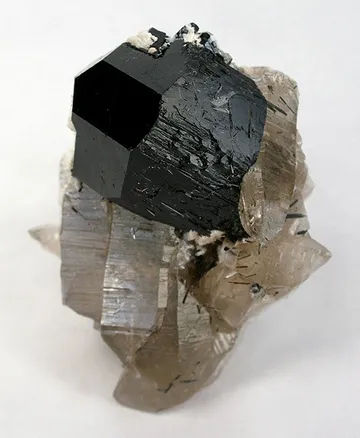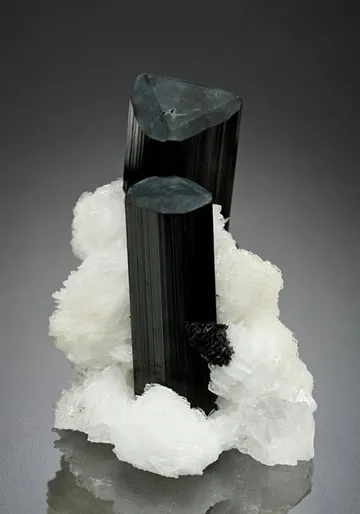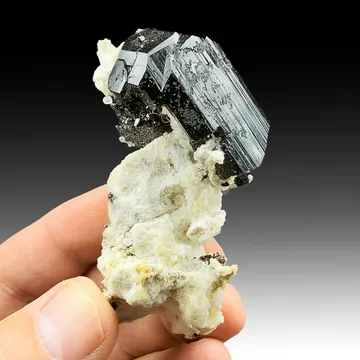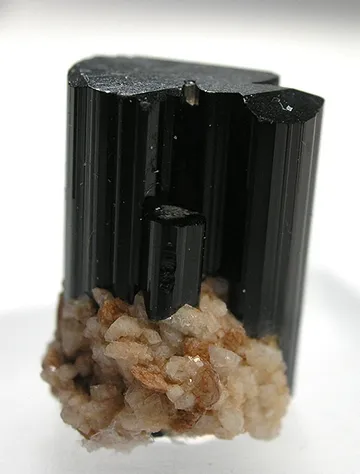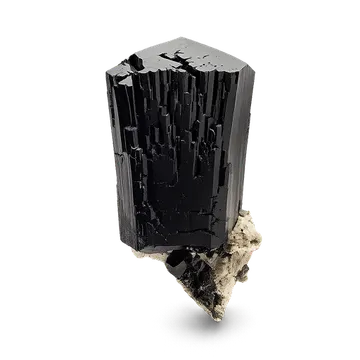
Schorl from Erongo Mountains, Namibia - glossy, architectural black tourmaline with sharp trigonal prisms; a top collector locality for striking specimens.
Key facts
The Erongo Mountains are one of the few localities where black tourmaline can carry a specimen on aesthetics alone. Erongo schorl is not merely “black tourmaline”: the best pieces are glossy, architectural, and sharply geometric, with stout trigonal prisms, flared hemimorphic terminations, “Mercedes” patterns, hollow-ended growth, and floater clusters that look carved rather than broken from granite. When the black prisms are set against blue aquamarine, smoky quartz, white feldspar, green fluorite, or fluorescent hyalite opal, the contrast is among the most immediately recognizable mineral aesthetics from modern Namibia.
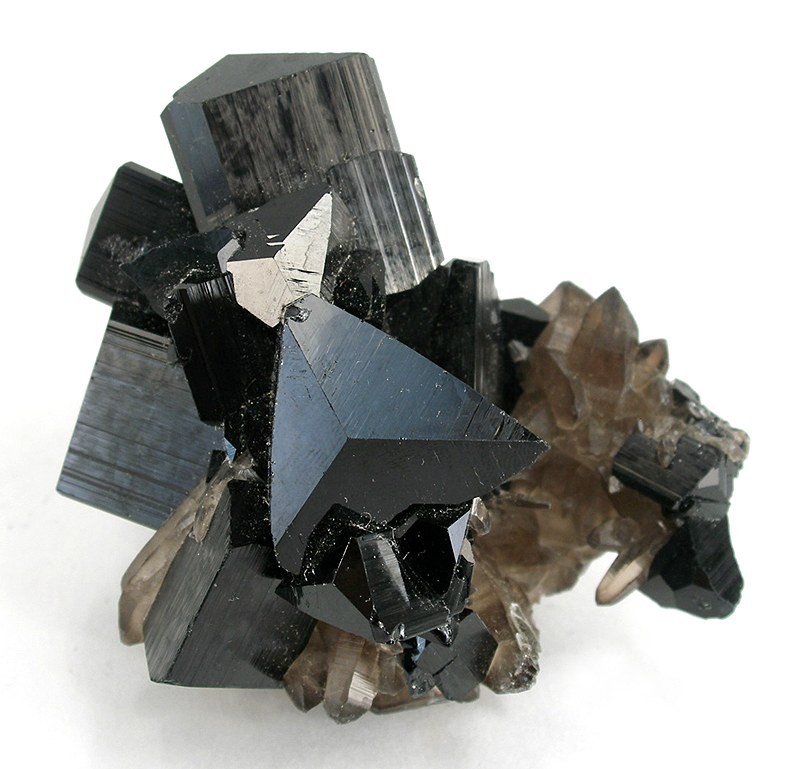
Photo: Wikimedia Commons
Geologically, the setting is a collector’s dream version of an anorogenic granite system. The Erongo is the eroded core of a Cretaceous volcano-plutonic complex: a broad, ancient volcanic structure later intruded by granite and granodiorite. Within the Erongo Granite, volatile-rich miarolitic cavities and quartz-tourmaline “nests” concentrated boron, fluorine, beryllium, tin, tungsten, and other incompatible elements. That unusual boron enrichment is why tourmaline is not a minor accessory here but a major pocket mineral, often dominating the cavities in which aquamarine, fluorite, topaz, jeremejevite, orthoclase, muscovite, quartz, and hyalite formed.
The modern collecting history is tightly tied to the 1999–2006 burst of Erongo specimen production. Mineral collecting in and around the mountains goes back to the early twentieth century, but the locality’s reputation changed dramatically with late-1990s and early-2000s discoveries of exceptional aquamarine, schorl, fluorite, and jeremejevite. The April 2000 “Easter Pocket” aquamarines at Bergsig 167 brought enormous attention; major schorl finds followed, including large trigonal groups and highly lustrous crystals that placed Erongo among the world’s most important schorl localities.

Photo: Wikimedia Commons
Collectors look first for form. A fine Erongo schorl should have strong three-dimensional architecture, crisp prism edges, sharp or complex terminations, and enough surface luster to keep a black mineral visually alive under cabinet lighting. Matrix and association matter enormously. Schorl with pale blue aquamarine is the classic contrast piece; schorl with smoky quartz gives a darker, more sculptural pegmatite look; schorl with fluorite or hyalite adds color and fluorescence; and schorl on white orthoclase or albite can make the black crystals appear especially crisp.
Search for specimens: View all schorl specimens from Erongo Mountains, Namibia
The Erongo Mountains lie in west-central Namibia, north of Usakos and southwest to west of Omaruru, rising abruptly from the surrounding plains. The massif is often called “Erongo granite” by collectors, but that shorthand conceals a more complicated volcano-plutonic complex. It is a large Cretaceous intrusive and volcanic system, roughly circular in outline, built from volcanic rocks and later intruded by granitic to granodioritic bodies. The mineral specimens that concern collectors mainly come from miarolitic cavities and quartz-tourmaline segregations in the Erongo Granite, rather than from a single conventional mine.
The deposit type is best understood as an anorogenic, subvolcanic granite with NYF-type miarolitic pegmatitic cavities and quartz-tourmaline orbicules or “nests.” The pockets are not long, zoned LCT pegmatite bodies like many tourmaline deposits of the Karibib district; they are cavities and segregations within the granite itself. The chemistry is unusual for an anorogenic granite because the system is strongly enriched in boron and volatiles. That enrichment produced abundant tourmaline in miaroles, quartz-tourmaline nests in granite, and a suite of boron- and fluorine-related collector minerals.
The Erongo Granite is related to Early Cretaceous rifting and the broader magmatic events associated with the breakup of Gondwana and opening of the South Atlantic. Published geochronology places major Erongo magmatism in the broad 136–130 Ma interval, with the Erongo Granite itself commonly cited around 133–132 Ma. The Namibia Geological Survey’s Roadside Geology sheet describes the Erongo as one of northwestern Namibia’s largest Cretaceous granitic complexes and as the eroded core of an ancient volcano with peripheral and central granite intrusions.
Mining and collecting history divide into two overlapping stories. The older story is economic: tin-bearing pegmatites and tungsten-tin-fluorine mineralization around the Erongo were worked long before the modern collector boom. Historical tin workings were mapped at Ameib 60 and Davib Ost 61 in the early twentieth century, and Krantzberg became an important tungsten-tin mine, operating intermittently until its closure in 1979. Those older operations produced some collectible minerals, but they were not the source of the great modern schorl matrix pieces.
The modern collector story began in earnest at the end of the twentieth century. The Mineralogical Record account of the Erongo Mountains notes early specimen production over nearly 90 years, but emphasizes the 1999–2006 discoveries that changed the locality’s standing internationally. In spring 1999, miarolitic cavities in the Erongo Granite began yielding good crystallized schorl and topaz for the collector market. The major schorl discovery at Tubussis 22 in 1999, the April 2000 Easter Pocket aquamarines at Bergsig 167, and subsequent finds of schorl, fluorite, jeremejevite, topaz, smoky quartz, and hyalite established the locality’s modern reputation.
Production is overwhelmingly artisanal. Local small-scale miners work pockets in steep granite terrain, often following visible quartz-tourmaline nests as clues. Cavities may be small and barren, clay-filled, or large enough to yield cabinet and museum-sized plates. Published field accounts describe pockets from less than 10 cm across to tubular cavities 50–80 cm wide and more than 2 meters deep, with some larger workings several meters across. Because the productive pockets are scattered through rugged, privately owned mountain land, output has always been episodic. A single productive pocket can place specimens on the international market for months; then years may pass with only modest production.
Collecting access is not casual. Much of the Erongo is private farmland, and portions lie within the Erongo Mountain Nature Conservancy. The farms and areas named in collector literature—Bergsig 167, Tubussis 22, Davib Ost 61, Ameib 60, Erongorus 166, Hohenstein Gorge, Lion’s Head, and others—are not open public collecting grounds. Namibia’s mineral rights are state-controlled, and prospecting or removal requires proper authorization. Export of minerals, gemstones, and geological specimens from Namibia requires official documents. For collectors, the practical route is to buy from reputable Namibian dealers, established international dealers, or well-documented old collections rather than attempt unauthorized field collecting.
Erongo schorl is typically black to jet black in hand specimen, but “black” undersells it. The finest crystals have a bright vitreous luster, almost lacquered on smooth prism faces, and the high reflectivity gives large clusters their sculptural presence. Other pieces are more matte, with dense vertical striations that can make the prism faces look ribbed or vinyl-grooved. Both styles are legitimate Erongo habits, and both can be desirable when the crystal form is strong.
Crystal habit is the locality’s great strength. Erongo schorl occurs as individual prisms, divergent sprays, floater clusters, matrix plates, acicular aggregates, pseudo-isometric equant crystals, and complex hemimorphic forms. Many crystals show different terminations at opposite ends: one end may carry a pyramidal termination, while the other flares or splays into multiple trigonal surfaces. Collectors often refer to the threefold termination pattern as “Mercedes” style, and the best examples show sharp triangular geometry without appearing clumsy or overgrown.
Hollow and cavernous terminations are especially characteristic. In some Erongo crystals, the outer prism faces advanced faster than the center, leaving arena-like hollows at the termination. Later muscovite, fluorite, or other pocket minerals may occupy these cavities. Some crystals show fractured rims collapsed into the hollow and then naturally cemented by continued schorl growth, producing a complex shard-and-frame texture that is distinctive under magnification.
Size ranges are broad. Miniatures and thumbnails are abundant on the market, particularly single crystals and small groups. Good small-cabinet and cabinet pieces are common enough to be a core Erongo collecting category. Published descriptions record individual schorl crystals to about 15 cm, and significant early-2000s finds produced crystals to 20 cm in groups to 50 cm. Modern auction and dealer examples regularly show clusters in the 6–14 cm range, while truly large, complete, highly lustrous display pieces remain much scarcer and command strong prices.
The classic associated minerals are aquamarine, orthoclase, microcline or feldspar group minerals, albite, smoky quartz, colorless to white quartz, fluorite, muscovite, topaz, and hyalite opal. Mindat’s photo-based association data for schorl from the Erongo Mountains heavily emphasizes beryl—especially aquamarine—followed by quartz, fluorite, feldspar-group minerals, opal, muscovite, albite, foitite, goethite, siderite, topaz, and rarer species. The visual vocabulary of Erongo schorl is therefore not a single association, but a series of contrasts: black against blue, black against smoky brown, black against white feldspar, black against green fluorite, and black under glassy botryoidal opal.
Aquamarine-schorl combinations are the most iconic. The strongest examples show freestanding blue beryl rising from or crossing through nests of lustrous schorl, with enough matrix to prove natural association. Some Erongo aquamarines contain schorl inclusions or are partly included at the base, a locality trait that can be very appealing when the beryl remains translucent or gemmy at the termination.
Fluorite associations are a newer collector favorite and can be extremely aesthetic: green to multicolored fluorite perched on black schorl, sometimes with white feldspar, smoky quartz, or hyalite. Fluorite can also include or be pierced visually by schorl, creating specimens that feel more like a pocket story than a simple two-mineral combination.
Hyalite opal is both an aesthetic asset and a condition complication. Some Erongo opal fluoresces vivid yellow-green and may glow under UV; some is non-fluorescent. It occurs as glassy botryoidal coatings and late-stage films over previously formed minerals. On schorl it can add sparkle or fluorescence, but it can also obscure luster if the coating is thick, uneven, or chalky.
Quality factors are specific and unforgiving. The best Erongo schorls have complete terminations, a clean three-dimensional outline, sharp edges, high luster, and little distracting damage. For matrix pieces, the schorl should be visibly integral to the matrix, not just a black mass supporting the more colorful species. For combination specimens, balance matters: aquamarine or fluorite should enhance the schorl rather than hide it. A specimen with one fine schorl crystal and a modest but well-placed aquamarine can be preferable to a busier piece with broken black tourmalines scattered throughout.
Chemically, not every black Erongo tourmaline labeled “schorl” is necessarily pure schorl in the strict modern species sense. Analytical work has documented schorl, foitite, and fluor-schorl compositions in the Erongo system, including zoning from schorl toward foitite in some crystals and fluor-schorl in some granite and quartz-tourmaline nest material. For collectors, “schorl” remains the traditional and market-recognized label for most black Erongo tourmaline, but high-end or research-sensitive specimens deserve the more cautious label “schorl/foitite/fluor-schorl group tourmaline” unless analyzed.
The most important authenticity issue for Erongo schorl is not widespread artificial treatment, but accuracy of species and locality labeling. Black tourmaline from Erongo is commonly sold as schorl, yet published analytical work shows that some material belongs to or trends toward foitite and fluor-schorl. This matters most for systematic collectors. For aesthetic collectors, the distinction may not affect desirability, but it should affect label language. A conservative label such as “black tourmaline, schorl group” or “schorl, possibly foitite in part” is preferable for unanalysed fibrous, altered, or compositionally ambiguous material.
Repairs and reconstructions deserve close inspection on any Erongo combination piece. Aquamarine crystals projecting from schorl nests, schorl groups on feldspar, and fluorite-on-schorl specimens all have natural leverage points where breaks can occur. Repaired contact points are not automatically disqualifying in fine specimens, but they should be disclosed. Watch for glossy adhesive in recesses, unnatural gaps filled with crushed matrix, misaligned growth direction, or a single showy crystal that appears planted into a carved socket. UV inspection can help detect some glues, though not all.
Condition problems are common because the best Erongo habits are complex. Schorl terminations may be naturally hollow, frayed, or growth-interrupted; these should not be confused with breakage. Damage tends to show as fresh, flat, non-lustrous chips across prism edges or termination points. Dense striations can hide tiny bruises, so rotate the specimen under a single strong light. In matrix specimens, also check whether associated aquamarine terminations are intact, whether fluorite cubes are bruised at corners, and whether hyalite coatings have flaked or dulled.
Cleaning requires restraint. Schorl itself is hard and durable, but the associated minerals may not be. Hyalite opal coatings, muscovite rosettes, altered feldspar, and delicate fluorite can be damaged by aggressive mechanical cleaning or harsh chemical treatment. Iron staining is sometimes present on feldspar and schorl; experienced preparators may reduce it, but amateur cleaning can strip away aesthetic opal, loosen repairs, or leave residues in hollow terminations. Specimens with fluorescent hyalite should be treated as opal-bearing combinations, not as simple tourmaline.
Rarity is tiered. Ordinary Erongo schorl thumbnails and small clusters remain available, and modest specimens continue to appear from dealers and online auctions. Attractive cabinet pieces with lustrous, sharp crystals are less common but still obtainable. Top-class matrix schorls, large complete floaters, “Mercedes” termination groups, schorl-aquamarine classics with strong blue beryl, and schorl with vivid green fluorite are increasingly selective purchases. The best early-2000s material is now often seen as old-collection or ex-dealer stock rather than steady current production.
Market availability remains healthy compared with many classic localities, but the quality curve is steep. Small examples may trade in the tens to low hundreds of dollars. Fine small-cabinet and cabinet schorls can move into the mid hundreds or low thousands depending on luster, completeness, association, and provenance. Exceptional aquamarine-schorl or fluorite-schorl combinations are priced more by overall aesthetics than by schorl alone, and a superb blue aquamarine on a lustrous schorl nest can far exceed the price of an equally sized schorl-only specimen.
The Erongo collector boom reads like a field diary written on steep granite. In August 2005, Bruce Cairncross and Uli Bahmann set out to document the mountain’s modern specimen localities, meeting Windhoek collectors Herbert Nagele and Ernst Schnaitmann before driving west toward Usakos. The morning they approached the mountains, an unusual fog had pushed far inland from the Atlantic. The massif appeared through the mist, its peaks lifting out of the pale air before the fog began to clear near Bergsig, where Gerd Bachran was waiting.
Bachran, based in Swakopmund, knew both the terrain and the local Damara miners. He arranged for David from Tubussis to guide the group up into the collecting ground. The route began through granite boulder scree and thornveld, where even low on the slope the mineralizing system announced itself: black schorl in coarse quartz protruded from weathered boulders as tougher “nests,” standing proud from the softer granite around them. Those knobby quartz-tourmaline clues are exactly what miners look for when deciding where to open a pocket.
The climb was sobering. The easiest way into the productive zones was through a Schlucht, a gorge-like valley; otherwise the route meant steep granite faces. In some sections, miners used ropes to pull themselves up the rock. Shortly before the visit, a miner had died while climbing with a jackhammer on his back. A rope snapped, and he fell down the slope. Cairncross recorded the detail plainly, and it changes how one sees every beautiful Erongo matrix piece: many were won from terrain where even reaching the pocket was dangerous.
The granite itself helped and threatened at the same time. Its coarse texture—quartz and interlocking feldspar laths up to 5 cm—gave rubber-soled boots something to grip, but the slopes still ran at 40° to 60°. The local guides moved with casual confidence. The visiting geologists and collectors, less adapted to the mountain, had to learn the rhythm. At one point a miner appeared in a crevice about 100 meters above them, waving down from the very place they were headed.
At the productive zone on Bergsig, the old pockets were already empty mouths in the granite, with small tailings sliding downslope. Some cavities were barely 10 cm across. Others were tubular openings 50–80 cm wide and more than 2 meters deep. The miners selected them from the telltale quartz-schorl nests, but not every cavity rewarded the work; some were clay-filled and barren. Because repeated climbs were so arduous, miners had made semi-permanent camps among fallen rocks, using natural boulder shelters and rough tents. Water was precious. At one locality, a large pocket had filled with rainwater, and David said it would last for months.
From Bergsig the party continued toward Tubussis 22, the northwestern Erongo farm tied to the original major schorl discovery of 1999. After getting the key to the farm gate, they visited a pipe-like pocket about 2 meters deep and 60–70 cm wide, where large orthoclase crystals more than 10 cm across had been excavated with schorl and yellow hyaline opal. Nearby, in the late-afternoon sun, Bushman paintings were visible on a rock face: antelope, especially kudu and eland, plus giraffes and caricatured human figures. It is a memorable juxtaposition—ancient paintings beside a modern mineral pocket, both held in the same granite landscape.
The next day, the route steepened from Davib Ost 61 toward the jeremejevite area near the boundary with Ameib 60. Along the way they passed excavations that had produced schorl, quartz, and aquamarine. One especially large pocket had a tailings dump unlike the others: the cavity was about 5–6 meters wide and 4–5 meters deep. David explained that it had produced aquamarine, smoky quartz, opal, and highly lustrous complex cassiterite in July 2004. Scratching in the residue, the visitors found smoky gray to black quartz crystals up to 6 cm and lime-green fluorescent botryoidal hyalite opal.
At the jeremejevite diggings, the evidence of work was everywhere—small excavations, many under a meter across and a meter deep, with jackhammered cavities marking systematic effort. The visitors found only a tiny chip of blue jeremejevite in feldspar. “The diggers do not leave much behind,” Cairncross observed. From that granite koppie, though, the view opened dramatically: Gross Spitzkoppe to the northwest, the flat plain beyond the Erongo foothills, the dry Khan River snaking away, and old cassiterite pegmatites on Ameib 60 visible below.
Krantzberg added a different kind of field story. The old tungsten-tin mine, closed since 1979, sits on private farmland and required permission. Access was complicated by a hunting party on one neighboring property; Cairncross dryly noted that they did not like the idea of getting shot. Eventually a resident manager helped them in. What first looked like an adit turned out to be a loading area where ore had once been dropped from an upper level. Higher up, old concrete steps connected levels, and the final 20 or 30 meters tempted the party with an old telephone cable tied to an iron pole. With the recent Bergsig fatality in mind, Cairncross chose the old access road instead.
Inside the Krantzberg workings, the air began fresh because caved openings admitted light and ventilation, but farther in it turned foul. Bats hung from old cables and rock projections. Leopard droppings and spoor appeared in the workings; fortunately, the leopard was not home. The party saw drusy cassiterite and blue-green secondary copper staining, but no dramatic ferberite or fluorite. It was not the glittering pocket scene collectors imagine, but it completed the Erongo picture: specimen pockets on dangerous granite slopes, older tin-tungsten workings in the mountain, and a landscape where geology, wildlife, and human persistence are inseparable.
Bruce Cairncross and Uli Bahmann, “Famous mineral localities: The Erongo Mountains, Namibia,” The Mineralogical Record, 37(5), 361–370, 2006 — The core collector-locality article for the modern Erongo specimen era, including history, geology, schorl habits, notable pockets, access notes, and the 2005 field trip.
Free Library reprint of “Famous mineral localities: The Erongo Mountains Namibia” — Searchable text of the Cairncross and Bahmann article, especially useful for detailed species descriptions and field narrative.
Alexander U. Falster, William B. Simmons, Karen Webber, and Andrew P. Boudreaux, “Mineralogy and Geochemistry of the Erongo Sub-Volcanic Granite-Miarolitic-Pegmatite Complex, Erongo, Namibia,” The Canadian Mineralogist, 56(4), 425–449, 2018 — The key modern technical study of the Erongo Granite, miarolitic cavities, quartz-tourmaline orbicules, and schorl–foitite–fluor-schorl chemistry.
Martina Lensing-Burgdorf, Anke Watenphul, Jochen Schlüter, and Boriana Mihailova, “Crystal chemistry of tourmalines from the Erongo Mountains, Namibia, studied by Raman spectroscopy,” European Journal of Mineralogy, 29(2), 257–267, 2017 — Listed by Mindat for schorl from Erongo; important for tourmaline crystal-chemistry work on this locality.
M. Darby Dyar et al., “Fluor-schorl, a new member of the tourmaline supergroup, and new data on schorl from the cotype localities,” European Journal of Mineralogy, 28(1), 163–177, 2016 — Relevant to fluor-schorl recognition and the broader labeling issue for black tourmaline in the Erongo system.
Bruce Cairncross, Herman van Niekerk, Christian Reineke, and Uli Bahmann, “Raspite from the Erongo Mountains,” Rocks & Minerals, 85(3), 272–274, 2010 — Not a schorl paper, but a good example of continued analytical work on unusual Erongo pocket minerals after the main collector boom.
Cloos, “Geologie des Erongo im Hererolande,” 1911, cited in later Erongo literature — One of the earliest geological descriptions of the Erongo Mountains.
Cloos, “Der Erongo—Ein vulkanisches Massiv im Tafelgebirge des Hererolandes…,” 1919, cited in later Erongo literature — Early mapping and interpretation of the Erongo volcanic massif.
Gevers and Frommurze, “The tin-bearing pegmatites of the Erongo area, South-West Africa,” Transactions of the Geological Society of South Africa, 1930 — Historical economic-geology work on the tin-bearing pegmatites around Erongo, with relevance to early schorl-bearing pegmatite descriptions.
“Green fluorite & Tourmaline (Schorl), Erongo, Namibia,” Minerals and Crystals — Dealer page with an embedded specimen video of green fluorite supporting a black schorl crystal from Erongo.
Erongo geological information sheet, Geological Survey of Namibia / Roadside Geology of Namibia — A concise one-page illustrated geology sheet summarizing the Erongo complex, mineralization, and collector minerals.
Mindat locality page: Erongo Mountains, Erongo Region, Namibia — Best single locality database entry for the Erongo Mountains, with mineral list, references, photos, and sublocality context.
Mindat occurrence page: Schorl from Erongo Mountains — Focused schorl occurrence page with formula, locality data, photo-based associated minerals, and key references.
Mindat mineral page: Schorl — General schorl mineral data, useful for formula, classification, properties, and worldwide context.
Mindat occurrence page: Fluor-schorl from Erongo Mountains — Useful companion page for understanding why some Erongo “schorl” labels require analytical caution.
Wikimedia Commons: Schorl-Quartz-133036.jpg — Freely licensed image of a lustrous schorl and smoky quartz specimen from Erongo Mountain.
Wikimedia Commons: Beryl-Schorl-aquamarine-erongo-meieran.jpg — Freely licensed image of an aquamarine with schorl specimen from Erongo Mountain.
University of Johannesburg record: “Famous mineral localities: The Erongo Mountains, Namibia” — Bibliographic record for the definitive Mineralogical Record article.
The Free Library: “Famous mineral localities: the Erongo Mountains Namibia” — Searchable article text with detailed history, geology, species notes, and field observations.
Falster et al., 2018, Erongo Granite miarolitic pegmatite study — Technical mineralogical and geochemical study of the Erongo Granite, tourmaline chemistry, and miarolitic cavities.
Geological Survey of Namibia: Erongo Roadside Geology sheet — Official concise summary of Erongo’s geology, age relationships, mineralization, and cultural-geological setting.
Mineral Auctions: Schorl from Erongo Mountains, 2026 example — Recent market example showing cabinet-size lustrous Erongo schorl and auction presentation.
Mineral Auctions: Schorl from Erongo Mountains, 2023 example — Useful market comparison for “Mercedes” terminations, hyalite association, and pricing history.
McDougall Minerals: Schorl Tourmaline from Erongo Mountains — Dealer example emphasizing complex jet-black crystals, hollow textures, luster, and condition.
Namibian Brandberg Crystals: Schorl, Black Tourmaline from Erongo — Namibia-focused dealer page showing current retail-style availability of black tourmaline specimens from the Erongo region.