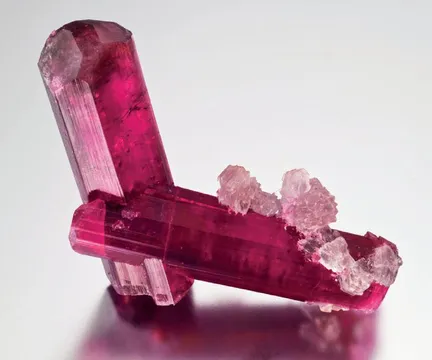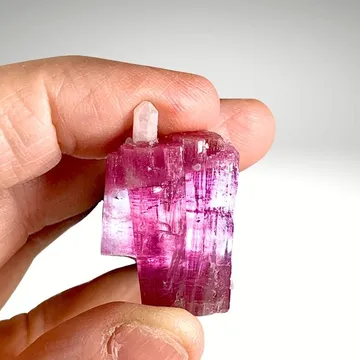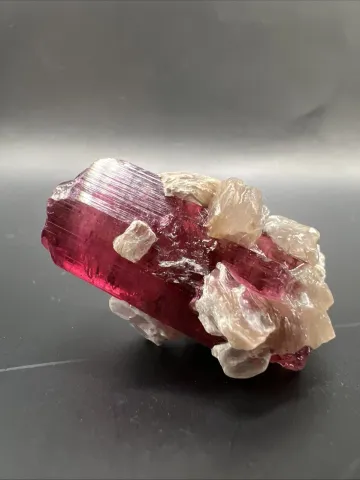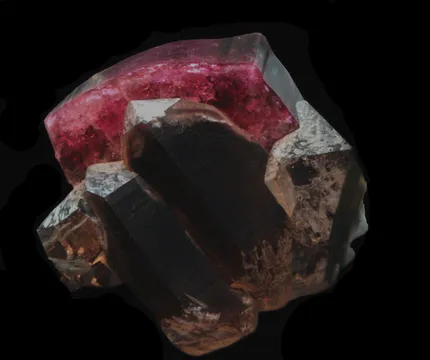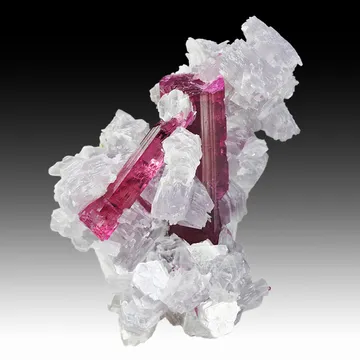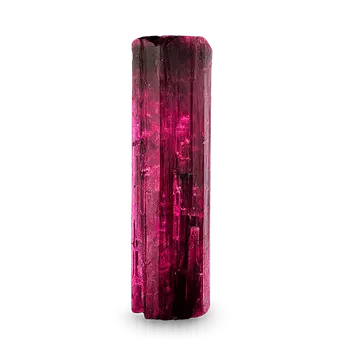
Rubellite from Jonas Mine, Brazil, renowned for saturated cranberry-red crystals with glassy luster, bold prisms on matrix, and top-tier collector appeal.
Key facts
Jonas Mine rubellite occupies a nearly mythic place in mineral collecting because it did something very few localities ever do: it produced crystals with the theatrical presence of cabinet minerals and the color and transparency of important gemstones. The best pieces have a saturated cranberry to deep magenta-red color, glassy luster, stout to slender striated prisms, and an inner glow that remains identifiable even among other great Brazilian tourmalines. Fine Jonas material is not merely “pink tourmaline”; it is the standard against which many later rubellites have been compared.

Photo: Rob Lavinsky, iRocks.com, via Wikimedia Commons
The mine lies on the Itatiaia hillside near Conselheiro Pena, in the Doce Valley of Minas Gerais, within the Eastern Brazilian Pegmatite Province. Mineralogically it is a lithium-rich gem pegmatite: the environment that grows elbaite, lepidolite, cleavelandite, quartz, and the other pocket minerals collectors expect from evolved Brazilian pegmatites. But Jonas was exceptional even in that company. In 1978, a single miarolitic cavity yielded an extraordinary mass of rubellite crystals and matrix specimens, including cuttable gem rough and several immense named specimens that became landmarks of the mineral world.
The classic visual language of Jonas is red tourmaline against white or pale matrix: cranberry prisms emerging from bladed cleavelandite, bright rubellite rising from lavender-to-silvery lepidolite, or crystal-and-quartz combinations that preserve the pocket’s original architecture. Matrix pieces are especially coveted because much Jonas material was recovered as single crystals or was cut as gem rough. When a rubellite sits naturally on cleavelandite or lepidolite, with no obvious repair and with strong color in ordinary case lighting, it commands attention immediately.

Photo: Rob Lavinsky, iRocks.com, via Wikimedia Commons
Collectors look first for the unmistakable Jonas color: rich cranberry-red, raspberry-red, or deep rose-red, ideally bright rather than brownish or blackish. Next come transparency, luster, termination quality, and condition. A sharp, glassy termination on a saturated crystal is a major plus. Complete miniatures and thumbnails are desirable; well-composed small-cabinet matrix pieces are much scarcer; large, important crystals with old provenance belong to the highest tier of tourmaline collecting.
Search for specimens: View all rubellite specimens from Jonas Mine, Brazil
Jonas Mine, also known historically as Lavra do Fiote or the João Pinto Mine, is a gem mine in the Conselheiro Pena municipality of Minas Gerais, Brazil. It is situated on the Itatiaia hillside, a few kilometers from the town of Conselheiro Pena and near the older Itatiaia workings, in one of the most productive pegmatite regions of eastern Minas Gerais.
The deposit is a lithium-bearing granitic pegmatite in the Conselheiro Pena pegmatite district of the Eastern Brazilian Pegmatite Province. The pegmatite was described as a body roughly 12 meters wide and about 200 meters long, trending nearly horizontally through the hillside. The portion worked during the great rubellite discovery represented only a short segment of the pegmatite, yet that small part produced one of the most consequential tourmaline pockets ever encountered.
The site was first worked in the early 1940s by João Pinto, a local farmer, and produced multicolored tourmalines before its later fame. Its modern history centers on Ailton Barbosa, Jonas Lima of Governador Valadares, and the 1977–1978 mining campaign that transformed the locality. After months of costly and discouraging tunneling, the miners broke into the great rubellite pocket in 1978. The cavity was about 2.5 to 3 meters across in its principal dimensions and was lined with rubellite crystals, albite, quartz, and lepidolite. Estimates for the pocket include roughly 3,600 kilograms of rubellite-bearing specimen material and about 200 kilograms of fine cuttable crystals.
The famous 1978 pocket became known as the bamburrio pocket, a Portuguese term conveying the idea of a jackpot. It produced the mine’s legendary named specimens, including Joninha, the Rocket, Tarugo, and Flor de Lis. Joninha was a monumental matrix piece with two enormous rubellite crystals on quartz and albite; the Rocket was a broken but spectacular 107-centimeter rubellite crystal on quartz matrix; Tarugo was a massive opaque crystal; and Flor de Lis combined rubellite, quartz, albite, and lepidolite in one of the locality’s best-known sculptural compositions.
A second important pocket was found in 1979 under a later lessee, Dilermando de Melo. That pocket produced the Rose of Itatiaia, a 35-centimeter rubellite on white cleavelandite that became one of the most celebrated public-museum rubellite specimens. The second pocket was large, sandy, and geode-like, but unlike the first pocket it yielded only one major rubellite specimen.
The main pocket minerals were rubellite, white albite or cleavelandite, transparent quartz, and pink lithium mica. Other minerals recorded from the Jonas pegmatite include elbaite, rossmanite, lepidolite, trilithionite, muscovite, microcline, cassiterite, fluorapatite, microlite-group minerals, monazite-group minerals, bertrandite, quartz, and spessartine. In the great pockets themselves, the classic association is notably simple and clean: red tourmaline with albite, quartz, and lepidolite.
Collecting access should be understood in the context of a historic Brazilian gem mine, not a public collecting locality. The great Jonas rubellites entered collections through mining, gem dealing, museum acquisitions, and later dispersals of older collections. Today, collectors generally encounter Jonas specimens through established dealers, mineral auctions, and estate collections rather than through field collecting.
Jonas rubellite is usually described as elbaite variety rubellite: lithium-rich tourmaline colored in the pink-to-red range. Its reputation rests on saturated red to magenta-red crystals that can remain lively and bright even in thick sections. The classic color vocabulary for Jonas includes cranberry-red, deep rose-red, raspberry-red, and, in exceptional cases, “pigeon-blood” red. Some crystals show a warmer salmon to pinkish core in transmitted or directed light with a hotter pink to red outer zone.
The dominant habit is prismatic tourmaline, commonly with strong vertical striations and flat to slightly complex terminations. Crystals may be slender and gemmy, stout and deeply colored, or thick enough to show dark internal saturation in ordinary light. Doubly terminated crystals were reported from the great pocket and are especially desirable because double terminations are less common in rubellite specimens of this size and quality.
Sizes span the full collecting range. Small thumbnails and miniatures from the 1978 material may show crystals from under 1 centimeter to several centimeters on lepidolite or cleavelandite. Fine small-cabinet examples can reach roughly 7 to 10 centimeters overall and may carry multiple red crystals on white matrix. The named historic pieces, however, move into a completely different scale: tens of centimeters to more than a meter for the largest known Jonas crystal. Those giants are museum-level or elite private-collection objects, not normal market specimens.
The most desirable matrix is snow-white cleavelandite or pale albite, because it sets off the rubellite dramatically. Lepidolite adds a softer lilac, pink, or silvery mica texture and gives a specimen strong pegmatitic context. Quartz is also important, particularly in the major named specimens, where large quartz crystals formed part of the pocket architecture. Jonas pieces with rubellite sitting cleanly and naturally on white cleavelandite are among the locality’s most visually satisfying specimens.
Several quality factors distinguish Jonas material from ordinary pink tourmaline:
The most typical collector-sized Jonas crystals are not huge; rather, they are intensely colored, lustrous, and sharply formed. A modest 2-centimeter crystal with fine color, a natural termination, and old provenance may be more desirable than a larger, duller, more damaged example.
The main authenticity issue with Jonas rubellite is locality attribution. Fine red tourmaline from Cruzeiro and other Minas Gerais pegmatites can resemble Jonas material closely enough that weakly provenanced specimens deserve scrutiny. A Jonas label should be supported by old collection history, a reputable dealer record, distinctive matrix association, or documentation tying the piece to known 1978 or later Jonas material. Cranberry-red color alone is not proof.
Repairs are a major consideration. The discovery itself produced large crystals and heavy matrix specimens under difficult mining conditions, and some famous Jonas pieces were broken, recovered in sections, or stabilized after extraction. A discreet, disclosed repair on an important historic specimen may be acceptable, especially if the piece is large or visually significant. Undisclosed repairs, rebuilt terminations, glued crystal-to-matrix contacts, or mismatched matrix are much more serious. Under magnification, look for glue lines crossing striations, unnatural gloss in fractures, misaligned prism edges, or termination surfaces that appear too uniformly polished.
Condition issues often appear at terminations and along the vertical prism edges. Rubellite has good hardness, but tourmaline crystals can chip where edges are sharp or where internal strain and inclusions are present. Pocket removal, transport, trimming, and repeated handling all leave marks. On matrix pieces, inspect the contact between rubellite and cleavelandite or lepidolite carefully; white albite blades are brittle and can hide joins or restoration.
Treatment concerns are more relevant to cut rubellite gems than to untouched mineral specimens, but they should not be ignored. Tourmaline can be heated or irradiated to modify color, and surface-reaching fractures can be filled with oils or resins. In mineral specimens, major color treatment is less commonly documented than in the gem trade, but any unusually clean, vivid loose crystal with no reliable history should be treated with the same caution applied to high-value colored stones. For faceted Jonas rubellite, a laboratory report is appropriate for important gems, particularly when natural color and lack of clarity enhancement affect price.
Market availability is limited and uneven. Small Jonas thumbnails and miniatures surface occasionally, often from old collections. Better matrix pieces are much scarcer. Recent auction records show that even thumbnails with good color and provenance can bring strong prices, while small-cabinet matrix specimens with multiple crystals on cleavelandite or lepidolite move into a higher tier. Large, gemmy, undamaged Jonas rubellites are rarely available publicly, and the named historic specimens are effectively institutional or trophy-level objects.
For buying, prioritize a complete natural termination, rich color in normal lighting, an honest condition report, and documented provenance. For long-term care, avoid thermal shock, ultrasonic cleaning, aggressive chemical cleaning, and prolonged direct sunlight if treatment history is unknown. Store matrix specimens so that fragile albite blades and mica books are not bearing weight.
The Jonas story begins with frustration rather than treasure. In 1977, Ailton Barbosa persuaded Jonas Lima, a well-capitalized gem dealer from Governador Valadares, to lease ground on the Itatiaia hillside. The arrangement was simple: Jonas would finance the mining, and Ailton would supervise the work. The lease payment was only about 1,000 cruzeiros a month, roughly seventy U.S. dollars at the time, and the landowner did not demand a royalty on gems.
Ailton began in October 1977 with only four garimpeiros. They extended an old tunnel into schist and pegmatite and worked for months with little to show for it. The first encouraging tourmalines were tiny green crystals, no more than matchstick-sized, on small white albite. Then came a false breakthrough: several large pockets opened in early 1978, but they contained tons of black tourmaline and albite, not the red gem crystals everyone hoped for. The crew had found bulk, but not value.
Jonas nearly stopped the operation. After months of blasting and digging, the mine had become expensive, and the returns were discouraging. Ailton, however, had noticed lepidolite in the pegmatite wall. To Brazilian tourmaline miners, lithium mica can be a powerful sign. Ailton pressed him to continue and made a promise that sounded impossible: “a huge gem pocket and rubellites as thick as his forearm.” The line is famous because it turned out to be almost uncannily accurate.
Even then, the mine demanded one last gamble. The miners blasted into another pocket, again full of black tourmaline, opaque pink-topped crystals, albite, mud, water, quartz, and mica. It was better than nothing, but still not the dream. Ailton was so close to the end of his finances that he surrendered the title to his Volkswagen to raise money for food and mining supplies for one more week. He told Jonas that when the food and dynamite were gone, he would finally quit.
The decisive clue was water. As Ailton cleaned the worthless chamber, water entered from above, suggesting another cavity overhead. He directed the excavation upward and used hand work with partial sticks of dynamite rather than careless blasting. He opened a small hole just large enough to reach through. In the dark, he put his arm into the space above. When he drew it back, he was holding a large, nearly flawless gem rubellite crystal.
The men closed the opening at once. Ailton went to Conselheiro Pena and telephoned Jonas in Governador Valadares with a message that became part of the legend: “I found the gems, COME ON DOWN.” Jonas came, and the miners worked through the night and into the next day to make a safer entrance. When they entered properly, they found a pocket large enough to walk into. Rubellites and albites crunched underfoot. The walls glittered with red crystals set among white albite, transparent quartz, and pink lepidolite.
The pocket was astonishingly clean. There was very little alteration, only some sand on the floor, and many specimens reportedly did not even need washing. The cavity was roughly oval, about 3 meters high, 3 meters long, and 2.5 meters wide. Many rubellite crystals remained intact on the walls; some had fallen; many were doubly terminated. In a Brazilian pegmatite world accustomed to mud, broken crystals, and corrosive alteration, the Jonas pocket was almost theatrical in its neatness.
Then the miners saw Joninha hanging from the ceiling. The piece was named for Jonas Lima’s young son and consisted of two huge rubellite crystals, one about 50 by 25 centimeters and another about 25 by 30 centimeters, on quartz crystals 20 and 45 centimeters long. Albite partly coated the piece, and a pale doubly terminated citrine crystal hung from the side. The whole mass weighed about 352 kilograms. Dynamite had loosened it; the miners could get their hands behind part of it. It was a masterpiece, and it was ready to fall.
Ailton’s solution was wonderfully practical. He stacked old tires beneath the specimen, covered the top with burlap, had miners push upward, and freed the piece with a crowbar so it settled gently onto the tires. The escape from the mine was almost as improbable as the recovery. Joninha was taken out and carried toward Governador Valadares that night. On the way, Ailton fell asleep at the wheel, missed a curve, and drove the Jeep down a 20-meter embankment. The specimen survived undamaged.
The other giants were just as memorable. The Rocket was found broken into three pieces on the floor. Reassembled, it rose 107 centimeters from a base of doubly terminated quartz crystals, making it the largest known rubellite crystal described from the find. Its broken edges had partly healed naturally with minute tourmaline growth, so the sections still fit together remarkably well. Tarugo, an 85-centimeter-long, 82-kilogram opaque rubellite, was a squat giant. Flor de Lis was a 35-centimeter tourmaline crystal associated with a large quartz crystal, much of it enveloped in albite.
Security around the discovery became nearly as famous as the minerals. The first pocket was cleaned out in only eight days, and the material was transported about 90 kilometers to Governador Valadares under heavy guard. The mine entrance and warehouse became armed camps. Dealers and collectors had trouble gaining access, and even government tax agents reportedly failed to inspect the find. One account says the major pieces sat on tables supposedly wired to dynamite beneath them, with Jonas threatening to destroy everything rather than surrender it to robbers or revenuers. Later, he charged eight dollars per person simply to view the great specimens.
The sequel came in 1979, after a disagreement over the lease and a change in operators. Dilermando de Melo, known as Dilo, began working the mine through an alternate entrance. His crew drove a tunnel more than 100 meters long and found small pockets, some green tourmalines, and occasional rubellite, but nothing like the great pocket. Then, nearly a year after the first discovery, signs of another cavity appeared beneath the tunnel floor.
Dilo was so eager that after a blast he went in before the gases had cleared. He leaned over the new opening and was overcome by fumes, then taken to the hospital. As soon as he was released, he returned to the mine. A thin wall of albite still sealed the pocket. The miners pried loose a nearly square piece of albite about 45 centimeters across, lifted it straight up, and turned it over. On the reverse was the Rose of Itatiaia: a brilliant rubellite nestled in gemmy cleavelandite. In the pocket, it had been hanging upside down from the ceiling.
That second pocket was large and sandy, but the Rose was its single great rubellite. It later passed to Keith Proctor, won the Viktor Goldschmidt Prize at the Munich Show in 1985, and entered one of the most important gem and mineral collections associated with Qatar. If the 1978 pocket was an avalanche of red crystals, the 1979 pocket was a one-specimen miracle.