Payún Matrú, Argentina - a modern classic locality yielding skeletal martite (hematite) pseudomorphs after magnetite formed in fumaroles; prized by collectors.
Key facts
Payún Matrú is one of the few modern volcanic localities whose reputation among mineral collectors rests almost entirely on a single, unmistakable style of specimen: skeletal octahedra of magnetite preserved as brilliant hematite pseudomorphs, the variety long known in ore-mineral terminology as martite. The locality lies in the Payún Matrú Volcanic Field of southern Mendoza Province, Argentina, inside the volcanic country of La Payunia, a vast Andean back-arc landscape of black lava plains, scoria cones, fissure-fed basalt flows, and the large Payún Matrú shield volcano with its summit caldera. For collectors, the geology matters because the best crystals are not normal pegmatite, skarn, or vein products; they are volcanic-vapor, fumarolic growths, formed in cavities and vents where iron oxides crystallized in a high-temperature oxidizing volcanic environment.
The classic specimens are metallic gray to silvery gray, glittering under a strong light because broad triangular octahedral faces are overgrown or replaced by countless minute specular hematite crystals. Many preserve the octahedral architecture of the original magnetite with remarkable fidelity: elongated octahedra, stacked towers, open skeletal “windows,” hopper faces, parallel growths, and airy interlocking clusters. The locality became a modern classic in the early 2000s, when a sizeable lot of dramatic pseudomorphs appeared on the mineral market and immediately caused discussion because nothing quite like them had been widely available before. Later material, especially pieces attributed to the 2008 production, includes some of the sharpest, brightest, and most sculptural examples.
Regional View
Country View
The geological stage is much grander than the hand specimens suggest. Payún Matrú belongs to the Payenia volcanic province, east of the main Andean arc and far inland from the subduction trench. The volcanic field includes the Payún Matrú shield and caldera, Payún Liso/Cerro Payén, and extensive basaltic fields aligned broadly east-west. In the surrounding volcanic province are some of Earth’s longest Quaternary basaltic lava flows, including the Pampas Onduladas flow, a benchmark example of inflated pahoehoe transport over extraordinary distances. Against that enormous landscape, the collectible iron oxides are intimate objects: vent-grown crystal forms, many only a few centimeters across, that preserve a fleeting chemical episode in an otherwise massive volcanic system.
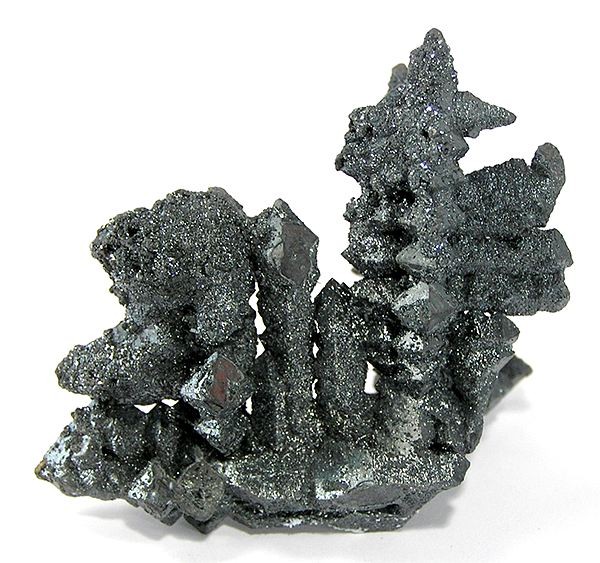
Photo: Wikimedia Commons
Search for specimens: View all specimens from Payun volcano, null
The collector locality is best understood as the Payún Matrú Volcano, Altiplano de Payún Matrú, Agua Escondida District, Malargüe Department, Mendoza Province, Argentina. In mineral-label usage it is often shortened to “Payun Volcano,” “Payún Matrú volcano,” “Payún volcano, Altiplano de Payún Matrú,” or simply “Payun, Mendoza, Argentina.” The locality is a volcanic one, not a mine, and the important specimens are fumarolic iron-oxide crystals and replacements rather than ore from a mined body. The magnetite crystals grew in volcanic-vapor settings and were subsequently replaced wholly or partly by hematite, producing martite pseudomorphs that retain the original octahedral habit.
Payún Matrú itself is part of a Quaternary volcanic field in the Andean back-arc of western Argentina. Geological studies describe the field as containing Payún Matrú and Payún Liso, together with eastern and western basaltic fields made of scoria cones and lava flows. Payún Matrú is a broad shield-like edifice capped by a large caldera; its volcanic products include alkaline basaltic to trachytic rocks, with evidence that basaltic magmas interacted with more evolved trachytic magmas during parts of the volcano’s history. Collectors do not usually see this complexity on a label, but it is the reason the locality should be thought of as a volcanic-field specimen source rather than a simple “iron oxide pocket.”
There are no conventional ore bodies, shafts, stopes, mining companies, or production tonnages associated with the classic collector material. The “production” collectors refer to is specimen recovery: loose and cavity specimens from fumarolic/vent environments, mostly entering commerce in discrete waves rather than as continuous mining output. The earliest widely noted commercial wave was circulating by the early 2000s, with later lots—especially material labeled 2008—bringing sharper, more lustrous, and sometimes more open skeletal pieces to market. The best specimens are floaters or nearly complete clusters, usually without matrix; matrix pieces are uncommon and especially interesting because they preserve more of the immediate volcanic context.
The locality lies within the protected La Payunia reserve system, where access is controlled for tourism and conservation. Modern visitors encounter the area through official routes, 4x4 excursions, and guided circuits rather than as an open collecting ground. For mineral collectors, the practical consequence is simple: legal new collecting is not part of normal public access, and the market depends on older collected material, documented private collections, and specimens already in circulation. Labels should therefore be read carefully, with attention to whether a specimen is old stock from the early commercial waves, a later 2008-style piece, or a recently re-traded specimen from an established collection.
The original Payún Matrú crystals were magnetite, typically expressed as octahedra and elongated octahedral aggregates, commonly with hopper or skeletal development rather than simple solid-looking crystals; in many specimens the magnetite survives only as the preserved form, because hematite has replaced it to produce martite. Good Payún examples show sharp octahedral geometry, open architectural growth, crisp triangular faces, and obvious three-dimensional stacking rather than dull massive iron oxide; the finest pieces are complete floaters or balanced clusters with individual octahedral forms from thumbnail scale to several centimeters, including documented specimens with major crystals around 3 cm and cabinet clusters exceeding 8–10 cm overall. Magnetite and hematite are intimately associated here, and the collector appeal lies precisely in the tension between the magnetite habit and the hematite surface: an octahedral magnetite sculpture now armored in glittering specular hematite.
Hematite is the visible collector mineral of the classic Payún Matrú specimens: bright steel-gray to silvery, micaceous to finely sparkling, and pseudomorphous after earlier magnetite octahedra. The best pieces are not merely “hematite after magnetite” in a chemical sense; they are sculptural martite clusters with open skeletal forms, tower-like octahedral stacks, ribbed faces, sharp edges, and a lively reflective surface that flashes under direct light. Sizes range from small thumbnail and miniature singles to small-cabinet and cabinet clusters; pieces around 5–8 cm are frequently seen in good collections, while larger, well-composed examples with multiple sharp octahedra are scarce and command strong prices. Quality here is judged by completeness, luster, degree of preserved octahedral form, freedom from abrasion on the points, and whether the specimen has the frosty sparkle and open architecture associated with the better early-2000s and 2008-style lots.
Other minerals documented from the Payún Matrú locality include fumarolic aegirine and biotite, fluorapatite as prismatic white crystals on magnetite, sanidine, cristobalite, opal-AN, plagioclase, olivine-group minerals, clinopyroxene, amphibole-supergroup minerals, and the rare lead-bearing species wulfenite and anglesite. Wulfenite is especially intriguing on collector specimens because it has been observed as tiny yellow-orange crystals on martite/hematite after magnetite, adding a rare color accent to an otherwise monochrome iron-oxide association. Payún Matrú is not known as a type locality; its importance is instead as a modern classic locality for spectacular volcanic martite pseudomorphs.
The first authenticity issue with Payún Matrú material is not widespread outright faking, but misdescription. Specimens are variously sold as magnetite, hematite, martite, hematite after magnetite, magnetite after hematite, or simply “magnetic hematite.” The correct collector description for the classic material is hematite pseudomorph after magnetite, or martite, from Payún Matrú. A specimen may still contain magnetite, and some examples can show magnetic response, but the bright micaceous surface and reddish-brown streak expected of hematite are useful clues. The octahedral form alone does not prove current magnetite; here it usually records the original magnetite habit.
Condition is critical. The points and raised skeletal ribs are easily rubbed, and a specimen with many octahedral tips will often have tiny edge bruises that are hard to see in a single front-facing photograph. Examine all sides, especially the high points of the triangular faces, the ends of elongated octahedra, and the contact points between crystal “towers.” The best pieces are complete all around, bright rather than sooty, and do not rely on a single photogenic face. Because many are floater clusters, they should be mounted securely but reversibly, with no glue obscuring broken areas or artificially stabilizing weak bridges.
Cleaning deserves special caution. A published mineralogical study identified lead hydrogen citrate monohydrate crystals that formed on a Payún Matrú hematite pseudomorph after magnetite as the result of cleaning in citric acid, apparently after minor associated lead-bearing species were dissolved into the cleaning solution. That is a useful warning for collectors: do not acid-clean these specimens casually, and be especially wary of citric-acid treatments on pieces with possible wulfenite, anglesite, or other lead-bearing micro-associations. Mechanical dusting with a soft brush and careful compressed air is usually safer than chemical cleaning.
Rarity is stratified. Small, ordinary pieces remain available, and Payún Matrú is not impossible to acquire; however, truly fine specimens—large, undamaged, lustrous, complete, sharply skeletal, and visually balanced—are much scarcer than the general market volume suggests. Strong small-cabinet pieces and large cabinet examples have crossed from “interesting pseudomorph” into high-end modern classic territory, with major auction results in the five-figure range for exceptional examples. Current availability is mostly from old stock, dealers reintroducing private-collection pieces, and collections formed during the early market waves.
When the Payún Matrú pseudomorphs first hit the market, they did not arrive with the slow familiarity of an old European district. They appeared like a small invasion of metallic architecture. One dealer account places the original new find at the Tucson show in 2002, on the third floor of the Executive Inn Annex, brought by an Argentine collector and new dealer attending Tucson for the first time. The room was not arranged like a museum case: four eight-foot tables were reportedly covered with thousands of specimens laid out flat, unboxed, unlabeled, and touching one another. The pricing already revealed that collectors had recognized something important—about $50 for thumbnails, $250 for miniatures, $400–500 for cabinets, and $1000 or more for large cabinet pieces.
That sudden abundance produced a second story: disbelief. The forms were so strange—sharp octahedra, hollowed windows, glittering hematite skins over magnetite geometry—that some collectors questioned whether the pieces could be natural. The arguments eventually quieted as the locality became documented, photographed, and represented in serious collections, but the early suspicion is part of the locality’s mythology. Payún Matrú specimens were not colorful in the manner of tourmaline or fluorite; they won people over by geometry. A good one looks less like a chunk of ore than a cast-metal city.
The 2008 material made another strong impression in Europe. A 10.3 x 4.3 x 4 cm specimen photographed for the “what’s new at Munich 2008” section of Mineralien Welt displayed parallel growths of octahedral crystals, their magnetite forms pseudomorphed by hematite and marked by skeletal development. A collector later described a related piece of about 10 x 7 x 6 cm as having ribbed skeletal features on all four sides and surfaces that “just shimmer in the light.” That is exactly the Payún Matrú effect: the specimen may look dark in a tray, but rotate it under a lamp and every tiny hematite plate begins to flash.
There is also a quieter cautionary tale attached to the locality. A Payún Matrú hematite-after-magnetite specimen became the subject of a crystallographic paper not because of its famous martite, but because an unintended lead-citrate compound had grown on it during cleaning. A specimen that began as a volcanic pseudomorph acquired an artificial microcrystalline overprint in a cleaning solution. For collectors, it is a memorable reminder that a mineral specimen can gain “new crystals” in the wrong way, and that Payún Matrú pieces with minor lead-bearing species should be treated as chemically sensitive objects, not as rugged lumps of iron oxide.